Page 380 of 493
HAZARD WARNING FLASHER
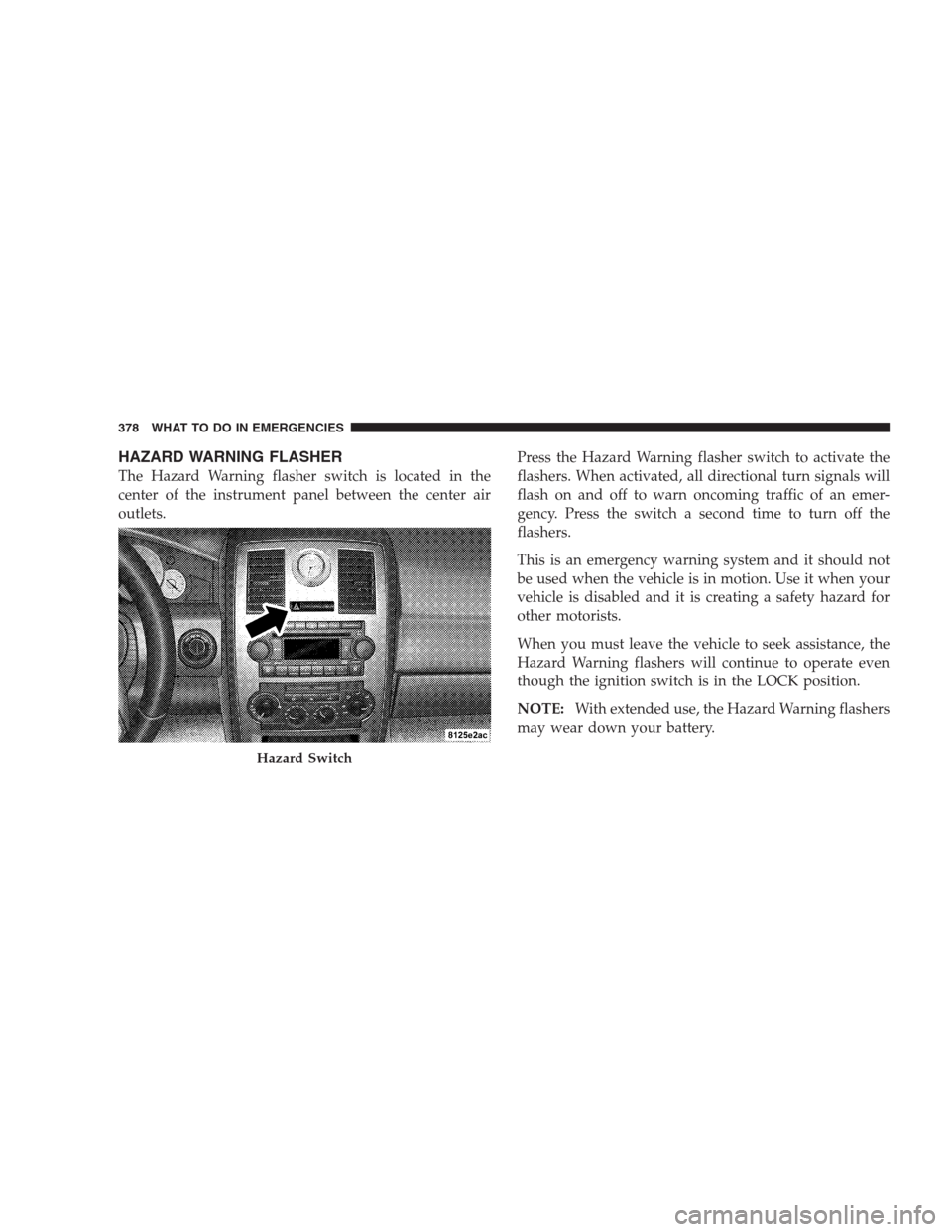
The Hazard Warning flasher switch is located in the
center of the instrument panel between the center air
outlets.Press the Hazard Warning flasher switch to activate the
flashers. When activated, all directional turn signals will
flash on and off to warn oncoming traffic of an emer-
gency. Press the switch a second time to turn off the
flashers.
This is an emergency warning system and it should not
be used when the vehicle is in motion. Use it when your
vehicle is disabled and it is creating a safety hazard for
other motorists.
When you must leave the vehicle to seek assistance, the
Hazard Warning flashers will continue to operate even
though the ignition switch is in the LOCK position.
NOTE:With extended use, the Hazard Warning flashers
may wear down your battery.
Hazard Switch
378 WHAT TO DO IN EMERGENCIES
Page 388 of 493
WARNING! (Continued)
•Battery fluid is a corrosive acid solution; do not
allow battery fluid to contact eyes, skin, or cloth-
ing. Don’t lean over battery when attaching
clamps or allow the clamps to touch each other. If
acid splashes in eyes or on skin, flush contami-
nated area immediately with large quantities of
water.
•A battery generates hydrogen gas, which is flam-
mable and explosive. Keep flame or spark away
from the vent holes.
•Do not use a booster battery or any other booster
source with an output that exceeds 12-Volts.
•The battery in this vehicle has a vent hose that
should not be disconnected and should only be
replaced with a battery of the same type (vented).NOTE:The battery is stored under an access cover in
the trunk. Remote battery terminals are located in the
engine compartment for jump-starting.
1. Wear eye protection and remove any metal jewelry
such as watchbands or bracelets that might make an
inadvertent electrical contact.
2. When boost is provided by a battery in another
vehicle, park that vehicle within booster cable reach, but
do not allow the vehicles to touch one another.
WARNING!
Do not permit vehicles to touch each other as this
could establish a ground connection and personal
injury could result.
3. Set the parking brake, place the automatic transmis-
sion in PARK, and turn the ignition switch to the LOCK
position on both vehicles.
386 WHAT TO DO IN EMERGENCIES
Page 392 of 493
WARNING!
Fast spinning tires can be dangerous. Forces gener-
ated by excessive wheel speeds may cause tire dam-
age or failure. A tire could explode and injure some-
one. Do not spin your vehicle’s wheels faster than
35 mph (55 km/h) when you are stuck, and don’t let
anyone near a spinning wheel, no matter what the
speed.
TOWING A DISABLED VEHICLE
Without The Ignition Key
Special care must be taken when the vehicle is towed
with the ignition in the LOCK position. The only ap-
proved method of towing without the ignition key is
with a flatbed truck. Proper towing equipment is neces-
sary to prevent damage to the vehicle.
Towing This Vehicle Behind Another Vehicle (Flat
Towing With All Four Wheels On The Ground)
Flat towing of vehicles equipped with an automatic
transmission, is only permitted within the following
limitations.
With The Ignition Key
Your vehicle may be towed under the following condi-
tions: The shift lever must be in NEUTRAL, the distance
to be traveled must not exceed 30 miles (48 km), and the
towing speed must not exceed 30 mph (48 km/h).
Exceeding these towing limits may cause a transmission
gear failure. If the transmission is not operative or if the
vehicle is to be towed more than 30 miles (48 km), the
vehicle must be transported using a flatbed truck.
390 WHAT TO DO IN EMERGENCIES
Page 409 of 493
filter. Install the new filter with arrows pointing in the
direction of airflow, which is toward the rear of the
vehicle (text and arrows on the filter indicate this).
Refer to the “Maintenance Schedule” in Section 8 for
proper maintenance intervals.
Body Lubrication
Locks and all body pivot points, including such items as
seat tracks, door hinge pivot points and rollers, liftgate,
tailgate, sliding doors and hood hinges, should be lubri-
cated periodically with a lithium based grease such as
MOPAR�Spray White Lube to assure quiet, easy opera-
tion and to protect against rust and wear. Prior to the
application of any lubricant, the parts concerned should
be wiped clean to remove dust and grit; after lubricating
excess oil and grease should be removed. Particular
attention should also be given to hood latching compo-
nents to insure proper function. When performing otherunderhood services, the hood latch, release mechanism
and safety catch should be cleaned and lubricated.
The external lock cylinders should be lubricated twice a
year, preferably in the Fall and Spring. Apply a small
amount of a high quality lubricant such as MOPAR�
Lock Cylinder Lubricant directly into the lock cylinder.Windshield Wiper Blades
Clean the rubber edges of the wiper blades and the
windshield periodically with a sponge or soft cloth and a
mild nonabrasive cleaner. This will remove accumula-
tions of salt or road film.
Operation of the wipers on dry glass for long periods
may cause deterioration of the wiper blades. Always use
washer fluid when using the wipers to remove salt or dirt
from a dry windshield.
MAINTAINING YOUR VEHICLE 407
7
Page 413 of 493
Cooling System
WARNING!
•When working near the radiator cooling fan, dis-
connect the fan motor lead or turn the ignition
switch to the LOCK position. The fan is tempera-
ture controlled and can start at any time the
ignition switch is in the ON position.
•You or others can be badly burned by hot engine
coolant (antifreeze) or steam from your radiator. If
you see or hear steam coming from under the
hood, do not open the hood until the radiator has
had time to cool. Never try to open a cooling
system pressure cap when the radiator is hot.
Coolant Checks
Check engine coolant (antifreeze) protection every
12 months (before the onset of freezing weather, where
applicable). If the engine coolant (antifreeze) is dirty or
rusty in appearance, the system should be drained,flushed, and refilled with fresh engine coolant (anti-
freeze). Check the front of the A/C condenser for any
accumulation of bugs, leaves, etc. If dirty, clean by gently
spraying water from a garden hose vertically down the
face of the condenser.
Check the coolant recovery bottle tubing for brittle rub-
ber, cracking, tears, cuts, and tightness of the connection
at the bottle and radiator. Inspect the entire system for
leaks.
With the engine at normal operating temperature (but
not running), check the cooling system pressure cap for
proper vacuum sealing by draining a small amount of
engine coolant (antifreeze) from the radiator drain cock.
If the cap is sealing properly, the engine coolant (anti-
freeze) will begin to drain from the coolant recovery
bottle. DO NOT REMOVE THE COOLANT PRESSURE
CAP WHEN THE COOLING SYSTEM IS HOT.
MAINTAINING YOUR VEHICLE 411
7
Page 428 of 493
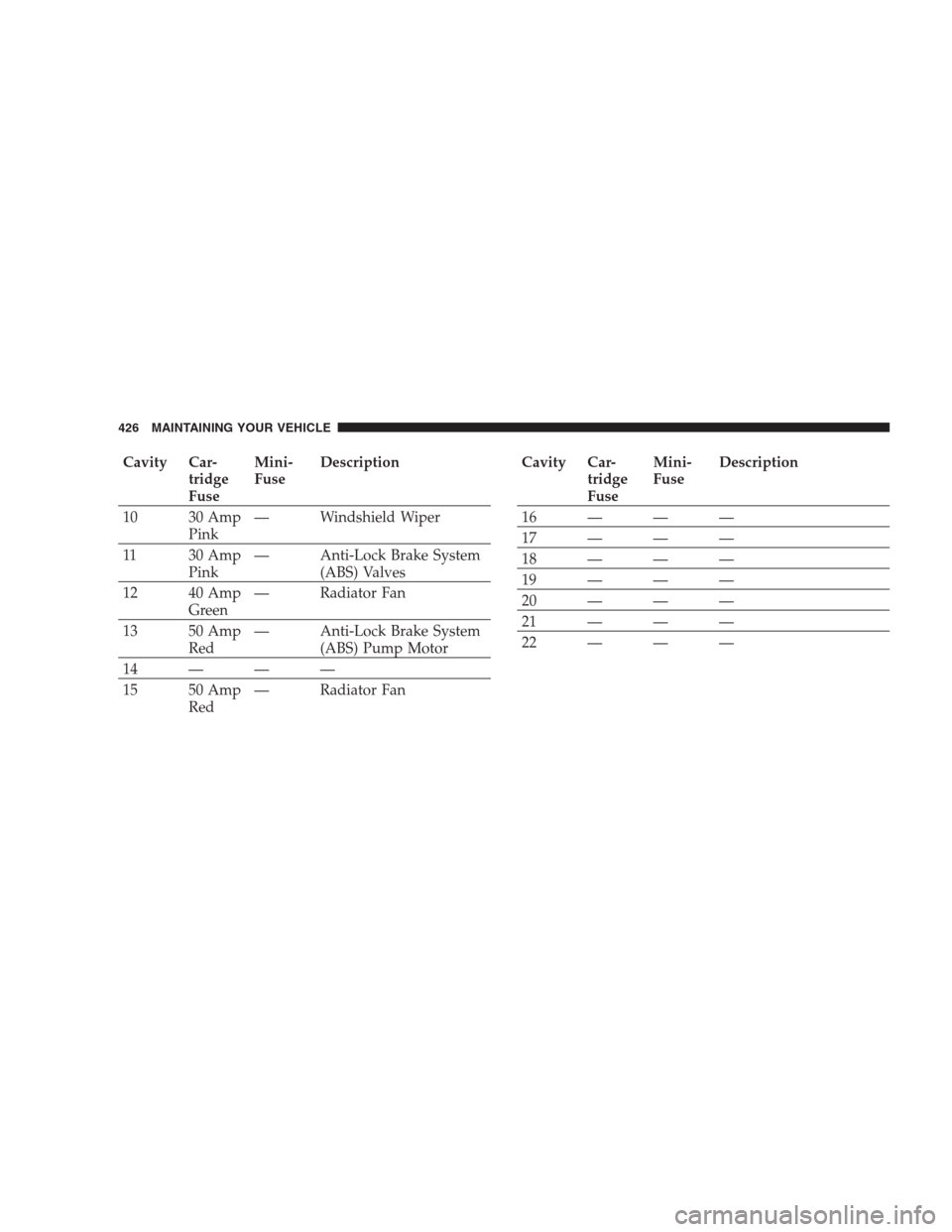
Cavity Car-
tridge
FuseMini-
FuseDescription
10 30 Amp
Pink— Windshield Wiper
11 30 Amp
Pink— Anti-Lock Brake System
(ABS) Valves
12 40 Amp
Green— Radiator Fan
13 50 Amp
Red— Anti-Lock Brake System
(ABS) Pump Motor
14———
15 50 Amp
Red— Radiator FanCavity Car-
tridge
FuseMini-
FuseDescription
16———
17———
18———
19———
20———
21———
22———
426 MAINTAINING YOUR VEHICLE
Page 435 of 493
BULB REPLACEMENT
Low Beam Headlight, High Beam Headlight, and
Park/Turn Light
High Intensity Discharge Headlights (HID)
The headlights are a type of high voltage discharge tube.
High voltage can remain in the circuit even with the
HEADLIGHT switch off and the key removed.Because
of this, you should not attempt to service a headlight
bulb yourself. If a headlight bulb fails, take your
vehicle to an authorized dealer for service.
NOTE:When HID headlights are turned on, there is a
blue hue to the lights. This diminishes and becomes more
white after approximately 10 seconds, as the system
charges.
Tail/Stop, Tail, Turn Signal Light, and Backup
Light
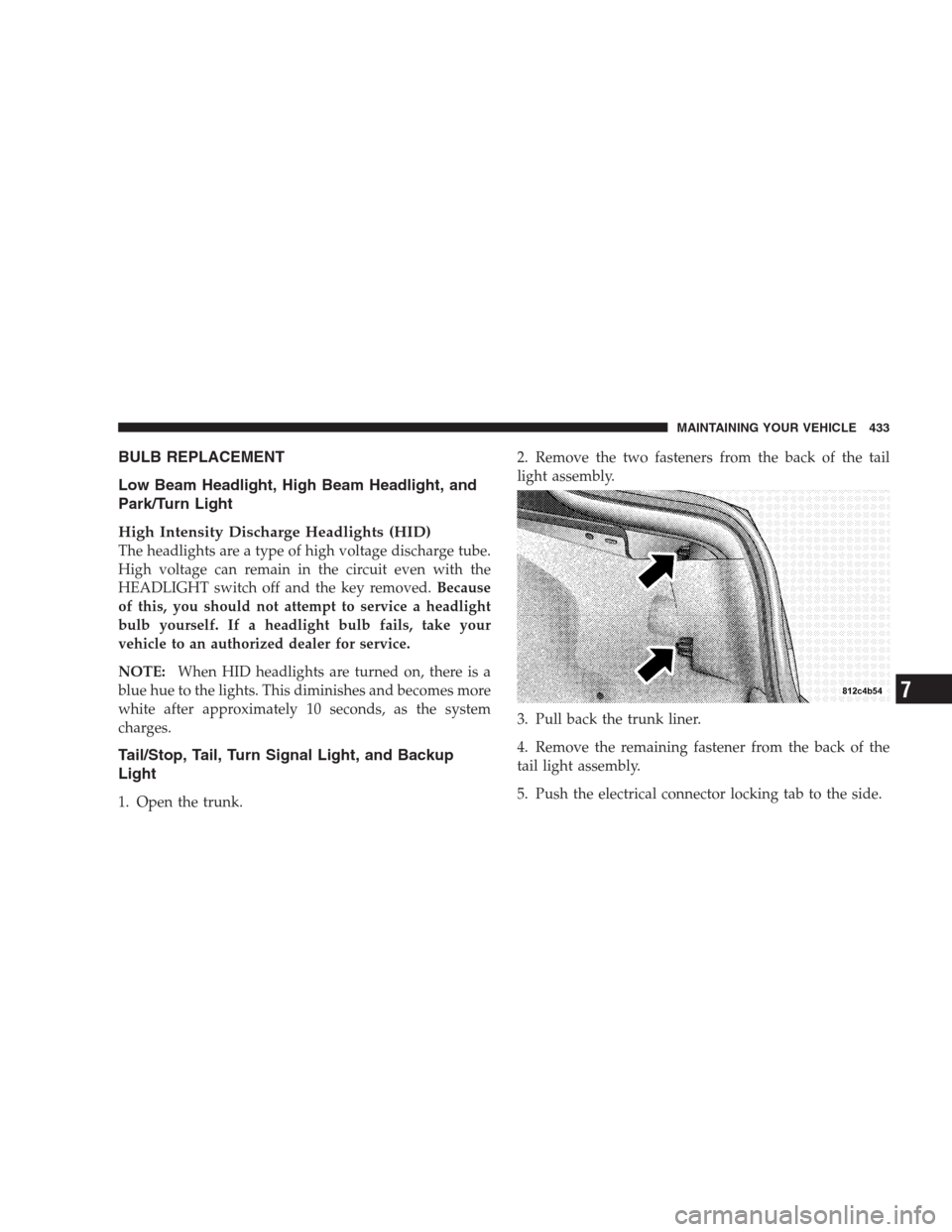
1. Open the trunk.2. Remove the two fasteners from the back of the tail
light assembly.
3. Pull back the trunk liner.
4. Remove the remaining fastener from the back of the
tail light assembly.
5. Push the electrical connector locking tab to the side.
MAINTAINING YOUR VEHICLE 433
7
Page 436 of 493
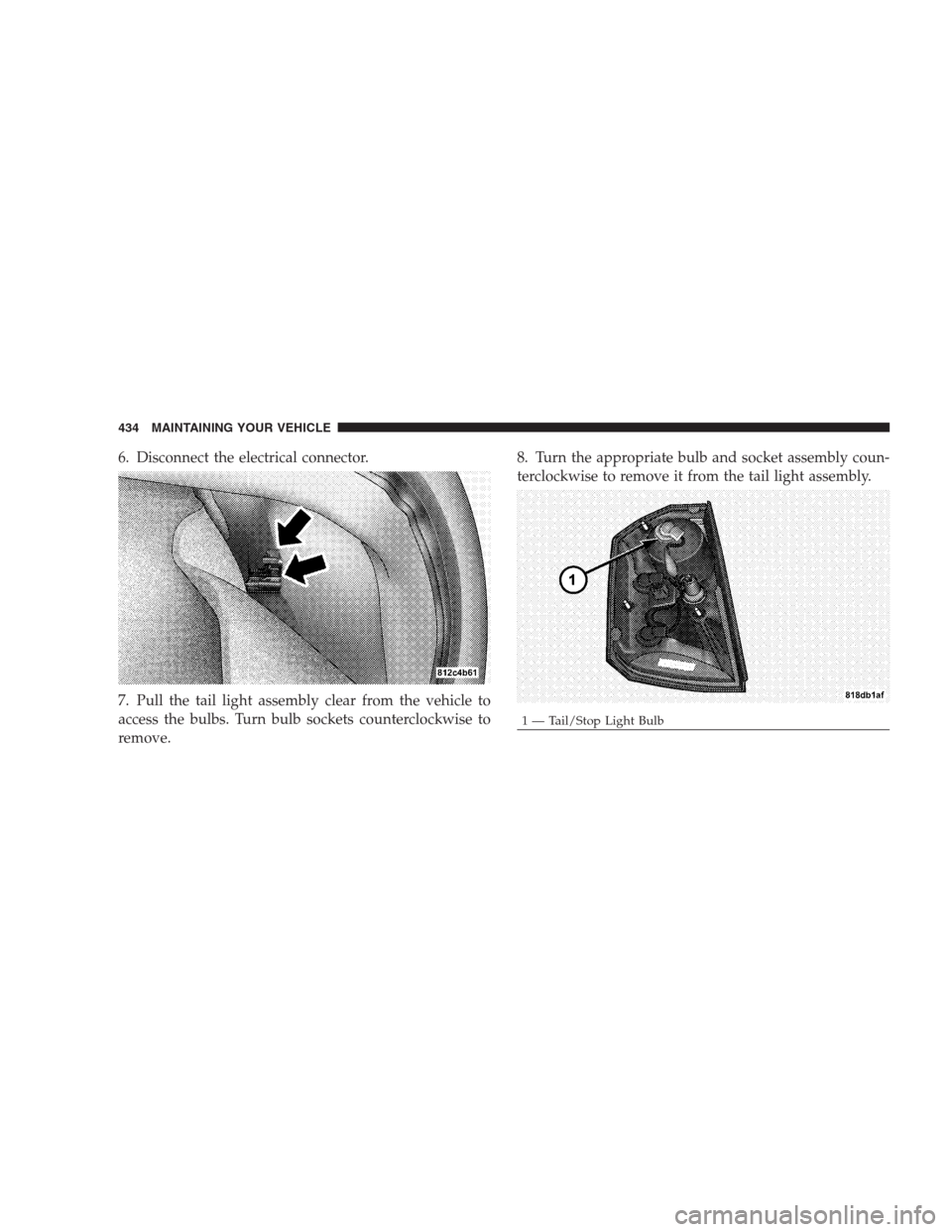
6. Disconnect the electrical connector.
7. Pull the tail light assembly clear from the vehicle to
access the bulbs. Turn bulb sockets counterclockwise to
remove.8. Turn the appropriate bulb and socket assembly coun-
terclockwise to remove it from the tail light assembly.
1 — Tail/Stop Light Bulb 434 MAINTAINING YOUR VEHICLE