Page 272 of 422
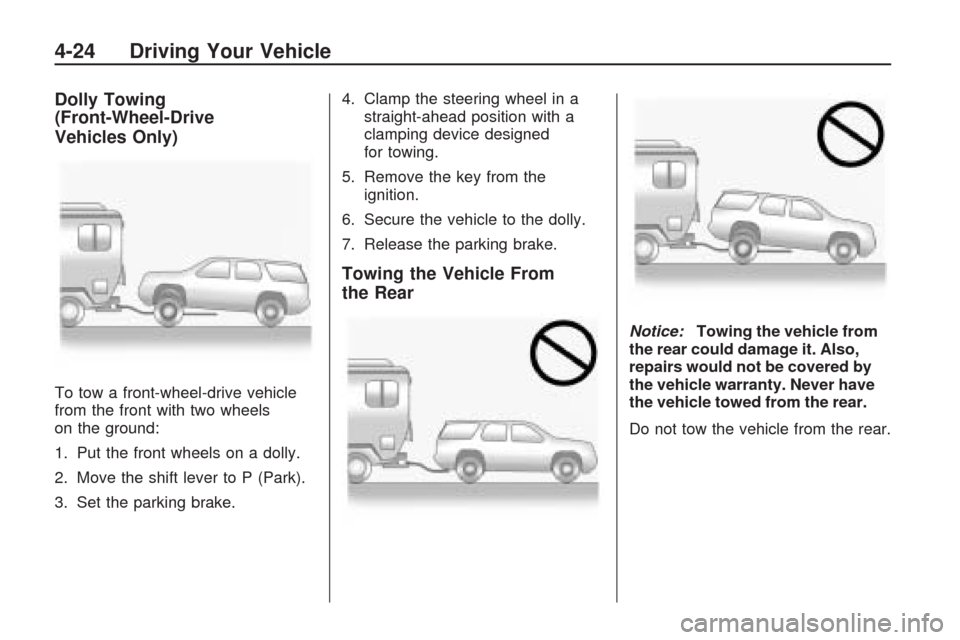
Dolly Towing
(Front-Wheel-Drive
Vehicles Only)
To tow a front-wheel-drive vehicle
from the front with two wheels
on the ground:
1. Put the front wheels on a dolly.
2. Move the shift lever to P (Park).
3. Set the parking brake.4. Clamp the steering wheel in a
straight-ahead position with a
clamping device designed
for towing.
5. Remove the key from the
ignition.
6. Secure the vehicle to the dolly.
7. Release the parking brake.
Towing the Vehicle From
the Rear
Notice:Towing the vehicle from
the rear could damage it. Also,
repairs would not be covered by
the vehicle warranty. Never have
the vehicle towed from the rear.
Do not tow the vehicle from the rear.
4-24 Driving Your Vehicle
Page 278 of 422
Safety Chains
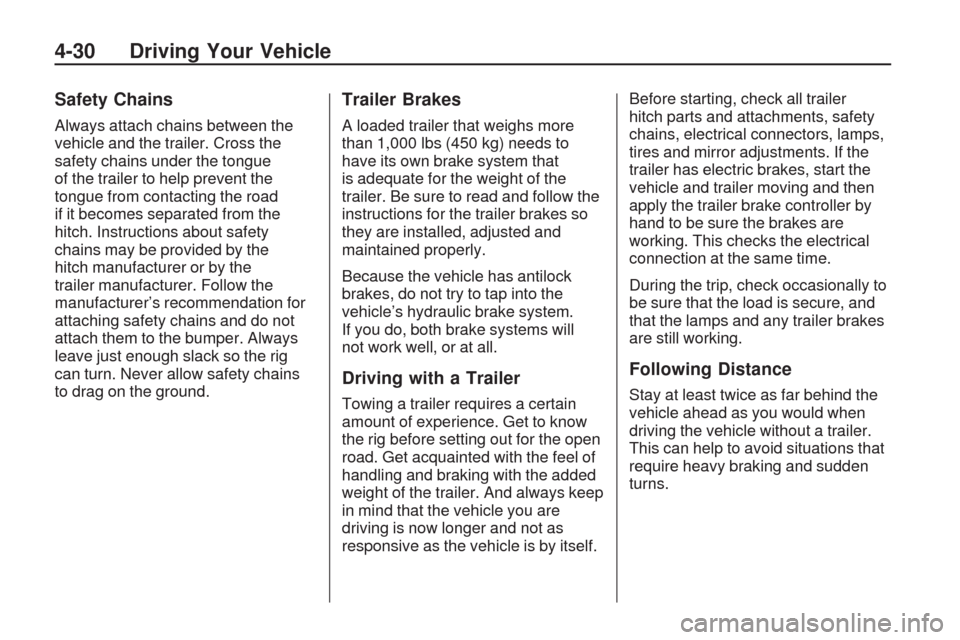
Always attach chains between the
vehicle and the trailer. Cross the
safety chains under the tongue
of the trailer to help prevent the
tongue from contacting the road
if it becomes separated from the
hitch. Instructions about safety
chains may be provided by the
hitch manufacturer or by the
trailer manufacturer. Follow the
manufacturer’s recommendation for
attaching safety chains and do not
attach them to the bumper. Always
leave just enough slack so the rig
can turn. Never allow safety chains
to drag on the ground.
Trailer Brakes
A loaded trailer that weighs more
than 1,000 lbs (450 kg) needs to
have its own brake system that
is adequate for the weight of the
trailer. Be sure to read and follow the
instructions for the trailer brakes so
they are installed, adjusted and
maintained properly.
Because the vehicle has antilock
brakes, do not try to tap into the
vehicle’s hydraulic brake system.
If you do, both brake systems will
not work well, or at all.
Driving with a Trailer
Towing a trailer requires a certain
amount of experience. Get to know
the rig before setting out for the open
road. Get acquainted with the feel of
handling and braking with the added
weight of the trailer. And always keep
in mind that the vehicle you are
driving is now longer and not as
responsive as the vehicle is by itself.Before starting, check all trailer
hitch parts and attachments, safety
chains, electrical connectors, lamps,
tires and mirror adjustments. If the
trailer has electric brakes, start the
vehicle and trailer moving and then
apply the trailer brake controller by
hand to be sure the brakes are
working. This checks the electrical
connection at the same time.
During the trip, check occasionally to
be sure that the load is secure, and
that the lamps and any trailer brakes
are still working.
Following Distance
Stay at least twice as far behind the
vehicle ahead as you would when
driving the vehicle without a trailer.
This can help to avoid situations that
require heavy braking and sudden
turns.
4-30 Driving Your Vehicle
Page 302 of 422
How to Add Coolant to the
Radiator
{CAUTION
An electric engine cooling fan
under the hood can start up even
when the engine is not running
and can cause injury. Keep
hands, clothing, and tools away
from any underhood electric fan.
{CAUTION
Steam and scalding liquids from a
hot cooling system can blow out
and burn you badly. They are
under pressure, and if you turn the
surge tank pressure cap — even a
little — they can come out at high
speed. Never turn the cap when
the cooling system, including the
surge tank pressure cap, is hot.
(Continued)
CAUTION (Continued)
Wait for the cooling system and
surge tank pressure cap to cool
if you ever have to turn the
pressure cap.
If coolant is needed, add the proper
mixture directly to the radiator,
but be sure the cooling system is
cool before this is done.
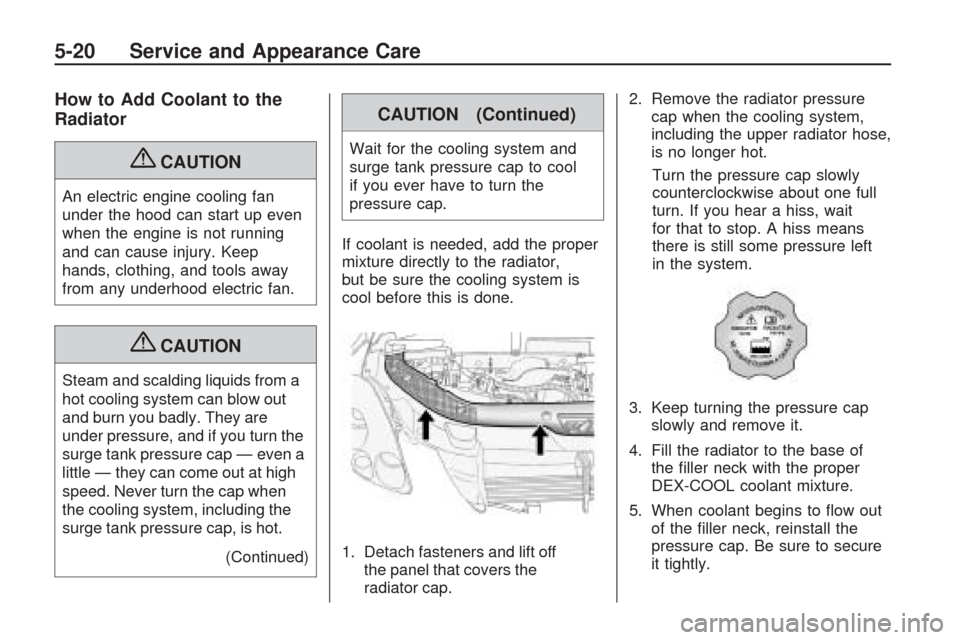
1. Detach fasteners and lift off
the panel that covers the
radiator cap.2. Remove the radiator pressure
cap when the cooling system,
including the upper radiator hose,
is no longer hot.
Turn the pressure cap slowly
counterclockwise about one full
turn. If you hear a hiss, wait
for that to stop. A hiss means
there is still some pressure left
in the system.
3. Keep turning the pressure cap
slowly and remove it.
4. Fill the radiator to the base of
the ller neck with the proper
DEX-COOL coolant mixture.
5. When coolant begins to ow out
of the ller neck, reinstall the
pressure cap. Be sure to secure
it tightly.
5-20 Service and Appearance Care
Page 303 of 422
6. Fill the coolant recovery tank to
the FULL COLD mark.
7. Reinstall the cap on the coolant
recovery tank but leave the
radiator pressure cap off.8. Start the engine and let it run
until the upper radiator hose
feels warm. Any time during this
procedure, watch out for the
engine cooling fan(s).9. If the coolant level inside the
radiator ller neck is low, add
more of the proper DEX-COOL
coolant mixture through the
ller neck until the level is back
up to the base of the ller
neck. Replace the pressure cap.
Be sure to secure it tightly.
Notice:If the pressure cap is
not tightly installed, coolant loss
and possible engine damage
may occur. Be sure the cap is
properly and tightly secured.
Service and Appearance Care 5-21
Page 331 of 422

Any time you notice unusual
wear, rotate the tires as soon
as possible and check wheel
alignment. Also check for
damaged tires or wheels.
SeeWhen It Is Time for New
Tires on page 5-50andWheel
Replacement on page 5-54.
When rotating the vehicle’s tires,
always use the correct rotation
pattern shown here.
If the vehicle has a compact
spare tire, do not include it in
the tire rotation.After the tires have been rotated,
adjust the front and rear ination
pressures as shown on the Tire
and Loading Information label.
SeeInflation - Tire Pressure on
page 5-42andLoading the
Vehicle on page 4-16.
Reset the Tire Pressure Monitor
System. SeeTire Pressure
Monitor Operation on page 5-45.
Make certain that all wheel
nuts are properly tightened.
See “Wheel Nut Torque” under
Capacities and Specifications on
page 5-92.
{CAUTION
Rust or dirt on a wheel, or
on the parts to which it is
fastened, can make wheel
nuts become loose after time.
(Continued)
CAUTION (Continued)
The wheel could come off and
cause an accident. When you
change a wheel, remove any
rust or dirt from places where
the wheel attaches to the
vehicle. In an emergency, you
can use a cloth or a paper
towel to do this; but be sure to
use a scraper or wire brush
later, if needed, to get all the
rust or dirt off. SeeChanging
a Flat Tire on page 5-65.
Make sure the spare tire, if
the vehicle has one, is stored
securely. Push, pull, and then
try to rotate or turn the tire. If it
moves, tighten the cable. See
Storing a Flat or Spare Tire and
Tools on page 5-74.
Service and Appearance Care 5-49
Page 350 of 422
Do the following to check the cable:
1. Check under the vehicle to
see if the cable is visible.
2. If it is not visible, seeSecondary
Latch System on page 5-72.
If it is visible, rst try to tighten the
cable by turning the lug wrench
clockwise until you hear two clicks
or feel it skip twice. You cannot
over-tighten the cable.
3. Loosen the cable by turning the
wrench counterclockwise three
or four turns.
4. If the spare tire has not lowered,
tighten the cable all the way and
then loosen it at least two times.
If the spare tire did lower to the
ground, continue with Step 5
under “Removing the Spare Tire
(Vehicles with the Rear
Convenience Center)” listed
previously.
5. If you still cannot lower the spare
tire to the ground, seeSecondary
Latch System on page 5-72.Removing the Flat Tire
and Installing the
Spare Tire
1. Do a safety check before
proceeding. SeeChanging a Flat
Tire on page 5-65for more
information.
2. If the vehicle has a wheel cover,
loosen the plastic nut caps with
the wheel wrench. They will not
come off. Then, using the at end
of the wheel wrench, pry along
the edge of the cover until it
comes off. Be careful; the edges
may be sharp. Do not try to
remove the cover with your
bare hands.
Store the wheel cover securely
in the rear of the vehicle until you
have the at tire repaired or
replaced.
If the vehicle has aluminum
wheels, remove the wheel nut
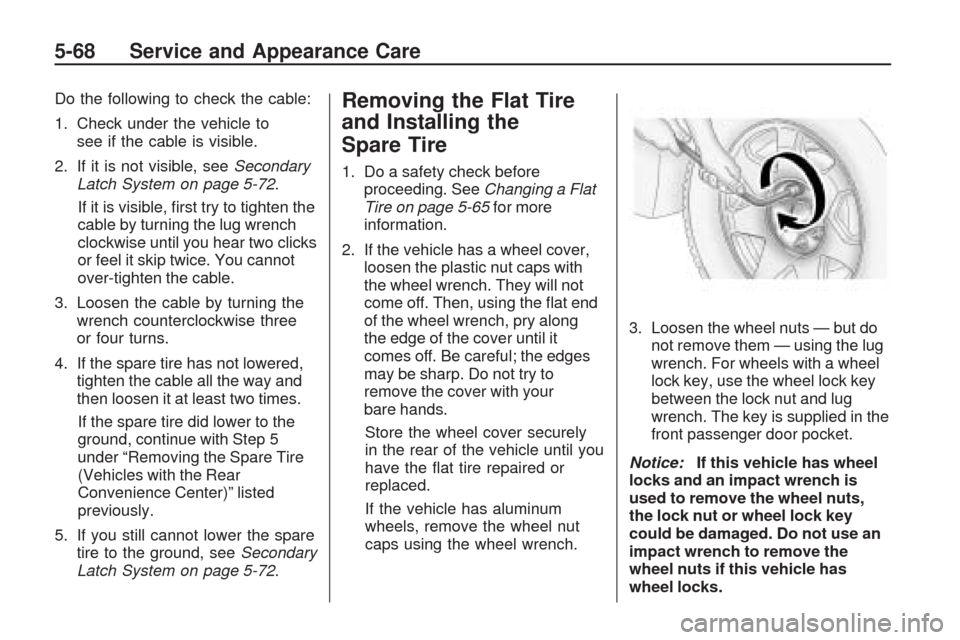
caps using the wheel wrench.3. Loosen the wheel nuts — but do
not remove them — using the lug
wrench. For wheels with a wheel
lock key, use the wheel lock key
between the lock nut and lug
wrench. The key is supplied in the
front passenger door pocket.
Notice:If this vehicle has wheel
locks and an impact wrench is
used to remove the wheel nuts,
the lock nut or wheel lock key
could be damaged. Do not use an
impact wrench to remove the
wheel nuts if this vehicle has
wheel locks.
5-68 Service and Appearance Care
Page 356 of 422
Storing a Flat or Spare
Tire and Tools
Storing the Spare Tire
{CAUTION
The underbody-mounted spare tire
needs to be stored with the valve
stem pointing down. If the spare
tire is stored with the valve stem
pointing upwards, the secondary
latch will not work properly and
the spare tire could loosen and
suddenly fall from the vehicle.
If this happened when the vehicle
was being driven, the tire might
contact a person or another
vehicle, causing injury and
damage to itself. Be sure the
underbody-mounted spare tire
is stored with the valve stem
pointing down.
{CAUTION
Storing a jack, a tire, or other
equipment in the passenger
compartment of the vehicle could
cause injury. In a sudden stop or
collision, loose equipment could
strike someone. Store all these in
the proper place.
To store the spare tire:
1. Lay the compact spare tire near
the rear of the vehicle with the
valve stem down.
2. Reinstall the plastic spare tire
heat shield on the compact
spare tire.
3. Slide the cable retainer through
the center of the wheel and start
to raise the compact spare tire.
Make sure the retainer is fully
seated across the underside of
the wheel.4. When the compact spare tire is
almost in the stored position,
turn the tire so the valve is
toward the rear of the vehicle.
This position helps when
checking the air pressure in the
compact spare tire.
5. Raise the tire fully against the
underside of the vehicle. Continue
turning the lug wrench until you
feel more than two clicks. This
indicates that the compact spare
tire is secure and the cable is
tight. The spare tire hoist cannot
be overtightened.
5-74 Service and Appearance Care
Page 357 of 422
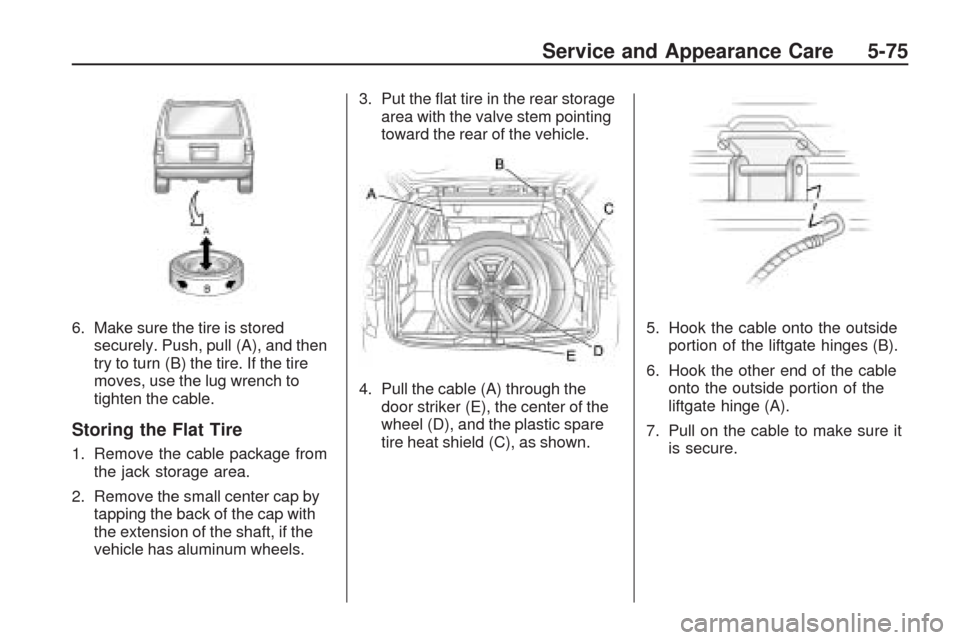
6. Make sure the tire is stored
securely. Push, pull (A), and then
try to turn (B) the tire. If the tire
moves, use the lug wrench to
tighten the cable.
Storing the Flat Tire
1. Remove the cable package from
the jack storage area.
2. Remove the small center cap by
tapping the back of the cap with
the extension of the shaft, if the
vehicle has aluminum wheels.3. Put the at tire in the rear storage
area with the valve stem pointing
toward the rear of the vehicle.
4. Pull the cable (A) through the
door striker (E), the center of the
wheel (D), and the plastic spare
tire heat shield (C), as shown.5. Hook the cable onto the outside
portion of the liftgate hinges (B).
6. Hook the other end of the cable
onto the outside portion of the
liftgate hinge (A).
7. Pull on the cable to make sure it
is secure.
Service and Appearance Care 5-75