Page 380 of 484

Reset the Tire Pressure Monitor System. SeeTire
Pressure Monitor Operation on page 5-69.
Make certain that all wheel nuts are properly
tightened. See “Wheel Nut Torque” under
Capacities and Specifications on page 5-125.
{CAUTION:
Rust or dirt on a wheel, or on the parts to
which it is fastened, can make wheel nuts
become loose after time. The wheel could
come off and cause an accident. When you
change a wheel, remove any rust or dirt from
places where the wheel attaches to the
vehicle. In an emergency, you can use a cloth
or a paper towel to do this; but be sure to use a
scraper or wire brush later, if needed, to get all
the rust or dirt off. SeeChanging a Flat Tire on
page 5-93.
Make sure the spare tire, if the vehicle has one,
is stored securely. Push, pull, and then try to rotate
or turn the tire. If it moves, tighten the cable.
SeeStoring a Flat or Spare Tire and Tools on
page 5-106.
When It Is Time for New Tires
Various factors, such as maintenance, temperatures,
driving speeds, vehicle loading, and road conditions,
inuence when you need new tires.
One way to tell when it
is time for new tires is to
check the treadwear
indicators, which appear
when your tires have only
1/16 inch (1.6 mm) or less
of tread remaining. Some
commercial truck tires
may not have treadwear
indicators.
5-74
Page 388 of 484

If a Tire Goes Flat
It is unusual for a tire to blowout while you are driving,
especially if you maintain your vehicle’s tires properly.
If air goes out of a tire, it is much more likely to leak
out slowly. But if you should ever have a blowout, here
are a few tips about what to expect and what to do:
If a front tire fails, the at tire creates a drag that pulls
the vehicle toward that side. Take your foot off the
accelerator pedal and grip the steering wheel rmly.
Steer to maintain lane position, and then gently brake
to a stop well out of the traffic lane.
A rear blowout, particularly on a curve, acts much like
a skid and may require the same correction you would
use in a skid. In any rear blowout remove your foot from
the accelerator pedal. Get the vehicle under control by
steering the way you want the vehicle to go. It may be
very bumpy and noisy, but you can still steer. Gently
brake to a stop, well off the road if possible.{CAUTION:
Lifting a vehicle and getting under it to do
maintenance or repairs is dangerous without the
appropriate safety equipment and training. If a jack
is provided with the vehicle, it is designed only for
changing a at tire. If it is used for anything else,
you or others could be badly injured or killed if the
vehicle slips off the jack. If a jack is provided with
the vehicle, only use it for changing a at tire.
This vehicle may come with a jack and spare tire or a
tire sealant and compressor kit. To use the jack and
spare tire, seeChanging a Flat Tire on page 5-93.
To use the tire sealant and compressor kit, seeTire
Sealant and Compressor Kit on page 5-83.
5-82
Page 401 of 484
To remove the underbody-mounted spare from your
vehicle:
Notice:If you remove or restow a tire from/to
the storage position under the vehicle while it is
supported by a jack, you could damage the tire
and/or your vehicle. Always remove or restow a
tire when the vehicle is on the ground.
A. Wheel Wrench
B. Hoist Shaft
C. Extension
D. Retainer
E. Spare or Flat Tire (Valve
Stem Pointed Up)
1. Open the liftgate. SeeLiftgate/Liftglass on
page 2-13for more information.
2. Attach the wheel wrench (A) to the extension (C).3. Insert the socket end
of the extension (C)
on a 45 degree angle
downward into the hoist
drive shaft hole.
It is exposed when the rear gate is open and is just
above the rear bumper. Be sure the socket end
of the extension (C) connects to the hoist shaft.
5-95
Page 406 of 484
{CAUTION:
Rust or dirt on a wheel, or on the parts to which it
is fastened, can make wheel nuts become loose
after time. The wheel could come off and cause an
accident. When changing a wheel, remove any rust
or dirt from places where the wheel attaches to the
vehicle. In an emergency, use a cloth or a paper
towel to do this; but be sure to use a scraper or wire
brush later, if needed, to get all the rust or dirt off.
SeeChanging a Flat Tire on page 5-93.9. Remove any rust or dirt
from the wheel bolts,
mounting surfaces
and spare wheel.
10. Place the spare tire on the wheel-mounting surface.
5-100
Page 407 of 484
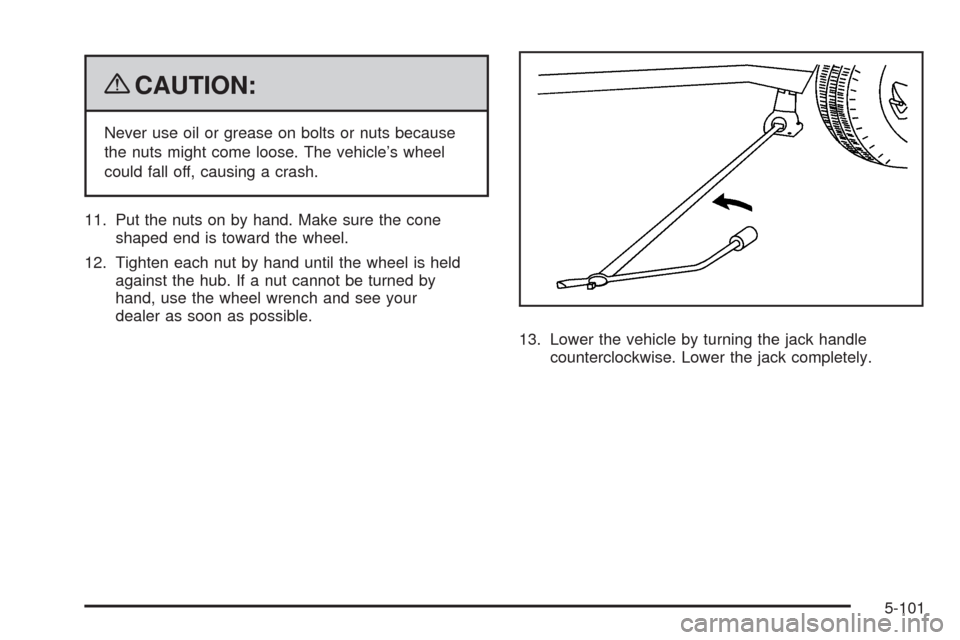
{CAUTION:
Never use oil or grease on bolts or nuts because
the nuts might come loose. The vehicle’s wheel
could fall off, causing a crash.
11. Put the nuts on by hand. Make sure the cone
shaped end is toward the wheel.
12. Tighten each nut by hand until the wheel is held
against the hub. If a nut cannot be turned by
hand, use the wheel wrench and see your
dealer as soon as possible.
13. Lower the vehicle by turning the jack handle
counterclockwise. Lower the jack completely.
5-101
Page 410 of 484
2. If visible, rst try to tighten the cable by turning the
wheel wrench clockwise until you hear two clicks or
feel it skip twice. You cannot overtighten the cable.
3. Loosen the cable by turning the wheel wrench
counterclockwise three or four turns.
4. Repeat this procedure at least two times.
If the spare tire lowers to the ground, continue with
Step 2 ofRemoving the Spare Tire and Tools on
page 5-94.
5. Turn the wrench counterclockwise until
approximately 6 inches (15 cm) of cable is exposed.
6. Attach the jack handle, extension(s) and the wheel
wrench to the jack and place it under the vehicle
towards the front of the rear bumper. Position
the center lift point of the jack under the center
of the spare tire.
7. Turn the wrench clockwise to raise the jack until it
lifts the end tting.
8. Continue raising the jack until the spare tire
stops moving upward and is held rmly in place.
The secondary latch has released and the spare
tire is balancing on the jack.
5-104
Page 412 of 484

Storing a Flat or Spare Tire and
Tools
{CAUTION:
Storing a jack, a tire, or other equipment in the
passenger compartment of the vehicle could
cause injury. In a sudden stop or collision, loose
equipment could strike someone. Store all these in
the proper place.
{CAUTION:
The underbody-mounted spare tire needs to be
stored with the valve stem pointing up. If the
spare tire is stored with the valve stem pointing
downward, its secondary latch will not work
properly and the spare tire could loosen and
suddenly fall from your vehicle. If this happened
when your vehicle was being driven, the tire might
contact a person or another vehicle, causing injury
and, of course, damage to itself as well. Be sure
the underbody-mounted spare tire is stored with its
valve stem pointing up.
Notice:An aluminum wheel with a at tire should
always be stored under the vehicle with the hoist.
However, storing it that way for an extended period
could damage the wheel. To avoid this, always stow
the wheel properly with the valve stem pointing up
and have the wheel repaired as soon as possible.
5-106
Page 417 of 484

Fabric/Carpet
Use a vacuum cleaner with a soft brush attachment
frequently to remove dust and loose dirt. A canister
vacuum with a beater bar in the nozzle may only be used
on oor carpet and carpeted oor mats. For any soil,
always try to remove it rst with plain water or club soda.
Before cleaning, gently remove as much of the soil as
possible using one of the following techniques:
For liquids: gently blot the remaining soil with a paper
towel. Allow the soil to absorb into the paper towel
until no more can be removed.
For solid dry soils: remove as much as possible and
then vacuum.
To clean:
1. Saturate a lint-free, clean white cloth with water or
club soda.
2. Wring the cloth to remove excess moisture.
3. Start on the outside edge of the soil and gently rub
toward the center. Continue cleaning, using a clean
area of the cloth each time it becomes soiled.
4. Continue to gently rub the soiled area until the
cleaning cloth remains clean.
5. If the soil is not completely removed, use a mild
soap solution and repeat the cleaning process
that was used with plain water.If any of the soil remains, a commercial fabric cleaner
or spot lifter may be necessary. When a commercial
upholstery cleaner or spot lifter is to be used, test a small
hidden area for colorfastness rst. If the locally cleaned
area gives any impression that a ring formation may
result, clean the entire surface.
After the cleaning process has been completed, a paper
towel can be used to blot excess moisture from the
fabric or carpet.
Leather
A soft cloth dampened with water can be used to
remove dust. If a more thorough cleaning is necessary,
a soft cloth dampened with a mild soap solution can be
used. Allow the leather to dry naturally. Do not use heat
to dry. Never use steam to clean leather. Never use spot
lifters or spot removers on leather. Many commercial
leather cleaners and coatings that are sold to preserve
and protect leather may permanently change the
appearance and feel of the leather and are not
recommended. Do not use silicone or wax-based
products, or those containing organic solvents to
clean the vehicle’s interior because they can alter the
appearance by increasing the gloss in a non-uniform
manner. Never use shoe polish on leather.
5-111