2009 CHEVROLET SUBURBAN ECO mode
[x] Cancel search: ECO modePage 3 of 578
GENERAL MOTORS, GM, the GM Emblem,
CHEVROLET, the CHEVROLET Emblem, and the
names TAHOE, SUBURBAN, and Z71 are registered
trademarks of General Motors Corporation.
This manual includes the latest information at the time it
was printed. GM reserves the right to make changes
in the product after that time without notice. For vehicles
rst sold in Canada, substitute the name “General
Motors of Canada Limited” for Chevrolet Motor Division
wherever it appears in this manual.
This manual describes features that may or may not be
on your specic vehicle.
Read this manual from beginning to end to learn about
the vehicle’s features and controls. Pictures, symbols,
and words work together to explain vehicle operation.If your vehicle is a Two-mode Hybrid, see the Two-mode
Hybrid manual for more information.
Keep this manual in the vehicle for quick reference.
Canadian Owners
Canadian Owners (Propriétaires
Canadiens)
A French language copy of this manual can be obtained
from your dealer/retailer or from:
On peut obtenir un exemplaire de ce guide en français
auprès du concessionnaire ou à l’adresse suivante:
Helm, Incorporated
P.O. Box 07130
Detroit, MI 48207
1-800-551-4123
Numéro de poste 6438 de langue française
www.helminc.com
Litho in U.S.A.
Part No. 15911385 B Second Printing
©2008 General Motors Corporation. All Rights Reserved.
iii
Page 74 of 578
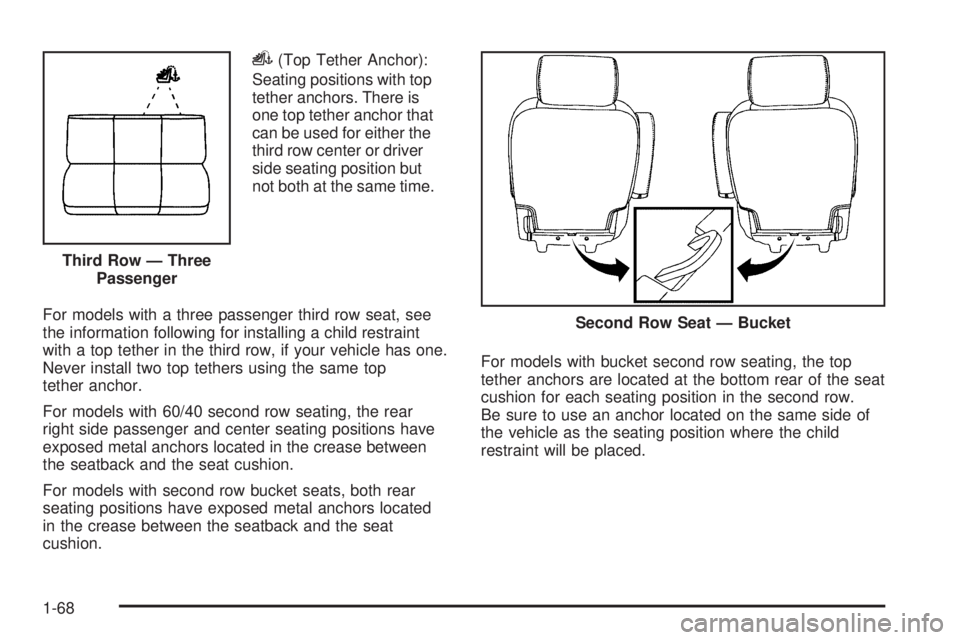
i(Top Tether Anchor):
Seating positions with top
tether anchors. There is
one top tether anchor that
can be used for either the
third row center or driver
side seating position but
not both at the same time.
For models with a three passenger third row seat, see
the information following for installing a child restraint
with a top tether in the third row, if your vehicle has one.
Never install two top tethers using the same top
tether anchor.
For models with 60/40 second row seating, the rear
right side passenger and center seating positions have
exposed metal anchors located in the crease between
the seatback and the seat cushion.
For models with second row bucket seats, both rear
seating positions have exposed metal anchors located
in the crease between the seatback and the seat
cushion.For models with bucket second row seating, the top
tether anchors are located at the bottom rear of the seat
cushion for each seating position in the second row.
Be sure to use an anchor located on the same side of
the vehicle as the seating position where the child
restraint will be placed. Third Row — Three
Passenger
Second Row Seat — Bucket
1-68
Page 75 of 578
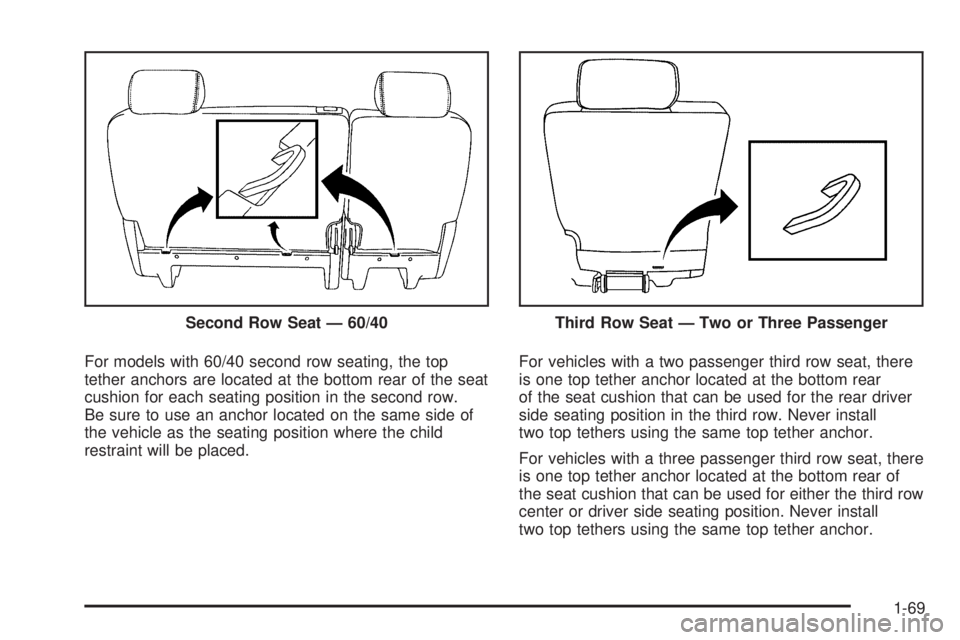
For models with 60/40 second row seating, the top
tether anchors are located at the bottom rear of the seat
cushion for each seating position in the second row.
Be sure to use an anchor located on the same side of
the vehicle as the seating position where the child
restraint will be placed.For vehicles with a two passenger third row seat, there
is one top tether anchor located at the bottom rear
of the seat cushion that can be used for the rear driver
side seating position in the third row. Never install
two top tethers using the same top tether anchor.
For vehicles with a three passenger third row seat, there
is one top tether anchor located at the bottom rear of
the seat cushion that can be used for either the third row
center or driver side seating position. Never install
two top tethers using the same top tether anchor. Second Row Seat — 60/40
Third Row Seat — Two or Three Passenger
1-69
Page 94 of 578
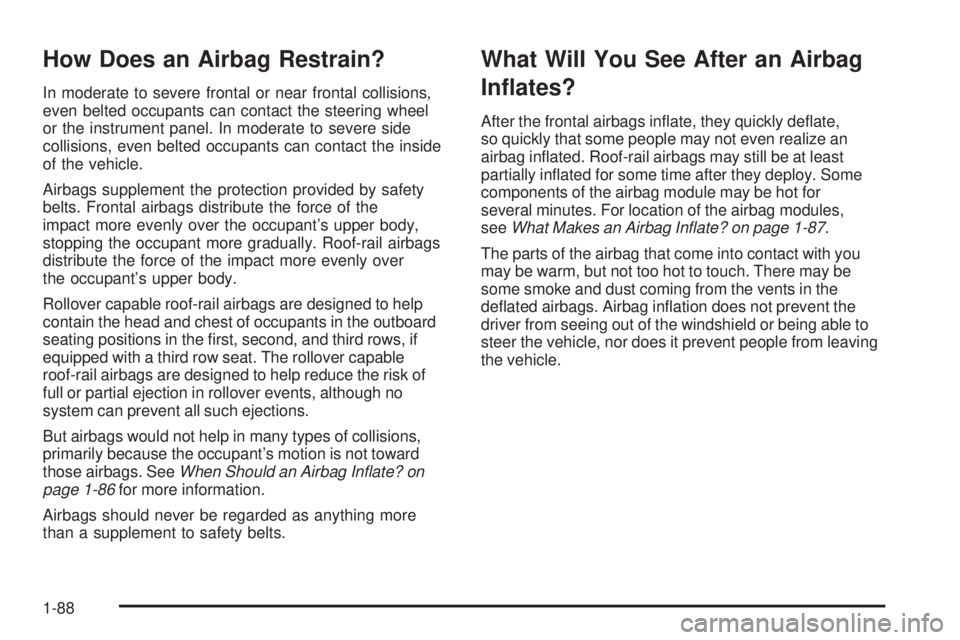
How Does an Airbag Restrain?
In moderate to severe frontal or near frontal collisions,
even belted occupants can contact the steering wheel
or the instrument panel. In moderate to severe side
collisions, even belted occupants can contact the inside
of the vehicle.
Airbags supplement the protection provided by safety
belts. Frontal airbags distribute the force of the
impact more evenly over the occupant’s upper body,
stopping the occupant more gradually. Roof-rail airbags
distribute the force of the impact more evenly over
the occupant’s upper body.
Rollover capable roof-rail airbags are designed to help
contain the head and chest of occupants in the outboard
seating positions in the rst, second, and third rows, if
equipped with a third row seat. The rollover capable
roof-rail airbags are designed to help reduce the risk of
full or partial ejection in rollover events, although no
system can prevent all such ejections.
But airbags would not help in many types of collisions,
primarily because the occupant’s motion is not toward
those airbags. SeeWhen Should an Airbag Inflate? on
page 1-86for more information.
Airbags should never be regarded as anything more
than a supplement to safety belts.
What Will You See After an Airbag
Inates?
After the frontal airbags inate, they quickly deate,
so quickly that some people may not even realize an
airbag inated. Roof-rail airbags may still be at least
partially inated for some time after they deploy. Some
components of the airbag module may be hot for
several minutes. For location of the airbag modules,
seeWhat Makes an Airbag Inflate? on page 1-87.
The parts of the airbag that come into contact with you
may be warm, but not too hot to touch. There may be
some smoke and dust coming from the vents in the
deated airbags. Airbag ination does not prevent the
driver from seeing out of the windshield or being able to
steer the vehicle, nor does it prevent people from leaving
the vehicle.
1-88
Page 114 of 578
Remote Vehicle Start
Your vehicle may have a remote starting feature. This
feature allows you to start the engine from outside of the
vehicle. It may also start up the vehicle’s heating or air
conditioning systems and rear window defogger. Normal
operation of the system will return after the key is turned
to the ON/RUN position.
If your vehicle has an automatic climate control system,
the climate control system will default to a heating or
cooling mode depending on the outside temperatures.
If your vehicle does not have an automatic climate control
system, the system will turn on at the setting the vehicle
was set to when the vehicle was last turned off.
During a remote start, if your vehicle has an automatic
climate control system and heated seats, the heated
seats will turn on during colder outside temperatures and
will shut off when the key is turned to ON/RUN. If your
vehicle does not have an automatic climate control
system, during remote start, you will need to manually
turn the heated seats on and off. SeeHeated Seats on
page 1-7for additional information.
Laws in some communities may restrict the use of remote
starters. For example, some laws may require a person
using the remote start to have the vehicle in view when
doing so. Check local regulations for any requirements
on remote starting of vehicles.
Do not use the remote start feature if your vehicle is low
on fuel. Your vehicle may run out of fuel.If your vehicle has the remote start feature, the RKE
transmitter functions will have an increased range
of operation. However, the range may be less while
the vehicle is running.
There are other conditions which can affect the
performance of the transmitter, seeRemote Keyless
Entry (RKE) System on page 2-4for additional
information.
/(Remote Start):This button will be on the RKE
transmitter if you have remote start.
To start the vehicle using the remote start feature:
1. Aim the transmitter at the vehicle.
2. Press and release the transmitter’s lock button.
The vehicle’s doors will lock. Immediately press
and hold the transmitter’s remote start button until
the turn signal lights ash. If you cannot see
the vehicle’s lights, press and hold the remote
start button for two to four seconds. Pressing the
remote start button again after the vehicle has
started will turn the engine off.
When the vehicle starts, the parking lamps will turn
on and remain on while the vehicle is running.
If the vehicle is left running it will automatically shut
off after 10 minutes unless a time extension has
been done.
2-8
Page 137 of 578

{CAUTION:
Plugging the cord into an ungrounded outlet could
cause an electrical shock. Also, the wrong kind of
extension cord could overheat and cause a re.
You could be seriously injured. Plug the cord into
a properly grounded three-prong 110-volt AC
outlet. If the cord will not reach, use a heavy-duty
three-prong extension cord rated for at least
15 amps.
4. Before starting the engine, be sure to unplug and
store the cord as it was before to keep it away
from moving engine parts. If you do not, it could be
damaged.
The length of time the heater should remain plugged in
depends on several factors. Ask a dealer/retailer in
the area where you will be parking the vehicle for the
best advice on this.
Active Fuel Management™
Vehicles with V8 engines may have Active Fuel
Management™. This system allows the engine to
operate on either all or half of its cylinders, depending
on the driving conditions.
When less power is required, such as cruising at a
constant vehicle speed, the system will operate in the
half cylinder mode, allowing the vehicle to achieve better
fuel economy. When greater power demands are
required, such as accelerating from a stop, passing,
or merging onto a freeway, the system will maintain
full-cylinder operation.
If your vehicle has an Active Fuel Management™
indicator, seeDIC Operation and Displays (With DIC
Buttons) on page 3-52orDIC Operation and Displays
(Without DIC Buttons) on page 3-58for more information
on using this display.
2-31
Page 141 of 578
The vehicle has a shift stabilization feature that adjusts
the transmission shifting to the current driving conditions
in order to reduce rapid upshifts and downshifts. This shift
stabilization feature is designed to determine, before
making an upshift, if the engine is able to maintain vehicle
speed by analyzing things such as vehicle speed, throttle
position, and vehicle load. If the shift stabilization feature
determines that a current vehicle speed cannot be
maintained, the transmission does not upshift and instead
holds the current gear. In some cases, this could appear
to be a delayed shift, however the transmission is
operating normally.
The vehicle’s transmission uses adaptive shift controls.
Adaptive shift controls continually compares key shift
parameters to pre-programmed ideal shifts stored in the
transmissions computer. The transmission constantly
makes adjustments to improve vehicle performance
according to how the vehicle is being used, such as with
a heavy load or when the temperature changes. During
this adaptive shift control process, shifting might feel
different as the transmission determines the best
settings.
When temperatures are very cold, the Hydra-Matic
®
6-Speed transmission’s gear shifting could be delayed
providing more stable shifts until the engine warms
up. Shifts could be more noticeable with a cold
transmission. This difference in shifting is normal.M (Manual Mode):This position is available on
vehicles with the Hydra-Matic
®6-Speed transmission.
It lets drivers select the range of gears appropriate
for current driving conditions. If the vehicle has
this feature, see Range Select Mode (Hydra-Matic
®
6-Speed transmission) later in this section.
3 (Third):This position is also used for normal driving.
It reduces vehicle speed more than D (Drive) without
using the brakes. You might choose 3 (Third) instead of
D (Drive) when driving on hilly, winding roads, when
towing a trailer, so there is less shifting between gears
and when going down a steep hill.
2 (Second):This position reduces vehicle speed
even more than 3 (Third) without using the brakes.
You can use 2 (Second) on hills. It can help control
vehicle speed as you go down steep mountain roads,
but then you would also want to use the brakes off
and on.
If you manually select 2 (Second) in an automatic
transmission, the transmission will start in second gear.
You can use this feature for reducing the speed of
the rear wheels when you are trying to start the vehicle
from a stop on slippery road surfaces.
2-35
Page 142 of 578
1 (First):For the Hydra-Matic®4-Speed transmission
this position reduces vehicle speed even more than
2 (Second) without using the brakes. You can use it
on very steep hills, or in deep snow or mud. If the shift
lever is put in 1 (First) while the vehicle is moving
forward, the transmission does not shift into rst gear
until the vehicle is going slowly enough.
For a Hydra-Matic
®6-Speed transmission, this position
reduces vehicle speed without using the brakes.
You can use it for major/severe downgrades and
off-road driving where the vehicle would otherwise
accelerate due to steepness of grade. When you shift
to 1 (First) it provides the lowest gear appropriate to
the vehicle’s current road speed and continues to
downshift as the vehicle slows, eventually downshifting
to 1 (First) gear.
Notice:Spinning the tires or holding the vehicle in
one place on a hill using only the accelerator pedal
may damage the transmission. The repair will not be
covered by the vehicle warranty. If you are stuck, do
not spin the tires. When stopping on a hill, use the
brakes to hold the vehicle in place.
Range Selection Mode (Hydra-Matic®
6-Speed Transmission)
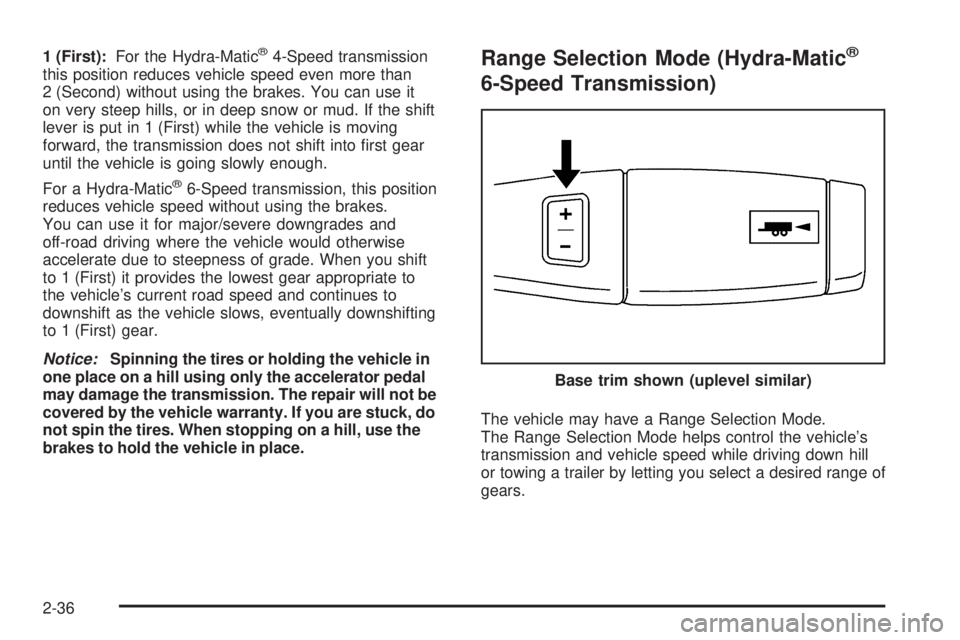
The vehicle may have a Range Selection Mode.
The Range Selection Mode helps control the vehicle’s
transmission and vehicle speed while driving down hill
or towing a trailer by letting you select a desired range of
gears.Base trim shown (uplevel similar)
2-36