Page 423 of 578
5. Keep the engine running and press the Trip/Fuel
button or trip odometer reset stem until TRANS
TEMP (Transmission Temperature) displays on the
Driver Information Center (DIC).
6. Using the TRANS TEMP reading, determine and
perform the appropriate check procedure. If the
TRANS TEMP reading is not within the required
temperature ranges, allow the vehicle to cool,
or operate the vehicle until the appropriate
transmission uid temperature is reached.
Cold Check Procedure
Use this procedure only as a reference to determine
if the transmission has enough uid to be operated
safely until a hot check procedure can be made.The hot check procedure is the most accurate method
to check the uid level. Perform the hot check procedure
at the rst opportunity. Use this cold check procedure
to check uid level when the transmission temperature is
between 80°F and 90°F (27°C and 32°C).
1. Locate the transmission
dipstick at the
rear of the engine
compartment, on the
passenger side of
the vehicle.
SeeEngine Compartment Overview on page 5-14
for more information.
2. Flip the handle up, and then pull out the dipstick
and wipe it with a clean rag or paper towel.
3. Install the dipstick by pushing it back in all the way,
wait three seconds, and then pull it back out again.
4. Check both sides of the dipstick and read the lower
level. Repeat the check procedure to verify the
reading.
5-23
Page 483 of 578
Your dealer/retailer will know the kind of wheel you need.
Each new wheel should have the same load-carrying
capacity, diameter, width, offset, and be mounted
the same way as the one it replaces.
If you need to replace any of your wheels, wheel bolts,
wheel nuts, or Tire Pressure Monitor System (TPMS)
sensors, replace them only with new GM original
equipment parts. This way, you will be sure to have the
right wheel, wheel bolts, wheel nuts, and TPMS
sensors for your vehicle.
{CAUTION:
Using the wrong replacement wheels, wheel bolts,
or wheel nuts on your vehicle can be dangerous. It
could affect the braking and handling of your
vehicle, make your tires lose air and make you
lose control. You could have a collision in which
you or others could be injured. Always use the
correct wheel, wheel bolts, and wheel nuts for
replacement.Notice:The wrong wheel can also cause problems
with bearing life, brake cooling, speedometer or
odometer calibration, headlamp aim, bumper height,
vehicle ground clearance, and tire or tire chain
clearance to the body and chassis.
SeeChanging a Flat Tire on page 5-86for more
information.
Used Replacement Wheels
{CAUTION:
Putting a used wheel on the vehicle is dangerous.
You cannot know how it has been used or how far
it has been driven. It could fail suddenly and
cause a crash. If you have to replace a wheel, use
a new GM original equipment wheel.
5-83
Page 541 of 578
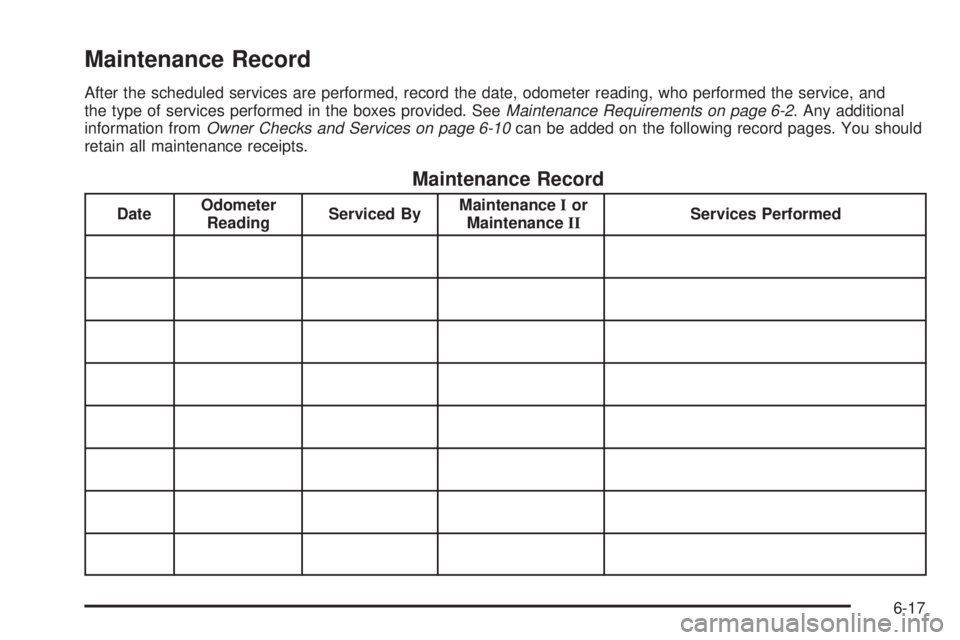
Maintenance Record
After the scheduled services are performed, record the date, odometer reading, who performed the service, and
the type of services performed in the boxes provided. SeeMaintenance Requirements on page 6-2. Any additional
information fromOwner Checks and Services on page 6-10can be added on the following record pages. You should
retain all maintenance receipts.
Maintenance Record
DateOdometer
ReadingServiced ByMaintenanceIor
MaintenanceIIServices Performed
6-17
Page 542 of 578
Maintenance Record (cont’d)
DateOdometer
ReadingServiced ByMaintenanceIor
MaintenanceIIServices Performed
6-18
Page 543 of 578
Maintenance Record (cont’d)
DateOdometer
ReadingServiced ByMaintenanceIor
MaintenanceIIServices Performed
6-19
Page 544 of 578
Maintenance Record (cont’d)
DateOdometer
ReadingServiced ByMaintenanceIor
MaintenanceIIServices Performed
6-20
Page 552 of 578
Model, year, color, and license plate number of the
vehicle
Odometer reading, Vehicle Identication Number
(VIN), and delivery date of the vehicle
Description of the problem
Coverage
Services are provided up to 5 years/100,000 miles
(160 000 km), whichever comes rst.
In the U.S., anyone driving the vehicle is covered. In
Canada, a person driving the vehicle without permission
from the owner is not covered.
Roadside Assistance is not a part of the New Vehicle
Limited Warranty. Chevrolet and General Motors of
Canada Limited reserve the right to make any changes
or discontinue the Roadside Assistance program at
any time without notication.
Chevrolet and General Motors of Canada Limited
reserve the right to limit services or payment to an owner
or driver if they decide the claims are made too often,
or the same type of claim is made many times.
Services Provided
Emergency Fuel Delivery:Delivery of enough fuel
for the vehicle to get to the nearest service station.
Lock-Out Service:Service is provided to unlock the
vehicle if you are locked out. A remote unlock may
be available if you have OnStar
®. For security
reasons, the driver must present identication
before this service is given.
Emergency Tow From a Public Road or
Highway:Tow to the nearest Chevrolet dealer for
warranty service, or if the vehicle was in a crash
and cannot be driven. Assistance is also given when
the vehicle is stuck in the sand, mud, or snow.
Flat Tire Change:Service is provided to change a
at tire with the spare tire. The spare tire, if
equipped, must be in good condition and properly
inated. It is the owner’s responsibility for the repair
or replacement of the tire if it is not covered by
the warranty.
Battery Jump Start:Service is provided to jump
start a dead battery.
7-8
Page 568 of 578
F
Filter
Engine Air Cleaner......................................5-20
Finish Damage.............................................5-113
Flashers, Hazard Warning.................................. 3-6
Flash-to-Pass................................................... 3-8
Flat Tire........................................................5-85
Flat Tire, Changing.........................................5-86
Flat Tire, Storing...........................................5-102
Fluid
Automatic Transmission........................5-22, 5-25
Power Steering...........................................5-38
Windshield Washer......................................5-39
Fog Lamps
Bulb Replacement.......................................3-17
Light..........................................................3-49
Four-Wheel Drive....................................2-40, 5-51
Front Axle......................................................5-52
Fuel............................................................... 5-5
Additives...................................................... 5-6
California Fuel.............................................. 5-6
E85 (85% Ethanol)........................................ 5-7
Economy Driving........................................... 4-2
Filling a Portable Fuel Container....................5-11
Filling the Tank............................................. 5-9
Fuels in Foreign Countries.............................. 5-8
Gage .........................................................3-50
Gasoline Octane........................................... 5-5Fuel (cont.)
Gasoline Specications.................................. 5-6
Low Fuel Warning Light................................3-51
Management, Active.....................................2-31
Fuses
Center Instrument Panel Fuse Block.............5-118
Fuses and Circuit Breakers.........................5-115
Instrument Panel Fuse Block.......................5-116
Underhood Fuse Block...............................5-119
Windshield Wiper.......................................5-115
G
Gages
Engine Coolant Temperature.........................3-42
Fuel..........................................................3-50
Oil Pressure...............................................3-46
Speedometer..............................................3-36
Tachometer.................................................3-36
Trip Odometer.............................................3-36
Voltmeter Gage...........................................3-39
Garage Door Opener.......................................2-71
Gasoline
Octane........................................................ 5-5
Specications............................................... 5-6
Glove Box.....................................................2-78
GM Mobility Reimbursement Program.................. 7-7
6