Page 459 of 600
{CAUTION:
Fans or other moving engine parts can injure you
badly. Keep your hands away from moving parts
once the engine is running.
6. Check that the jumper cables do not have loose or
missing insulation. If they do, you could get a
shock. The vehicles could be damaged too.
Before you connect the cables, here are some
basic things you should know. Positive (+) will go
to positive (+) or to a remote positive (+) terminal if
the vehicle has one. Negative (−) will go to a heavy,
unpainted metal engine part or to a remote
negative (−) terminal if the vehicle has one.
Do not connect positive (+) to negative (−) or you will
get a short that would damage the battery and maybe
other parts too. And do not connect the negative (−)
cable to the negative (−) terminal on the dead battery
because this can cause sparks.7. Connect the red
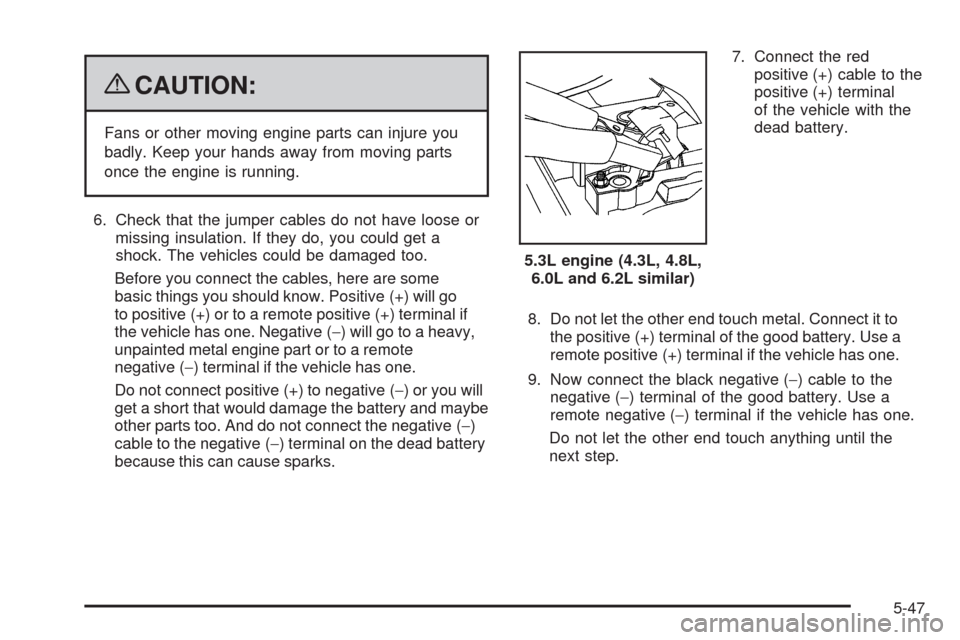
positive (+) cable to the
positive (+) terminal
of the vehicle with the
dead battery.
8. Do not let the other end touch metal. Connect it to
the positive (+) terminal of the good battery. Use a
remote positive (+) terminal if the vehicle has one.
9. Now connect the black negative (−) cable to the
negative (−) terminal of the good battery. Use a
remote negative (−) terminal if the vehicle has one.
Do not let the other end touch anything until the
next step. 5.3L engine (4.3L, 4.8L,
6.0L and 6.2L similar)
5-47
Page 460 of 600
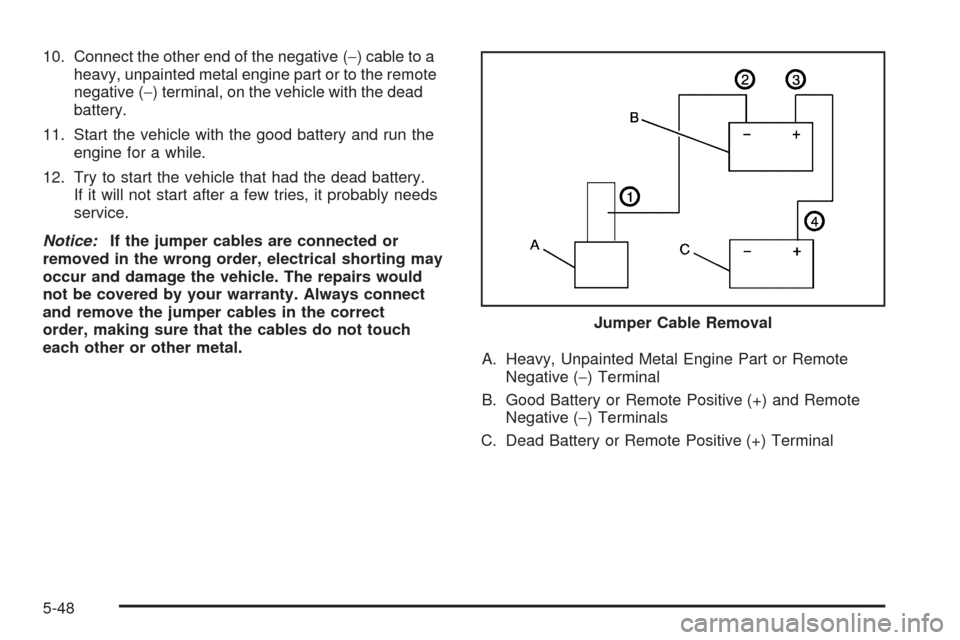
10. Connect the other end of the negative (−) cable to a
heavy, unpainted metal engine part or to the remote
negative (−) terminal, on the vehicle with the dead
battery.
11. Start the vehicle with the good battery and run the
engine for a while.
12. Try to start the vehicle that had the dead battery.
If it will not start after a few tries, it probably needs
service.
Notice:If the jumper cables are connected or
removed in the wrong order, electrical shorting may
occur and damage the vehicle. The repairs would
not be covered by your warranty. Always connect
and remove the jumper cables in the correct
order, making sure that the cables do not touch
each other or other metal.
A. Heavy, Unpainted Metal Engine Part or Remote
Negative (−) Terminal
B. Good Battery or Remote Positive (+) and Remote
Negative (−) Terminals
C. Dead Battery or Remote Positive (+) TerminalJumper Cable Removal
5-48
Page 462 of 600
How to Check Lubricant
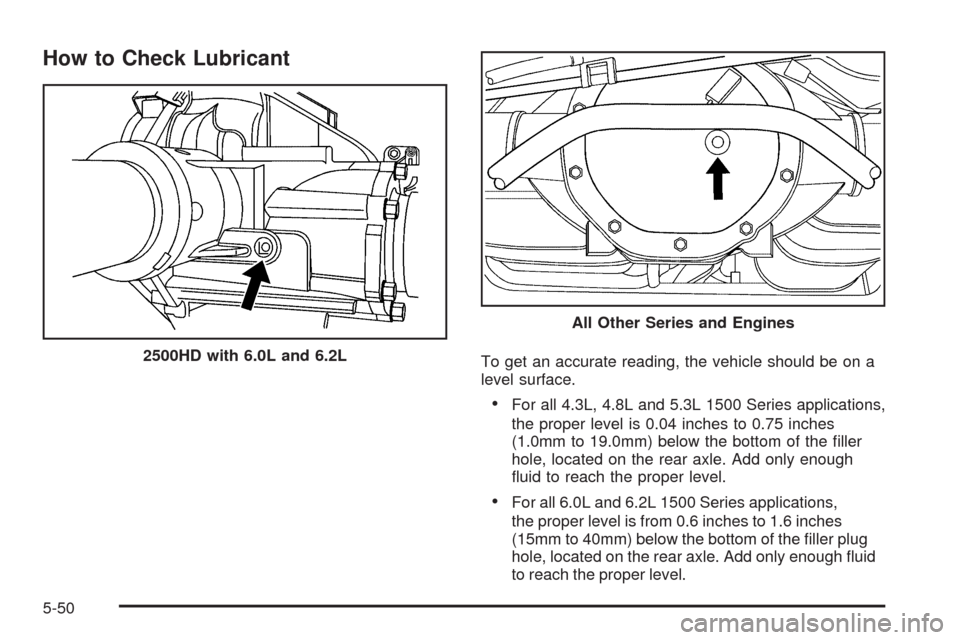
To get an accurate reading, the vehicle should be on a
level surface.
For all 4.3L, 4.8L and 5.3L 1500 Series applications,
the proper level is 0.04 inches to 0.75 inches
(1.0mm to 19.0mm) below the bottom of the ller
hole, located on the rear axle. Add only enough
uid to reach the proper level.
For all 6.0L and 6.2L 1500 Series applications,
the proper level is from 0.6 inches to 1.6 inches
(15mm to 40mm) below the bottom of the ller plug
hole, located on the rear axle. Add only enough uid
to reach the proper level. 2500HD with 6.0L and 6.2L
All Other Series and Engines
5-50
Page 465 of 600
When to Change Lubricant
Refer to the Maintenance Schedule to determine
how often to change the lubricant. SeeScheduled
Maintenance (Gasoline Engine) on page 6-4.
What to Use
Refer to the Maintenance Schedule to determine what
kind of lubricant to use. SeeRecommended Fluids
and Lubricants on page 6-15.
Front Axle
When to Check and Change Lubricant
It is not necessary to regularly check front axle uid
unless you suspect there is a leak or you hear an
unusual noise. A uid loss could indicate a problem.
Have it inspected and repaired.
How to Check Lubricant
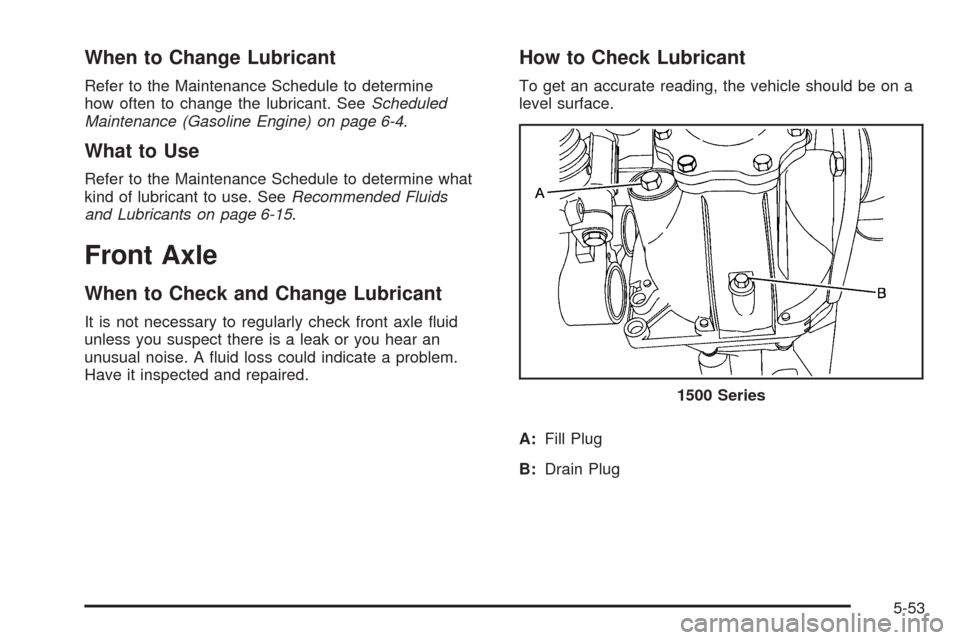
To get an accurate reading, the vehicle should be on a
level surface.
A:Fill Plug
B:Drain Plug1500 Series
5-53
Page 467 of 600
Federal law prohibits the following acts or the causing
thereof:
1. The removal or rendering inoperative by any
person, other than for purposes of maintenance,
repair or replacement, of any device or element
of design incorporated into any new vehicle for
the purpose of noise control, prior to its sale
or delivery to the ultimate purchaser or while
it is in use; or
2. The use of the vehicle after such device or element
of design has been removed or rendered inoperative
by any person.
Among those acts presumed to constitute tampering are
the acts listed below.
Insulation:
Removal of the noise shields or any underhood
insulation.
Engine:
Removal or rendering engine speed governor, if the
vehicle has one, inoperative so as to allow engine
speed to exceed manufacturer specications.
Fan and Drive:
Removal of fan clutch, if the vehicle has one, or
rendering clutch inoperative.
Removal of the fan shroud, if the vehicle has one.
Air Intake:
Removal of the air cleaner silencer.
Modication of the air cleaner.
Exhaust:
Removal of the muffler and/or resonator.
Removal of the exhaust pipes and exhaust pipe
clamps.
Headlamp Aiming
The vehicle has a visual optical headlamp aiming
system. The aim of the headlamps have been preset at
the factory and should need no further adjustment.
However, if the vehicle is damaged in a crash, the aim
of the headlamps can be affected and adjustment
can be necessary.
If oncoming vehicles ash their high beams at you, this
can mean the vertical aim of your headlamps needs
to be adjusted.
It is recommended that the vehicle is taken to your
dealer/retailer for service if the headlamps need to be
adjusted. It is possible however, to re-aim the
headlamps as described.
5-55
Page 470 of 600
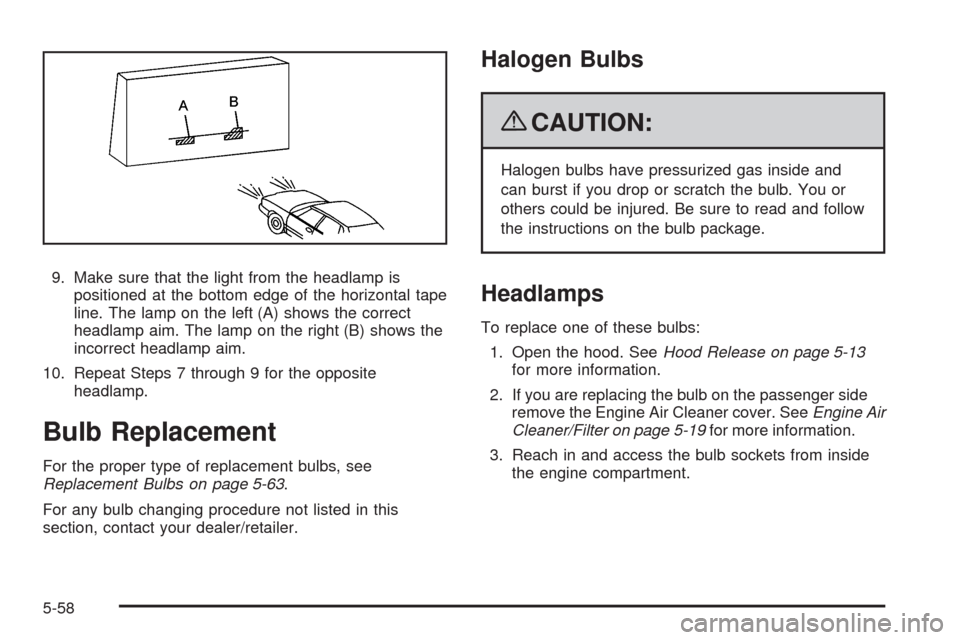
9. Make sure that the light from the headlamp is
positioned at the bottom edge of the horizontal tape
line. The lamp on the left (A) shows the correct
headlamp aim. The lamp on the right (B) shows the
incorrect headlamp aim.
10. Repeat Steps 7 through 9 for the opposite
headlamp.
Bulb Replacement
For the proper type of replacement bulbs, see
Replacement Bulbs on page 5-63.
For any bulb changing procedure not listed in this
section, contact your dealer/retailer.
Halogen Bulbs
{CAUTION:
Halogen bulbs have pressurized gas inside and
can burst if you drop or scratch the bulb. You or
others could be injured. Be sure to read and follow
the instructions on the bulb package.
Headlamps
To replace one of these bulbs:
1. Open the hood. SeeHood Release on page 5-13
for more information.
2. If you are replacing the bulb on the passenger side
remove the Engine Air Cleaner cover. SeeEngine Air
Cleaner/Filter on page 5-19for more information.
3. Reach in and access the bulb sockets from inside
the engine compartment.
5-58
Page 476 of 600
Windshield Wiper Blade
Replacement
Windshield wiper blades should be inspected for wear
or cracking. SeeScheduled Maintenance (Gasoline
Engine) on page 6-4for more information on wiper blade
inspection.
Replacement blades come in different types and are
removed in different ways. Here is how to remove
the wiper blade:
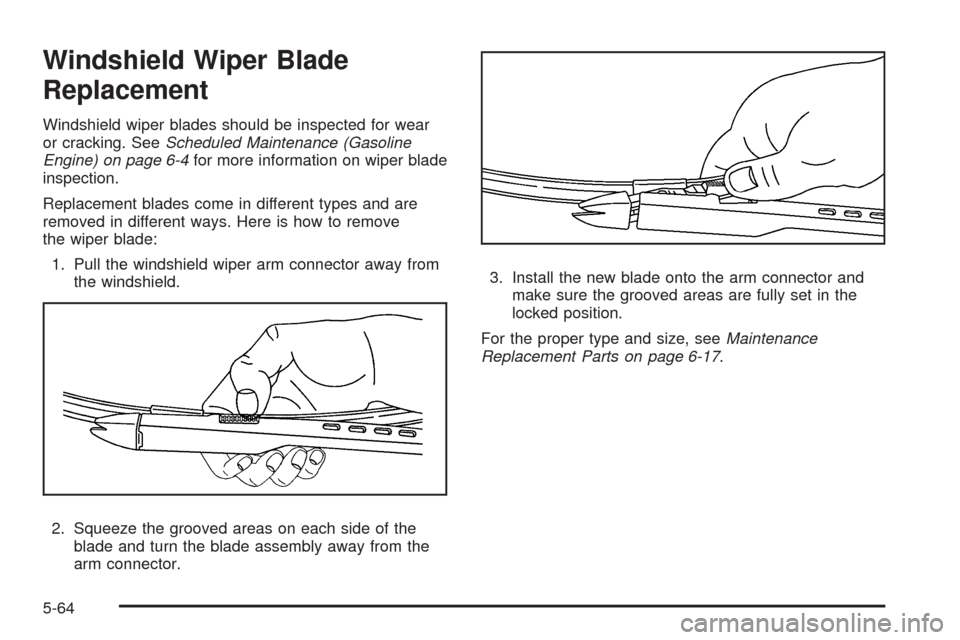
1. Pull the windshield wiper arm connector away from
the windshield.
2. Squeeze the grooved areas on each side of the
blade and turn the blade assembly away from the
arm connector.3. Install the new blade onto the arm connector and
make sure the grooved areas are fully set in the
locked position.
For the proper type and size, seeMaintenance
Replacement Parts on page 6-17.
5-64
Page 481 of 600
(F) Tire Ply Material:The type of cord and
number of plies in the sidewall and under the
tread.
(G) Single Tire Maximum Load
:Maximum load
that can be carried and the maximum pressure
needed to support that load when used as a
single. For information on recommended
tire pressure seeInflation - Tire Pressure on
page 5-73andLoading the Vehicle on page 4-32.
Tire Size
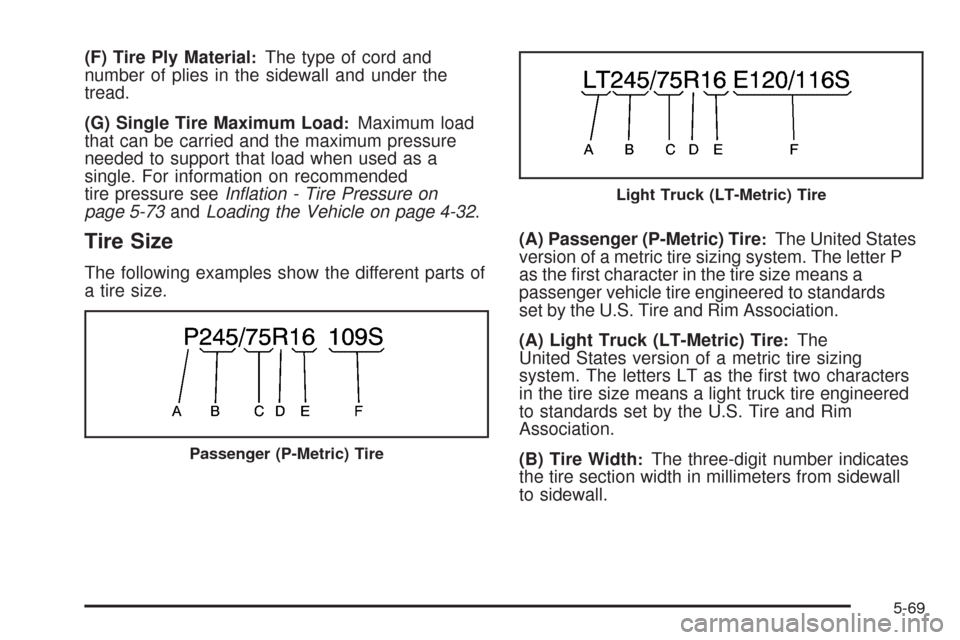
The following examples show the different parts of
a tire size.(A) Passenger (P-Metric) Tire
:The United States
version of a metric tire sizing system. The letter P
as the rst character in the tire size means a
passenger vehicle tire engineered to standards
set by the U.S. Tire and Rim Association.
(A) Light Truck (LT-Metric) Tire
:The
United States version of a metric tire sizing
system. The letters LT as the rst two characters
in the tire size means a light truck tire engineered
to standards set by the U.S. Tire and Rim
Association.
(B) Tire Width
:The three-digit number indicates
the tire section width in millimeters from sidewall
to sidewall.Passenger (P-Metric) Tire
Light Truck (LT-Metric) Tire
5-69