2009 CHEVROLET MALIBU four wheel drive
[x] Cancel search: four wheel drivePage 106 of 420
I (Intermediate):This position is also used for normal
driving. However, it reduces vehicle speed without using
the brakes for slight downgrades where the vehicle
would otherwise accelerate. If constant upshifting or
downshifting occurs while driving up steep hills, this
position can be used to prevent repetitive types of shifts.
You might choose I (Intermediate) instead of D (Drive)
when driving on hilly, winding roads and when towing a
trailer, so that there is less shifting between gears.
L (Low):This position gives you access to 4 (Fourth),
3 (Third), 2 (Second) and 1 (First) gear ranges.
This provides more engine braking but lower fuel
economy than D (Drive). You can use it on very steep
hills, or in deep snow or mud. If the electronic range
select is put in L (Low), the transmission will not shift
into lower gears until the vehicle is going slow enough.Automatic Transmission Operation
(Six Speed Transmission)
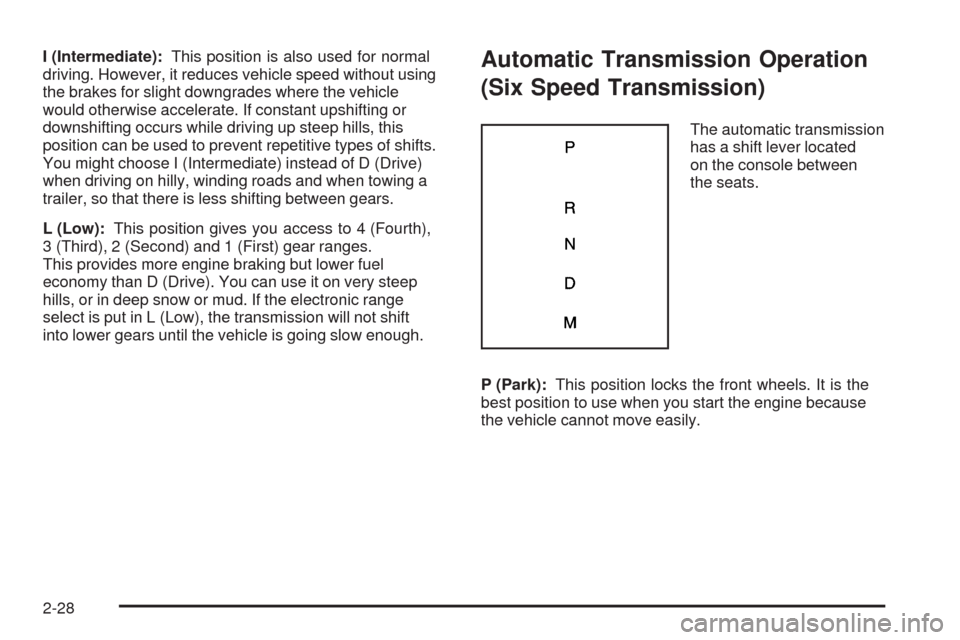
The automatic transmission
has a shift lever located
on the console between
the seats.
P (Park):This position locks the front wheels. It is the
best position to use when you start the engine because
the vehicle cannot move easily.
2-28
Page 135 of 420
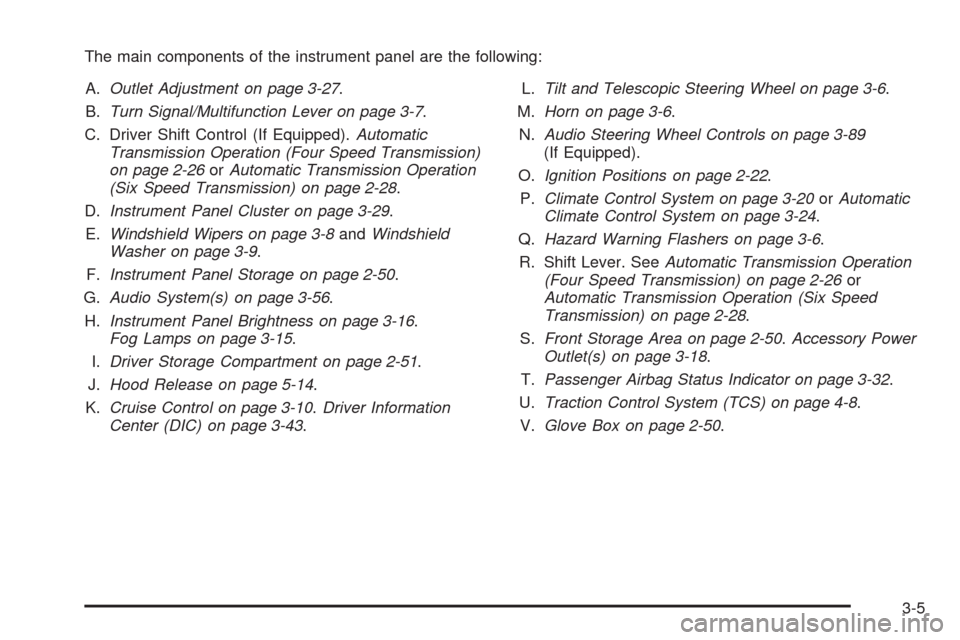
The main components of the instrument panel are the following:
A.Outlet Adjustment on page 3-27.
B.Turn Signal/Multifunction Lever on page 3-7.
C. Driver Shift Control (If Equipped).Automatic
Transmission Operation (Four Speed Transmission)
on page 2-26orAutomatic Transmission Operation
(Six Speed Transmission) on page 2-28.
D.Instrument Panel Cluster on page 3-29.
E.Windshield Wipers on page 3-8andWindshield
Washer on page 3-9.
F.Instrument Panel Storage on page 2-50.
G.Audio System(s) on page 3-56.
H.Instrument Panel Brightness on page 3-16.
Fog Lamps on page 3-15.
I.Driver Storage Compartment on page 2-51.
J.Hood Release on page 5-14.
K.Cruise Control on page 3-10.Driver Information
Center (DIC) on page 3-43.L.Tilt and Telescopic Steering Wheel on page 3-6.
M.Horn on page 3-6.
N.Audio Steering Wheel Controls on page 3-89
(If Equipped).
O.Ignition Positions on page 2-22.
P.Climate Control System on page 3-20orAutomatic
Climate Control System on page 3-24.
Q.Hazard Warning Flashers on page 3-6.
R. Shift Lever. SeeAutomatic Transmission Operation
(Four Speed Transmission) on page 2-26or
Automatic Transmission Operation (Six Speed
Transmission) on page 2-28.
S.Front Storage Area on page 2-50.Accessory Power
Outlet(s) on page 3-18.
T.Passenger Airbag Status Indicator on page 3-32.
U.Traction Control System (TCS) on page 4-8.
V.Glove Box on page 2-50.
3-5
Page 173 of 420
Here are four things that some owners ask about.
These are normal and do not indicate a problem with
the fuel gage:
At the service station, the gas pump shuts off
before the gage reads full.
It takes a little more or less fuel to ll up than the
gage indicated. For example, the gage may have
indicated the fuel tank was half full, but it actually
took a little more or less than half the fuel tank’s
capacity to ll it.
The indicator moves a little while turning a corner or
speeding up.
The gage goes back to empty when the ignition is
turned off.
Driver Information Center (DIC)
Your vehicle has a Driver Information Center (DIC).
The DIC display gives you the status of many of your
vehicle’s systems. The DIC is also used to display driver
personalization menu modes and warning/status
messages. All messages will appear in the DIC display,
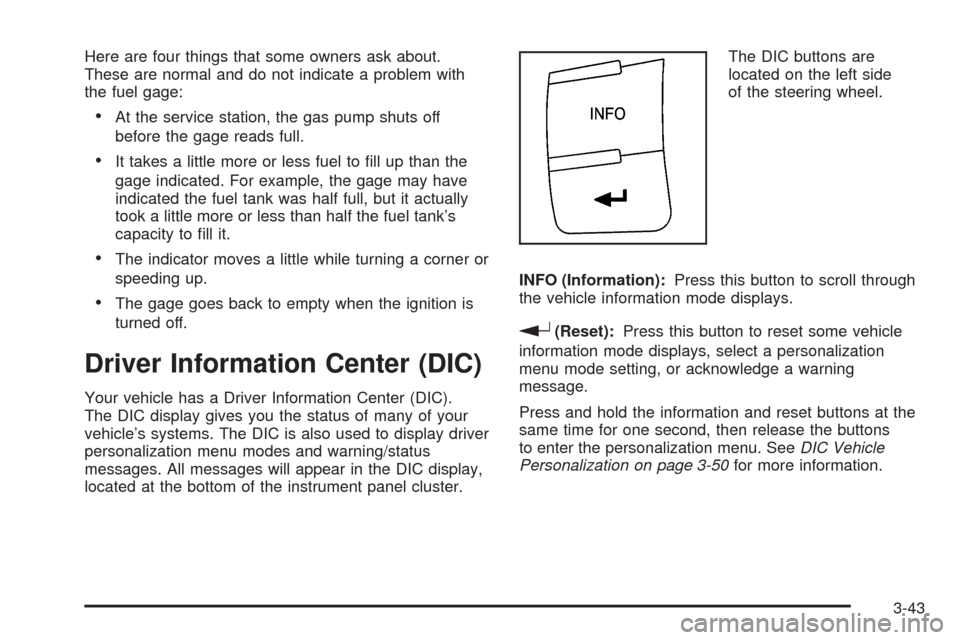
located at the bottom of the instrument panel cluster.The DIC buttons are
located on the left side
of the steering wheel.
INFO (Information):Press this button to scroll through
the vehicle information mode displays.
r(Reset):Press this button to reset some vehicle
information mode displays, select a personalization
menu mode setting, or acknowledge a warning
message.
Press and hold the information and reset buttons at the
same time for one second, then release the buttons
to enter the personalization menu. SeeDIC Vehicle
Personalization on page 3-50for more information.
3-43
Page 310 of 420
Low-Prole Performance Tire
If your vehicle has P225/50R18 or P225/50R17
size tires, they are classied as low-prole
performance tires. These tires are designed for
very responsive driving on wet or dry pavement.
You may also notice more road noise with
low-prole performance tires and that they
tend to wear faster.
Notice:If the vehicle has low-prole tires,
they are more susceptible to damage from road
hazards or curb impact than standard prole
tires. Tire and/or wheel assembly damage can
occur when coming into contact with road
hazards like, potholes, or sharp edged objects,
or when sliding into a curb. The vehicle
warranty does not cover this type of damage.
Keep tires set to the correct ination pressure
and, when possible avoid contact with curbs,
potholes, and other road hazards.
Winter Tires
If you expect to drive on snow or ice covered roads
often, you may want to get winter tires for your vehicle.
All season tires provide good overall performance
on most surfaces but they may not offer the traction
you would like or the same level of performance
as winter tires on snow or ice covered roads.
Winter tires, in general, are designed for increased
traction on snow and ice covered roads. With winter tires,
there may be decreased dry road traction, increased road
noise, and shorter tread life. After switching to winter
tires, be alert for changes in vehicle handling and braking.
See your dealer/retailer for details regarding winter tire
availability and proper tire selection. Also, seeBuying
New Tires on page 5-68.
If you choose to use winter tires:
Use tires of the same brand and tread type on all
four wheel positions.
Use only radial ply tires of the same size, load
range, and speed rating as the original equipment
tires.
Winter tires with the same speed rating as your original
equipment tires may not be available for H, V, W, Y,
and ZR speed rated tires. If you choose winter tires with
a lower speed rating, never exceed the tire’s maximum
speed capability.
5-52
Page 323 of 420
The TPMS matching process is outlined below:
1. Set the parking brake.
2. Turn the ignition switch to ON/RUN with the
engine off.
3. Press and hold the Remote Keyless Entry (RKE)
transmitter’s LOCK and UNLOCK buttons, at the
same time, for about ve seconds to start the TPMS
learn mode. The horn sounds twice indicating the
TPMS receiver is ready and in learn mode.
4. Start with the driver side front tire. The driver side
front turn signal also comes on to indicate that
corner’s sensor is ready to be learned.
5. Remove the valve cap from the tire’s valve
stem. Activate the TPMS sensor by increasing
or decreasing the tire’s air pressure for about
eight seconds. The horn chirp, can take up to
30 seconds to sound. It chirps one time and then
all the turn signals ash one time to conrm the
sensor identication code has been matched to
the tire/wheel position.
6. The passenger side front turn signal comes on to
indicate that corner sensor is ready to be learned.
Proceed to the passenger side front tire and
repeat the procedure in Step 5.7. The passenger side rear turn signal comes on to
indicate that corner sensor is ready to be learned.
Proceed to the passenger side rear tire and
repeat the procedure in Step 5.
8. The driver side rear turn signal comes on to
indicate that corner sensor is ready to be learned.
Proceed to the driver side rear tire, and repeat
the procedure in Step 5.
9. After hearing the single horn chirp for the driver
side rear tire, two additional horn chirps sound
to indicate the tire learning process is done.
Turn the ignition switch to LOCK/OFF.
If no tires are learned after entering the TPMS learn
mode, or if communication with the receiver stops, or
if the time limit has expired, turn the ignition switch to
LOCK/OFF and start over beginning with Step 2.
10. Set all four tires to the recommended air pressure
level as indicated on the Tire and Loading
Information label.
11. Put the valve caps back on the valve stems.
5-65
Page 327 of 420
GM recommends replacing tires in sets of four.
This is because uniform tread depth on all tires will
help keep your vehicle performing most like it did
when the tires were new. Replacing less than a
full set of tires can affect the braking and handling
performance of your vehicle. SeeTire Inspection
and Rotation on page 5-66for information on
proper tire rotation.
{CAUTION:
Mixing tires could cause you to lose control
while driving. If you mix tires of different sizes,
brands, or types (radial and bias-belted tires),
the vehicle may not handle properly, and you
could have a crash. Using tires of different
sizes, brands, or types may also cause
damage to your vehicle. Be sure to use the
correct size, brand, and type of tires on all
wheels. It is all right to drive with your compact
spare temporarily, as it was developed for use
on your vehicle. SeeCompact Spare Tire on
page 5-89.
{CAUTION:
If you use bias-ply tires on the vehicle, the
wheel rim anges could develop cracks after
many miles of driving. A tire and/or wheel
could fail suddenly, causing a crash. Use only
radial-ply tires with the wheels on the vehicle.
If you must replace your vehicle’s tires with those
that do not have a TPC Spec number, make sure
they are the same size, load range, speed rating,
and construction type (radial and bias-belted tires)
as your vehicle’s original tires.
Vehicles that have a tire pressure monitoring
system could give an inaccurate low-pressure
warning if non-TPC Spec rated tires are installed
on your vehicle. Non-TPC Spec rated tires may give
a low-pressure warning that is higher or lower than
the proper warning level you would get with TPC
Spec rated tires. SeeTire Pressure Monitor System
on page 5-61.
Your vehicle’s original equipment tires are listed
on the Tire and Loading Information Label.
SeeLoading the Vehicle on page 4-20, for more
information about the Tire and Loading Information
Label and its location on your vehicle.
5-69