Page 6 of 376
Front Seats
Bucket Seats
On vehicles with bucket seats, you can adjust the seats
several different ways.
Fore-and-Aft Adjustment
{CAUTION:
You can lose control of the vehicle if you try to
adjust the seat while the vehicle is moving. The
sudden movement could startle and confuse you,
or make you push a pedal when you do not want
to. Adjust the driver’s seat only when the vehicle is
not moving.You can adjust the seat forward or rearward with the
bar located under the front of the seat cushion.
Lift the bar to unlock the seat. Slide the seat to where you
want it and release the bar. Try to move the seat with
your body to be sure the seat is locked in place.
1-2
Page 7 of 376
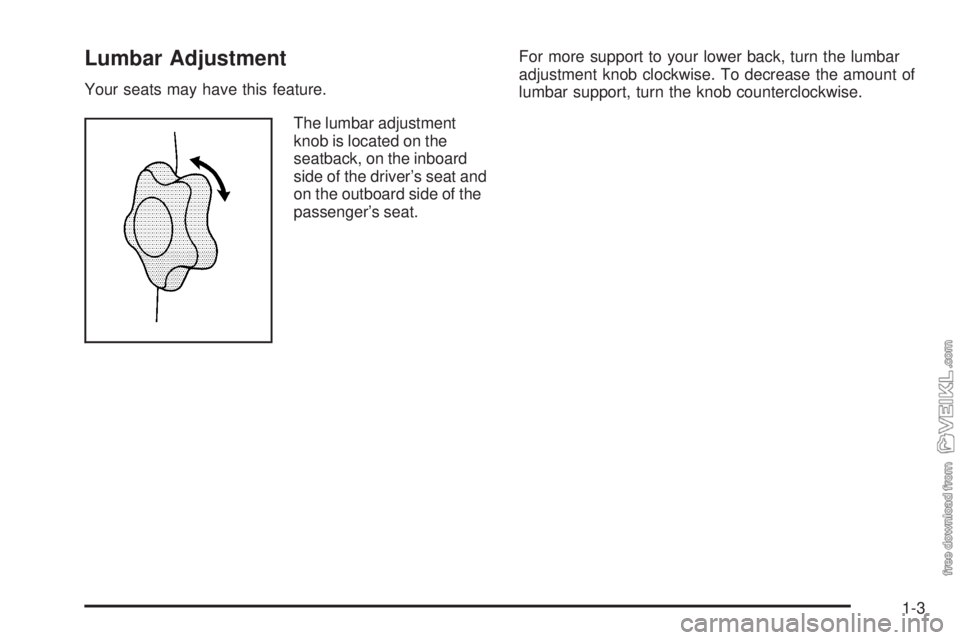
Lumbar Adjustment
Your seats may have this feature.
The lumbar adjustment
knob is located on the
seatback, on the inboard
side of the driver’s seat and
on the outboard side of the
passenger’s seat.For more support to your lower back, turn the lumbar
adjustment knob clockwise. To decrease the amount of
lumbar support, turn the knob counterclockwise.
1-3
Page 8 of 376

Seatback Adjustment
{CAUTION:
You can lose control of the vehicle if you try to
adjust a manual driver’s seat while the vehicle is
moving. The sudden movement could startle and
confuse you, or make you push a pedal when you
do not want to. Adjust the driver’s seat only when
the vehicle is not moving.
{CAUTION:
If either seatback is not locked, it could move
forward in a sudden stop or crash. That could
cause injury to the person sitting there. Always
push and pull on the seatbacks to be sure they
are locked.The recline lever is located on the outboard side of the
driver’s and passenger’s seat cushions.
To recline the seatback, do the following:
1. Lift the recline lever.
2. Move the seatback to the desired position, then
release the lever to lock the seatback in place.
3. Push and pull on the seatback to make sure it is
locked.
To return the seatback to an upright position, do the
following:
1. Lift the lever fully without applying pressure to the
seatback and the seatback will return to the upright
position.
2. Push and pull on the seatback to make sure it is
locked.
1-4
Page 10 of 376
Split Bench Seat (80/20 Split)
If your vehicle has a split bench seat, the passenger
seat is not adjustable.
There is a storage area underneath the seat cushion.
SeeStorage Areas on page 2-53.
Air Suspension Seats
Your vehicle may have a low-back or high-back air
suspension seat. There are several ways to adjust
the seat.
Fore-and-Aft Adjustment
If your vehicle has this lever
it is located underneath the
front of the driver’s seat.
To slide the seat forward or rearward, move the lever
toward the outboard side of the seat. The seat will lock in
at 1/2 inch (1.5 cm) increments. Try to move the seat with
your body to be sure the seat is locked in place.
1-6
Page 11 of 376
Height Adjustment
On a vehicle with an air suspension seat height
adjustment lever, it is located on the front inboard side
of the seat.
To adjust the height of the air suspension seat, pull the
lever up to inflate. Push the lever down to deflate.
Your seat cushion may also be able to be raised or
lowered.If your vehicle has this
feature, the seat cushion
height adjustment handle is
located underneath the
front of the seat.
To adjust the height of the cushion, lift the handle up
and pull it forward. You can choose between two
settings. Seat Height Adjustment
Lever
1-7
Page 12 of 376
Lumbar Adjustment
If your vehicle has a lumbar adjustment knob, it is
located on the inboard side of the driver’s seatback, or
on the outboard side of the passenger’s seatback.
For more support to your lower back, turn the lumbar
adjustment knob clockwise. To decrease the amount of
lumbar support, turn the knob counterclockwise.
Seatback Adjustment
Your vehicle has a seatback adjustment control located
on the outboard side of the seat.
Recline the seatback by turning the control
counterclockwise.
Return the seatback to an upright position by turning the
control clockwise. Lumbar Adjustment
Knob
1-8
Page 28 of 376

Lap-Shoulder Belt
All seating positions in the vehicle have a lap-shoulder
belt except for the center passenger positions (if
equipped), which have a lap belt. SeeLap Belt on
page 1-27for more information.
The following instructions explain how to wear a
lap-shoulder belt properly.
1. Adjust the seat, if the seat is adjustable, so you can
sit up straight. To see how, see “Seats” in the Index.
2. Pick up the latch plate and pull the belt across you.
Do not let it get twisted.
The lap-shoulder belt may lock if you pull the belt
across you very quickly. If this happens, let the belt
go back slightly to unlock it. Then pull the belt
across you more slowly.
If the shoulder portion of a passenger belt is pulled
out all the way, the child restraint locking feature
may be engaged. If this happens, let the belt
go back all the way and start again.3. Push the latch plate into the buckle until it clicks.
Pull up on the latch plate to make sure it is secure.
If the belt is not long enough, seeSafety Belt
Extender on page 1-28.
Position the release button on the buckle so that
the safety belt could be quickly unbuckled if
necessary.
4. If equipped with a shoulder belt height adjuster,
move it to the height that is right for you. See
“Shoulder Belt Height Adjustment” later in this
section for instructions on use and important safety
information.
1-24
Page 30 of 376

Shoulder Belt Height Adjustment
The vehicle has a shoulder belt height adjuster for each
seating position next to a window.
Adjust the height so that the shoulder portion of the belt
is centered on the shoulder. The belt should be away
from the face and neck, but not falling off the shoulder.
Improper shoulder belt height adjustment could
reduce the effectiveness of the safety belt in a crash.
To move it down, press in
at the top of the arrows
and move the height
adjuster to the desired
position. You can move the
height adjuster up just
by pushing up on the
shoulder belt guide.
After you move the height adjuster to where you want it,
try to move it down without pressing in to make sure
it has locked into position.
Safety Belt Use During Pregnancy
Safety belts work for everyone, including pregnant
women. Like all occupants, they are more likely to be
seriously injured if they do not wear safety belts.
A pregnant woman should wear a lap-shoulder belt, and
the lap portion should be worn as low as possible,
below the rounding, throughout the pregnancy.
The best way to protect the fetus is to protect the
mother. When a safety belt is worn properly, it is more
likely that the fetus will not be hurt in a crash. For
pregnant women, as for anyone, the key to making
safety belts effective is wearing them properly.
1-26