2009 CHEVROLET KODIAK service
[x] Cancel search: servicePage 213 of 376

Very Cold Weather Operation
Follow the instructions listed previously under the
heading “What Fuel to Use.”
Notice:Never use home heating oil or gasoline in
your vehicle’s diesel engine. They can cause
engine damage.
In cold weather, the fuel filter could become clogged
(waxed). To unclog it, move the vehicle to a warm
garage area and warm the filter to between 32°F and
50°F (0°C to 10°C). You will not need to replace it.
Additional information on the fuel filter follows.
Water in Fuel
{CAUTION:
Diesel fuel containing water is still flammable. You
could be burned. If you ever try to drain water
from the fuel, keep sparks, flames, and smoking
materials away from the mixture.Notice:If there is water in the diesel fuel and the
weather is warm or humid, fungus and bacteria can
grow in the fuel. They can damage the fuel system.
A diesel fuel biocide can be used to sterilize the
fuel system. However, the fuel system may still need
to be cleaned. Your dealer/retailer can advise you
of the appropriate solution.
If the fuel tank needs to be purged to remove water,
see your dealer/retailer or a qualified technician.
Improper purging can damage the fuel system.
Sometimes, water can be pumped into the fuel tank
along with the diesel fuel. This can happen if a service
station does not regularly inspect and clean its fuel
tanks, or if it gets contaminated fuel from its suppliers.
If this happens, the
water-in-fuel light, if
equipped, will come on in
the instrument panel. If it
does, the water must be
drained. Your dealer/
retailer can show you
how to do this.
If the light comes on, use this chart to determine what
action to take.
5-11
Page 219 of 376

Running Out of Fuel
If the diesel engine stalls and you think that you have
run out of fuel, do this to restart the engine:
{CAUTION:
Diesel fuel is flammable. It could start a fire if it
gets on hot engine parts. You could be burned. Do
not let too much fuel flow from the air bleed valve,
and wipe up any spilled fuel with a cloth.
1. If parked on a level surface, add at least 2 gallons
(7.6 liters) of fuel. However, if parked on a slope, up
to 5 gallons (18.9 liters) of fuel might need to be
added.2. Follow the fuel priming procedure earlier in this
section to prime the fuel filter.
3. Close the air bleed valve.
4. Turn the ignition key to START for 10 to 15 seconds
at a time until the engine starts. If the engine tries
to run, but does not run smoothly, increase the rpm
a little using the accelerator pedal. This will help
force air through the system.
The service engine soon light may come on if the
vehicle has run out of fuel. This light may stay on for a
few drive cycles after the condition is corrected, but
will eventually clear itself.
5-17
Page 229 of 376

•American Petroleum Institute (API) symbol
This doughnut-shaped logo
(symbol) is used on most
oil containers to help you
select the correct oil. It
means that the oil has been
certified by the American
Petroleum Institute.
Look for this on the oil container, and use only
those oils that display this logo.
Notice:Use only engine oils that have the
designation CJ-4 for the diesel engine. Failure to
use the recommended oil can result in engine
damage not covered by the vehicle warranty.Engine Oil Additives
Do not add anything to the oil. The recommended oils
with the API service symbol are all you need for
good performance and engine protection.
When to Change Engine Oil (Vehicles
Without the Engine Oil Life System)
Change the engine oil and filter every 15,000 miles
(24 000 km), or every 12 months, or every 750 hours of
engine operation, whichever occurs first. See
Scheduled Maintenance on page 6-5.
Engine Oil (Caterpillar Diesel
Engine)
See the Caterpillar®Operation & Maintenance Manual
for information on oil quality and viscosities as well
as the temperature range chart.
5-27
Page 233 of 376

•American Petroleum Institute (API) symbol
This doughnut-shaped logo
(symbol) is used on most
oil containers to help you
select the correct oil. It
means that the oil has been
certified by the American
Petroleum Institute.
Look for this on the oil container, and use only
those oils that display this logo.
Notice:Use only engine oils that have the
designation CJ-4 for the diesel engine. Failure to
use the recommended oil can result in engine
damage not covered by the vehicle warranty.Engine Oil Additives
Do not add anything to the oil. The recommended oils
with the API service symbol are all you need for
good performance and engine protection.
When to Change Engine Oil (Vehicles
Without the Engine Oil Life System)
Change the engine oil and filter every 15,000 miles
(24 000 km), or every 12 months, or every 750 hours of
engine operation, whichever occurs first. If the vehicle
is used primarily for long trip, highway service, change
the engine oil and filter every 18,000 miles (28 800 km),
or every 12 months, or every 750 hours of engine
operation, whichever occurs first. SeeScheduled
Maintenance on page 6-5.
5-31
Page 237 of 376

Engine Oil Additives / Engine Oil
Flushes
Do not add anything to the oil. The recommended oils
with the API service symbol are all that is needed
for good performance and engine protection.
Engine oil system flushes are not recommended and
could cause engine damage not covered by the vehicle
warranty.
Engine Oil Life System (Gasoline
Engine)
When to Change Engine Oil
This vehicle has a computer system that indicates when
to change the engine oil and filter. This is based on
engine revolutions and engine temperature, and not on
mileage. Based on driving conditions, the mileage at
which an oil change is indicated can vary considerably.
For the oil life system to work properly, the system
must be reset every time the oil is changed.
When the system has calculated that oil life has been
diminished, it indicates that an oil change is necessary.
A change engine oil light comes on. SeeChangeEngine Oil Light on page 3-39. Change the oil as soon
as possible within the next 600 miles (1 000 km). It
is possible that, if driving under the best conditions, the
oil life system might not indicate that an oil change
is necessary for over a year. However, the engine oil
and filter must be changed at least once a year and at
this time the system must be reset. Your dealer/retailer
has trained service people who will perform this
work using genuine parts and reset the system. It is
also important to check the oil regularly and keep it at
the proper level.
If the system is ever reset accidentally, the oil must be
changed at 3,000 miles (5 000 km) since the last oil
change. Remember to reset the oil life system whenever
the oil is changed.How to Reset the Engine Oil Life
System
The Engine Oil Life System calculates when to change
the engine oil and filter based on vehicle use. Whenever
the oil is changed, reset the system so it can calculate
when the next oil change is required. If a situation occurs
where the oil is changed prior to a change engine oil light
being turned on, reset the system.
5-35
Page 238 of 376
To reset the change engine oil light:
1. Turn the ignition key to ON/RUN with the
engine off.
2. Fully press and release the accelerator pedal slowly
three times within 10 seconds.
If the change engine oil light flashes for
five seconds, the system is resetting.
3. Turn the key to OFF.
If the change engine oil light comes back on when the
vehicle is started, the engine oil life system has not
reset. Repeat the procedure.
What to Do with Used Oil
Used engine oil contains certain elements that can be
unhealthy for your skin and could even cause cancer.
Do not let used oil stay on your skin for very long. Clean
your skin and nails with soap and water, or a good
hand cleaner. Wash or properly dispose of clothing or
rags containing used engine oil. See the manufacturer’s
warnings about the use and disposal of oil products.
Used oil can be a threat to the environment. If you
change your own oil, be sure to drain all the oil from the
filter before disposal. Never dispose of oil by putting it
in the trash, pouring it on the ground, into sewers, or into
streams or bodies of water. Recycle it by taking it to a
place that collects used oil.
Engine Oil Life System
(DURAMAX/Isuzu Diesel Engines)
When to Change Engine Oil
If the vehicle has the Engine Oil Life System, it has a
computer system that indicates when to change
the engine oil and filter. This is based on injection timing,
engine load, and engine temperature, and not on
mileage. Based on driving conditions, the mileage at
which an oil change is indicated can vary considerably.
For the oil life system to work properly, the system
must be reset every time the oil is changed.
When the system has calculated that oil life has been
diminished, it indicates that an oil change is necessary.
A change engine oil light comes on. SeeChange Engine
Oil Light on page 3-39. Change the oil as soon as
possible within the next 600 miles (1 000 km) or 30 hours
of engine operation, whichever occurs first. It is possible
that, if driving under the best conditions, the oil life system
might not indicate that an oil change is necessary for over
a year. However, the engine oil and filter must be
changed at least once a year and at this time the system
must be reset. Your dealer/retailer has trained service
people who will perform this work using genuine parts
and reset the system. It is also important to check the oil
regularly and keep it at the proper level.
5-36
Page 246 of 376

The coolant level should
be at the FULL COLD
mark or higher. If it is not,
you may have a leak at
the pressure cap or in the
radiator hoses, heater
hoses, radiator, water
pump, or somewhere else
in the cooling system.
{CAUTION:
Heater and radiator hoses, and other engine parts,
can be very hot. Do not touch them. If you do, you
can be burned.
Do not run the engine if there is a leak. If you run
the engine, it could lose all coolant. That could
cause an engine fire, and you could be burned.
Get any leak fixed before you drive the vehicle.If there seems to be no leak, start the engine again. The
engine cooling fan speed should increase when idle
speed is doubled by pushing the accelerator pedal down.
If it does not, your vehicle needs service. Turn off the
engine.
Notice:Engine damage from running the engine
without coolant is not covered by the warranty.
Notice:Using coolant other than DEX-COOL can
cause premature engine, heater core or radiator
corrosion. In addition, the engine coolant may
require changing sooner, at 30,000 miles (50 000 km)
or 24 months, whichever occurs first. Any repairs
would not be covered by the vehicle warranty.
Always use DEX-COOL (silicate-free) coolant in
your vehicle.
How to Add Coolant to the Coolant
Surge Tank
If you have not found a problem yet, check to see if
coolant is visible in the surge tank. If coolant is visible
but the coolant level is not at the FULL COLD mark
or higher, add a 50/50 mixture of clean, drinkable water
and DEX-COOL
®coolant at the coolant surge tank,
but be sure the cooling system, including the coolant
surge tank pressure cap, is cool before you do it.
SeeEngine Coolant (Caterpillar Diesel Engines) on
page 5-47for more information.
5-44
Page 249 of 376
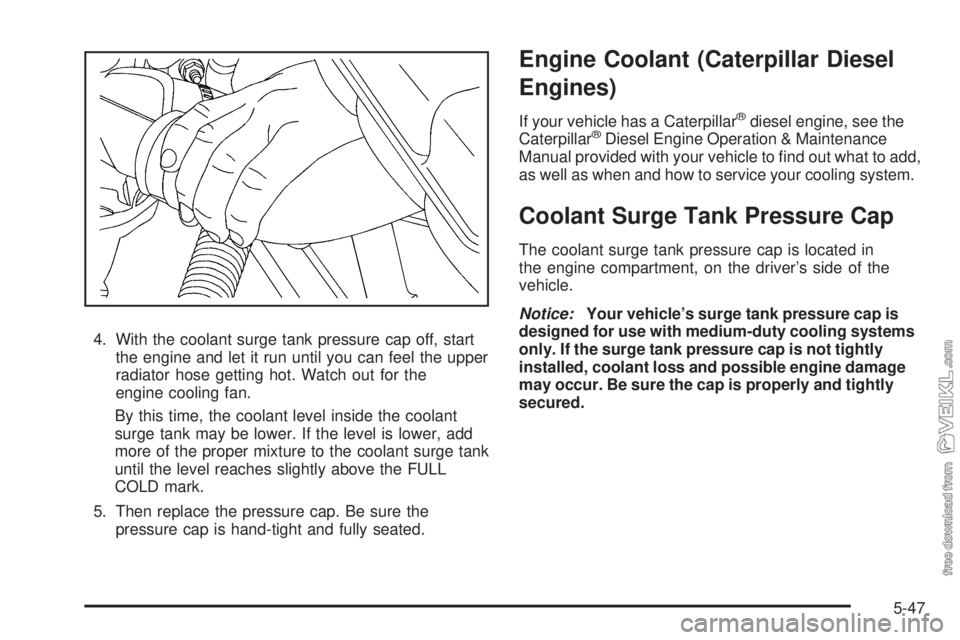
4. With the coolant surge tank pressure cap off, start
the engine and let it run until you can feel the upper
radiator hose getting hot. Watch out for the
engine cooling fan.
By this time, the coolant level inside the coolant
surge tank may be lower. If the level is lower, add
more of the proper mixture to the coolant surge tank
until the level reaches slightly above the FULL
COLD mark.
5. Then replace the pressure cap. Be sure the
pressure cap is hand-tight and fully seated.
Engine Coolant (Caterpillar Diesel
Engines)
If your vehicle has a Caterpillar®diesel engine, see the
Caterpillar®Diesel Engine Operation & Maintenance
Manual provided with your vehicle to find out what to add,
as well as when and how to service your cooling system.
Coolant Surge Tank Pressure Cap
The coolant surge tank pressure cap is located in
the engine compartment, on the driver’s side of the
vehicle.
Notice:Your vehicle’s surge tank pressure cap is
designed for use with medium-duty cooling systems
only. If the surge tank pressure cap is not tightly
installed, coolant loss and possible engine damage
may occur. Be sure the cap is properly and tightly
secured.
5-47