Page 26 of 376
Q:What is wrong with this?
A:The belt is behind the body.
{CAUTION:
You can be seriously injured by not wearing the
lap-shoulder belt properly. In a crash, you would
not be restrained by the shoulder belt. Your body
could move too far forward increasing the chance
of head and neck injury. You might also slide
under the lap belt. The belt force would then be
applied right on the abdomen. That could cause
serious or fatal injuries. The shoulder belt should
go over the shoulder and across the chest.
1-22
Page 27 of 376
Q:What is wrong with this?
A:The belt is twisted across the body.
{CAUTION:
You can be seriously injured by a twisted belt. In a
crash, you would not have the full width of the belt
to spread impact forces. If a belt is twisted, make
it straight so it can work properly, or ask your
dealer/retailer to fix it.
1-23
Page 28 of 376

Lap-Shoulder Belt
All seating positions in the vehicle have a lap-shoulder
belt except for the center passenger positions (if
equipped), which have a lap belt. SeeLap Belt on
page 1-27for more information.
The following instructions explain how to wear a
lap-shoulder belt properly.
1. Adjust the seat, if the seat is adjustable, so you can
sit up straight. To see how, see “Seats” in the Index.
2. Pick up the latch plate and pull the belt across you.
Do not let it get twisted.
The lap-shoulder belt may lock if you pull the belt
across you very quickly. If this happens, let the belt
go back slightly to unlock it. Then pull the belt
across you more slowly.
If the shoulder portion of a passenger belt is pulled
out all the way, the child restraint locking feature
may be engaged. If this happens, let the belt
go back all the way and start again.3. Push the latch plate into the buckle until it clicks.
Pull up on the latch plate to make sure it is secure.
If the belt is not long enough, seeSafety Belt
Extender on page 1-28.
Position the release button on the buckle so that
the safety belt could be quickly unbuckled if
necessary.
4. If equipped with a shoulder belt height adjuster,
move it to the height that is right for you. See
“Shoulder Belt Height Adjustment” later in this
section for instructions on use and important safety
information.
1-24
Page 29 of 376
5. To make the lap part tight, pull up on the
shoulder belt.
It may be necessary to pull stitching on the safety
belt through the latch plate to fully tighten the
lap belt on smaller occupants.To unlatch the belt, push the button on the buckle.
The belt should return to its stowed position.
Before a door is closed, be sure the safety belt is out of
the way. If a door is slammed against a safety belt,
damage can occur to both the belt and the vehicle.
1-25
Page 30 of 376

Shoulder Belt Height Adjustment
The vehicle has a shoulder belt height adjuster for each
seating position next to a window.
Adjust the height so that the shoulder portion of the belt
is centered on the shoulder. The belt should be away
from the face and neck, but not falling off the shoulder.
Improper shoulder belt height adjustment could
reduce the effectiveness of the safety belt in a crash.
To move it down, press in
at the top of the arrows
and move the height
adjuster to the desired
position. You can move the
height adjuster up just
by pushing up on the
shoulder belt guide.
After you move the height adjuster to where you want it,
try to move it down without pressing in to make sure
it has locked into position.
Safety Belt Use During Pregnancy
Safety belts work for everyone, including pregnant
women. Like all occupants, they are more likely to be
seriously injured if they do not wear safety belts.
A pregnant woman should wear a lap-shoulder belt, and
the lap portion should be worn as low as possible,
below the rounding, throughout the pregnancy.
The best way to protect the fetus is to protect the
mother. When a safety belt is worn properly, it is more
likely that the fetus will not be hurt in a crash. For
pregnant women, as for anyone, the key to making
safety belts effective is wearing them properly.
1-26
Page 31 of 376
Lap Belt
This part is only for the lap belt. To learn how to wear a
lap-shoulder belt, seeLap-Shoulder Belt on page 1-24.
You vehicle may have a center seating position.
When you sit in the center front or rear seating position,
you may have a lap safety belt, which has no retractor.
To make the belt longer, tilt the latch plate and pull it
along the belt.To make the belt shorter, pull its free end as shown
until the belt is snug.
Buckle, position and release it the same way as the lap
part of a lap-shoulder belt. If the belt is not long
enough, seeSafety Belt Extender on page 1-28.
Make sure the release button on the buckle is positioned
so you would be able to unbuckle the safety belt
quickly if you ever had to.
1-27
Page 32 of 376
Safety Belt Extender
If the safety belt will fasten around you, you should
use it.
But if a safety belt is not long enough, your
dealer/retailer will order you an extender. When you go
in to order it, take the heaviest coat you will wear,
so the extender will be long enough for you. To help
avoid personal injury, do not let someone else use
it, and use it only for the seat it is made to fit. The
extender has been designed for adults. Never use it for
securing child seats. To wear it, attach it to the
regular safety belt. For more information, see the
instruction sheet that comes with the extender.
Child Restraints
Older Children
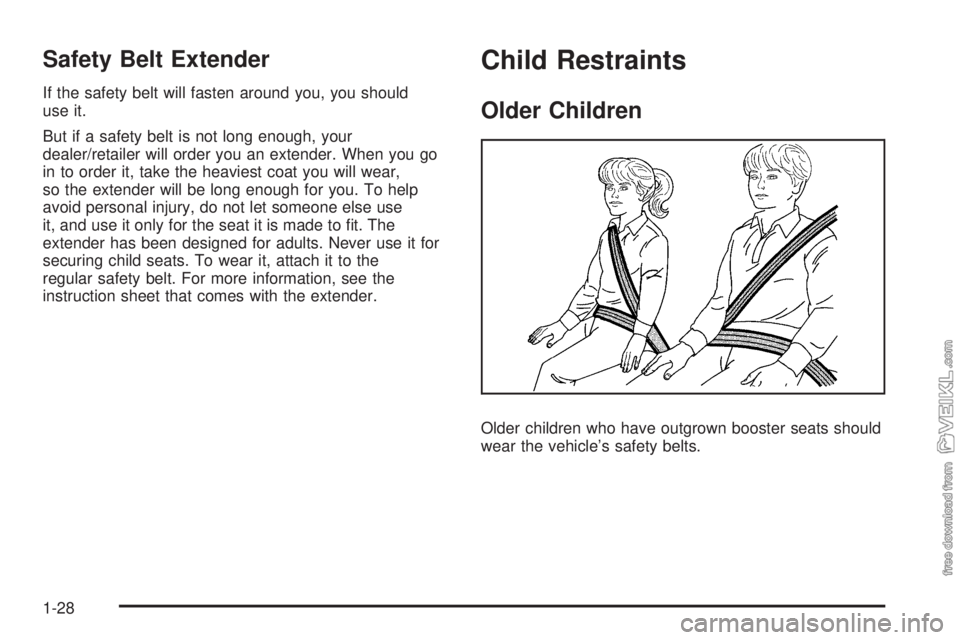
Older children who have outgrown booster seats should
wear the vehicle’s safety belts.
1-28
Page 33 of 376

The manufacturer’s instructions that come with the
booster seat, state the weight and height limitations for
that booster. Use a booster seat with a lap-shoulder
belt until the child passes the below fit test:
•Sit all the way back on the seat. Do the knees bend
at the seat edge? If yes, continue. If no, return to
the booster seat.
•Buckle the lap-shoulder belt. Does the shoulder belt
rest on the shoulder? If yes, continue. If no, then
return to the booster seat.
•Does the lap belt fit low and snug on the hips,
touching the thighs? If yes, continue. If no, return to
the booster seat.
•Can proper safety belt fit be maintained for
length of trip? If yes, continue. If no, return to
the booster seat.
If you have the choice, a child should sit in a position
with a lap-shoulder belt and get the additional restraint a
shoulder belt can provide.
Q:What is the proper way to wear safety belts?
A:An older child should wear a lap-shoulder belt
and get the additional restraint a shoulder belt can
provide. The shoulder belt should not cross the face
or neck. The lap belt should fit snugly below the hips,
just touching the top of the thighs. This applies belt
force to the child’s pelvic bones in a crash. It should
never be worn over the abdomen, which could cause
severe or even fatal internal injuries in a crash.
According to accident statistics, children and infants are
safer when properly restrained in the rear seating
positions than in the front seating positions.
In a crash, children who are not buckled up can strike
other people who are buckled up, or can be thrown
out of the vehicle. Older children need to use safety
belts properly.
1-29