2009 CHEVROLET IMPALA fuel
[x] Cancel search: fuelPage 381 of 406
Services Provided
Emergency Fuel Delivery:Delivery of enough fuel
for the vehicle to get to the nearest service station.
Lock-Out Service:Service is provided to unlock the
vehicle if you are locked out. A remote unlock may
be available if you have OnStar
®. For security
reasons, the driver must present identication
before this service is given.
Emergency Tow From a Public Road or
Highway:Tow to the nearest Chevrolet dealer
for warranty service, or if the vehicle was in a crash
and cannot be driven. Assistance is also given when
the vehicle is stuck in the sand, mud, or snow.
Flat Tire Change:Service is provided to change a
at tire with the spare tire. The spare tire, if equipped,
must be in good condition and properly inated.
It is the owner’s responsibility for the repair or
replacement of the tire if it is not covered by the
warranty.
Battery Jump Start:Service is provided to jump
start a dead battery.
Trip Interruption Benets and Assistance:If your
trip is interrupted due to a warranty failure, incidental
expenses may be reimbursed during the 5 years/
100,000 miles (160 000 km) Powertrain warranty
period. Items considered are hotel, meals, and
rental car.
Services Not Included in Roadside
Assistance
Impound towing caused by violation of any laws.
Legal nes.
Mounting, dismounting or changing of snow tires,
chains, or other traction devices.
Towing or services for vehicles driven on a
non-public road or highway.
Services Specic to Canadian
Purchased Vehicles
Fuel delivery:Reimbursement is approximately
$5 Canadian. Diesel fuel delivery may be restricted.
Propane and other fuels are not provided through
this service.
Lock-Out Service:Vehicle registration is required.
Trip Routing Service:Detailed maps of North
America are provided when requested either with
the most direct route or the most scenic route. There
is a limit of six requests per year. Additional travel
information is also available. Allow three weeks for
delivery.
7-9
Page 384 of 406
Public Transportation or Fuel
Reimbursement
If your vehicle requires overnight warranty repairs,
and public transportation is used instead of the dealer’s
shuttle service, the expense must be supported by
original receipts and can only be up to the maximum
amount allowed by GM for shuttle service. In addition,
for U.S. customers, should you arrange transportation
through a friend or relative, limited reimbursement for
reasonable fuel expenses may be available. Claim
amounts should reect actual costs and be supported
by original receipts. See your dealer for information
regarding the allowance amounts for reimbursement
of fuel or other transportation costs.
Courtesy Rental Vehicle
Your dealer may arrange to provide you with a courtesy
rental vehicle or reimburse you for a rental vehicle that
you obtain if your vehicle is kept for an overnight warranty
repair. Rental reimbursement will be limited and must
be supported by original receipts. This requires that you
sign and complete a rental agreement and meet state/
provincial, local, and rental vehicle provider requirements.
Requirements vary and may include minimum age
requirements, insurance coverage, credit card, etc.
You are responsible for fuel usage charges and may
also be responsible for taxes, levies, usage fees,
excessive mileage, or rental usage beyond the
completion of the repair.It may not be possible to provide a like-vehicle as a
courtesy rental.
Additional Program Information
All program options, such as shuttle service, may not
be available at every dealer. Please contact your dealer
for specic information about availability. All Courtesy
Transportation arrangements will be administered
by appropriate dealer personnel.
General Motors reserves the right to unilaterally modify,
change or discontinue Courtesy Transportation at
any time and to resolve all questions of claim eligibility
pursuant to the terms and conditions described
herein at its sole discretion.
Collision Damage Repair
If your vehicle is involved in a collision and it is
damaged, have the damage repaired by a qualied
technician using the proper equipment and quality
replacement parts. Poorly performed collision repairs
diminish your vehicle’s resale value, and safety
performance can be compromised in subsequent
collisions.
7-12
Page 390 of 406
Vehicle Data Recording and
Privacy
Your GM vehicle has a number of sophisticated
computers that record information about the vehicle’s
performance and how it is driven. For example, your
vehicle uses computer modules to monitor and control
engine and transmission performance, to monitor the
conditions for airbag deployment and deploy airbags
in a crash and, if so equipped, to provide antilock braking
to help the driver control the vehicle. These modules
may store data to help your dealer/retailer technician
service your vehicle. Some modules may also store data
about how you operate the vehicle, such as rate of fuel
consumption or average speed. These modules may also
retain the owner’s personal preferences, such as radio
pre-sets, seat positions, and temperature settings.
Event Data Recorders
This vehicle has an Event Data Recorder (EDR).
The main purpose of an EDR is to record, in certain
crash or near crash-like situations, such as an airbag
deployment or hitting a road obstacle, data that will assist
in understanding how a vehicle’s systems performed.
The EDR is designed to record data related to vehicle
dynamics and safety systems for a short period of time,
typically 30 seconds or less. The EDR in this vehicle is
designed to record such data as:
How various systems in your vehicle were operating
Whether or not the driver and passenger safety belts
were buckled/fastened
How far, if at all, the driver was pressing the
accelerator and/or brake pedal
How fast the vehicle was traveling
This data can help provide a better understanding of the
circumstances in which crashes and injuries occur.
Important:EDR data is recorded by your vehicle
only if a non-trivial crash situation occurs; no data is
recorded by the EDR under normal driving conditions
and no personal data (e.g., name, gender, age, and crash
location) is recorded. However, other parties, such as law
enforcement, could combine the EDR data with the type
of personally identifying data routinely acquired during a
crash investigation.
7-18
Page 393 of 406
A
Accessories and Modications............................ 5-3
Accessory Power............................................2-21
Accessory Power Outlets.................................3-18
Active Fuel Management™...............................2-23
Adding Equipment to Your Airbag-Equipped
Vehicle.......................................................1-72
Additional Required Services, Scheduled
Maintenance................................................. 6-6
Additives, Fuel................................................. 5-6
Add-On Electrical Equipment............................5-96
Air Cleaner/Filter, Engine.................................5-21
Air Conditioning..............................................3-20
Air Filter, Passenger Compartment....................3-23
Airbag
Readiness Light..........................................3-28
Airbag System................................................1-57
Adding Equipment to Your Airbag-Equipped
Vehicle...................................................1-72
How Does an Airbag Restrain?......................1-63
Passenger Sensing System...........................1-65
Servicing Your Airbag-Equipped Vehicle..........1-71
What Makes an Airbag Inate?......................1-63
What Will You See After an Airbag Inates?....1-64
When Should an Airbag Inate?....................1-62
Where Are the Airbags?...............................1-59Airbags
Passenger Status Indicator...........................3-29
Antenna
Backglass...................................................3-96
Antenna, XM™ Satellite Radio Antenna
System......................................................3-96
Antilock Brake System (ABS)............................. 4-5
Warning Light.............................................3-31
Appearance Care
Aluminum Wheels........................................5-94
Care of Safety Belts....................................5-92
Chemical Paint Spotting...............................5-95
Cleaning Exterior Lamps/Lenses....................5-93
Fabric/Carpet..............................................5-90
Finish Care.................................................5-93
Finish Damage
............................................5-95
Instrument Panel, Vinyl, and Other Plastic
Surfaces.................................................5-91
Interior Cleaning..........................................5-89
Leather......................................................5-91
Sheet Metal Damage...................................5-95
Tires..........................................................5-95
Underbody Maintenance...............................5-95
Washing Your Vehicle...................................5-92
Weatherstrips..............................................5-92
Windshield and Wiper Blades........................5-94
1
Page 394 of 406

Ashtray.........................................................3-19
Assistance Program, Roadside........................... 7-8
Audio System.................................................3-63
Audio Steering Wheel Controls......................3-94
Setting the Clock.........................................3-64
XM™ Satellite Radio Antenna System............3-96
Audio System(s).............................................3-66
Audio Systems
Radio Reception..........................................3-95
Theft-Deterrent Feature................................3-93
Automatic Door Lock.......................................2-10
Automatic Transmission
Fluid..........................................................5-24
Operation...................................................2-24
B
Backglass Antenna..........................................3-96
Battery..........................................................5-40
Electric Power Management..........................3-17
Run-Down Protection...................................3-18
Belt Routing, Engine.......................................6-14
Bluetooth
®.....................................................3-82
Brake
Emergencies................................................ 4-6
Brake Fluid....................................................5-37Brakes..........................................................5-37
Antilock....................................................... 4-5
Parking......................................................2-26
System Warning Light..................................3-30
Braking........................................................... 4-4
Braking in Emergencies..................................... 4-6
Break-In, New Vehicle.....................................2-19
Bulb Replacement...........................................5-51
Fog Lamp ..................................................3-14
Halogen Bulbs............................................5-45
Headlamp Aiming........................................5-45
Headlamps.................................................5-45
Headlamps, Front Turn Signal, Sidemarker,
and Parking Lamps..................................5-46
License Plate Lamps....................................5-51
Taillamps, Turn Signal, Sidemarker, Stoplamps,
and Back-Up Lamps.................................5-49
Buying New Tires...........................................5-69
C
Calibration.....................................................3-47
California
Perchlorate Materials Requirements................. 5-4
California Fuel.................................................. 5-6
California Proposition 65 Warning....................... 5-4
2
Page 396 of 406

Cooling System..............................................5-26
Courtesy Lamps.............................................3-15
Courtesy Transportation...................................7-11
Cruise Control.................................................. 3-9
Cruise Control Light........................................3-40
Cupholders....................................................2-43
Customer Assistance......................................... 7-6
Offices......................................................... 7-6
Text Telephone (TTY) Users........................... 7-6
Customer Information
Service Publications Ordering Information........7-17
Customer Satisfaction Procedure........................ 7-2
D
Damage Repair, Collision.................................7-12
Data Recorders
Event.........................................................7-18
Daytime Running Lamps/Automatic Headlamp
System......................................................3-14
Defensive Driving............................................. 4-2
Delayed Entry Lighting.....................................3-16
Delayed Exit Lighting.......................................3-16
Delayed Locking.............................................2-10
DIC Compass.................................................3-47
Disc, MP3......................................................3-77Doing Your Own Service Work........................... 5-4
Dome Lamp ...................................................3-15
Door
Automatic Door Lock....................................2-10
Delayed Locking..........................................2-10
Locks.......................................................... 2-9
Power Door Locks.......................................2-10
Programmable Automatic Door Unlock............2-11
Rear Door Security Locks.............................2-11
Driver Information Center (DIC).........................3-42
DIC Operation and Displays..........................3-42
DIC Vehicle Customization............................3-57
DIC Warnings and Messages........................3-49
Driving
At Night.....................................................4-13
Before a Long Trip......................................4-15
Defensive..................................................... 4-2
Drunk.......................................................... 4-3
Highway Hypnosis.......................................4-15
Hill and Mountain Roads..............................4-16
In Rain and on Wet Roads...........................4-14
Loss of Control...........................................4-11
Off-Road Recovery......................................4-11
Rocking Your Vehicle to Get it Out.................4-20
Winter........................................................4-17
Driving for Better Fuel Economy......................... 4-2
4
Page 397 of 406

E
E85 Fuel......................................................... 5-8
EDR .............................................................7-18
Electrical Equipment
Add-On Equipment......................................5-96
Electrical System
Fuses and Circuit Breakers...........................5-97
Headlamp Wiring.........................................5-97
Instrument Panel Fuse Block.........................5-97
Power Windows and Other Power Options......5-97
Underhood Fuse Block.................................5-98
Windshield Wiper Fuses...............................5-97
Electronic Immobilizer
PASS-Key
®III+...........................................2-17
Electronic Immobilizer Operation
PASS-Key
®III+...........................................2-18
Electronic Stability Control................................. 4-6
Engine
Air Cleaner/Filter.........................................5-21
Check and Service Engine Soon Lamp...........3-36
Compartment Overview................................5-14
Coolant......................................................5-28
Coolant Heater............................................2-22
Coolant Temperature Gage...........................3-34
Coolant Temperature Warning Light................3-34
Cooling System...........................................5-26
Drive Belt Routing.......................................6-14
Exhaust.....................................................2-30
Oil .............................................................5-17Engine (cont.)
Oil Life System...........................................5-20
Overheated Protection Operating Mode...........5-34
Overheating................................................5-31
Starting......................................................2-21
Entry Lighting.................................................3-15
Event Data Recorders.....................................7-18
Extender, Safety Belt.......................................1-33
Exterior Lamps...............................................3-12
F
Filter
Engine Air Cleaner......................................5-21
Finish Damage...............................................5-95
Flashers, Hazard Warning.................................. 3-6
Flash-to-Pass................................................... 3-8
Flat Tire........................................................5-75
Flat Tire, Changing.........................................5-76
Flat Tire, Storing.............................................5-85
Fluid
Automatic Transmission................................5-24
Power Steering...........................................5-34
Windshield Washer......................................5-35
Fog Lamp
Fog ...........................................................3-14
Fog Lamp Light..............................................3-40
Folding Rear Seat...........................................1-10
5
Page 398 of 406
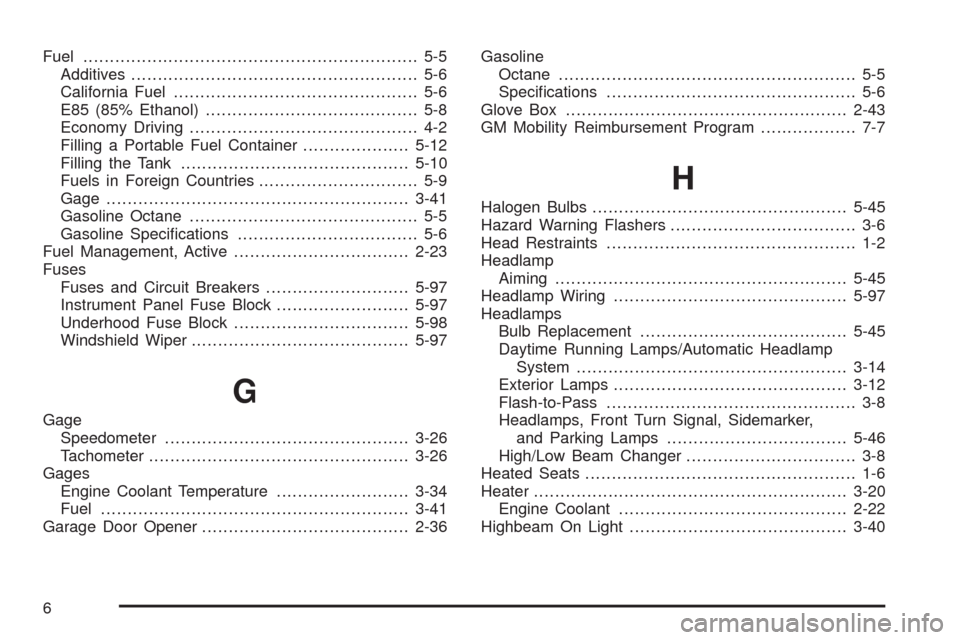
Fuel............................................................... 5-5
Additives...................................................... 5-6
California Fuel.............................................. 5-6
E85 (85% Ethanol)........................................ 5-8
Economy Driving........................................... 4-2
Filling a Portable Fuel Container....................5-12
Filling the Tank...........................................5-10
Fuels in Foreign Countries.............................. 5-9
Gage .........................................................3-41
Gasoline Octane........................................... 5-5
Gasoline Specications.................................. 5-6
Fuel Management, Active.................................2-23
Fuses
Fuses and Circuit Breakers...........................5-97
Instrument Panel Fuse Block.........................5-97
Underhood Fuse Block.................................5-98
Windshield Wiper.........................................5-97
G
Gage
Speedometer..............................................3-26
Tachometer.................................................3-26
Gages
Engine Coolant Temperature.........................3-34
Fuel..........................................................3-41
Garage Door Opener.......................................2-36Gasoline
Octane........................................................ 5-5
Specications............................................... 5-6
Glove Box.....................................................2-43
GM Mobility Reimbursement Program.................. 7-7
H
Halogen Bulbs................................................5-45
Hazard Warning Flashers................................... 3-6
Head Restraints............................................... 1-2
Headlamp
Aiming .......................................................5-45
Headlamp Wiring............................................5-97
Headlamps
Bulb Replacement.......................................5-45
Daytime Running Lamps/Automatic Headlamp
System...................................................3-14
Exterior Lamps............................................3-12
Flash-to-Pass............................................... 3-8
Headlamps, Front Turn Signal, Sidemarker,
and Parking Lamps..................................5-46
High/Low Beam Changer................................ 3-8
Heated Seats................................................... 1-6
Heater...........................................................3-20
Engine Coolant...........................................2-22
Highbeam On Light.........................................3-40
6