2009 CHEVROLET HHR light
[x] Cancel search: lightPage 255 of 450
Driving in Rain and on Wet Roads
Rain and wet roads can reduce vehicle traction and affect
your ability to stop and accelerate. Always drive slower
in these types of driving conditions and avoid driving
through large puddles and deep-standing or owing
water.
{CAUTION:
Wet brakes can cause crashes. They might not
work as well in a quick stop and could cause
pulling to one side. You could lose control of the
vehicle.
After driving through a large puddle of water or a
car/vehicle wash, lightly apply the brake pedal until
the brakes work normally.
Flowing or rushing water creates strong forces.
Driving through owing water could cause your
vehicle to be carried away. If this happens, you
and other vehicle occupants could drown. Do not
ignore police warnings and be very cautious about
trying to drive through owing water.
Hydroplaning
Hydroplaning is dangerous. Water can build up under
your vehicle’s tires so they actually ride on the water. This
can happen if the road is wet enough and you are going
fast enough. When your vehicle is hydroplaning, it has
little or no contact with the road.
There is no hard and fast rule about hydroplaning.
The best advice is to slow down when the road is wet.
Other Rainy Weather Tips
Besides slowing down, other wet weather driving tips
include:
Allow extra following distance.
Pass with caution.
Keep windshield wiping equipment in good shape.
Keep the windshield washer uid reservoir lled.
Have good tires with proper tread depth. SeeTires
on page 5-53.
Turn off cruise control.
4-19
Page 259 of 450
{CAUTION:
Snow can trap engine exhaust under the vehicle.
This may cause exhaust gases to get inside.
Engine exhaust contains carbon monoxide (CO)
which cannot be seen or smelled. It can cause
unconsciousness and even death.If the vehicle is
stuck in the snow:
Clear away snow from around the base of
your vehicle, especially any that is blocking
the exhaust pipe.
Check again from time to time to be sure
snow does not collect there.
Open a window about two inches (5 cm) on
the side of the vehicle that is away from the
wind to bring in fresh air.
Fully open the air outlets on or under the
instrument panel.
Adjust the Climate Control system to a setting
that circulates the air inside the vehicle and
set the fan speed to the highest setting.
See Climate Control System in the Index.
For more information about carbon monoxide, see
Engine Exhaust on page 2-37.
CAUTION: (Continued)
CAUTION: (Continued)
Snow can trap exhaust gases under your vehicle.
This can cause deadly CO (carbon monoxide) gas
to get inside. CO could overcome you and kill you.
You cannot see it or smell it, so you might not
know it is in your vehicle. Clear away snow from
around the base of your vehicle, especially any
that is blocking the exhaust.
Run the engine for short periods only as needed to
keep warm, but be careful.
To save fuel, run the engine for only short periods as
needed to warm the vehicle and then shut the engine
off and close the window most of the way to save heat.
Repeat this until help arrives but only when you feel really
uncomfortable from the cold. Moving about to keep warm
also helps.
If it takes some time for help to arrive, now and then
when you run the engine, push the accelerator
pedal slightly so the engine runs faster than the idle
speed. This keeps the battery charged to restart
the vehicle and to signal for help with the headlamps.
Do this as little as possible to save fuel.
4-23
Page 261 of 450
Rocking Your Vehicle to Get It Out
Turn the steering wheel left and right to clear the area
around the front wheels. Turn off any traction system.
Shift back and forth between R (Reverse) and a forward
gear, or with a manual transmission, between 1 (First) or
2 (Second) and R (Reverse), spinning the wheels as little
as possible. To prevent transmission wear, wait until the
wheels stop spinning before shifting gears. Release the
accelerator pedal while shifting, and press lightly on the
accelerator pedal when the transmission is in gear.
Slowly spinning the wheels in the forward and reverse
directions causes a rocking motion that could free the
vehicle. If that does not get the vehicle out after a few
tries, it might need to be towed out. If the vehicle does
need to be towed out, seeTowing Your Vehicle on
page 4-31.
Loading the Vehicle
It is very important to know how much weight your
vehicle can carry. Two labels on your vehicle show
how much weight it may properly carry, the Tire
and Loading Information label and the Vehicle
Certication label.
{CAUTION:
Do not load the vehicle any heavier than the
Gross Vehicle Weight Rating (GVWR), or
either the maximum front or rear Gross Axle
Weight Rating (GAWR). If you do, parts on the
vehicle can break, and it can change the way
your vehicle handles. These could cause you
to lose control and crash. Also, overloading
can shorten the life of the vehicle.
4-25
Page 283 of 450
Keep a record with all parts receipts and list the
mileage and the date of any service work performed.
SeeMaintenance Record on page 6-18.
Adding Equipment to the Outside of
the Vehicle
Things added to the outside of the vehicle can affect the
airow around it. This can cause wind noise and can
affect fuel economy and windshield washer performance.
Check with your dealer/retailer before adding equipment
to the outside of the vehicle.
Fuel
Use of the recommended fuel is an important part
of the proper maintenance of this vehicle. To help
keep the engine clean and maintain optimum vehicle
performance, we recommend the use of gasoline
advertised as TOP TIER Detergent Gasoline.
The 8th digit of the Vehicle Identication Number (VIN)
shows the code letter or number that identies the
vehicle’s engine. The VIN is at the top left of the
instrument panel. SeeVehicle Identification Number
(VIN) on page 5-107.
If the vehicle has the 2.2L L4 engine (VIN Code B)
or the 2.4L L4 engine (VIN Code V), you can use either
unleaded gasoline or ethanol fuel containing up to85% ethanol (E85). SeeFuel E85 (85% Ethanol) on
page 5-7. If the vehicle has the 2.0L L4 engine
(VIN Code X), use only unleaded gasoline.
SeeGasoline Octane on page 5-5.
Gasoline Octane
If the vehicle has the 2.2L L4 engine (VIN Code B), use
regular unleaded gasoline with a posted octane rating
of 87 or higher. If the octane rating is less than 87, you
might notice an audible knocking noise when you
drive, commonly referred to as spark knock. If this
occurs, use a gasoline rated at 87 octane or higher as
soon as possible. If you are using gasoline rated at
87 octane or higher and you hear heavy knocking, the
engine needs service.
If the vehicle has the 2.4L L4 engine (VIN Code V) or
the 2.0L L4 engine (VIN Code X), use premium unleaded
gasoline with a posted octane rating of 91 or higher.
You can also use regular unleaded gasoline rated at
87 octane or higher, but the vehicle’s acceleration could
be slightly reduced, and you might notice a slight audible
knocking noise, commonly referred to as spark knock.
If the octane is less than 87, you might notice a heavy
knocking noise when you drive. If this occurs, use a
gasoline rated at 87 octane or higher as soon as possible.
Otherwise, you could damage the engine. If you are using
gasoline rated at 87 octane or higher and you hear heavy
knocking, the engine needs service.
5-5
Page 289 of 450
When replacing the fuel cap, turn it clockwise
until it clicks. Make sure the cap is fully installed.
The diagnostic system can determine if the fuel cap
has been left off or improperly installed. This would
allow fuel to evaporate into the atmosphere.
SeeMalfunction Indicator Lamp on page 3-37.
The CHECK GAS CAP message displays on the Driver
Information Center (DIC) if the fuel cap is not properly
installed. SeeDIC Warnings and Messages on
page 3-50for more information.
To close the fuel door securely, push the door to the
closed position.
{CAUTION:
If a re starts while you are refueling, do not
remove the nozzle. Shut off the ow of fuel by
shutting off the pump or by notifying the station
attendant. Leave the area immediately.
Notice:If you need a new fuel cap, be sure to get
the right type. Your dealer/retailer can get one
for you. If you get the wrong type, it may not t
properly. This may cause the malfunction indicator
lamp to light and may damage the fuel tank and
emissions system. SeeMalfunction Indicator Lamp
on page 3-37.
5-11
Page 301 of 450
Used oil can be a threat to the environment. If you
change your own oil, be sure to drain all the oil from the
lter before disposal. Never dispose of oil by putting it
in the trash, pouring it on the ground, into sewers, or into
streams or bodies of water. Recycle it by taking it to a
place that collects used oil.
Engine Air Cleaner/Filter
When to Inspect the Engine Air
Cleaner/Filter
Inspect the air cleaner/lter at the MaintenanceII
intervals and replace it at the rst oil change after each
50,000 mile (80 000 km) interval. SeeScheduled
Maintenance on page 6-4for more information. If you
are driving in dusty/dirty conditions, inspect the lter
at each engine oil change. The 2.0L engine inspect at
each oil change. Replace lter if appears dusty or dirty.
How to Inspect the Engine Air
Cleaner/Filter (2.2L and 2.4L Engines)
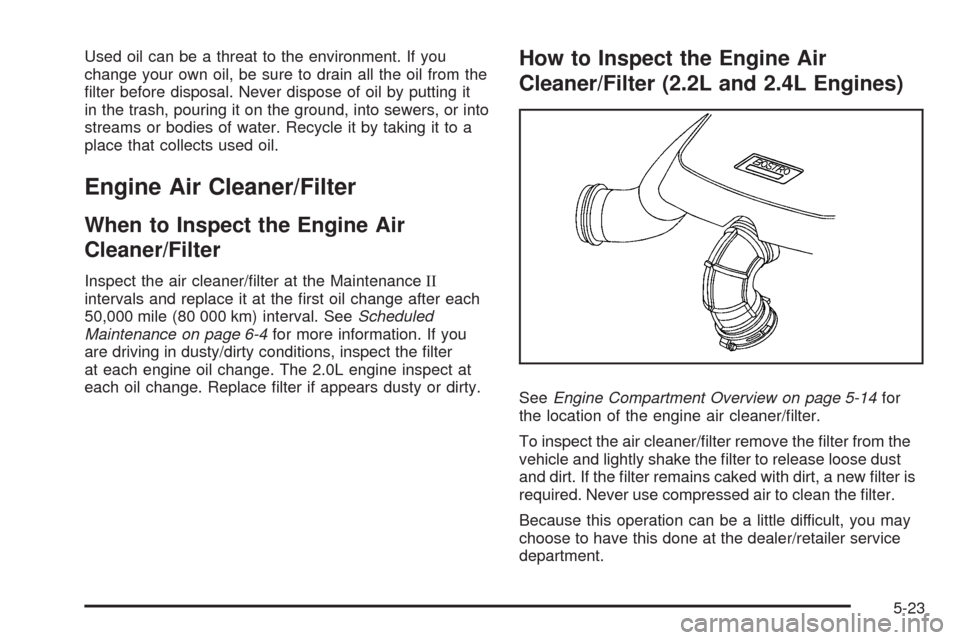
SeeEngine Compartment Overview on page 5-14for
the location of the engine air cleaner/lter.
To inspect the air cleaner/lter remove the lter from the
vehicle and lightly shake the lter to release loose dust
and dirt. If the lter remains caked with dirt, a new lter is
required. Never use compressed air to clean the lter.
Because this operation can be a little difficult, you may
choose to have this done at the dealer/retailer service
department.
5-23
Page 302 of 450
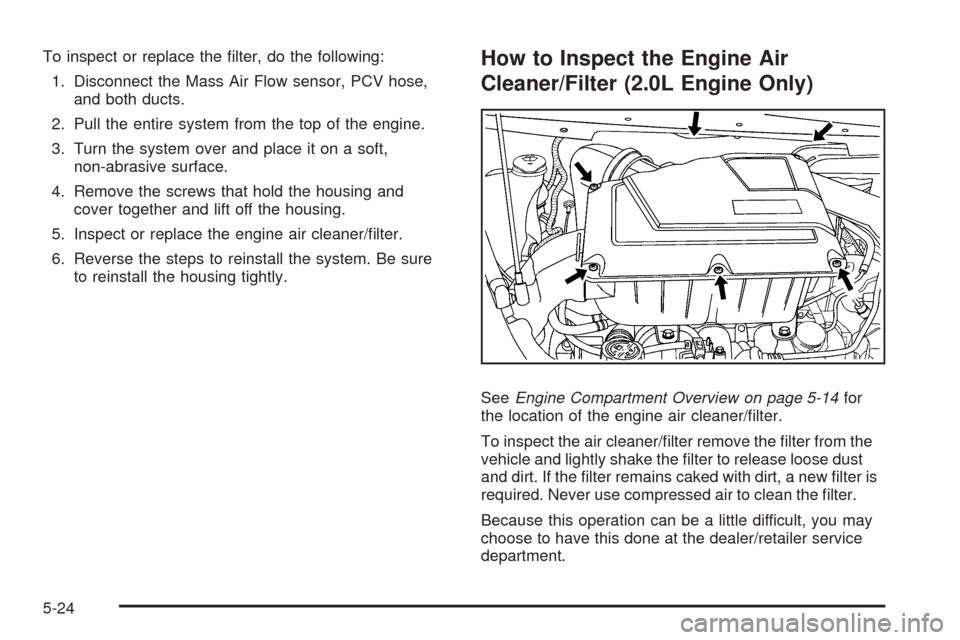
To inspect or replace the lter, do the following:
1. Disconnect the Mass Air Flow sensor, PCV hose,
and both ducts.
2. Pull the entire system from the top of the engine.
3. Turn the system over and place it on a soft,
non-abrasive surface.
4. Remove the screws that hold the housing and
cover together and lift off the housing.
5. Inspect or replace the engine air cleaner/lter.
6. Reverse the steps to reinstall the system. Be sure
to reinstall the housing tightly.How to Inspect the Engine Air
Cleaner/Filter (2.0L Engine Only)
SeeEngine Compartment Overview on page 5-14for
the location of the engine air cleaner/lter.
To inspect the air cleaner/lter remove the lter from the
vehicle and lightly shake the lter to release loose dust
and dirt. If the lter remains caked with dirt, a new lter is
required. Never use compressed air to clean the lter.
Because this operation can be a little difficult, you may
choose to have this done at the dealer/retailer service
department.
5-24
Page 310 of 450
8. By this time, the coolant level inside the radiator
ller port may be lower. If the level is lower, add
more of the proper DEX-COOL
®coolant mixture
through the ll port until the level reaches the base
of the ll port.
9. Then replace the pressure cap. At any time during
this procedure, if coolant begins to ow out of the
ll port, reinstall the pressure cap. Be sure the
pressure cap is hand-tight and fully seated.
10. When the engine has cooled, check the coolant in
the coolant recovery tank. The level in the coolant
recovery tank should be at the COLD FILL line
when the engine is cold.
Pressure Cap
Notice:If the pressure cap is not tightly installed,
coolant loss and possible engine damage may
occur. Be sure the cap is properly and tightly
secured.
SeeEngine Compartment Overview on page 5-14for
more information on location.
Engine Overheating
The vehicle has several indicators to warn of engine
overheating.
You will nd a coolant temperature warning light and a
coolant temperature gage on your vehicle’s instrument
panel. SeeEngine Coolant Temperature Warning
Light on page 3-36andEngine Coolant Temperature
Gage on page 3-36for more information.
You may decide not to lift the hood when this warning
appears, but instead get service help right away.
SeeRoadside Assistance Program on page 7-7.
If you do decide to lift the hood, make sure the vehicle
is parked on a level surface.
Then check to see if the engine cooling fans are
running. If the engine is overheating, both fans should
be running. If they are not, do not continue to run
the engine and have the vehicle serviced.
Notice:Engine damage from running the engine
without coolant is not covered by the warranty.
Notice:If the engine catches re because of being
driven with no coolant, your vehicle can be badly
damaged. The costly repairs would not be covered
by the vehicle warranty.
5-32