2009 CHEVROLET EXPRESS CARGO VAN coolant temperature
[x] Cancel search: coolant temperaturePage 270 of 408
What to Use
{CAUTION:
Adding only plain water to the cooling system can
be dangerous. Plain water, or some other liquid
such as alcohol, can boil before the proper coolant
mixture will. The vehicle’s coolant warning system
is set for the proper coolant mixture. With plain
water or the wrong mixture, the engine could get
too hot but you would not get the overheat
warning. The engine could catch fire and you or
others could be burned. Use a 50/50 mixture of
clean, drinkable water and DEX-COOL
®coolant.Use a 50/50 mixture of clean, drinkable water and
DEX-COOL
®coolant. If using this mixture, nothing else
needs to be added. This mixture:
•Gives freezing protection down to−34°F (−37°C),
outside temperature.
•Gives boiling protection up to 265°F (129°C),
engine temperature.
•Protects against rust and corrosion.
•Will not damage aluminum parts.
•Helps keep the proper engine temperature.
Notice:If an improper coolant mixture is used,
the engine could overheat and be badly damaged.
The repair cost would not be covered by the vehicle
warranty. Too much water in the mixture can freeze
and crack the engine, radiator, heater core, and other
parts.
Notice:If extra inhibitors and/or additives are used
in the vehicle’s cooling system, the vehicle could
be damaged. Use only the proper mixture of
the engine coolant listed in this manual for the
cooling system. SeeRecommended Fluids and
Lubricants on page 6-13for more information.
5-26
Page 275 of 408
Radiator Pressure Cap
The radiator pressure cap is located near the center of
the engine compartment. SeeEngine Compartment
Overview on page 5-14for more information on location.
Notice:If the pressure cap is not tightly installed,
coolant loss and possible engine damage may
occur. Be sure the cap is properly and tightly
secured.
Engine Overheating
If your vehicle has the DURAMAX Diesel engine, see
the DURAMAX Diesel manual for more information.
The vehicle has an indicator to warn of engine
overheating.
You will find an engine coolant temperature gage on
your vehicle’s instrument panel. SeeEngine Coolant
Temperature Gage on page 3-33for more information.You may decide not to lift the hood when this warning
appears, but instead get service help right away.
SeeRoadside Assistance Program on page 7-7.
If you do decide to lift the hood, make sure the vehicle
is parked on a level surface.
Then check to see if the engine cooling fans are
running. If the engine is overheating, both fans should
be running. If they are not, do not continue to run
the engine and have the vehicle serviced.
See if the engine cooling fan speed increases when idle
speed is doubled by pushing the accelerator pedal down.
If it does not, your vehicle needs service. Turn off the
engine.
Notice:Engine damage from running the engine
without coolant is not covered by the warranty.
Notice:If the engine catches re because of being
driven with no coolant, your vehicle can be badly
damaged. The costly repairs would not be covered
by the vehicle warranty.
5-31
Page 276 of 408
If Steam Is Coming From The Engine
Compartment
{CAUTION:
Steam from an overheated engine can burn you
badly, even if you just open the hood. Stay away
from the engine if you see or hear steam coming
from it. Just turn it off and get everyone away
from the vehicle until it cools down. Wait until
there is no sign of steam or coolant before you
open the hood.
If you keep driving when your engine is
overheated, the liquids in it can catch fire. You or
others could be badly burned. Stop your engine if
it overheats, and get out of the vehicle until the
engine is cool.
If No Steam Is Coming From The
Engine Compartment
If an engine overheat warning is displayed but no steam
can be seen or heard, the problem may not be too
serious. Sometimes the engine can get a little too hot
when the vehicle:
•Climbs a long hill on a hot day.
•Stops after high-speed driving.
•Idles for long periods in traffic.
•Tows a trailer. See “Driving on Grades” under
Towing a Trailer on page 4-27.
If the overheat warning is displayed with no sign of
steam:
1. Turn the air off.
2. Turn the heater on to the highest temperature and
to the highest fan speed. Open the windows as
necessary.
3. In heavy traffic, let the engine idle in N (Neutral)
while stopped. If it is safe to do so, pull off the
road, shift to P (Park) or N (Neutral) and let
the engine idle.
5-32
Page 279 of 408
Windshield Washer Fluid
What to Use
When you need windshield washer fluid, be sure to read
the manufacturer’s instructions before use. If you will be
operating your vehicle in an area where the temperature
may fall below freezing, use a fluid that has sufficient
protection against freezing.
Adding Washer Fluid
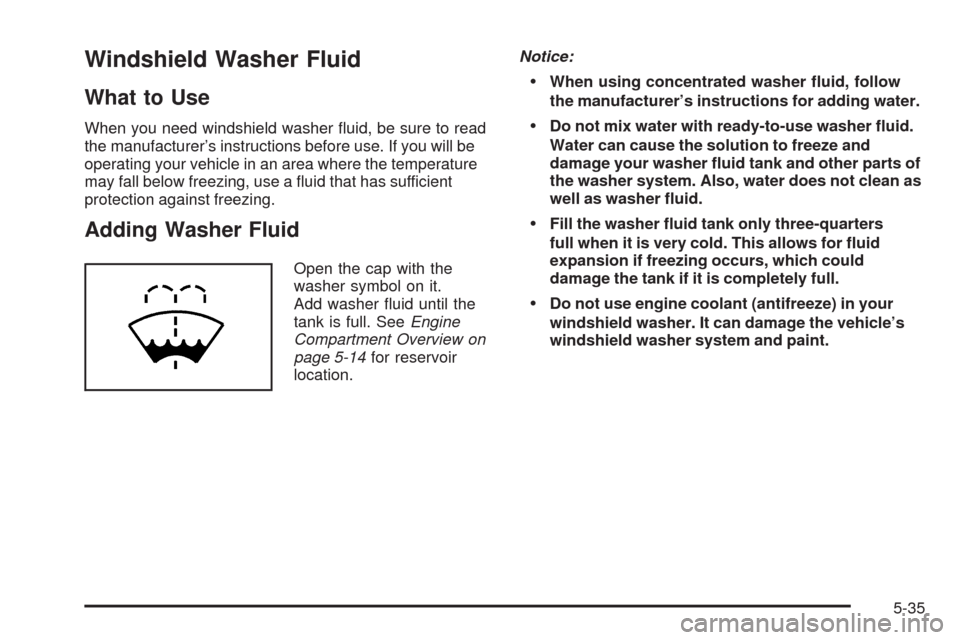
Open the cap with the
washer symbol on it.
Add washer fluid until the
tank is full. SeeEngine
Compartment Overview on
page 5-14for reservoir
location.Notice:
When using concentrated washer uid, follow
the manufacturer’s instructions for adding water.
Do not mix water with ready-to-use washer uid.
Water can cause the solution to freeze and
damage your washer uid tank and other parts of
the washer system. Also, water does not clean as
well as washer uid.
Fill the washer uid tank only three-quarters
full when it is very cold. This allows for uid
expansion if freezing occurs, which could
damage the tank if it is completely full.
Do not use engine coolant (antifreeze) in your
windshield washer. It can damage the vehicle’s
windshield washer system and paint.
5-35
Page 365 of 408
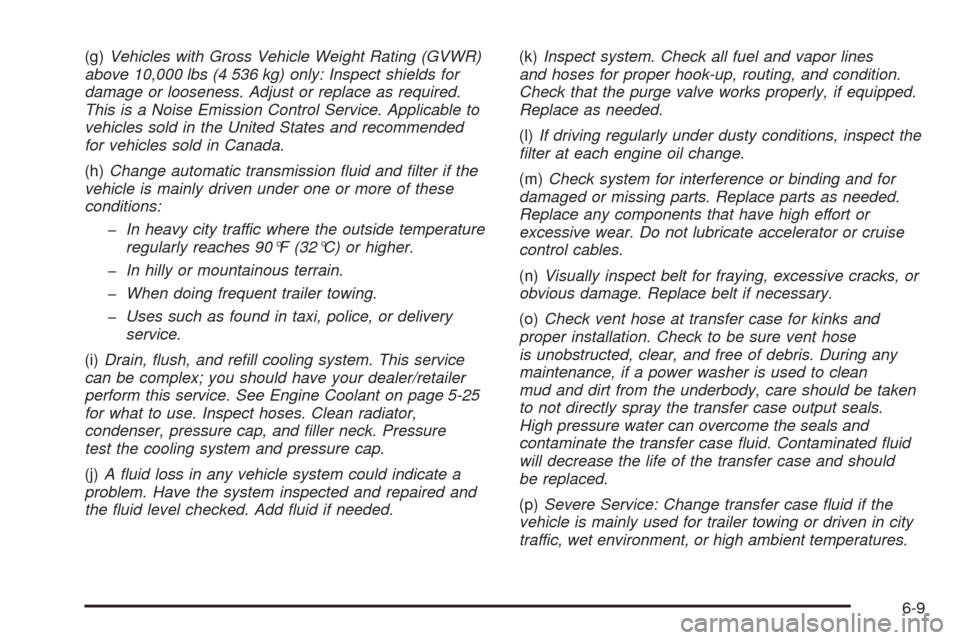
(g)Vehicles with Gross Vehicle Weight Rating (GVWR)
above 10,000 lbs (4 536 kg) only: Inspect shields for
damage or looseness. Adjust or replace as required.
This is a Noise Emission Control Service. Applicable to
vehicles sold in the United States and recommended
for vehicles sold in Canada.
(h)Change automatic transmission fluid and filter if the
vehicle is mainly driven under one or more of these
conditions:
-In heavy city traffic where the outside temperature
regularly reaches 90°F (32°C) or higher.
-In hilly or mountainous terrain.
-When doing frequent trailer towing.
-Uses such as found in taxi, police, or delivery
service.
(i)Drain, flush, and refill cooling system. This service
can be complex; you should have your dealer/retailer
perform this service. See Engine Coolant on page 5-25
for what to use. Inspect hoses. Clean radiator,
condenser, pressure cap, and filler neck. Pressure
test the cooling system and pressure cap.
(j)A fluid loss in any vehicle system could indicate a
problem. Have the system inspected and repaired and
the fluid level checked. Add fluid if needed.(k)Inspect system. Check all fuel and vapor lines
and hoses for proper hook-up, routing, and condition.
Check that the purge valve works properly, if equipped.
Replace as needed.
(l)If driving regularly under dusty conditions, inspect the
filter at each engine oil change.
(m)Check system for interference or binding and for
damaged or missing parts. Replace parts as needed.
Replace any components that have high effort or
excessive wear. Do not lubricate accelerator or cruise
control cables.
(n)Visually inspect belt for fraying, excessive cracks, or
obvious damage. Replace belt if necessary.
(o)Check vent hose at transfer case for kinks and
proper installation. Check to be sure vent hose
is unobstructed, clear, and free of debris. During any
maintenance, if a power washer is used to clean
mud and dirt from the underbody, care should be taken
to not directly spray the transfer case output seals.
High pressure water can overcome the seals and
contaminate the transfer case fluid. Contaminated fluid
will decrease the life of the transfer case and should
be replaced.
(p)Severe Service: Change transfer case fluid if the
vehicle is mainly used for trailer towing or driven in city
traffic, wet environment, or high ambient temperatures.
6-9
Page 399 of 408
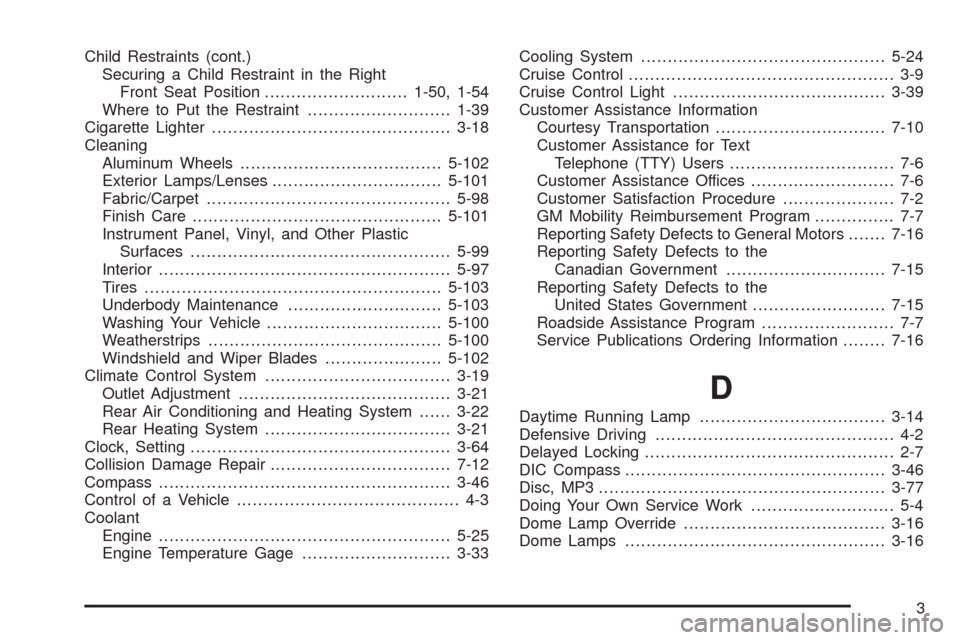
Child Restraints (cont.)
Securing a Child Restraint in the Right
Front Seat Position...........................1-50, 1-54
Where to Put the Restraint...........................1-39
Cigarette Lighter.............................................3-18
Cleaning
Aluminum Wheels......................................5-102
Exterior Lamps/Lenses................................5-101
Fabric/Carpet..............................................5-98
Finish Care...............................................5-101
Instrument Panel, Vinyl, and Other Plastic
Surfaces.................................................5-99
Interior.......................................................5-97
Tires........................................................5-103
Underbody Maintenance.............................5-103
Washing Your Vehicle.................................5-100
Weatherstrips............................................5-100
Windshield and Wiper Blades......................5-102
Climate Control System...................................3-19
Outlet Adjustment........................................3-21
Rear Air Conditioning and Heating System......3-22
Rear Heating System...................................3-21
Clock, Setting.................................................3-64
Collision Damage Repair..................................7-12
Compass.......................................................3-46
Control of a Vehicle.......................................... 4-3
Coolant
Engine.......................................................5-25
Engine Temperature Gage............................3-33Cooling System..............................................5-24
Cruise Control.................................................. 3-9
Cruise Control Light........................................3-39
Customer Assistance Information
Courtesy Transportation................................7-10
Customer Assistance for Text
Telephone (TTY) Users............................... 7-6
Customer Assistance Offices........................... 7-6
Customer Satisfaction Procedure..................... 7-2
GM Mobility Reimbursement Program............... 7-7
Reporting Safety Defects to General Motors.......7-16
Reporting Safety Defects to the
Canadian Government..............................7-15
Reporting Safety Defects to the
United States Government.........................7-15
Roadside Assistance Program......................... 7-7
Service Publications Ordering Information........7-16
D
Daytime Running Lamp...................................3-14
Defensive Driving............................................. 4-2
Delayed Locking............................................... 2-7
DIC Compass.................................................3-46
Disc, MP3......................................................3-77
Doing Your Own Service Work........................... 5-4
Dome Lamp Override......................................3-16
Dome Lamps .................................................3-16
3
Page 400 of 408
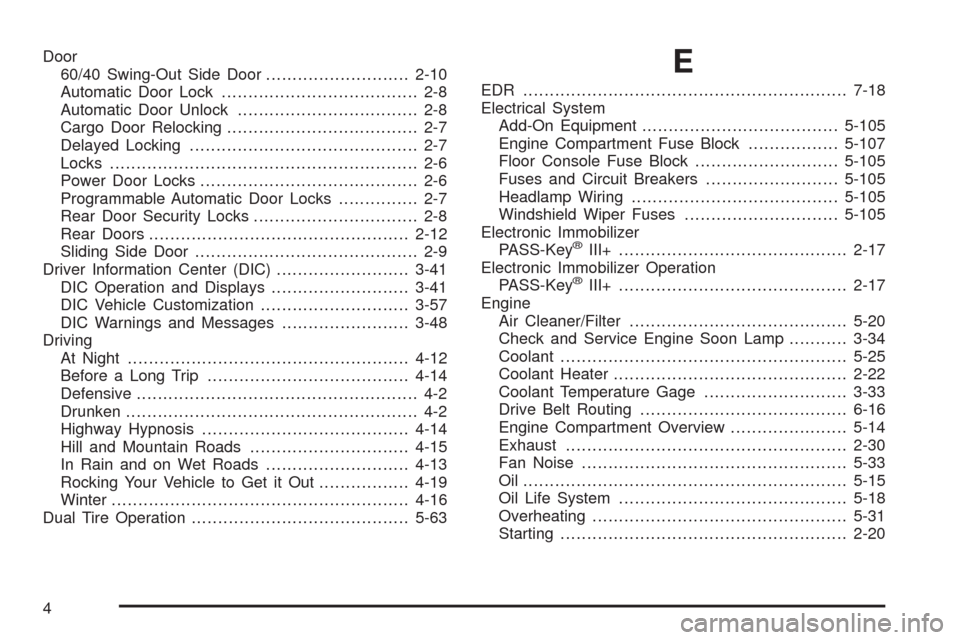
Door
60/40 Swing-Out Side Door...........................2-10
Automatic Door Lock..................................... 2-8
Automatic Door Unlock.................................. 2-8
Cargo Door Relocking.................................... 2-7
Delayed Locking........................................... 2-7
Locks.......................................................... 2-6
Power Door Locks......................................... 2-6
Programmable Automatic Door Locks............... 2-7
Rear Door Security Locks............................... 2-8
Rear Doors.................................................2-12
Sliding Side Door.......................................... 2-9
Driver Information Center (DIC).........................3-41
DIC Operation and Displays..........................3-41
DIC Vehicle Customization............................3-57
DIC Warnings and Messages........................3-48
Driving
At Night.....................................................4-12
Before a Long Trip......................................4-14
Defensive..................................................... 4-2
Drunken....................................................... 4-2
Highway Hypnosis.......................................4-14
Hill and Mountain Roads..............................4-15
In Rain and on Wet Roads...........................4-13
Rocking Your Vehicle to Get it Out.................4-19
Winter........................................................4-16
Dual Tire Operation.........................................5-63E
EDR .............................................................7-18
Electrical System
Add-On Equipment.....................................5-105
Engine Compartment Fuse Block.................5-107
Floor Console Fuse Block...........................5-105
Fuses and Circuit Breakers.........................5-105
Headlamp Wiring.......................................5-105
Windshield Wiper Fuses.............................5-105
Electronic Immobilizer
PASS-Key
®III+...........................................2-17
Electronic Immobilizer Operation
PASS-Key
®III+...........................................2-17
Engine
Air Cleaner/Filter.........................................5-20
Check and Service Engine Soon Lamp...........3-34
Coolant......................................................5-25
Coolant Heater............................................2-22
Coolant Temperature Gage...........................3-33
Drive Belt Routing.......................................6-16
Engine Compartment Overview......................5-14
Exhaust.....................................................2-30
Fan Noise..................................................5-33
Oil .............................................................5-15
Oil Life System...........................................5-18
Overheating................................................5-31
Starting......................................................2-20
4
Page 401 of 408
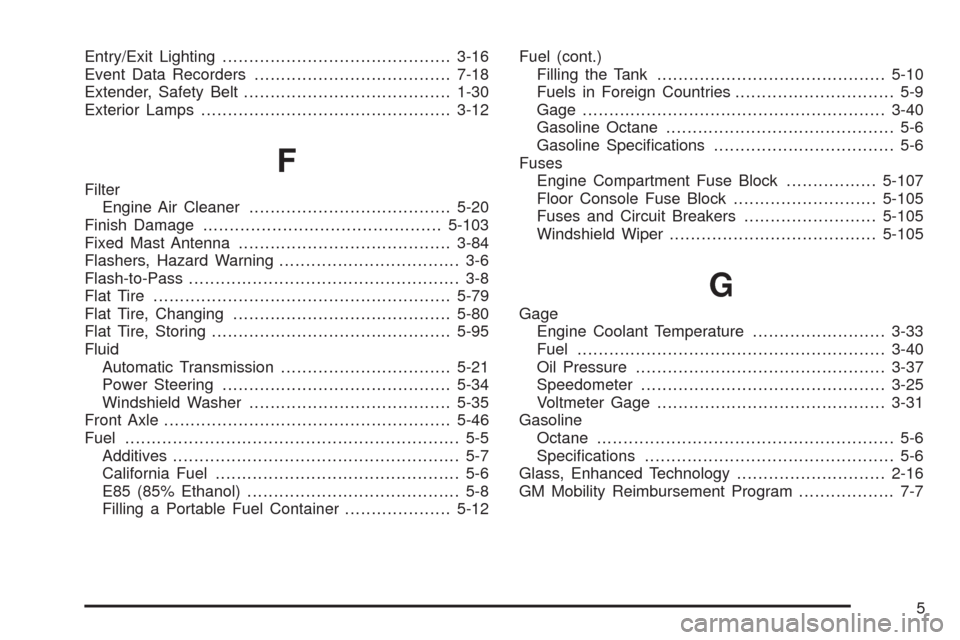
Entry/Exit Lighting...........................................3-16
Event Data Recorders.....................................7-18
Extender, Safety Belt.......................................1-30
Exterior Lamps...............................................3-12
F
Filter
Engine Air Cleaner......................................5-20
Finish Damage.............................................5-103
Fixed Mast Antenna........................................3-84
Flashers, Hazard Warning.................................. 3-6
Flash-to-Pass................................................... 3-8
Flat Tire........................................................5-79
Flat Tire, Changing.........................................5-80
Flat Tire, Storing.............................................5-95
Fluid
Automatic Transmission................................5-21
Power Steering...........................................5-34
Windshield Washer......................................5-35
Front Axle......................................................5-46
Fuel............................................................... 5-5
Additives...................................................... 5-7
California Fuel.............................................. 5-6
E85 (85% Ethanol)........................................ 5-8
Filling a Portable Fuel Container....................5-12Fuel (cont.)
Filling the Tank...........................................5-10
Fuels in Foreign Countries.............................. 5-9
Gage .........................................................3-40
Gasoline Octane........................................... 5-6
Gasoline Specifications.................................. 5-6
Fuses
Engine Compartment Fuse Block.................5-107
Floor Console Fuse Block...........................5-105
Fuses and Circuit Breakers.........................5-105
Windshield Wiper.......................................5-105
G
Gage
Engine Coolant Temperature.........................3-33
Fuel..........................................................3-40
Oil Pressure...............................................3-37
Speedometer..............................................3-25
Voltmeter Gage...........................................3-31
Gasoline
Octane........................................................ 5-6
Specifications............................................... 5-6
Glass, Enhanced Technology............................2-16
GM Mobility Reimbursement Program.................. 7-7
5