2009 CHEVROLET EQUINOX ECU
[x] Cancel search: ECUPage 99 of 442
To program the new additional key:
1. Verify that the new key has a
1stamped on it.
2. Insert the original, already programmed, key in the
ignition and start the engine. If the engine will not
start, see your dealer/retailer for service.
3. After the engine has started, turn the key to
LOCK/OFF, and remove the key.
4. Insert the new key to be programmed and turn it to
the ON/RUN position within ve seconds of
removing the original key.
The security light will turn off once the key has
been programmed.
5. Repeat Steps 1 through 4 if additional keys are to
be programmed.
If you lose or damage your PASS-Key
®III+ key, see
your dealer/retailer or a locksmith who can service
PASS-Key
®III+ to have a new key made.
Do not leave the key or device that disarms or
deactivates the theft deterrent system in the vehicle.
Starting and Operating Your
Vehicle
New Vehicle Break-In
Notice:The vehicle does not need an elaborate
break-in. But it will perform better in the long run if
you follow these guidelines:
Do not drive at any one constant speed, fast or
slow, for the rst 500 miles (805 km). Do not
make full-throttle starts. Avoid downshifting to
brake or slow the vehicle.
Avoid making hard stops for the rst 200 miles
(322 km) or so. During this time the new brake
linings are not yet broken in. Hard stops with
new linings can mean premature wear and
earlier replacement. Follow this breaking-in
guideline every time you get new brake linings.
Do not tow a trailer during break-in. SeeTowing
a Trailer on page 4-32for the trailer towing
capabilities of your vehicle and more
information.
Following break-in, engine speed and load can be
gradually increased.
2-19
Page 117 of 442
Outside Convex Mirrors
{CAUTION:
A convex mirror can make things (like other
vehicles) look farther away than they really are.
If you cut too sharply into the right lane, you could
hit a vehicle on the right. Check the inside mirror
or glance over your shoulder before changing
lanes.
The passenger side mirror is convex shaped. A convex
mirror’s surface is curved so more can be seen from
the driver’s seat.
OnStar®System
OnStar uses several innovative technologies and live
advisors to provide a wide range of safety, security,
information, and convenience services. If the airbags
deploy, the system is designed to make an automatic
call to OnStar Emergency advisors who can request
emergency services be sent to your location. If the keys
are locked in the vehicle, call OnStar at 1-888-4-ONSTAR
to have a signal sent to unlock the doors. OnStar
Hands-Free Calling, including 30 trial minutes good
for 60 days, is available on most vehicles. OnStar
Turn-by-Turn Navigation service, with one trial route, is
available on most vehicles. Press the OnStar button to
have an OnStar advisor contact Roadside Service.
2-37
Page 123 of 442
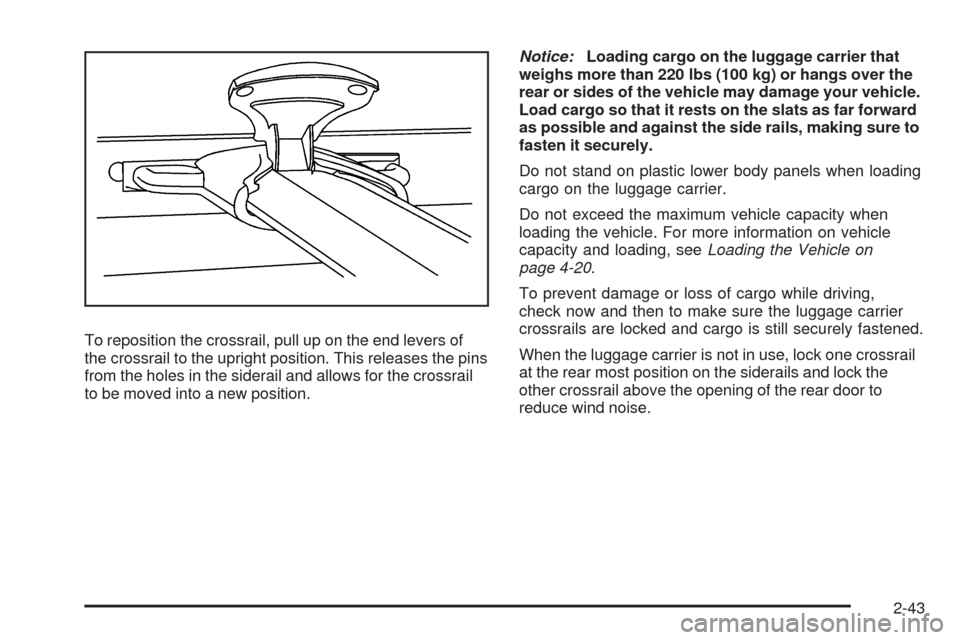
To reposition the crossrail, pull up on the end levers of
the crossrail to the upright position. This releases the pins
from the holes in the siderail and allows for the crossrail
to be moved into a new position.Notice:Loading cargo on the luggage carrier that
weighs more than 220 lbs (100 kg) or hangs over the
rear or sides of the vehicle may damage your vehicle.
Load cargo so that it rests on the slats as far forward
as possible and against the side rails, making sure to
fasten it securely.
Do not stand on plastic lower body panels when loading
cargo on the luggage carrier.
Do not exceed the maximum vehicle capacity when
loading the vehicle. For more information on vehicle
capacity and loading, seeLoading the Vehicle on
page 4-20.
To prevent damage or loss of cargo while driving,
check now and then to make sure the luggage carrier
crossrails are locked and cargo is still securely fastened.
When the luggage carrier is not in use, lock one crossrail
at the rear most position on the siderails and lock the
other crossrail above the opening of the rear door to
reduce wind noise.
2-43
Page 125 of 442
{CAUTION:
If you were to carry things on the adjustable panel
when it is in the upper (cargo cover) or center
positions, during a sudden vehicle movement or a
crash, those things could be thrown around in the
vehicle. You or others could be injured. When it is
in the upper or center position, always secure any
cargo on the oor beneath the panel/cover.
To use the panel in the center position, do the following:
1. Insert the front corners of the panel into the
middle guides.
2. Slide the panel forward.
3. Press down and pull rearward on the back of the
panel to lock it in place.The panel can be used in this position when a at or
spare tire has to be placed in the rear cargo area.
To use the panel in the upper position, do the following:
1. Insert the front corners of the panel into the top
guides.
2. Slide the panel forward.
3. Press down and pull rearward on the back of the
panel to lock it in place.
This can be used as a cargo cover for the rear area.
The panel may be installed either carpet or plastic
side up. The panel may also be used as a table in this
position. SeeTable on page 2-46for more information.
2-45
Page 126 of 442
Rear Seat Armrest
Vehicles with a rear seat armrest, have two cupholders.
Pull the armrest down from the rear seatback to access
the cupholders.
Table
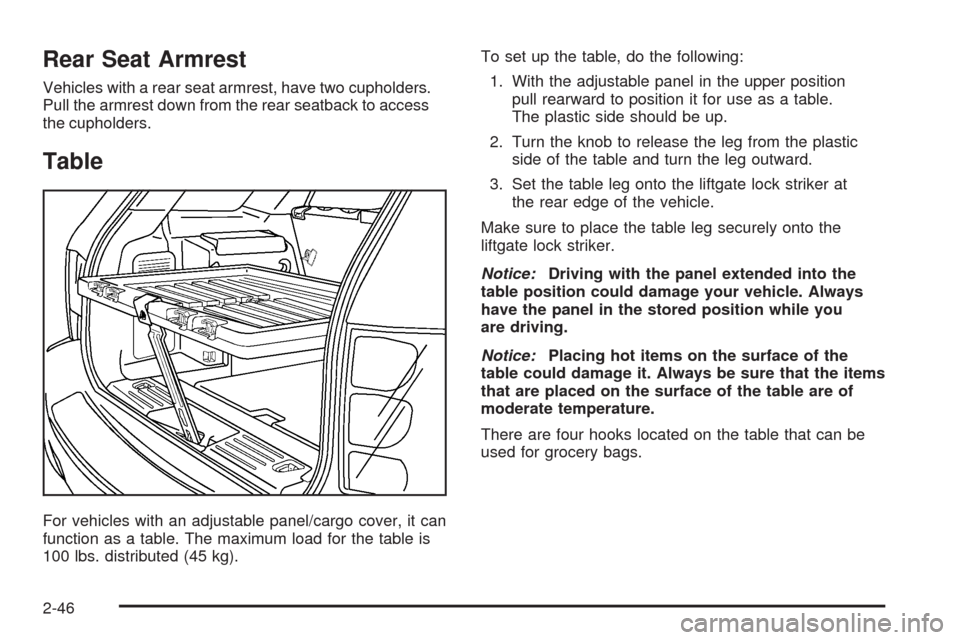
For vehicles with an adjustable panel/cargo cover, it can
function as a table. The maximum load for the table is
100 lbs. distributed (45 kg).To set up the table, do the following:
1. With the adjustable panel in the upper position
pull rearward to position it for use as a table.
The plastic side should be up.
2. Turn the knob to release the leg from the plastic
side of the table and turn the leg outward.
3. Set the table leg onto the liftgate lock striker at
the rear edge of the vehicle.
Make sure to place the table leg securely onto the
liftgate lock striker.
Notice:Driving with the panel extended into the
table position could damage your vehicle. Always
have the panel in the stored position while you
are driving.
Notice:Placing hot items on the surface of the
table could damage it. Always be sure that the items
that are placed on the surface of the table are of
moderate temperature.
There are four hooks located on the table that can be
used for grocery bags.
2-46
Page 127 of 442
Convenience Net
Use the convenience net, located in the rear, to store
small loads as far forward as possible. The net should
not be used to store heavy loads.
Cargo Tie Downs
Four cargo tie-downs are located in the rear
compartment of the vehicle. The tie-downs can
be used to secure small loads.
Sunroof
If the vehicle is equipped with a sunroof, the controls
to operate it are located on the headliner above the
rearview mirror. The ignition must be in RUN/ON or
ACC/ACCESSORY, or Retained Accessory Power (RAP)
must be active, to operate the sunroof. SeeRetained
Accessory Power (RAP) on page 2-21for more
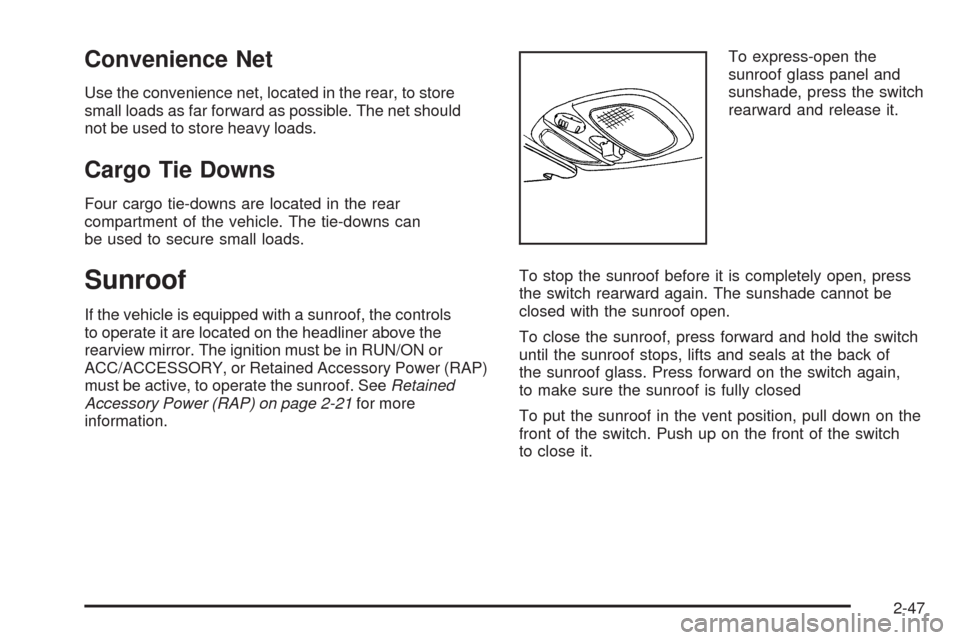
information.To express-open the
sunroof glass panel and
sunshade, press the switch
rearward and release it.
To stop the sunroof before it is completely open, press
the switch rearward again. The sunshade cannot be
closed with the sunroof open.
To close the sunroof, press forward and hold the switch
until the sunroof stops, lifts and seals at the back of
the sunroof glass. Press forward on the switch again,
to make sure the sunroof is fully closed
To put the sunroof in the vent position, pull down on the
front of the switch. Push up on the front of the switch
to close it.
2-47
Page 129 of 442
Instrument Panel Overview...............................3-4
Hazard Warning Flashers................................3-6
Horn .............................................................3-6
Tilt Wheel.....................................................3-6
Turn Signal/Multifunction Lever.........................3-7
Turn and Lane-Change Signals........................3-7
Headlamp High/Low-Beam Changer..................3-8
Flash-to-Pass.................................................3-8
Windshield Wipers..........................................3-8
Windshield Washer.........................................3-9
Rear Window Wiper/Washer.............................3-9
Cruise Control..............................................3-10
Headlamps..................................................3-13
Headlamps on Reminder................................3-13
Daytime Running Lamps (DRL).......................3-13
Automatic Headlamp System..........................3-14
Fog Lamps ..................................................3-14
Instrument Panel Brightness...........................3-14
Dome Lamp .................................................3-15
Entry Lighting...............................................3-15
Map Lamps .................................................3-15
Cargo Lamp.................................................3-15
Electric Power Management...........................3-16
Battery Run-Down Protection..........................3-16
Accessory Power Outlet(s).............................3-17
Ashtray(s) and Cigarette Lighter......................3-17Climate Controls............................................3-18
Climate Control System.................................3-18
Outlet Adjustment.........................................3-21
Passenger Compartment Air Filter...................3-22
Warning Lights, Gages, and Indicators............3-23
Instrument Panel Cluster................................3-24
Speedometer and Odometer...........................3-25
Trip Odometer..............................................3-25
Tachometer.................................................3-25
Safety Belt Reminders...................................3-26
Airbag Readiness Light..................................3-27
Passenger Airbag Status Indicator...................3-28
Charging System Light..................................3-29
Brake System Warning Light..........................3-29
Antilock Brake System (ABS) Warning Light.....3-30
Traction Control System (TCS) Warning Light......3-31
Engine Coolant Temperature Warning Light......3-31
Engine Coolant Temperature Gage..................3-32
Tire Pressure Light.......................................3-32
Malfunction Indicator Lamp.............................3-33
Oil Pressure Light.........................................3-36
Change Engine Oil Light................................3-36
Security Light...............................................3-37
Fog Lamp Light............................................3-37
Cruise Control Light......................................3-37
Reduced Engine Power Light.........................3-38
Section 3 Instrument Panel
3-1
Page 165 of 442
A CHANGE OIL SOON message will appear on the
DIC. For more information seeDIC Warnings and
Messages on page 3-49.
After having the oil changed you will need to reset the
light. SeeEngine Oil on page 5-15, andScheduled
Maintenance on page 6-4for more information.
Security Light
For information regarding
this light and the vehicle’s
security system, see
Content Theft-Deterrent
on page 2-17, and
PASS-Key
®III+ Electronic
Immobilizer Operation
on page 2-18.
Fog Lamp Light
The fog lamp light comes
on when the fog lamps
are in use.
The light goes out when the fog lamps are turned off.
SeeFog Lamps on page 3-14for more information.
Cruise Control Light
The cruise control light
comes on whenever the
cruise control is set.
The light goes out when the cruise control is turned off.
SeeCruise Control on page 3-10for more information.
3-37