2009 CHEVROLET EQUINOX ignition
[x] Cancel search: ignitionPage 143 of 442
Dome Lamp
For vehicles with a dome lamp, move the lever to
change the setting.
9(Off):Turns the lamp off, even when a door is open.
1(Door):The lamp comes on automatically when a
door is opened.
+(On):Turns the dome lamp on.
Entry Lighting
The dome lamp and the cargo lamp inside the vehicle
comes on when any door is opened, if the dome lamp is
in the door position. In addition, these lamps come on
when the Remote Keyless Entry (RKE) unlock button
is pressed. It stays on for 20 seconds or until a door
is opened. After the door is opened and then closed, the
light remains on for 20 seconds, or until the key is put
in the ignition and turned to the ON/RUN position.
Map Lamps
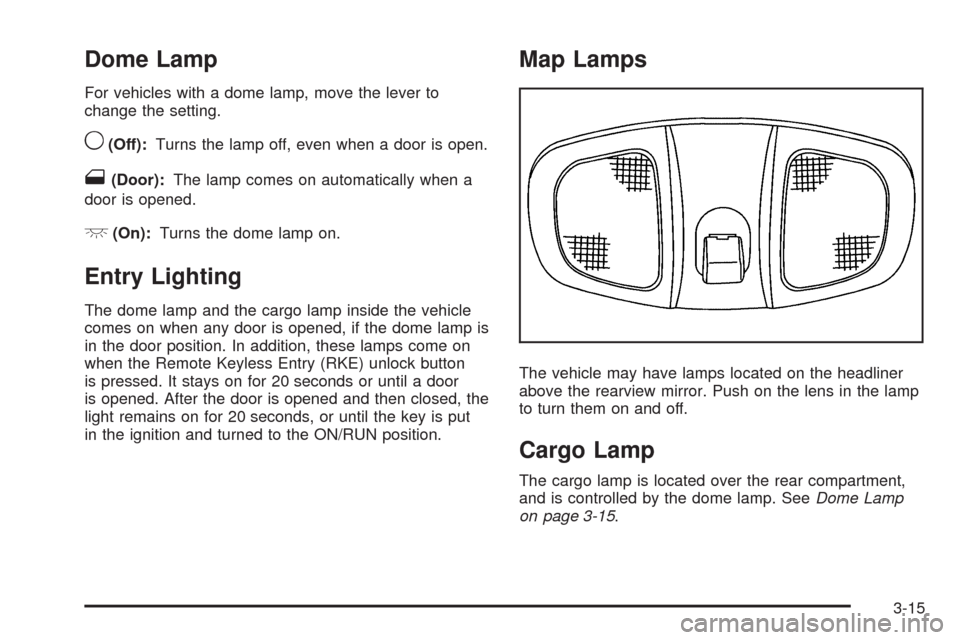
The vehicle may have lamps located on the headliner
above the rearview mirror. Push on the lens in the lamp
to turn them on and off.
Cargo Lamp
The cargo lamp is located over the rear compartment,
and is controlled by the dome lamp. SeeDome Lamp
on page 3-15.
3-15
Page 144 of 442
Electric Power Management
The vehicle has Electric Power Management (EPM) that
estimates the battery’s temperature and state of charge.
It then adjusts the voltage for best performance and
extended life of the battery.
When the battery’s state of charge is low, the voltage is
raised slightly to quickly bring the charge back up.
When the state of charge is high, the voltage is lowered
slightly to prevent overcharging. If the vehicle has a
voltmeter gage or a voltage display on the Driver
Information Center (DIC), you may see the voltage
move up or down. This is normal. If there is a problem,
an alert will be displayed.
The battery can be discharged at idle if the electrical
loads are very high. This is true for all vehicles.
This is because the generator (alternator) may not be
spinning fast enough at idle to produce all the power that
is needed for very high electrical loads.
A high electrical load occurs when several of the
following are on, such as: headlamps, high beams,
fog lamps, rear window defogger, climate control fan at
high speed, heated seats, engine cooling fans, trailer
loads, and loads plugged into accessory power outlets.
EPM works to prevent excessive discharge of the
battery. It does this by balancing the generator’s output
and the vehicle’s electrical needs. It can increaseengine idle speed to generate more power, whenever
needed. It can temporarily reduce the power demands of
some accessories.
Normally, these actions occur in steps or levels, without
being noticeable. In rare cases at the highest levels
of corrective action, this action may be noticeable to
the driver. If so, a Driver Information Center (DIC)
message might be displayed, such as BATTERY
SAVER ACTIVE, BATTERY VOLTAGE LOW, or
LOW BATTERY. If this message is displayed, it is
recommended that the driver reduce the electrical loads
as much as possible. SeeDIC Warnings and Messages
on page 3-49.
Battery Run-Down Protection
The vehicle has a battery saver feature designed to
protect the vehicle’s battery.
When any interior lamp is left on and the ignition is
turned off, the battery rundown protection system will
automatically turn the lamp off after 20 minutes. This will
avoid draining the battery. This vehicle also has a
retained accessory power feature. If the radio is on,
it will turn off after 10 minutes or if any door on
the vehicle is opened. SeeRetained Accessory Power
(RAP) on page 2-21.
3-16
Page 146 of 442
Climate Controls
Climate Control System
The heating, cooling, and ventilation for the vehicle can
be controlled with this system. For vehicles with the
remote start feature, the climate control system functions
as part of the remote start feature. SeeRemote
Keyless Entry (RKE) System Operation on page 2-5.
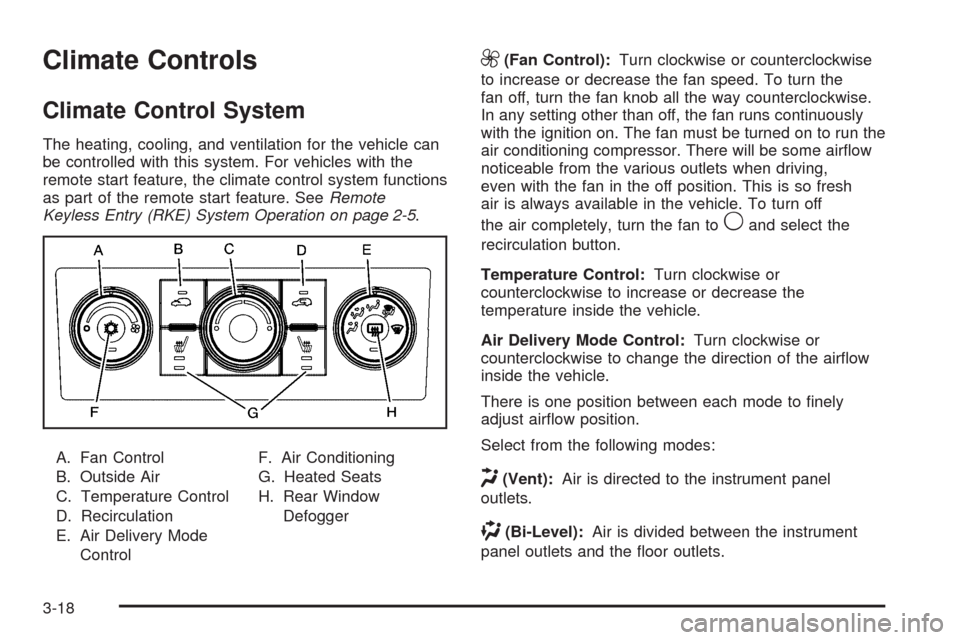
A. Fan Control
B. Outside Air
C. Temperature Control
D. Recirculation
E. Air Delivery Mode
ControlF. Air Conditioning
G. Heated Seats
H. Rear Window
Defogger
9(Fan Control):Turn clockwise or counterclockwise
to increase or decrease the fan speed. To turn the
fan off, turn the fan knob all the way counterclockwise.
In any setting other than off, the fan runs continuously
with the ignition on. The fan must be turned on to run the
air conditioning compressor. There will be some airow
noticeable from the various outlets when driving,
even with the fan in the off position. This is so fresh
air is always available in the vehicle. To turn off
the air completely, turn the fan to
9and select the
recirculation button.
Temperature Control:Turn clockwise or
counterclockwise to increase or decrease the
temperature inside the vehicle.
Air Delivery Mode Control:Turn clockwise or
counterclockwise to change the direction of the airow
inside the vehicle.
There is one position between each mode to nely
adjust airow position.
Select from the following modes:
H(Vent):Air is directed to the instrument panel
outlets.
)(Bi-Level):Air is divided between the instrument
panel outlets and the oor outlets.
3-18
Page 148 of 442
Using these settings together for long periods of time
may cause the air inside of the vehicle to become
too dry. To prevent this from happening, after the air
inside of the vehicle has cooled, turn the recirculation
mode off.
The air conditioning system removes moisture from the
air, so a small amount of water might drip under the
vehicle while idling or after turning off the engine.
;(Outside Air):Press to turn the outside air mode
on. An indicator light comes on to show that outside
air is on. Air from outside the vehicle will circulate
throughout the vehicle. The outside air mode can be
used with all modes, but it cannot be used with
the recirculation mode. Pressing
;will cancel the
recirculation mode.
@(Recirculation):Press to turn the recirculation
mode on. An indicator light comes on to show
recirculation is on. The air inside the vehicle will be
recirculated through the climate control system and the
vehicle, not from outside the vehicle. It can be used
to prevent outside air and odors from entering the
vehicle or to help cool the air inside the vehicle more
quickly. Avoid using the recirculation mode during highperiods of humidity and cool outside temperatures since
this may result in increased window fogging. If window
fogging is experienced, select the defrost mode.
Recirculation mode is not available in oor, defog or
defrost modes and will shut off automatically and change
to outside air. If the button is selected in these modes,
the indicator will ash. This helps prevent window
fogging and moisture building up within the cabin.
Rear Window Defogger
The rear window defogger uses a warming grid to
remove fog from the rear window.
The rear window defogger only works when the ignition
is in ON/RUN.
<(Rear Window Defogger):Press to turn the rear
window defogger on or off. An indicator light comes
on to show that the rear window defogger is on.
The rear window defogger stays on for about 10 minutes
if the vehicle remains at slower vehicle speeds, or
until the button is pressed or the ignition is turned to
ACC/ACCESSORY or LOCK/OFF. If turned on again,
the defogger only runs for about ve minutes before
turning off again. At higher vehicle speeds, the defogger
may stay on continuously. The defogger can also be
turned off by turning off the engine.
3-20
Page 157 of 442
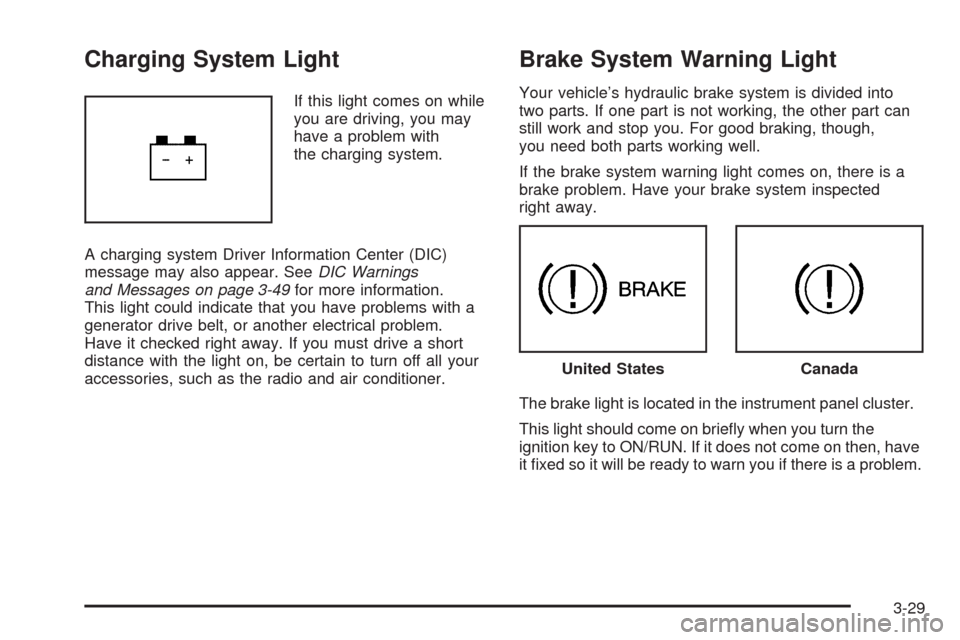
Charging System Light
If this light comes on while
you are driving, you may
have a problem with
the charging system.
A charging system Driver Information Center (DIC)
message may also appear. SeeDIC Warnings
and Messages on page 3-49for more information.
This light could indicate that you have problems with a
generator drive belt, or another electrical problem.
Have it checked right away. If you must drive a short
distance with the light on, be certain to turn off all your
accessories, such as the radio and air conditioner.
Brake System Warning Light
Your vehicle’s hydraulic brake system is divided into
two parts. If one part is not working, the other part can
still work and stop you. For good braking, though,
you need both parts working well.
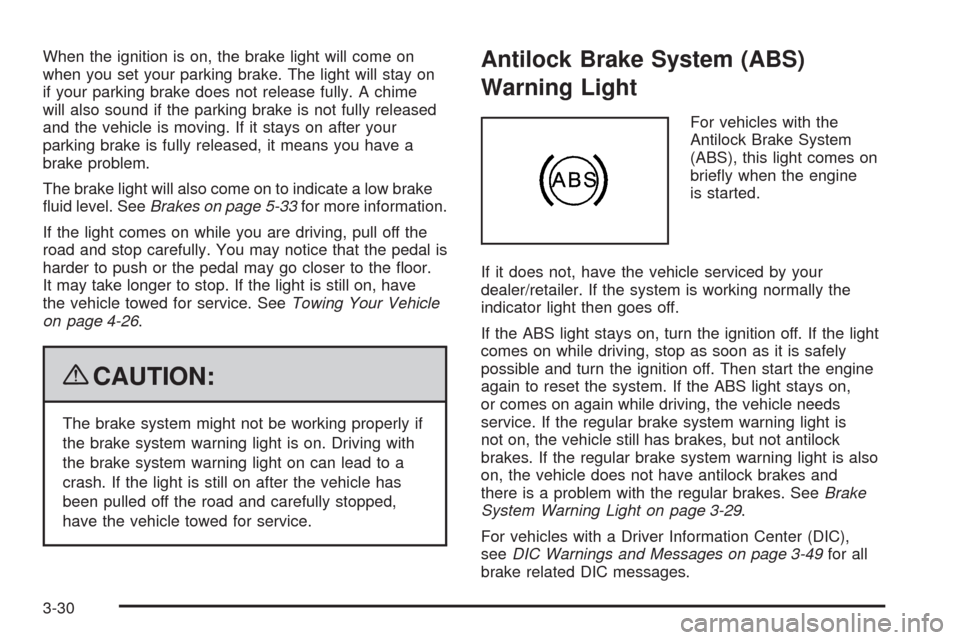
If the brake system warning light comes on, there is a
brake problem. Have your brake system inspected
right away.
The brake light is located in the instrument panel cluster.
This light should come on briey when you turn the
ignition key to ON/RUN. If it does not come on then, have
it xed so it will be ready to warn you if there is a problem.
United StatesCanada
3-29
Page 158 of 442
When the ignition is on, the brake light will come on
when you set your parking brake. The light will stay on
if your parking brake does not release fully. A chime
will also sound if the parking brake is not fully released
and the vehicle is moving. If it stays on after your
parking brake is fully released, it means you have a
brake problem.
The brake light will also come on to indicate a low brake
uid level. SeeBrakes on page 5-33for more information.
If the light comes on while you are driving, pull off the
road and stop carefully. You may notice that the pedal is
harder to push or the pedal may go closer to the oor.
It may take longer to stop. If the light is still on, have
the vehicle towed for service. SeeTowing Your Vehicle
on page 4-26.
{CAUTION:
The brake system might not be working properly if
the brake system warning light is on. Driving with
the brake system warning light on can lead to a
crash. If the light is still on after the vehicle has
been pulled off the road and carefully stopped,
have the vehicle towed for service.
Antilock Brake System (ABS)
Warning Light
For vehicles with the
Antilock Brake System
(ABS), this light comes on
briey when the engine
is started.
If it does not, have the vehicle serviced by your
dealer/retailer. If the system is working normally the
indicator light then goes off.
If the ABS light stays on, turn the ignition off. If the light
comes on while driving, stop as soon as it is safely
possible and turn the ignition off. Then start the engine
again to reset the system. If the ABS light stays on,
or comes on again while driving, the vehicle needs
service. If the regular brake system warning light is
not on, the vehicle still has brakes, but not antilock
brakes. If the regular brake system warning light is also
on, the vehicle does not have antilock brakes and
there is a problem with the regular brakes. SeeBrake
System Warning Light on page 3-29.
For vehicles with a Driver Information Center (DIC),
seeDIC Warnings and Messages on page 3-49for all
brake related DIC messages.
3-30
Page 160 of 442
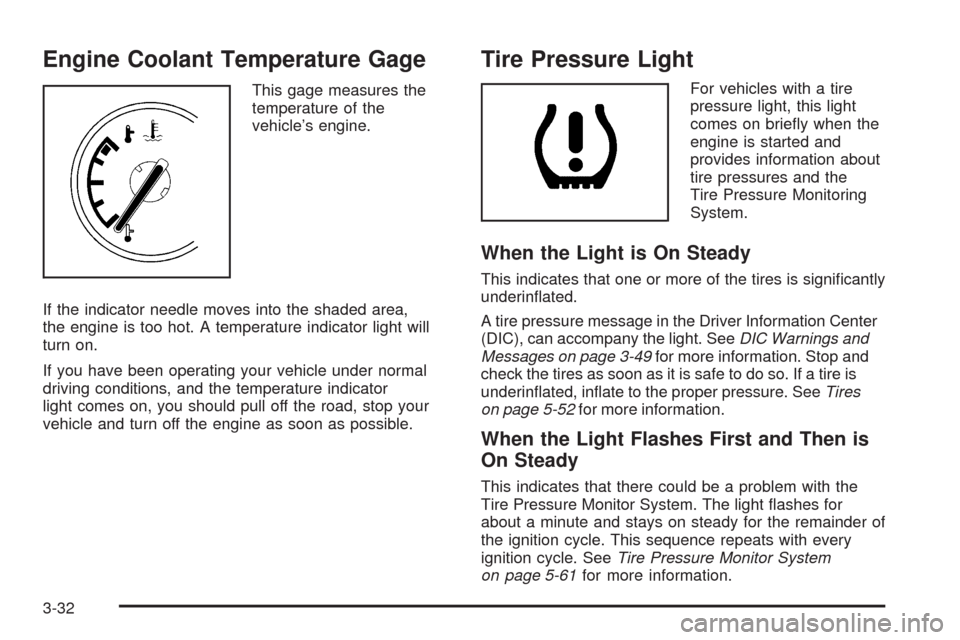
Engine Coolant Temperature Gage
This gage measures the
temperature of the
vehicle’s engine.
If the indicator needle moves into the shaded area,
the engine is too hot. A temperature indicator light will
turn on.
If you have been operating your vehicle under normal
driving conditions, and the temperature indicator
light comes on, you should pull off the road, stop your
vehicle and turn off the engine as soon as possible.
Tire Pressure Light
For vehicles with a tire
pressure light, this light
comes on briey when the
engine is started and
provides information about
tire pressures and the
Tire Pressure Monitoring
System.
When the Light is On Steady
This indicates that one or more of the tires is signicantly
underinated.
A tire pressure message in the Driver Information Center
(DIC), can accompany the light. SeeDIC Warnings and
Messages on page 3-49for more information. Stop and
check the tires as soon as it is safe to do so. If a tire is
underinated, inate to the proper pressure. SeeTires
on page 5-52for more information.
When the Light Flashes First and Then is
On Steady
This indicates that there could be a problem with the
Tire Pressure Monitor System. The light ashes for
about a minute and stays on steady for the remainder of
the ignition cycle. This sequence repeats with every
ignition cycle. SeeTire Pressure Monitor System
on page 5-61for more information.
3-32
Page 161 of 442

Malfunction Indicator Lamp
Check Engine Light
A computer system called OBD II (On-Board
Diagnostics-Second Generation) monitors operation
of the fuel, ignition, and emission control systems.
It ensures that emissions are at acceptable levels for
the life of the vehicle, helping to produce a cleaner
environment.
This light should come on
when the ignition is on, but
the engine is not running,
as a check to show it
is working. If it does not,
have the vehicle serviced
by your dealer/retailer.
If the check engine light comes on and stays on, while
the engine is running, this indicates that there is an
OBD II problem and service is required.Malfunctions often are indicated by the system before
any problem is apparent. Being aware of the light
can prevent more serious damage to the vehicle.
This system assists the service technician in correctly
diagnosing any malfunction.
Notice:If the vehicle is continually driven with this
light on, after a while, the emission controls might
not work as well, the vehicle’s fuel economy might
not be as good, and the engine might not run as
smoothly. This could lead to costly repairs that
might not be covered by the vehicle warranty.
Notice:Modications made to the engine,
transmission, exhaust, intake, or fuel system of the
vehicle or the replacement of the original tires with
other than those of the same Tire Performance
Criteria (TPC) can affect the vehicle’s emission
controls and can cause this light to come on.
Modications to these systems could lead to
costly repairs not covered by the vehicle warranty.
This could also result in a failure to pass a required
Emission Inspection/Maintenance test. See
Accessories and Modifications on page 5-3.
3-33