2009 CHEVROLET COLORADO engine
[x] Cancel search: enginePage 236 of 420
Four-Wheel Drive Vehicles
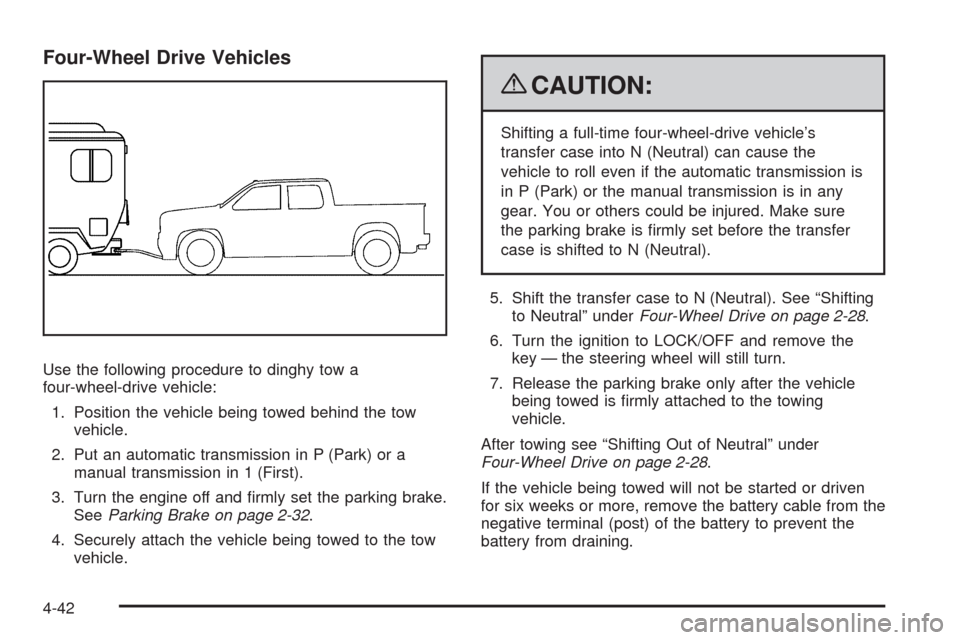
Use the following procedure to dinghy tow a
four-wheel-drive vehicle:
1. Position the vehicle being towed behind the tow
vehicle.
2. Put an automatic transmission in P (Park) or a
manual transmission in 1 (First).
3. Turn the engine off and rmly set the parking brake.
SeeParking Brake on page 2-32.
4. Securely attach the vehicle being towed to the tow
vehicle.
{CAUTION:
Shifting a full-time four-wheel-drive vehicle’s
transfer case into N (Neutral) can cause the
vehicle to roll even if the automatic transmission is
in P (Park) or the manual transmission is in any
gear. You or others could be injured. Make sure
the parking brake is rmly set before the transfer
case is shifted to N (Neutral).
5. Shift the transfer case to N (Neutral). See “Shifting
to Neutral” underFour-Wheel Drive on page 2-28.
6. Turn the ignition to LOCK/OFF and remove the
key — the steering wheel will still turn.
7. Release the parking brake only after the vehicle
being towed is rmly attached to the towing
vehicle.
After towing see “Shifting Out of Neutral” under
Four-Wheel Drive on page 2-28.
If the vehicle being towed will not be started or driven
for six weeks or more, remove the battery cable from the
negative terminal (post) of the battery to prevent the
battery from draining.
4-42
Page 238 of 420
Four-Wheel-Drive Vehicles
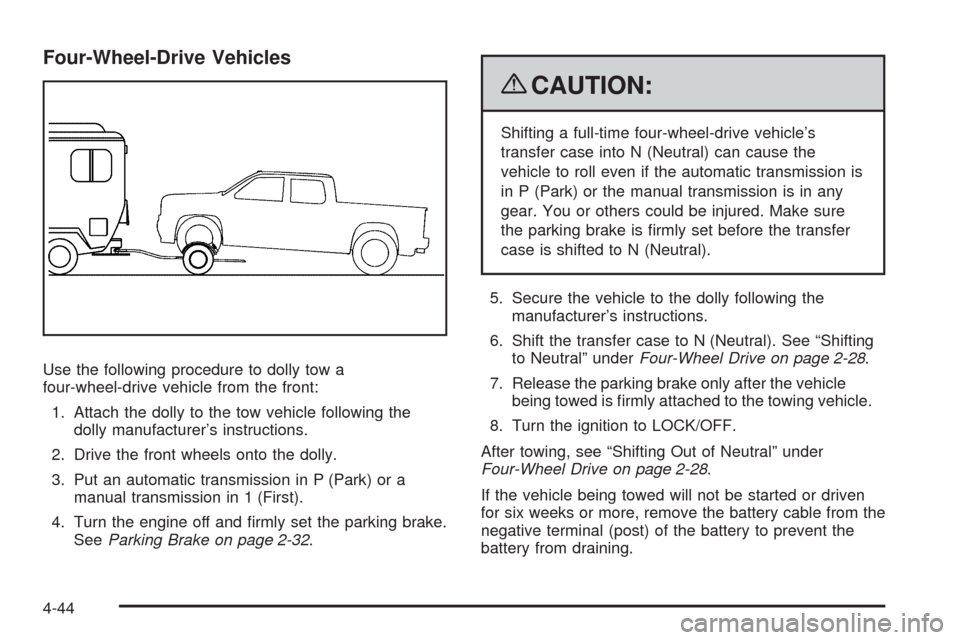
Use the following procedure to dolly tow a
four-wheel-drive vehicle from the front:
1. Attach the dolly to the tow vehicle following the
dolly manufacturer’s instructions.
2. Drive the front wheels onto the dolly.
3. Put an automatic transmission in P (Park) or a
manual transmission in 1 (First).
4. Turn the engine off and rmly set the parking brake.
SeeParking Brake on page 2-32.
{CAUTION:
Shifting a full-time four-wheel-drive vehicle’s
transfer case into N (Neutral) can cause the
vehicle to roll even if the automatic transmission is
in P (Park) or the manual transmission is in any
gear. You or others could be injured. Make sure
the parking brake is rmly set before the transfer
case is shifted to N (Neutral).
5. Secure the vehicle to the dolly following the
manufacturer’s instructions.
6. Shift the transfer case to N (Neutral). See “Shifting
to Neutral” underFour-Wheel Drive on page 2-28.
7. Release the parking brake only after the vehicle
being towed is rmly attached to the towing vehicle.
8. Turn the ignition to LOCK/OFF.
After towing, see “Shifting Out of Neutral” under
Four-Wheel Drive on page 2-28.
If the vehicle being towed will not be started or driven
for six weeks or more, remove the battery cable from the
negative terminal (post) of the battery to prevent the
battery from draining.
4-44
Page 242 of 420

Pulling A Trailer
Here are some important points:
There are many different laws, including speed limit
restrictions, having to do with trailering. Make sure
the rig will be legal, not only where you live but
also where you will be driving. A good source for
this information can be state or provincial police.
Consider using a sway control. See “Hitches” later
in this section.
Do not tow a trailer at all during the rst 500 miles
(800 km) the new vehicle is driven. The engine,
axle or other parts could be damaged.
Then, during the rst 500 miles (800 km) that a
trailer is towed, do not drive over 50 mph (80 km/h)
and do not make starts at full throttle. This helps
the engine and other parts of the vehicle wear in at
the heavier loads.
Vehicles with automatic transmissions can tow in
D (Drive), but you may want to shift to a lower
gear selection if the transmission shifts too often
(e.g., under heavy loads and/or hilly conditions).
If the vehicle has a manual transmission it is better
not to use the highest gear.Three important considerations have to do with weight:
The weight of the trailer
The weight of the trailer tongue
The weight on the vehicle’s tires
Weight of the Trailer
How heavy can a trailer safely be?
It depends on how the rig is used. For example, speed,
altitude, road grades, outside temperature and how
much the vehicle is used to pull a trailer are all
important. It can depend on any special equipment on
the vehicle, and the amount of tongue weight the vehicle
can carry. See “Weight of the Trailer Tongue” later in
this section for more information.
Maximum trailer weight is calculated assuming only the
driver is in the tow vehicle and it has all the required
trailering equipment. The weight of additional optional
equipment, passengers and cargo in the tow vehicle
must be subtracted from the maximum trailer weight.
4-48
Page 248 of 420

Driving with a Trailer
{CAUTION:
When towing a trailer, exhaust gases may collect
at the rear of the vehicle and enter if the liftgate,
trunk/hatch, or rear-most window is open.
Engine exhaust contains carbon monoxide (CO)
which cannot be seen or smelled. It can cause
unconsciousness and even death.
To maximize safety when towing a trailer:
Have the exhaust system inspected for leaks
and make necessary repairs before starting
a trip.
Never drive with the liftgate, trunk/hatch, or
rear-most window open.
Fully open the air outlets on or under the
instrument panel.
Adjust the Climate Control system to a setting
that brings in only outside air and set the fan
speed to the highest setting. See Climate
Control System in the Index.
For more information about carbon monoxide, see
Engine Exhaust on page 2-37.Towing a trailer requires a certain amount of experience.
Get to know the rig before setting out for the open road.
Get acquainted with the feel of handling and braking with
the added weight of the trailer. And always keep in mind
that the vehicle you are driving is now longer and not as
responsive as the vehicle is by itself.
Before starting, check all trailer hitch parts and
attachments, safety chains, electrical connectors, lamps,
tires and mirror adjustments. If the trailer has electric
brakes, start the vehicle and trailer moving and then
apply the trailer brake controller by hand to be sure the
brakes are working. This checks the electrical connection
at the same time.
During the trip, check occasionally to be sure that the
load is secure, and that the lamps and any trailer brakes
are still working.
While towing a trailer or when exposed to long periods
of sunshine, the oor of the truck bed may become very
warm. Avoid putting items in the truck bed that might be
affected by high ambient temperatures.Following Distance
Stay at least twice as far behind the vehicle ahead as
you would when driving the vehicle without a trailer.
This can help to avoid situations that require heavy
braking and sudden turns.
4-54
Page 250 of 420

When towing at high altitude on steep uphill grades,
consider the following: Engine coolant will boil at a lower
temperature than at normal altitudes. If the engine is
turned off immediately after towing at high altitude on
steep uphill grades, the vehicle may show signs similar to
engine overheating. To avoid this, let the engine run while
parked, preferably on level ground, with an automatic
transmission in P (Park) or a manual transmission in
N (Neutral) with the parking brake applied, for a few
minutes before turning the engine off. If the overheat
warning comes on, seeEngine Overheating on
page 5-34.
Parking on Hills
{CAUTION:
Parking the vehicle on a hill with the trailer attached
can be dangerous. If something goes wrong, the rig
could start to move. People can be injured, and
both the vehicle and the trailer can be damaged.
When possible, always park the rig on a at
surface.If parking the rig on a hill:
1. Press the brake pedal, but do not shift into P (Park)
yet for vehicles with an automatic transmission, or
into gear for vehicles with a manual transmission.
Turn the wheels into the curb if facing downhill
or into traffic if facing uphill.
2. Have someone place chocks under the trailer
wheels.
3. When the wheel chocks are in place, release the
brake pedal until the chocks absorb the load.
4. Reapply the brake pedal. Then apply the parking
brake and shift into P (Park) for vehicles with an
automatic transmission or into gear for vehicles with
a manual transmission.
5. If the vehicle has four-wheel-drive, be sure
the transfer case is in a drive gear and not in
N (Neutral). SeeFour-Wheel Drive on page 2-28
for more information.
6. Release the brake pedal.
4-56
Page 251 of 420

Leaving After Parking on a Hill
1. Apply and hold the brake pedal while you:
Start the engine
Shift into a gear
Release the parking brake
2. Let up on the brake pedal.
3. Drive slowly until the trailer is clear of the chocks.
4. Stop and have someone pick up and store the
chocks.
Maintenance When Trailer Towing
The vehicle needs service more often when pulling a
trailer. SeeScheduled Maintenance on page 6-4or the
Index for more information. Things that are especially
important in trailer operation are automatic transmission
uid, engine oil, axle lubricant, belts, cooling system and
brake system. It is a good idea to inspect these before
and during the trip.
Check periodically to see that all hitch nuts and bolts
are tight.
Trailer Wiring Harness
The vehicle may be equipped with a four-pin trailer
towing harness. This harness has a four-pin trailer
connector that is attached to a bracket on the hitch
platform. The four-wire harness contains the following
trailer circuits:
Yellow: Left Stop/Turn Signal
Green: Right Stop/Turn Signal
Brown: Taillamps/Park lamps
White: Ground
Trailer Recommendations
Subtract the hitch loads from the Cargo Weight Rating
(CWR). CWR is the maximum weight of the load the
vehicle can carry. It does not include the weight of the
people inside, but you can gure about 150 lbs. (68 kg)
for each passenger. The total cargo load must not be
more than the vehicles CWR.
Weigh the vehicle with the trailer attached, so the GVWR
or GAWR are not exceeded. If using a weight-distributing
hitch, weigh the vehicle without the spring bars in place.
The best performance is obtained by correctly spreading
out the weight of the load and choosing the correct hitch
and trailer brakes.
For more information seeTowing a Trailer on page 4-47.
4-57
Page 253 of 420

Service............................................................5-3
Accessories and Modications..........................5-3
California Proposition 65 Warning.....................5-4
California Perchlorate Materials Requirements......5-4
Doing Your Own Service Work.........................5-4
Adding Equipment to the Outside of the
Vehicle......................................................5-5
Fuel................................................................5-5
Gasoline Octane............................................5-5
Gasoline Specications....................................5-6
California Fuel...............................................5-6
Additives.......................................................5-6
Fuels in Foreign Countries...............................5-7
Filling the Tank..............................................5-8
Filling a Portable Fuel Container.....................5-10
Checking Things Under the Hood....................5-10
Hood Release..............................................5-11
Engine Compartment Overview.......................5-12
Engine Oil...................................................5-15
Engine Oil Life System..................................5-18
Engine Air Cleaner/Filter................................5-20
Automatic Transmission Fluid.........................5-21
Manual Transmission Fluid.............................5-24
Hydraulic Clutch...........................................5-26
Cooling System............................................5-27Engine Coolant.............................................5-29
Engine Overheating.......................................5-34
Engine Fan Noise.........................................5-35
Power Steering Fluid.....................................5-36
Windshield Washer Fluid................................5-37
Brakes........................................................5-38
Battery........................................................5-41
Jump Starting...............................................5-42
Rear Axle.......................................................5-46
Four-Wheel Drive
............................................5-47
Front Axle......................................................5-48
Headlamp Aiming...........................................5-49
Bulb Replacement..........................................5-49
Halogen Bulbs..............................................5-49
Headlamps..................................................5-50
Front Turn Signal, Parking and Daytime
Running Lamps (DRL)................................5-51
Center High-Mounted Stoplamp (CHMSL).........5-51
Taillamps, Turn Signal, Stoplamps and
Back-up Lamps.........................................5-52
License Plate Lamp......................................5-53
Replacement Bulbs.......................................5-53
Windshield Wiper Blade Replacement..............5-54
Section 5 Service and Appearance Care
5-1
Page 254 of 420

Tires..............................................................5-56
Tire Sidewall Labeling...................................5-57
Tire Terminology and Denitions.....................5-60
Ination - Tire Pressure.................................5-63
High-Speed Operation...................................5-64
Tire Pressure Monitor System.........................5-65
Tire Pressure Monitor Operation.....................5-67
Tire Inspection and Rotation...........................5-70
When It Is Time for New Tires.......................5-72
Buying New Tires.........................................5-72
Different Size Tires and Wheels......................5-74
Uniform Tire Quality Grading..........................5-75
Wheel Alignment and Tire Balance..................5-77
Wheel Replacement......................................5-77
Tire Chains..................................................5-78
If a Tire Goes Flat........................................5-79
Changing a Flat Tire.....................................5-80
Removing the Spare Tire and Tools................5-81
Removing the Flat Tire and Installing the
Spare Tire................................................5-85
Secondary Latch System...............................5-92
Storing a Flat or Spare Tire and Tools............5-95
Spare Tire.................................................5-100
Appearance Care..........................................5-101
Interior Cleaning.........................................5-101
Fabric/Carpet..............................................5-103
Leather......................................................5-103Instrument Panel, Vinyl, and Other Plastic
Surfaces.................................................5-104
Care of Safety Belts....................................5-104
Weatherstrips.............................................5-104
Washing Your Vehicle..................................5-105
Cleaning Exterior Lamps/Lenses....................5-105
Finish Care................................................5-105
Windshield and Wiper Blades.......................5-106
Aluminum or Chrome-Plated Wheels
and Trim................................................5-107
Tires.........................................................5-108
Sheet Metal Damage...................................5-108
Finish Damage...........................................5-108
Underbody Maintenance...............................5-108
Chemical Paint Spotting...............................5-108
Vehicle Identication.....................................5-109
Vehicle Identication Number (VIN)................5-109
Service Parts Identication Label...................5-109
Electrical System..........................................5-110
Add-On Electrical Equipment.........................5-110
Windshield Wiper Fuses...............................5-110
Fuses and Circuit Breakers..........................5-110
Engine Compartment Fuse Block...................5-111
Capacities and Specications........................5-117
Capacities and Specications........................5-117
Section 5 Service and Appearance Care
5-2