2009 CHEVROLET COLORADO key
[x] Cancel search: keyPage 377 of 420

Maintenance Footnotes
(a)Visually inspect brake lines and hoses for proper
hook-up, binding, leaks, cracks, chafing, etc. Inspect
disc brake pads for wear and rotors for surface
condition. Inspect drum brake linings/shoes for wear
or cracks. Inspect other brake parts, including drums,
wheel cylinders, calipers, parking brake, etc. Check
parking brake adjustment.
(b)Visually inspect front and rear suspension and
steering system for damaged, loose, or missing parts or
signs of wear. Inspect power steering lines and hoses
for proper hook-up, binding, leaks, cracks, chafing,
etc. Visually check constant velocity joints, rubber
boots, and axle seals for leaks.
(c)Visually inspect hoses and have them replaced if
they are cracked, swollen, or deteriorated. Inspect all
pipes, fittings, and clamps; replace with genuine parts as
needed. To help ensure proper operation, a pressure test
of the cooling system and pressure cap and cleaning the
outside of the radiator and air conditioning condenser is
recommended at least once a year.(d)Inspect wiper blades for wear, cracking, or
contamination. Clean the windshield and wiper blades,
if contaminated. Replace wiper blades that are worn or
damaged. See Windshield Wiper Blade Replacement
on page 5-54 and Windshield and Wiper Blades on
page 5-106 for more information.
(e)Make sure the safety belt reminder light and safety
belt assemblies are working properly. Look for any other
loose or damaged safety belt system parts. If you see
anything that might keep a safety belt system from doing
its job, have it repaired. Have any torn or frayed safety
belts replaced. Also see Checking the Restraint Systems
on page 1-77.
(f)Lubricate all key lock cylinders, body door and fuel
door hinges, latches and locks (including glove box and
console doors), hood latch assembly, secondary latch,
pivots, spring anchor, release pawl, and any moving seat
hardware. Lubricate hood safety lever pivot and prop rod
pivot and tailgate latch bolt, handle assembly pivot points,
and hinges. More frequent lubrication may be required
when exposed to a corrosive environment. Applying
silicone grease on weatherstrips with a clean cloth will
make them last longer, seal better, and not stick or
squeak.
6-7
Page 380 of 420

Automatic Transmission Shift Lock
Control System Check
{CAUTION:
When you are doing this inspection, the vehicle
could move suddenly. If the vehicle moves, you or
others could be injured.
1. Before starting this check, be sure there is enough
room around the vehicle. It should be parked on a
level surface.
2. Firmly apply the parking brake. SeeParking Brake
on page 2-32.
Be ready to apply the regular brake immediately if
the vehicle begins to move.3. With the engine off, turn the ignition to ON/RUN,
but do not start the engine. Without applying the
regular brake, try to move the shift lever out
of P (Park) with normal effort. If the shift lever
moves out of P (Park), contact your dealer/retailer
for service.Ignition Transmission Lock Check
While parked, and with the parking brake set, try to turn
the ignition to LOCK/OFF in each shift lever position.
For automatic transmission vehicles, the ignition
should turn to LOCK/OFF only when the shift
lever is in P (Park). The ignition key should
come out only in LOCK/OFF.
For manual transmission vehicles, the ignition key
should come out only in LOCK/OFF.
Contact your dealer/retailer if service is required.
6-10
Page 382 of 420

Recommended Fluids and
Lubricants
Fluids and lubricants identied below by name, part
number, or specication can be obtained from your
dealer/retailer.
Usage Fluid/Lubricant
Engine OilEngine oil which meets GM
Standard GM6094M and displays
the American Petroleum Institute
Certied for Gasoline Engines
starburst symbol. To determine the
proper viscosity for your vehicle’s
engine, seeEngine Oil on page 5-15.
Engine Coolant50/50 mixture of clean, drinkable
water and use only DEX-COOL
®
Coolant. SeeEngine Coolant on
page 5-29.
Hydraulic Brake
SystemDelco
®Supreme 11 Brake Fluid or
equivalent DOT-3 brake uid.
Windshield
WasherOptikleen
®Washer Solvent.
Usage Fluid/Lubricant
Parking Brake
Cable GuidesChassis Lubricant
(GM Part No. U.S. 12377985, in
Canada 88901242) or lubricant
meeting requirements of NLGI #2,
Category LB or GC-LB.
Power Steering
SystemGM Power Steering Fluid
(GM Part No. U.S. 89021184,
in Canada 89021186).
Automatic
TransmissionDEXRON
®-VI Automatic
Transmission Fluid.
Manual
TransmissionManual Transmission Fluid
(GM Part No. U.S. 89021806,
in Canada 89021807).
Hydraulic
Clutch SystemHydraulic Clutch Fluid
(GM Part No. U.S. 12345347,
in Canada 10953517) or equivalent
DOT-3 brake uid.
Key Lock
CylindersMulti-Purpose Lubricant, Superlube
(GM Part No. U.S. 12346241,
in Canada 10953474).
Chassis
LubricationChassis Lubricant
(GM Part No. U.S. 12377985, in
Canada 88901242) or lubricant
meeting requirements of NLGI #2,
Category LB or GC-LB.
6-12
Page 406 of 420

OnStar®
If your vehicle has OnStar and you subscribe to the
OnStar services, please refer to the OnStar Terms and
Conditions for information on data collection and
use. See alsoOnStar
®System on page 2-43in this
manual for more information.
Navigation System
If your vehicle has a navigation system, use of the
system may result in the storage of destinations,
addresses, telephone numbers, and other trip
information. Refer to the navigation system operating
manual for information on stored data and for deletion
instructions.
Radio Frequency
Identication (RFID)
RFID technology is used in some vehicles for functions
such as tire pressure monitoring and ignition system
security, as well as in connection with conveniences
such as key fobs for remote door locking/unlocking and
starting, and in-vehicle transmitters for garage door
openers. RFID technology in GM vehicles does not use
or record personal information or link with any other
GM system containing personal information.
7-18
Page 411 of 420
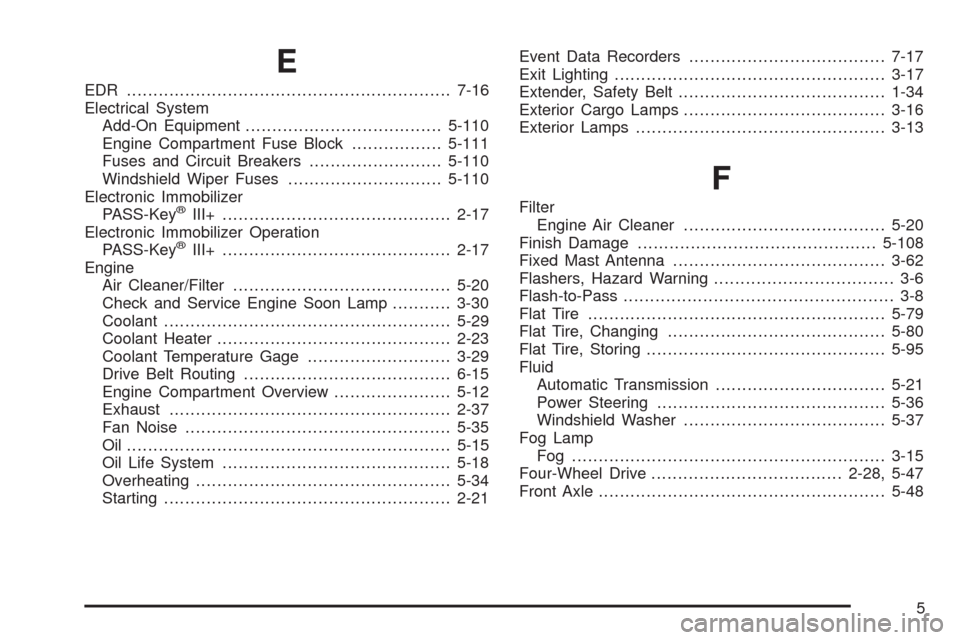
E
EDR .............................................................7-16
Electrical System
Add-On Equipment.....................................5-110
Engine Compartment Fuse Block.................5-111
Fuses and Circuit Breakers.........................5-110
Windshield Wiper Fuses.............................5-110
Electronic Immobilizer
PASS-Key
®III+...........................................2-17
Electronic Immobilizer Operation
PASS-Key
®III+...........................................2-17
Engine
Air Cleaner/Filter.........................................5-20
Check and Service Engine Soon Lamp...........3-30
Coolant......................................................5-29
Coolant Heater............................................2-23
Coolant Temperature Gage...........................3-29
Drive Belt Routing.......................................6-15
Engine Compartment Overview......................5-12
Exhaust.....................................................2-37
Fan Noise..................................................5-35
Oil .............................................................5-15
Oil Life System...........................................5-18
Overheating................................................5-34
Starting......................................................2-21Event Data Recorders.....................................7-17
Exit Lighting...................................................3-17
Extender, Safety Belt.......................................1-34
Exterior Cargo Lamps......................................3-16
Exterior Lamps...............................................3-13
F
Filter
Engine Air Cleaner......................................5-20
Finish Damage.............................................5-108
Fixed Mast Antenna........................................3-62
Flashers, Hazard Warning.................................. 3-6
Flash-to-Pass................................................... 3-8
Flat Tire........................................................5-79
Flat Tire, Changing.........................................5-80
Flat Tire, Storing.............................................5-95
Fluid
Automatic Transmission................................5-21
Power Steering...........................................5-36
Windshield Washer......................................5-37
Fog Lamp
Fog ...........................................................3-15
Four-Wheel Drive....................................2-28, 5-47
Front Axle......................................................5-48
5
Page 413 of 420
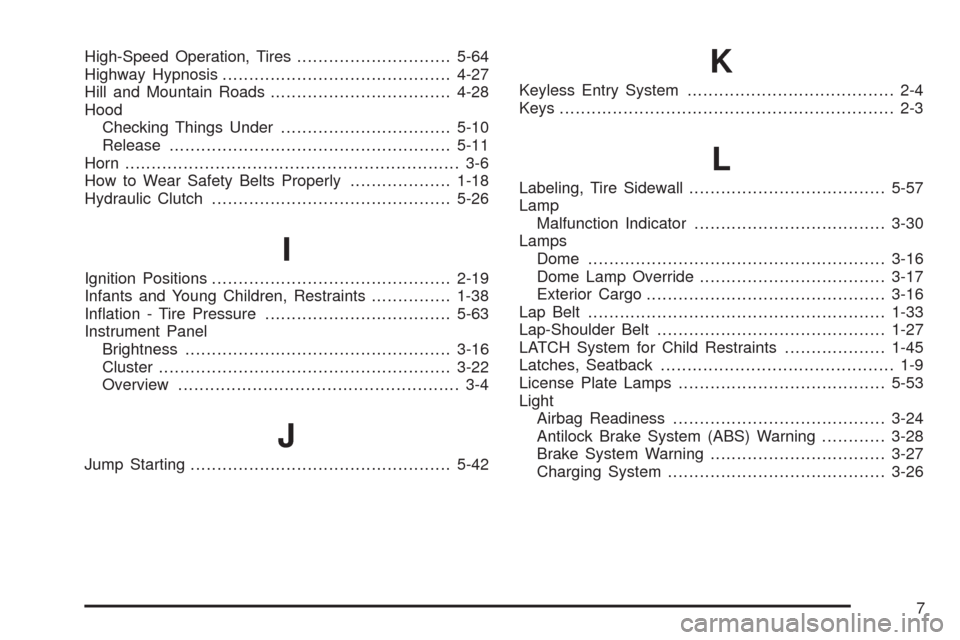
High-Speed Operation, Tires.............................5-64
Highway Hypnosis...........................................4-27
Hill and Mountain Roads..................................4-28
Hood
Checking Things Under................................5-10
Release.....................................................5-11
Horn ............................................................... 3-6
How to Wear Safety Belts Properly...................1-18
Hydraulic Clutch.............................................5-26
I
Ignition Positions.............................................2-19
Infants and Young Children, Restraints...............1-38
Ination - Tire Pressure...................................5-63
Instrument Panel
Brightness..................................................3-16
Cluster.......................................................3-22
Overview..................................................... 3-4
J
Jump Starting.................................................5-42
K
Keyless Entry System....................................... 2-4
Keys............................................................... 2-3
L
Labeling, Tire Sidewall.....................................5-57
Lamp
Malfunction Indicator....................................3-30
Lamps
Dome ........................................................3-16
Dome Lamp Override...................................3-17
Exterior Cargo.............................................3-16
Lap Belt........................................................1-33
Lap-Shoulder Belt...........................................1-27
LATCH System for Child Restraints...................1-45
Latches, Seatback............................................ 1-9
License Plate Lamps.......................................5-53
Light
Airbag Readiness........................................3-24
Antilock Brake System (ABS) Warning............3-28
Brake System Warning.................................3-27
Charging System.........................................3-26
7
Page 416 of 420

Parking
Over Things That Burn.................................2-37
Parking Your Vehicle.......................................2-36
Passenger Airbag Status Indicator.....................3-25
Passenger Sensing System..............................1-70
Passing.........................................................4-11
PASS-Key
®III+ Electronic Immobilizer...............2-17
PASS-Key®III+ Electronic Immobilizer
Operation...................................................2-17
Passlock
®......................................................2-16
Perchlorate Materials Requirements,
California..................................................... 5-4
Pickup Conversion to Chassis Cab....................4-40
Power
Door Locks.................................................. 2-8
Lumbar Controls........................................... 1-4
Retained Accessory.....................................2-21
Seat ............................................................ 1-3
Steering Fluid.............................................5-36
Windows....................................................2-13
Privacy..........................................................7-16
Event Data Recorders..................................7-17
Navigation System.......................................7-18
OnStar .......................................................7-18
Radio Frequency Identication.......................7-18
Programmable Automatic Door Locks.................. 2-8
R
Radio Frequency Identication (RFID),
Privacy......................................................7-18
Radio(s)........................................................3-44
Radios
Reception...................................................3-61
Setting the Clock.........................................3-44
Theft-Deterrent............................................3-60
Rear Axle......................................................5-46
Limited-Slip.................................................. 4-9
Rear Door Security Locks.................................. 2-9
Rear Doors...................................................... 2-9
Rear Seat Operation...............................1-10, 1-11
Rear Storage Area..........................................2-47
Rearview Mirror, Automatic Dimming..................2-40
Rearview Mirrors.............................................2-39
Reclining Seatbacks.......................................... 1-5
Recommended Fluids and Lubricants.................6-12
Recovery Hooks.............................................4-32
Recreational Vehicle Towing.............................4-41
Remote Keyless Entry (RKE) System.................. 2-4
Remote Keyless Entry (RKE) System,
Operation..................................................... 2-5
Removing the Flat Tire and Installing the
Spare Tire..................................................5-85
10
Page 418 of 420

Service (cont.)
California Perchlorate Materials Requirements . . . 5-4
California Proposition 65 Warning.................... 5-4
Doing Your Own Work................................... 5-4
Engine Soon Lamp......................................3-30
Publications Ordering Information...................7-15
Service, Scheduling Appointments.....................7-10
Servicing Your Airbag-Equipped Vehicle..............1-75
Setting the Clock............................................3-44
Sheet Metal Damage.....................................5-108
Shifting Into Park............................................2-34
Shifting Out of Park........................................2-36
Signals, Turn and Lane-Change.......................... 3-7
Sliding Rear Windows.....................................2-14
Spare Tire....................................................5-100
Installing....................................................5-85
Removing...................................................5-81
Storing.......................................................5-95
Specications, Capacities...............................5-117
Speedometer..................................................3-23
Stabilitrak
®System........................................... 4-6
StabiliTrak®/TCS Warning Light.........................3-29
Starting the Engine.........................................2-21
Steering.......................................................... 4-9
Steering Wheel, Tilt Wheel................................. 3-6Storage Areas
Center Console Storage Area........................2-47
Cupholders.................................................2-46
Glove Box..................................................2-46
Rear Storage Area.......................................2-47
Stuck in Sand, Mud, Ice, or Snow.....................4-31
Sun Visors.....................................................2-14
Sunroof.........................................................2-49
T
Tachometer....................................................3-23
Tailgate.........................................................2-10
Taillamps
Turn Signal, Stoplamps and
Back-up Lamps........................................5-52
Theft-Deterrent, Radio.....................................3-60
Theft-Deterrent Systems...................................2-15
Content Theft-Deterrent................................2-15
PASS-Key
®III+ Electronic Immobilizer............2-17
PASS-Key®III+ Electronic Immobilizer
Operation................................................2-17
Passlock
®...................................................2-16
Tilt Wheel........................................................ 3-6
Time, Setting..................................................3-44
12