2009 CADILLAC ESCALADE ESV door lock
[x] Cancel search: door lockPage 444 of 602

To open the fuel door, push the rearward center edge in
and release and it will open.
To remove the fuel cap, turn it slowly counterclockwise.
The fuel cap has a spring in it; if the cap is released
too soon, it will spring back to the right.
While refueling, hang the tethered fuel cap from the
hook on the fuel door. { CAUTION: Fuel can spray out on you if you open the fuel cap
too quickly. If you spill fuel and then something
ignites it, you could be badly burned. This spray
can happen if the tank is nearly full, and is more
likely in hot weather. Open the fuel cap slowly and
wait for any hiss noise to stop. Then unscrew the
cap all the way.
Be careful not to spill fuel. Do not top off or overll the
tank and wait a few seconds after you have nished
pumping before removing the nozzle. Clean fuel from
painted surfaces as soon as possible. See Washing Your
Vehicle on page 6-100 .
When replacing the fuel cap, insert the tether in its hole
before tightening the cap. Turn the fuel cap clockwise
until it clicks. It will require more effort to turn the fuel cap
on the last turn as you tighten it. Make sure the cap is
fully installed. The diagnostic system can determine
if the fuel cap has been left off or improperly installed.
This would allow fuel to evaporate into the atmosphere.
See Malfunction Indicator Lamp on page 3-42 .
6-10
Page 540 of 602

Fuses and Circuit Breakers If the vehicle is a Two-mode Hybrid, see the Two-mode
Hybrid manual for more information.
The wiring circuits in the vehicle are protected from
short circuits by a combination of fuses, circuit breakers
and fusible thermal links. This greatly reduces the
chance of res caused by electrical problems.
Look at the silver-colored band inside the fuse. If the
band is broken or melted, replace the fuse. Be sure you
replace a bad fuse with a new one of the identical size
and rating.
If you ever have a problem on the road and don’t have
a spare fuse, you can borrow one that has the same
amperage. Just pick some feature of your vehicle
that you can get along without – like the radio or
cigarette lighter – and use its fuse, if it is the correct
amperage. Replace it as soon as you can. Instrument Panel Fuse Block The instrument panel fuse
block access door is
located on the driver side
edge of the instrument
panel.
Pull off the cover to access the fuse block.
6-106
Page 541 of 602

The vehicle may not use all of the fuses shown.
Fuses Usage
1 Rear Seats
2 Rear Accessory Power Outlet
3 Steering Wheel Controls Backlight
4 Driver Door Module Fuses Usage
5 Dome Lamps, Driver Side Turn
Signal
6 Driver Side Turn Signal, Stoplamp
7 Instrument Panel Back Lighting
8 Passenger Side Turn Signal,
Stoplamp
9 Passenger Door Module, Driver
Unlock
10 Power Door Lock 2 (Unlock Feature)
11 Power Door Lock 2 (Lock Feature)
12 Stoplamps, Center-High Mounted
Stoplamp
13 Rear Climate Controls
14 Power Mirror
15 Body Control Module (BCM)
16 Accessory Power Outlets
17 Interior Lamps
18 Power Door Lock 1 (Unlock Feature)
19 Rear Seat Entertainment
20 Ultrasonic Rear Parking Assist,
Power Liftgate
6-107
Page 542 of 602

Fuses Usage
21 Power Door Lock 1 (Lock Feature)
22 Driver Information Center (DIC)
23 Rear Wiper
24 Cooled Seats
25 Driver Seat Module, Remote
Keyless Entry System
26 Driver Power Door Lock
(Unlock Feature)
Circuit Breaker Usage
LT DR Driver Side Power Window Circuit
Breaker
Harness
Connector Usage
LT DR Driver Door Harness Connection
BODY Harness Connector
BODY Harness Connector Center Instrument Panel Fuse Block The center instrument panel fuse block is located
underneath the instrument panel, to the left of the
steering column.
Top View
Harness
Connector Usage
BODY 2 Body Harness Connector 2
BODY 1 Body Harness Connector 1
BODY 3 Body Harness Connector 3
6-108
Page 557 of 602
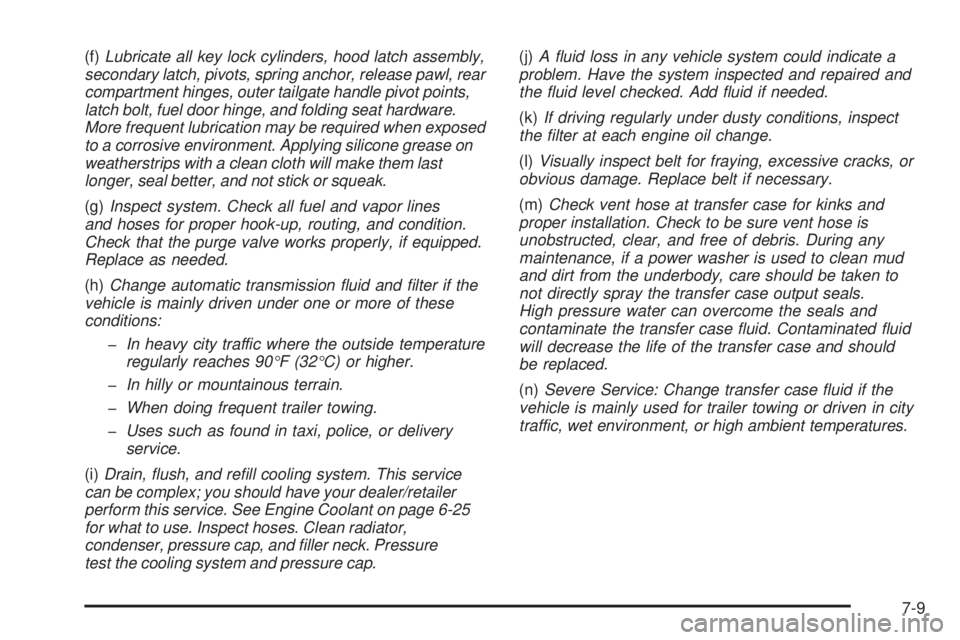
(f) Lubricate all key lock cylinders, hood latch assembly,
secondary latch, pivots, spring anchor, release pawl, rear
compartment hinges, outer tailgate handle pivot points,
latch bolt, fuel door hinge, and folding seat hardware.
More frequent lubrication may be required when exposed
to a corrosive environment. Applying silicone grease on
weatherstrips with a clean cloth will make them last
longer, seal better, and not stick or squeak.
(g) Inspect system. Check all fuel and vapor lines
and hoses for proper hook-up, routing, and condition.
Check that the purge valve works properly, if equipped.
Replace as needed.
(h) Change automatic transmission fluid and filter if the
vehicle is mainly driven under one or more of these
conditions:
In heavy city traffic where the outside temperature
regularly reaches 90°F (32°C) or higher.
In hilly or mountainous terrain.
When doing frequent trailer towing.
Uses such as found in taxi, police, or delivery
service.
(i) Drain, flush, and refill cooling system. This service
can be complex; you should have your dealer/retailer
perform this service. See Engine Coolant on page 6-25
for what to use. Inspect hoses. Clean radiator,
condenser, pressure cap, and filler neck. Pressure
test the cooling system and pressure cap. (j) A fluid loss in any vehicle system could indicate a
problem. Have the system inspected and repaired and
the fluid level checked. Add fluid if needed.
(k) If driving regularly under dusty conditions, inspect
the filter at each engine oil change.
(l) Visually inspect belt for fraying, excessive cracks, or
obvious damage. Replace belt if necessary.
(m) Check vent hose at transfer case for kinks and
proper installation. Check to be sure vent hose is
unobstructed, clear, and free of debris. During any
maintenance, if a power washer is used to clean mud
and dirt from the underbody, care should be taken to
not directly spray the transfer case output seals.
High pressure water can overcome the seals and
contaminate the transfer case fluid. Contaminated fluid
will decrease the life of the transfer case and should
be replaced.
(n) Severe Service: Change transfer case fluid if the
vehicle is mainly used for trailer towing or driven in city
traffic, wet environment, or high ambient temperatures.
7-9
Page 586 of 602

OnStar ®
If your vehicle has OnStar and you subscribe to the
OnStar services, please refer to the OnStar Terms and
Conditions for information on data collection and use.
See also OnStar ®
System on page 2-52 in this manual
for more information.
Navigation System If your vehicle has a navigation system, use of the
system may result in the storage of destinations,
addresses, telephone numbers, and other trip
information. Refer to the navigation system operating
manual for information on stored data and for deletion
instructions. Radio Frequency
Identication (RFID) RFID technology is used in some vehicles for functions
such as tire pressure monitoring and ignition system
security, as well as in connection with conveniences
such as key fobs for remote door locking/unlocking and
starting, and in-vehicle transmitters for garage door
openers. RFID technology in GM vehicles does not use
or record personal information or link with any other
GM system containing personal information.
8-18
Page 590 of 602

Cleaning (cont.)
Weatherstrips ............................................ 6-100
Windshield, Backglass, and Wiper Blades ...... 6-102
Wood Panels ............................................ 6-100
Climate Control System
Outlet Adjustment ........................................ 3-31
Rear Air Conditioning and Heating System,
Electronic ................................................ 3-32
Climate Control Systems
Dual Automatic ............................................ 3-27
Clock ............................................................ 3-26
Collision Damage Repair .................................. 8-12
Compass ....................................................... 3-53
Content Theft-Deterrent .................................... 2-21
Control of a Vehicle .......................................... 5-3
Coolant
Engine ....................................................... 6-25
Engine Temperature Gage ............................ 3-41
Cooled Seats ................................................... 1-6
Cooling System .............................................. 6-24
Courtesy Transportation Program ...................... 8-10
Cruise Control ................................................ 3-13
Light .......................................................... 3-46
Cupholders .................................................... 2-62 Customer Assistance ......................................... 8-6
Offices ......................................................... 8-6
Text Telephone (TTY) Users ........................... 8-6
Customer Information
Service Publications Ordering Information ........ 8-15
Customer Satisfaction Procedure ........................ 8-2
D Damage Repair, Collision ................................. 8-12
Data Recorders
Event ......................................................... 8-17
Database Coverage Explanations ...................... 4-62
Daytime Running Lamps (DRL) ......................... 3-21
Defensive Driving ............................................. 5-2
Delayed Locking ............................................. 2-10
DIC Compass ................................................. 3-53
Doing Your Own Service Work ........................... 6-4
Dome Lamp Override ...................................... 3-23
Dome Lamps ................................................. 3-23
Door
Delayed Locking .......................................... 2-10
Locks ........................................................ 2-10
Power Locks ............................................... 2-10
Programmable Automatic Door Locks ............. 2-11
Rear Door Security Locks ............................. 2-11
4
Page 595 of 602

Lights (cont.)
Flash-to-Pass ............................................... 3-9
Fog Lamps ................................................. 3-45
Highbeam On ............................................. 3-46
High/Low Beam Changer ................................ 3-8
Lights On Reminder ..................................... 3-45
Oil Pressure ............................................... 3-44
On Reminder .............................................. 3-21
Passenger Airbag Status Indicator .................. 3-37
Safety Belt Reminders .................................. 3-35
Security ..................................................... 3-45
StabiliTrak ®
Indicator .................................... 3-40
Tire Pressure .............................................. 3-41
Tow/Haul Mode ........................................... 3-46
Loading Your Vehicle ....................................... 5-33
Locking Rear Axle ............................................ 5-9
Locks
Delayed Locking .......................................... 2-10
Door .......................................................... 2-10
Lockout Protection ....................................... 2-12
Power Door ................................................ 2-10
Programmable Automatic Door Locks ............. 2-11
Rear Door Security Locks ............................. 2-11
Loss of Control ............................................... 5-12
Lower Anchors and Tethers for Children ............. 1-63
Luggage Carrier .............................................. 2-64
Lumbar
Power Controls ............................................. 1-4 M Magnetic Ride Control ....................................... 5-9
Maintenance
Footnotes ..................................................... 7-8
Schedule, Additional Required Services ............ 7-6
Maintenance Schedule
At Each Fuel Fill ......................................... 7-10
At Least Once a Month ................................ 7-10
At Least Once a Year .................................. 7-11
Maintenance Record .................................... 7-17
Maintenance Replacement Parts .................... 7-15
Maintenance Requirements ............................. 7-2
Owner Checks and Services ......................... 7-10
Recommended Fluids and Lubricants ............. 7-13
Scheduled Maintenance ................................. 7-4
Using .......................................................... 7-3
Your Vehicle and the Environment ................... 7-2
Malfunction Indicator Lamp ............................... 3-42
Maps ............................................................ 4-15
Memory Features ............................................. 1-7
Message
DIC Warnings and Messages ........................ 3-56
Mirrors
Automatic Dimming Rearview ........................ 2-40
Manual Rearview ......................................... 2-40
Outside Convex Mirror ................................. 2-41
9