2009 CADILLAC ESCALADE ESV cooling
[x] Cancel search: coolingPage 226 of 602

ENGINE POWER IS REDUCED This message displays and a chime sounds when the
cooling system temperature gets too hot and the engine
further enters the engine coolant protection mode. See
Engine Overheating on page 6-30 for further information.
This message also displays when the vehicle’s engine
power is reduced. Reduced engine power can affect the
vehicle’s ability to accelerate. If this message is on, but
there is no reduction in performance, proceed to your
destination. The performance may be reduced the next
time the vehicle is driven. The vehicle may be driven at a
reduced speed while this message is on, but acceleration
and speed may be reduced. Anytime this message stays
on, the vehicle should be taken to your dealer/retailer for
service as soon as possible.
FUEL LEVEL LOW This message displays and a chime sounds if the fuel
level is low. Refuel as soon as possible. See Fuel Gage
on page 3-46 and Fuel on page 6-5 for more information.
HEATED WASHER FLUID SYSTEM OFF This message displays when the heated windshield
washer has been turned off. See Windshield Washer
on page 3-11 for more information. HEATING WASH FLUID WASH WIPES
PENDING This message displays when the heated windshield
washer system is heating the uid. See Windshield
Washer on page 3-11 for more information.
HOOD OPEN This message displays and a chime sounds if the hood
is not fully closed. Stop and turn off the vehicle, check the
hood for obstructions, and close the hood again. Check to
see if the message still appears on the DIC.
ICE POSSIBLE DRIVE WITH CARE This message displays when ice conditions are possible.
LEFT REAR DOOR OPEN This message displays and a chime sounds if the driver
side rear door is not fully closed and the vehicle is shifted
out of P (Park). Stop and turn off the vehicle, check the
door for obstructions, and close the door again. Check to
see if the message still appears on the DIC.
3-58
Page 401 of 602

If the water is not too deep, drive slowly through it. At
faster speeds, water splashes on the ignition system and
the vehicle can stall. Stalling can also occur if you get the
tailpipe under water. If the tailpipe is under water, you will
never be able to start the engine. When going through
water, remember that when the brakes get wet, it might
take longer to stop. See Driving in Rain and on Wet
Roads on page 5-26 .
After Off-Road Driving Remove any brush or debris that has collected
on the underbody, chassis, or under the hood.
These accumulations can be a re hazard.
After operation in mud or sand, have the brake linings
cleaned and checked. These substances can cause
glazing and uneven braking. Check the body structure,
steering, suspension, wheels, tires, and exhaust system
for damage and check the fuel lines and cooling system
for any leakage.
The vehicle requires more frequent service due to
off-road use. Refer to the Maintenance Schedule for
additional information. Driving at Night Night driving is more dangerous than day driving because
some drivers are likely to be impaired — by alcohol or
drugs, with night vision problems, or by fatigue.
Night driving tips include:
Drive defensively.
Do not drink and drive.
Reduce headlamp glare by adjusting the inside
rearview mirror.
Slow down and keep more space between you and
other vehicles because headlamps can only light up
so much road ahead.
Watch for animals.
When tired, pull off the road.
Do not wear sunglasses.
Avoid staring directly into approaching headlamps.
Keep the windshield and all glass on your vehicle
clean — inside and out.
Keep your eyes moving, especially during turns or
curves.
No one can see as well at night as in the daytime.
But, as we get older, these differences increase.
A 50-year-old driver might need at least twice as much
light to see the same thing at night as a 20-year-old.
5-25
Page 404 of 602

Hill and Mountain Roads Driving on steep hills or through mountains is different
than driving on at or rolling terrain. Tips for driving
in these conditions include:
Keep the vehicle serviced and in good shape.
Check all uid levels and brakes, tires, cooling
system, and transmission.
Going down steep or long hills, shift to a
lower gear.
{ CAUTION: If you do not shift down, the brakes could get so
hot that they would not work well. You would then
have poor braking or even none going down a hill.
You could crash. Shift down to let the engine
assist the brakes on a steep downhill slope. { CAUTION: Coasting downhill in N (Neutral) or with the ignition
off is dangerous. The brakes will have to do all the
work of slowing down and they could get so hot
that they would not work well. You would then
have poor braking or even none going down a hill.
You could crash. Always have the engine running
and the vehicle in gear when going downhill.
Stay in your own lane. Do not swing wide or cut
across the center of the road. Drive at speeds
that let you stay in your own lane.
Top of hills: Be alert — something could be in your
lane (stalled car, accident).
Pay attention to special road signs (falling rocks
area, winding roads, long grades, passing or
no-passing zones) and take appropriate action.
See Off-Road Driving on page 5-13 for information
about driving off-road.
5-28
Page 432 of 602

Maintenance When Trailer Towing The vehicle needs service more often when pulling a
trailer. See this manual’s Maintenance Schedule or Index
for more information. Things that are especially important
in trailer operation are automatic transmission uid,
engine oil, axle lubricant, belts, cooling system and brake
system. It is a good idea to inspect these before and
during the trip.
Check periodically to see that all hitch nuts and bolts
are tight.
Trailer Wiring Harness Heavy-Duty Trailer Wiring Package
The vehicle is equipped with the seven-wire trailer
towing harness. This harness with a seven-pin universal
heavy-duty trailer connector is attached to the rear
bumper beam. It is located next to the integrated trailer
hitch. The seven-wire harness contains the following trailer
circuits:
Yellow: Left Stop/Turn Signal
Dark Green: Right Stop/Turn Signal
Brown: Taillamps
White: Ground
Light Green: Back-up Lamps
Red w/ Black Stripe: Battery Feed*
Dark Blue: Trailer Brake*
*The fuses for these two circuits are installed in the
underhood electrical center, but the circuits are
not connected. They should be installed by your dealer
or a qualied service center.
If charging a remote (non-vehicle) battery, press the
Tow/Haul mode button, if equipped, located at the end of
the shift lever. This will boost the vehicle system voltage
and properly charge the battery. If the trailer is too light
for Tow/Haul mode, or the vehicle is not equipped with
Tow/Haul, turn on the headlamps as a second way to
boost the vehicle system and charge the battery.
5-56
Page 435 of 602

Service ........................................................... .6-3
Accessories and Modications ......................... .6-3
California Proposition 65 Warning .................... .6-4
California Perchlorate Materials Requirements .... .6-4
Doing Your Own Service Work ........................ .6-4
Adding Equipment to the Outside of
the Vehicle ................................................ .6-5
Fuel ............................................................... .6-5
Gasoline Octane ........................................... .6-5
Gasoline Specications ................................... .6-6
California Fuel .............................................. .6-6
Additives ...................................................... .6-6
Fuel E85 (85% Ethanol) ................................. .6-7
Fuels in Foreign Countries .............................. .6-8
Filling the Tank ............................................. .6-9
Filling a Portable Fuel Container .................... .6-11
Checking Things Under the Hood ................... .6-12
Hood Release ............................................. .6-13
Engine Compartment Overview ...................... .6-14
Engine Oil .................................................. .6-15
Engine Oil Life System ................................. .6-18
Engine Air Cleaner/Filter ............................... .6-19
Automatic Transmission Fluid ........................ .6-20
Cooling System ........................................... .6-24
Engine Coolant ............................................ .6-25
Engine Overheating ...................................... .6-30 Overheated Engine Protection
Operating Mode ........................................ .6-33
Engine Fan Noise ........................................ .6-33
Power Steering Fluid .................................... .6-33
Windshield Washer Fluid ............................... .6-34
Brakes ....................................................... .6-36
Battery ....................................................... .6-39
Jump Starting .............................................. .6-40
All-Wheel Drive ............................................. .6-45
Rear Axle ...................................................... .6-46
Front
Axle ..................................................... .6-47
Headlamp Aiming .......................................... .6-48
Bulb Replacement ......................................... .6-51
High Intensity Discharge (HID) Lighting ........... .6-51
LED Lighting ............................................... .6-51
Back-Up Lamps ........................................... .6-51
License Plate Lamp ..................................... .6-53
Replacement Bulbs ...................................... .6-53
Windshield Wiper Blade Replacement ............. .6-54
Tires ............................................................. .6-56
Tire Sidewall Labeling .................................. .6-57
Tire Terminology and Denitions .................... .6-59
Ination - Tire Pressure ................................ .6-62
High-Speed Operation .................................. .6-63Section 6 Service and Appearance Care
6-1
Page 449 of 602

A. Engine Air Cleaner/Filter on page 6-19 .
B. Coolant Surge Tank and Pressure Cap. See Cooling
System on page 6-24 .
C. Remote Positive (+) Terminal. See Jump Starting on
page 6-40 .
D. Battery on page 6-39 .
E. Engine Oil Fill Cap. See “When to Add Engine Oil”
under Engine Oil on page 6-15 .
F. Automatic Transmission Dipstick (Out of View).
See “Checking the Fluid Level” under Automatic
Transmission Fluid on page 6-20 .
G. Remote Negative ( − ) Terminal (GND) (Out of View).
See Jump Starting on page 6-40 .
H. Engine Oil Dipstick (Out of View). See “Checking
Engine Oil” under Engine Oil on page 6-15 .
I. Engine Cooling Fan (Out of View). See Cooling
System on page 6-24 .
J. Power Steering Fluid Reservoir (Out of View).
See Power Steering Fluid on page 6-33 .
K. Brake Master Cylinder Reservoir. See “Brake Fluid”
under Brakes on page 6-36 . L. Underhood Fuse Block on page 6-109 .
M. Windshield Washer Fluid Reservoir. See “Adding
Washer Fluid” under Windshield Washer Fluid
on page 6-34 .
Engine Oil
Checking Engine Oil It is a good idea to check the engine oil level at each
fuel ll. In order to get an accurate reading, the oil must
be warm and the vehicle must be on level ground.
The engine oil dipstick handle is a yellow loop.
See Engine Compartment Overview on page 6-14
for the location of the engine oil dipstick.
1. Turn off the engine and give the oil several minutes
to drain back into the oil pan. If this is not done, the
oil dipstick might not show the actual level.
2. Pull out the dipstick and clean it with a paper towel
or cloth, then push it back in all the way. Remove it
again, keeping the tip down, and check the level.
6-15
Page 458 of 602
Consistency of Readings Always check the uid level at least twice using
the procedures described. Consistency (repeatable
readings) is important to maintaining proper uid level.
If uid is added, it may take 15 minutes or longer
to obtain an accurate reading because of residual
uid draining down the dipstick tube. If inconsistent
readings persist, check the transmission breather to be
sure it is clean and not clogged. If readings are still
inconsistent, contact your dealer/retailer.
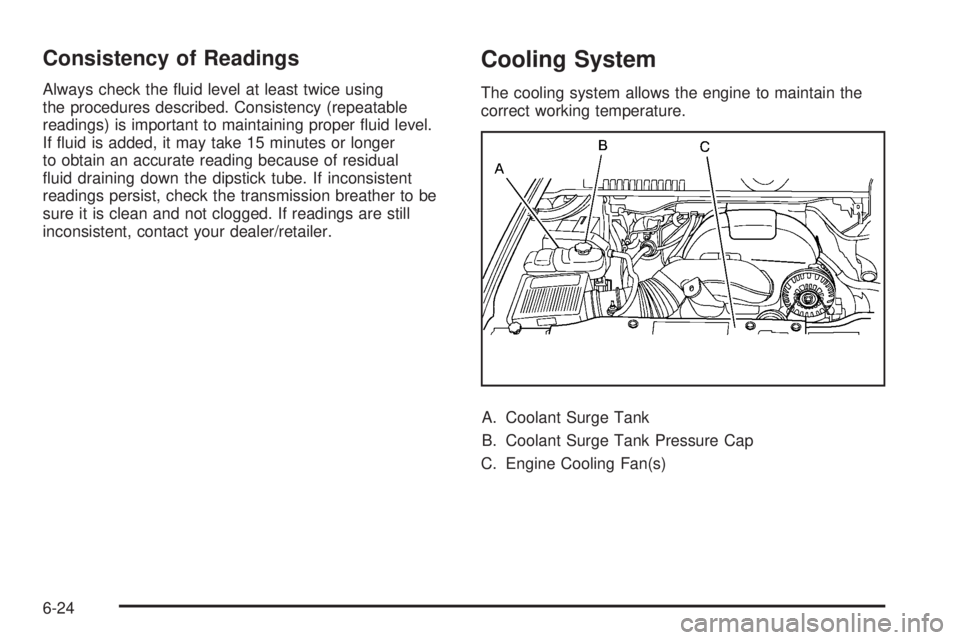
Cooling System The cooling system allows the engine to maintain the
correct working temperature.
A. Coolant Surge Tank
B. Coolant Surge Tank Pressure Cap
C. Engine Cooling Fan(s)
6-24
Page 459 of 602
{ CAUTION: An electric engine cooling fan under the hood can
start up even when the engine is not running and
can cause injury. Keep hands, clothing, and tools
away from any underhood electric fan.
{ CAUTION: Heater and radiator hoses, and other engine parts,
can be very hot. Do not touch them. If you do, you
can be burned.
Do not run the engine if there is a leak. If you run
the engine, it could lose all coolant. That could
cause an engine re, and you could be burned.
Get any leak xed before you drive the vehicle. Notice: Using coolant other than DEX-COOL ®
can
cause premature engine, heater core, or radiator
corrosion. In addition, the engine coolant could
require changing sooner, at 50 000 km (30,000 miles)
or 24 months, whichever occurs rst. Any repairs
would not be covered by the vehicle warranty.
Always use DEX-COOL ®
(silicate-free) coolant in the
vehicle.
Engine Coolant The cooling system in the vehicle is lled with
DEX-COOL ®
engine coolant. This coolant is designed
to remain in the vehicle for ve years or 150,000 miles
(240 000 km), whichever occurs rst.
The following explains the cooling system and how to
check and add coolant when it is low. If there is a
problem with engine overheating, see Engine
Overheating on page 6-30 .
6-25