2009 AUDI TT COUPE seats
[x] Cancel search: seatsPage 76 of 316
Seats and storage
App lies to veh ic les: wi th lumbar suppo rt
Lumbar support
The lumbar support can be adjusted to fit the natural
curvature of the occupant's spine .
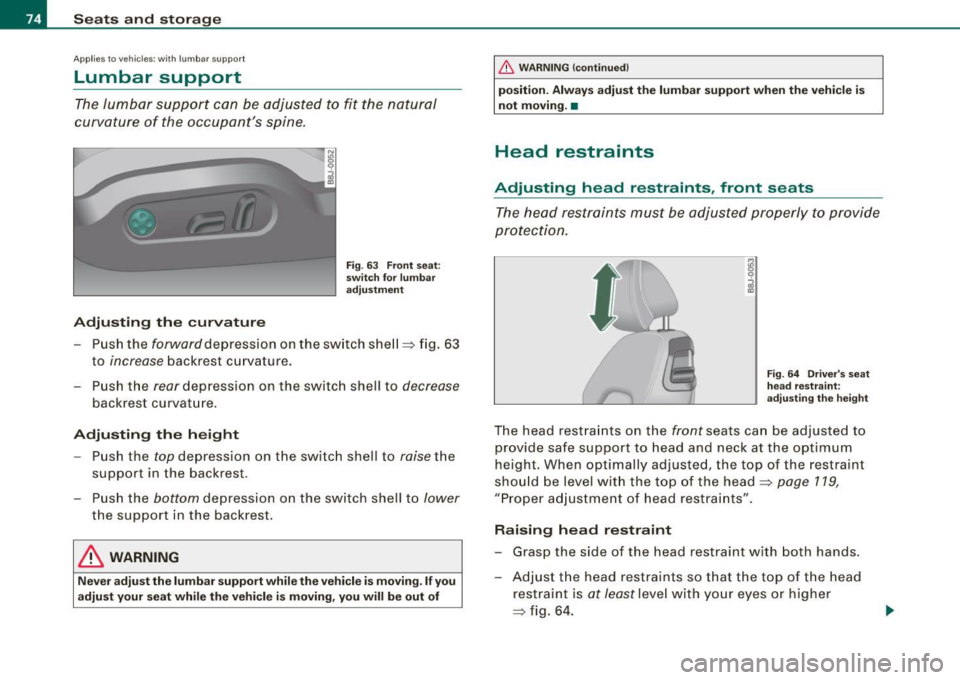
Adjusting the curvature
Fig. 63 Front seat:
switch for lumbar
adjustment
- Push the forward depression on the switch shell~ fig. 63
to
increase backrest curvatu re.
- Push the
rear depression on the switch shell to decrease
backrest curvature.
Adjusting the height
- Push the top depression on the sw itch shell to raise the
support in the backrest .
- Push the
bottom depression on the switch shell to lower
the support in the backrest.
& WARNING
Never adjust the lumbar support while the vehicle is moving. If you
adjust your seat while the vehicle is moving, you will be out of
& WARNING (continued)
position. Always adjust the lumbar support when the vehicle is
not moving. •
Head restraints
Adjusting head restraints , front seats
The head restraints must be adjusted properly to provide
protection.
Fig. 64 Driver's seat
head restraint:
adjusting the height
The head restraints on the front seats can be adjusted to
prov ide safe support to head and neck at the opt imum
height. When optimally adjusted, the top of the restra int
should be level with the top of the head~
page 119 ,
"Proper adjustment of head restraints" .
Raising head restraint
- Grasp the side of the head restraint with both hands .
- Adjust the head restraints so that the top of the head
r estraint is
at least level with your eyes or higher
~ fig. 64 .
Page 77 of 316
Lowering head restraint
- Grasp the sides of the head restraint with both hands.
-Press the button
=:> page 74, fig. 64 an d adjust the hea d
restraint .
- Adj us t the head restraints so tha t t he to p of th e he ad
re straint is
at least le vel with your eyes or higher
=:> page 7 4, fig . 64.
Refer to ~ page 119, "Prope r ad justment of head res traints" for
guide lines on how to ad just the height of the front head restraints
to fit the occupant 's body size.
& WARNING
• Driving without head restraint s or with head restraints that are
not properly adju sted increase s the ri sk of serious or fatal neck
injury dramatically .
• Read and heed all WARNINGS~
page 119.
[ i] Tips
Correctly adjusted head restraints and safety belts are an extremely
effective com bination of safety features. •
Controls and equip
ment
Seats and storage
Rear seats
General information
S a fe tr ansp ort atio n of passengers on t he re ar se ats
re quires prope r sa fety p rec autions.
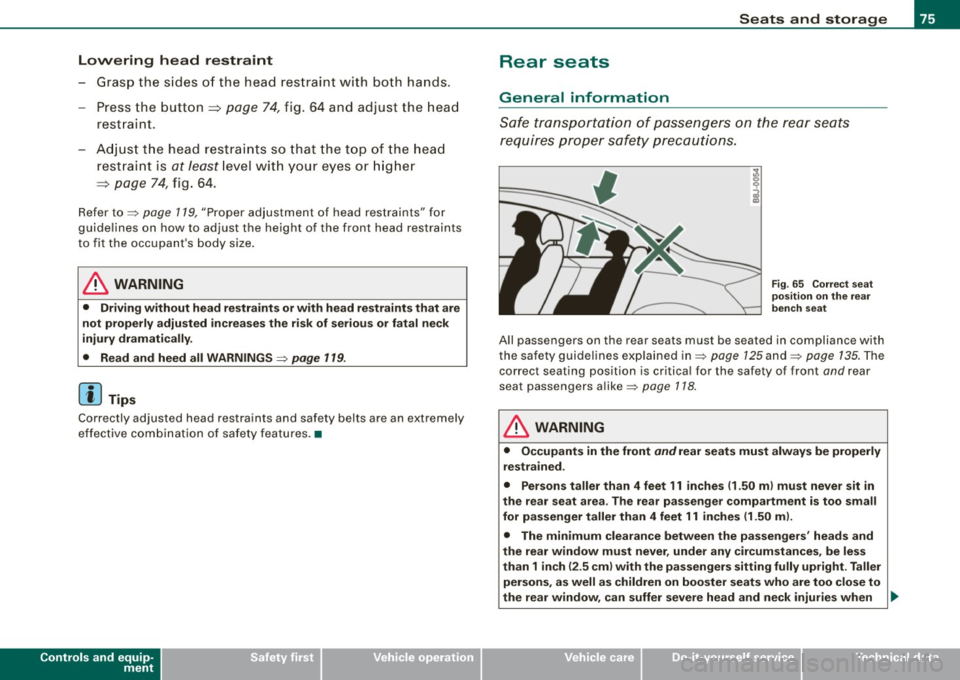
Fig . 6 5 Corre ct se at
po sit ion on the re ar
bench seat
All passengers on the rear seats must be seated in compliance with
the safety guidelines exp lained in~ page 125 and ~ page 135. The
correct seating position is critical for the safety of front and rear
seat passengers alike ~ page
118.
& WARNING
• Occupants in the front and rear seats must always be properly
restrained .
• Per sons taller than 4 feet 11 inche s (1.50
ml must never sit in
the rear seat area . The rear pas senger comp artment is too small
for passenger taller than 4 feet 11 inches (1 .50
ml.
• The min imum clearance between the pas sengers ' head s and
the rear window must never , under any cir cum stance s, be less
than 1 inch (2 .5 cm ) with the pa ssenger s sitting fully upright . Taller
persons , as well a s children on boo ster seats who are too clo se to
the rear windo w, can suffer severe head and neck injurie s when _,,
I • •
Page 78 of 316

Seats and storage
& WARNING (continued)
the rear lid is closed or if a crash occurs. Always make sure that
rear seat passengers cannot be struck when the rear lid is closed.
• When the rear backrest is folded down do not allow passengers
to occupy the load surface available while the vehicle is in motion.
Vehicle occupants must always be properly restrained.
• Never store any heavy, hard objects on the rear lid cover. This
can be hazardous for rear seat occupants if the rear lid is opened
or if the vehicle is braked suddenly or in the event of a crash.
• Loose items inside the passenger compartment, can fly
forward in a crash or sudden maneuver and injure occupants.
Always store articles in the luggage compartment and use the
fastening eyes, especially when the rear seat backs have been
folded down .
• Read and heed all WARNINGS=:>
page 118, "Proper seating
positions for passengers in rear seats". •
Rear window shelf
You can place light articles of clothing on the rear
window shelf behind the seatback.
& WARNING
Whenever you are driving, do not leave any hard objects on the
rear window shelf or allow your pet to sit on the shelf. These could
become a hazard for vehicle occupants in the event of sudden
braking or a crash!
[ i ] Tips
• A vent slot is located between the shelf and the rear window. Do
not block the vent with any items you may place on the rear window
shelf. •
Do not place bulky items on the rear window shelf as they would
restrict or block the driver's vision through the rear view mirror. •
Luggage compartment
Expanding the luggage compartment
You can increase the available luggage space by folding
the rear seatback down.
Tilting the seat back forward
Fig. 66 Unlocking lever
of the backrest (left
side)
Press the lever~ fig. 66 in the direction of the arrow.
Tilt the seat back forward.
Returning the seat back to its original position
-Tilt the seat back until it latches securely~&.
You can fold down both parts of the seatback either separately or
together to increase the size of the luggage compartment.
Stowing luggage
Follow instruction =:> page 121.
Page 79 of 316

& WARNING
• The ba ckrest must alw ay s be securely latched so that the
s afety belt can work properly to help protect the occupant .
• The ba ckres t must be se curely lat ched in position so that no
item s contained in the luggage compartment c an slide forward
upon sudden braking .
• Never allow safety belt s to become damaged by being caught
i n door or seat ha rd w are.
• Torn or fr ayed saf ety belt s can tear and da maged belt hardware
c an break in a cra sh . Inspe ct th e belts per iodi cally . Belts showing
dam age to webbing , binding s, buckle s, or retractor s mu st be
replaced .
& WARNING
Always read and heed WARNINGS ~ & in "Loading the luggage
c ompartment " on
page 1 21.
0 Note
When folding the backrest back into place, make sure the safety belt
does not get caught, because it can be damaged. A damaged belt
can fail to provide safe restraint .•
Con tro ls and eq uip
ment
Seats and storag e
Fastening eyelets
The l ugg age comp artment is equipped with four tie-down
eyelets to secure luggage and other items.
F ig . 67 Lu ggag e
co mpa rt m ent :
fa stening eye s
Use the tie-dow n eyelets to secure your cargo pro perly
~ fig . 67 -arrows- .
Read and heed all warnings~
page 121, "Stowing
luggage".
In a col lision, the laws of physics mean that even sma ller items that
are loose in the vehicle will turn into heavy m issiles that can cause
serious injury. Items in the vehicle pick up kinetic energy which
varies with vehicle and the weight of the item. The vehicle speed is
the most significant factor.
For example, in a frontal collision at a speed of 30 mph (48 km/h),
the fo rces ac ting on a 10 lbs (4.5 kg) object are about
20 times the
normal weight of the item. This means that the weight of the item
wo uld suddenly be about 200 lbs (90 kg) . One can easily imagine the
injuries that an item of that weight flying freely through the
passenger compartment can cause in a col lision at a speed consid -
ered relatively low .
~
Vehicle care I I irechnical data
Page 80 of 316

Seats and storage
& WARNING
Weak, damaged or improper straps used to secure items to tiedowns can fail during hard braking or in a collision and cause
serious personal injury.
• Always use suitable mounting straps and properly secure
items to the tie-downs in the luggage compartment to help
prevent items from shifting or flying forward as dangerous
missiles.
• When the rear seat backrest is folded down, always use suit
able mounting straps and properly secure items to the tie-downs
in the luggage compartment to help prevent items from flying
forward as dangerous missiles into the passenger compartment.
• Never attach a child safety seat tether strap to a tie-down. •
Applies to veh icles : w ith c arg o net
Elastic cargo net
The cargo net prevents light objects from sliding around
in the luggage compartment.
Fig. 68 Luggage
compartment: cargo
net
Securing objects to the luggage compartment
floor with the net
- Lay out the cargo net in the luggage compartment. Engage all
four hooks into the fastening eyes=> fig . 68.
- Place objects to be secured under the net.
Mounting hooks
There are two mounting hooks under rear window base inside the
luggage compartment . You can a ttach the cargo ne t as well as
light
objects to these hooks.
The mounting hooks are spring-loaded and will return to their
normal position wh en not in us e.
& WARNING
For strength-related reasons, the mounting hooks can only be
used to secure objects weighing up to 1 O lb. (5 kg). Heavier objects
will not be adequately secured -Risk of injury! •
Luggage compartment cover removal and
installation
The luggage compartment cover prevents people from
looking into the luggage compartment.
Fig. 69 Open rear lid
with luggage compart
ment cover
Removing the luggage compartment cover
- Pull the buttons G) => fig. 69
Page 81 of 316

-Pull the cover© out of the brackets 0 => fig. 69 in the
direction of the arrow.
Replacing the luggage compartment cover
-Push the cover up into the brackets 0-
- Press the buttons G) onto the ball heads.
& WARNING
Never store or place heavy objects on the luggage compartment
cover. If you leave something heavy on the cover and then open the
cover, the object could slide forward and injure anyone sitting in
the rear. Also, in the case of sudden braking or a crash, a heavy
object on the cover could fly forward and injure any passengers. •
Roof rack
First things first
A roof rack can be fitted to carry additional luggage on
the roof.
-Always read and follow the instructions provided by the
roof rack manufacturer when the roof rack system must
be installed.
If you are transporting luggage or other objects on the roof, please
note the following:
• Your vehicle has specially designed aerodynamic roof rails . Only
install a roof rack specifically designed for your model. Contact the
nearest Audi dealer for information on approved modular roof racks
for your vehicle.
• These approved roof racks are the basis for a complete roof rack
system. Additional attachments for the basic roof rack are neces-
Controls and equip
ment
Seats and storage
sary to safely transport luggage, bicycles, surf boards, skis or small
boats. All necessary hardware for these systems is available at your
authorized Audi dealer.
• We recommend that you keep the installation instructions for
your roof rack system together with your Owner's literature in the
vehicle.
When should the roof rack be removed?
• Before going through an automatic car wash (it is best to ask the
car wash operator for advice).
• When not in use , to reduce fuel consumption, wind noise and to
guard against theft.
& WARNING
• Use of an unapproved roof rack or incorrect mounting of an
approved roof rack can cause the roof rack or the items attached
to it to fall off the roof onto the road.
• Objects falling from the roof of a vehicle can cause a crash and
personal injury.
• Only mount the system between the markings shown in
~ page 80, fig. 70.
• The roof rack system must be installed exactly according to the
instructions provided.
0 Note
• Your vehicle warranty does not cover any damages to the vehicle
caused by using roof racks or mounting structures not approved by
Audi for your vehicle. The same applies to damage resulting from
incorrect roof rack installation .
• Always check the roof rack mountings and hardware before each
trip and during a trip to make sure everything is securely tightened.
If necessary, retighten the mountings and check the entire system
from time to time . .,,
I • •
Page 82 of 316

Seats and stor ag e
• After mounting a roof rack system, or when you transport
objects on the roof of your vehicle, the height of the vehicle is natu
rally increased . Be careful when driving under low bridges or in
parking garages for example. This cou ld cause damage to the load
and even the vehicle itself. •
Mounting locations
The roof rack must be attached only at the positioning
bolts.
Inst allati on
Fig . 7 0 M ounti ng l oca
tion s for roo f ra ck
When installing the feet make sure that they are positioned exactly
on the position ing bolts provided @ between the side panel and
the upper roof frame=> fig. 70. The positioning bolt is visible as
soon as the lip of the sealing strip is pushed back from the roof
frame with the tool provided. •
Loading the roof rack
Always distribute the loads evenly . M ake sure anything on
the roof rack is securely tied down.
- Always distr ibute the loads on the roo f rac k evenly . Always attach items t
o the roof rack sec urely bef ore you
d rive of f.
The maximum permiss ible roof weigh t is 16 5 lb (75 kgl. The roof
weight is made up of the weight of the roof rack system and the
we ight of the object being transported.
When using a roof rack system which has a lower load carrying
capacity, you must not use up the total maximum permissible load
carrying capacity specified above. Instead, you should load the roof
rack system only to the maximum capacity specified by the manu
facturer of the roof rack system .
& WARNING
Weak, d ama ged or imp rop er strap s used to se cure item s to the
roof ra ck c an f ail during hard braking or in a colli sion and cau se
s eriou s per sonal injury.
• Make sure the roof rack is installed e xactly a s specified abov e
=> page B O.
• Always use suitabl e mounting straps for securing i tems to the
roof ra ck to he lp prevent ite ms from s hifting or fly ing f orward .
• Items on the roof rack must alwa ys be securely mounted.
• The use of a roof rack can negatively affect the wa y a ve hicle
h andle s. Ca rgo that i s la rg e, heavy , bulky , long or fl at will hav e a
gr eater negative influen ce on th e vehicle' s aerodynamics , center
of gravity and overall handling . Al ways drive slowly , avo id sudden
br aking and man euver s when transport ing cargo on the roof of
y our vehicle.
• Never e xceed the ma ximu m permi ssible lo ad carr ying capac ity
of the roof of your vehic le , the permissible axle weights and the
perm is sible t ota l weight of your vehicle:::;,
page 289 , "Weight s".
• Alway s drive slowly , avoid sudden braking and maneuver s
when transport ing carg o on t he ro of of your vehi cle .
Page 83 of 316
<£> For the sake of the environment
Sometimes it may be easier to leave a roof rack installed even
though you are not using it . Due to the increased air resistance your
vehicle wi ll unnecessarily use more fuel. Remove the roo f rack if you
are not going to use it. •
Cup holder
Fig. 71 C up hol der
Two beverages can be carried in the cupholder .
& WARNING
Spilled hot liq uid ca n cause an a ccident and perso nal injury .
• Never carry any beverage container s with hot liquids , such a s
hot coffee or hot tea , in the vehicle while it i s moving . In case of an
accident , sudden braking o r other vehicle movement , hot liquid
c ould spill , cau sing scald ing burns . Spilled hot liquid c an also
c au se an accident and per sonal injury.
• Use only soft cups in the cupholder . Hard cups and gla sses c an
c au se injury in an accident .
• Never use the cupholder or adapter as an ashtray · risk of fire .
Con tro ls and eq uip
ment
Seats and storag e
0 Note
Only drink containers with lids should be carried in the cupholder.
Liquid cou ld spill out and damage your vehicles electronic equip
ment or stain the upho lstery, etc. •
Ashtray
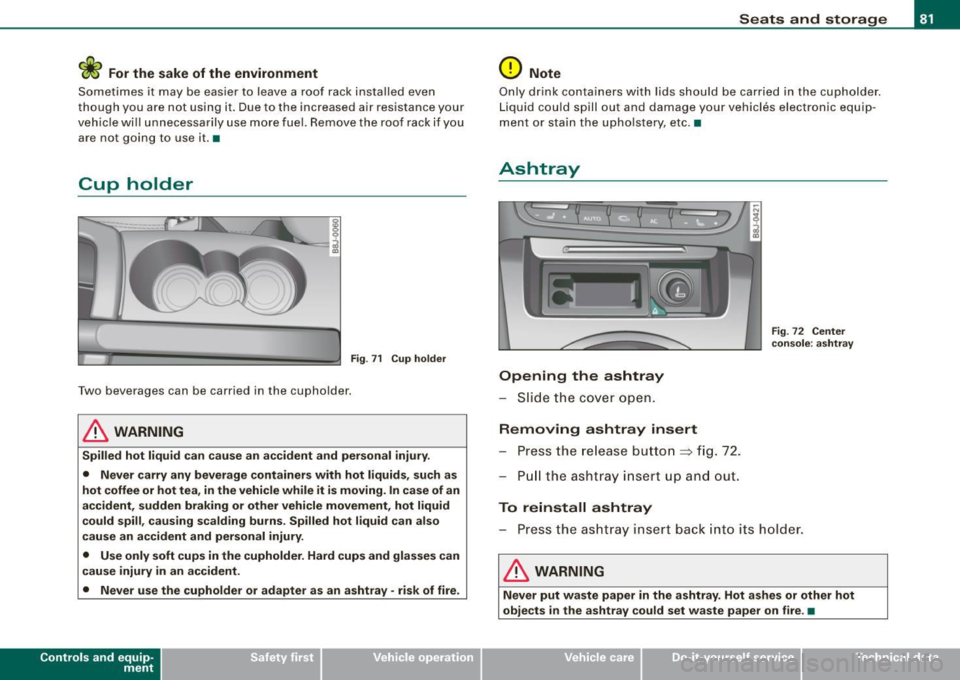
Opening the ashtray
- Slid e the cove r open.
Removing ashtray insert Press the re lease butto n
~ fig. 72.
P ull the ashtra y insert up and out .
To reinstall ashtray
F ig . 72 C enter
co nsole : a sht ray
- Press the ashtray insert back into its holder.
& WARNING
Nev er put w aste paper in the a shtr ay . Hot ashes or other hot
obje cts in the ashtr ay could set w aste paper on fire . •
Vehicle care I I irechnical data