2009 AUDI TT COUPE airbag
[x] Cancel search: airbagPage 72 of 316

Seats and storage
- Position the head restraint according to the occupant's height ~
page 74. For maximum protection, the top of
the head restraint should be at least at eye level, prefer
ably higher and ideally level with the top of the head
~ page 119, fig. 98.
& WARNING
Never place any objects in the driver's footwell. An object could
get into the pedal area and interfere with pedal function . In case
of sudden braking or an accident, you would not be able to brake
or accelerate! •
Front passenger's seat
Always move the front passenger seat into the rearmost position.
To avoid contact with the airbag while it is deploying, do not
sit any closer to the instrument panel than necessary and
always wear the three-point safety belt provided adjusted
correctly. We recommend that you adjust the passenger's
seat in the following manner :
- Move the front passenger seat into the rearmost position
of t he fore and aft adjustment range~
& in "Why is
your seat adjustment so important?" on
page 69.
- Bring the backrest up to an (a lmost) upright position . Do
not ride with the seat reclined.
- The ideal position for the head restraint is with the upper
edge of the restraint level with the top of your head
~ page 74. You should not lower the top of the restraint
below the level of your eyes. -
Place your feet on the floor in front of the passenger's
seat. •
Adjusting front seats manually
Applies to vehic les: with manua l seat ad justment
Adjustment controls
Various controls on the manual seats provide a wide
range for individual adjustments.
0 Moving the seat forward or backward
0 Adjusting the lumbar support~ page 74
® Adjusting the seat height
© Adjusting the seatback angle
© Releasing the seatback
[ i ] Tips
Fig. 58 Adjustment
controls: locations on
driver's seat
Some of the controls are fitted on certain models only or they are
optional equipment. •
Page 73 of 316
Applies to vehicles : wit h m anua l seat a djustment
Adjusting the manual seats
Position, angle and shape of the manual seats can be
adjusted to provide safe and comfortable seating.
Reed and heed all WARNINGS=:> & before you adjust your
seat.
Moving the front seats forward or backward
- Lift the lever (D =:> page 70, fig. 58 and slide the seat to
the desired position.
- Release the lever and then move the seat further until
you feel and hear it engage.
Adjusting the seat height
- Pull
the lever 0 up and pump it to raise the seat.
-Push the lever down and pump it to lower the seat.
Adjusting the seatback angle
-Lean forward to take your weight off the seatback.
- Turn the hand wheel© in the direction you want the
seatback to tilt .
Releasing seat back
-Pull the lever ® up.
- Push the seatback forward.
& WARNING
• Never adjust the driver's or front passenger's seat while the
vehicle is moving. If you do this while the vehicle is moving, you
Controls and equip
ment
Seats and storage
& WARNING (continued)
will be out of position . Always adjust the driver's or front
passenger's seat when the vehicle is not moving.
• Be careful when adjusting the seat height. Check to see that no
one is in the way, or serious injury could result!
• To reduce the risk of injury in the case of sudden braking or
accident, front passengers must never ride in a moving vehicle
with the seatback reclined . Safety belts and the airbag system
only offer maximum protection when the seatback is upright and
the safety belts are properly positioned on the body . The more the
seatback is reclined, the greater the risk of personal injury from an
incorrect seating position and improperly positioned safety
belts! •
Power seats
Applies to vehi cles : w it h p ower sea ts
Adjustment switches
The operating logic for the switches corresponds to the
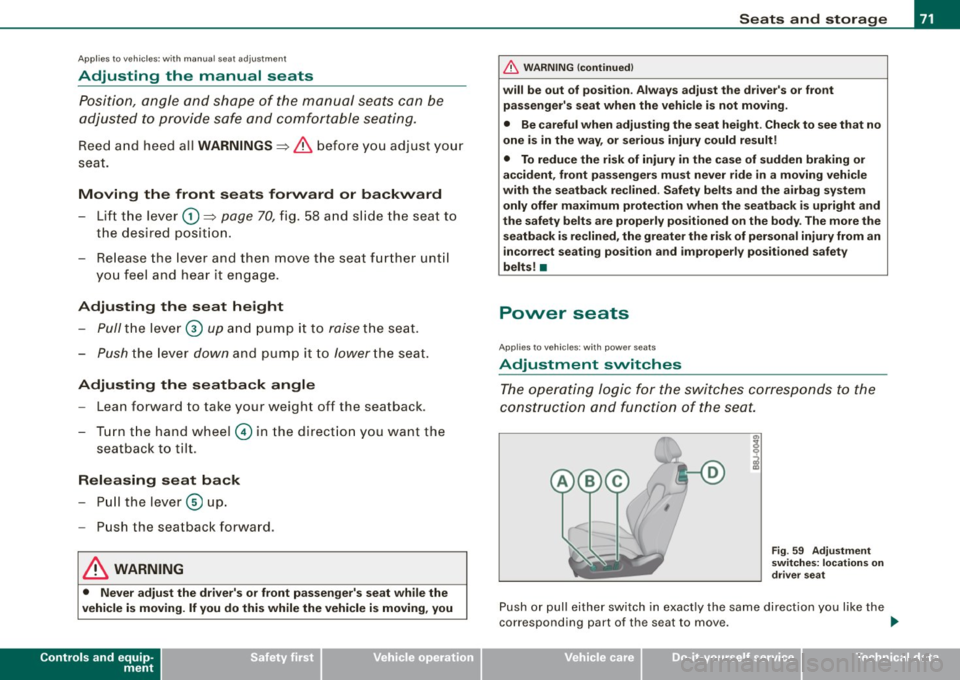
construction and function of the seat.
Fig. 59 Adjustment
switches: locations on
driver seat
Push or pull either switch in exactly the same direction you like the
corresponding part of the seat to move. ..,
I • •
Page 75 of 316
Applies to vehicles: wi th powe r seats
Adjusting the seatback
Fig . 61 Driver seat:
switch for seatback
adjustment
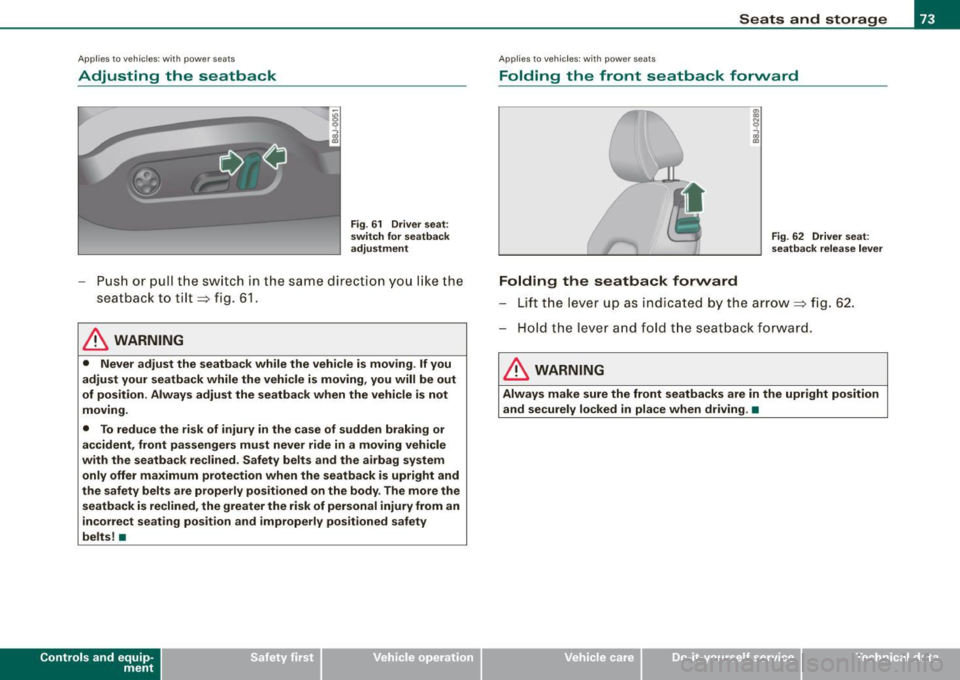
- Push or pull the switch in the same direction you like the
seatback to tilt => fig. 61.
& WARNING
• Never adjust the seatback while the vehicle is moving . If you
adjust your seatback while the vehicle is moving, you will be out
of position . Always adjust the seatback when the vehicle is not
moving.
• To reduce the risk of injury in the case of sudden braking or
accident, front passengers must never ride in a moving vehicle
with the seatback reclined. Safety belts and the airbag system
only offer maximum protection when the seatback is upright and
the safety belts are properly positioned on the body . The more the
seatback is reclined, the greater the risk of personal injury from an
incorrect seating position and improperly positioned safety
belts! •
Con tro ls and eq uip
ment
Seats and storage
A pp lies to vehicles: with power seats
Folding the front seatback forward
Folding the seatback forward
Fig. 62 Driver seat:
seatback release lever
Lift the lever up as indicated by the arrow=> fig. 62 .
Hold the lever and fold the seatback forward.
& WARNING
Always make sure the front seatbacks are in the upright position
and securely locked in place when driving . •
Vehicle care I I irechnical data
Page 85 of 316

Outlet
The o utle t in the fron t center cons ole may be used for 12 -
volt appliances .
-Fold the cove r for th e out let up.
- Plug in app lia nce to be used .
Fig . 7 4 Center
co nso le, fron t: 12 -vo lt
o utl et
The outlet may be used for 12-volt appliances with maximum
co nsumpt ion of up to 100 watts , such as a flash light. small vacuu m
cleaner , etc.
Before you purchase any accessories, a lways read and follow the
information in~
page 295, "Additiona l accessories and parts
replacement ".
& WARNING
The outlet plu s any appliances plugged into it remain functional
even if the ignition i s swit ched off or the ignition key i s removed .
Never l eave chi ldren in side the vehicle without supervision .
0 Note
To avoid damag ing the socket, only use plugs that fit properly.
Con tro ls and eq uip
ment
Seats and storag e
[ i ] Tips
Whe n the engine is off and accessories are stil l p lugged in and are
on, the vehicle battery can still be drained .•
Storage
General
& WARNING
• Alway s remo ve obje cts from the instrument panel. Any items
not put away could slide around in side the vehicle while driving or
when a ccelerating or when applying the br ake s or when driv ing
around a corner .
• When you are driving m ake sure t hat anything you may h ave
placed in the center con sole or oth er storage lo cations cannot fall
out into the foot wells . In case of sudden braking you would not be
able to brake , depres s the clut ch or accelerate .
• Any articles of clothing that you have hung up must n ot inter
fere with the driver' s view. The coa t hook s are de sig ned only for
lightwe ight clothing. Ne ver hang any clothing with hard , po inted
or heavy obj ects in the pockets on the coat ho oks . Dur ing sudden
braki ng or in an ac cident · especiall y if the airbag i s de plo yed ·
these ob je cts could injure any pa ssengers in side the vehicle . •
Vehicle care
I I irechnical data
Page 86 of 316

Seats and storage
Glove compartment
The glove compartment is illuminated and can be locked.
0 9
------------ i
To open glove compartment
Fig. 75 Glove compart
ment
-Pull the handle => fig. 75 in the direct ion of the arrow
push down lid to the fully open position.
To close glove compartment
- Push the glove compartment lid upward until the lock
engages.
CD changer*
The CD changer for the Sound System is located in the glove
compartmen t.
& WARNING
To reduce the risk of personal injury in an accident or sudden stop,
always keep the glove compartment closed while driving. •
Coat hooks
& WARNING
• Hang clothes in such a way that they do not impair the driver's
vision.
• The coat hooks must only be used for lightweight clothing. Do
not leave any heavy or sharp edged objects in the pockets which
may interfere with the side airbag deployment and can cause
personal injury in a crash.
• Do not hang heavy objects on the coat hooks, as they could
cause personal injury in a sudden stop. •
Applies to ve hi cle s: w ith sto rag e co mp art me nt in th e fr on t se at s
Storage compartment in the front seats
There is a fold-out storage compartment in the front of the
seats.
Opening
- Lift the handle and pull the drawer out .
Closing
- Push the drawer in completely until it latches.
[ i] Tips
The maximum carrying capacity 2.2 lbs (1 kg).•
Page 93 of 316

On the road
Steering
Adjusting the steering wheel column
The steering wheel position can be continuously adjusted
in height and distance.
First, adjust the driver's seat correctly.
Fig. 78 Lever under
the steering column
-Pu sh the lever~ fig. 78 -Arrow- ~& .
- Move the steering wheel to the desired position.
Pu sh the lever against the steering column until it locks.
T here must be at least 10 inches (25 cm) between your chest and the
center of the steering wheel. If you cannot sit more than 10 inches
(25 cm) from the steering wheel, see if adaptive equipment is avail
able to help you reach the pedals and increase the distance from the
steering wheel.
For detailed information on how to ad just the driver's seat, see
=> page
71.
Con tro ls and eq uip
ment
On the road
& WARNING
Improper use of steering wheel adjustment and improper seating
position can cause serious personal injury.
• Adjust the steering wheel column only when the vehicle is not
moving to prevent loss of vehicle control.
• Adjust the driver's seat or steering wheel so that there is a
minimum of 10 inches (25 cm) between your chest and the
steering wheel=> page 116, fig.
96. If you cannot maintain this
minimum distance , the airbag system cannot protect you prop
erly .
• If physical limitations prevent you from sitting 10 inches (25
cm) or more from the steering wheel, check with your authorized
Audi dealer to see if adaptive equipment is available.
• If the steering wheel is aligned with your face, the supple
mental driver's airbag cannot provide as much protection in an
accident. Always make sure that the steering wheel is aligned with
your chest .
• Always hold the steering wheel with your hands at the 9 o'clock
and 3 o'clock positions to reduce the risk of personal injury if the
driver's airbag deploys .
• Never hold the steering wheel at the
12 o'clock position or with
your hands inside the steering wheel rim or on the steering wheel
hub . Holding the steering wheel the wrong way can cause serious
injuries to the hands , arms and head if the driver's airbag
deploys .•
Vehicle care
I I irechnical data
Page 116 of 316

___ o_ r_iv _ i _n....; g::;_ S_ a_f _e _ly=-- -------------------------------------------------
Driving Safely
General notes
Safe driving habits
Please remember -safety first!
This chapter contains important information , tips, instructions and
warnings that you need to read and observe for your own safety, the
safety of your passengers and others. We have summarized here
what you need to know about safety belts, airbags, child restraints as well as child safety. Your safety is for us
priority number 1. Always
observe the information and warnings in this section -for your own
safety as well as for that of your passengers.
The information in this section applies to all model versions of your
vehicle. Some of the features described in this sections may be
standard equipment on some models, or may be optional equip
ment on others. If you are not sure, ask your authorized Audi dealer.
& WARNING
• Make certain that you follow the instructions and heed the
WARNINGS in this Manual. It is in your interest and in the interest of your passengers.
• Always keep the complete Owner's Literature in your Audi
when you lend or sell your vehicle so that this important informa
tion will always be available to the driver and passengers.
• Always keep the Owner's literature handy so that you can find
it easily if you have questions. •
Safety equipment
The safety features are part of the occupant restraint
system and work together to help reduce the risk of injury
in a wide variety of accident situations.
Your safety and the safety of your passengers should not be left to
chance. Advances in technology have made a variety of features
available to help reduce the risk of injury in an accident. The
following is a listing of just a few of the safety features in your Audi:
• sophisticated safety belts for driver and all passenger seating
positions,
• safety belt pre-tensioners,
• front airbags,
• knee airbags for the front seats,
• side airbags in the front seats,
• LATCH anchorages for child restraints,
• adjustable steering column .
These individual safety features can work together as a system to
help protect you and your passengers in a wide range of accidents.
These features cannot work as a system if they are not always prop
erly adjusted and properly used!
Safety is everybody's responsibility! •
Important things to do before driving
Safety is everybody's job! Vehicle and occupant safety
always depends on the informed and careful driver.
For your safety and the safety of your passengers, before
driving always: .,_
Page 118 of 316

___ D_ r_ i_v _in -= g;... S _ a_f _e _ly...._ ______________________________________________ _
Proper occupant seating positi·ons
Proper seating position for the driver
The proper driver seating position is important for safe,
relaxed driving.
"' N
;
Fig . 96 The correct
distance between
driver and steering
wheel
Fig. 97 Correct head
restraint position for
driver
For your own safety and to reduce the risk of injury in the
event of an accident, we recommend that you adjust the
driver's seat to the following position:
- Adjust the driver's seat so that you can easily push the
pedals all the way to the floor while keeping your knee(s)
slightly bent=:>& . - Adjust the angle
of the seatback so that it is in an upright
position so that your back comes in full contact with it
when you drive.
- Adjust the steering wheel so that there is a distance of at
least 10 inches (25 cm) between the steering wheel and
your breast bone=:> fig. 96. If not possible, see your
authorized Audi dealership about adaptive equipment.
- Adjust the steering wheel so that the steering wheel and
airbag cover points at your chest and not at your face.
- Grasp the top of the steering wheel with your elbow(s)
slightly bent.
- Adjust the head restraint so that the upper edge is as
even with the top of your head as possible but no lower
than eye level and so that it is as close to the back of your
head as possible =:> fig. 97.
- Fasten and wear safety belts correctly=:>
page 129.
- Always keep both feet in the footwell so that you are in
control of the vehicle at all times.
For detailed information on how to adjust the driver's seat, see
=> page 71.
& WARNING
Drivers who are unbelted, out of position or too close to the airbag
can be seriously injured by an airbag as it deploys. To help reduce
the risk of serious personal injury:
• Always adjust the driver's seat and the steering wheel so that
there are at least 10 inches
125 cm) between your breastbone and
the steering wheel. ..