Page 260 of 433

Press and release the Talk button.
If you say ‘‘No’’ af ter the beep, the
HFL system response is, ‘‘Security
willnotbeused.Thesystemsetup
is complete.’’
Press and release the Talk button.
Af ter the beep, say ‘‘Yes.’’ The
HFL response is ‘‘Security is on.
Each time the vehicle is turned on,
the passcode will be required to
use the system. The system setup
is complete. Returning to the main
menu.’’Press and release the Talk button.
Af ter the beep, say your f our-digit
passcode.Forexample,say‘‘1,2,3,
4.’’
If the passcode is correct, the HFL
response is ‘‘Main menu.’’ If the
passcode is not correct, the HFL
responseis‘‘1,2,3,4isincorrect.
Pleasetryagain.’’Gobacktothe
step 2.
If you f orget your passcode and you
cannot activate the HFL, consult
your dealer to cancel the passcode.
Once a passcode is set, you can lock
the HFL so it only operates after the
passcode is entered.
The HFL will prompt you f or your
passcode each time the ignition
switch is turned to the ON (II)
position and you press the Talk
button. You will only be asked f or
thepasscodeonceperignition
cycle. If the passcode is set, its
response is ‘‘The system is locked.
What is the f our-digit passcode?’’ 2.
3.
5.
6.
1.
To enter your passcode, do this;
BluetoothHandsFreeL ink
256
�\f���—�\f���—�
�
�y�
�������������y���
�(�)� �����\f�y�\f�����
�y
2009 RDX
Page 280 of 433
Holding the grip, pull the support
rod out of its clip. Insert the end
into the designated hole in the
hood.To close the hood, lif t it up slightly to
remove the support rod f rom the
hole. Put the support rod back into
its holding clip. Lower the hood to
about a f oot (30 cm) above the
f ender, then let it drop. Make sure it
is securely latched.
Wait a f ew minutes af ter turning the
engine of f bef ore you check the oil.
Park the vehicle on a level surf ace.Hold the dipstick with a clean
cloth or paper towel, and then
insert it all the way back in its hole.
Wipe of f the dipstick with a clean
cloth or paper towel.
Remove the dipstick (orange loop).
3.
3.
1.
2.
Service Station Procedures
Oil Check
276
GRIPCLIP
SUPPORT ROD DIPSTICK
�\f���—�\f���—�
�
�y�
�������������y���
�(�)� �����\f�y�\f�����
�y
2009 RDX
Page 290 of 433

Store or secure all items that could
be thrown around and hurt
someone during a crash.
Keep the glove box closed while
driving. If it is open, a passenger
could injure their knees during a
crash or sudden stop.
Be sure items placed on the f loor
behind the f ront seats cannot roll
underneath and interf ere with the
proper operation of the seats, the
sensors under the seats, or the
driver’s ability to operate the
pedals.
Do not put any items on top of the
cargo area cover. They can block
your view and be thrown around
the vehicle during a crash.If you carry large items that
prevent you f rom closing the
tailgate, exhaust gas can enter the
passenger area. To avoid the
possibility of
, f ollow the instructions
on page .
If you carry any items on a roof
rack,besurethetotalweightof
the rack and the items does not
exceed the maximum allowable
weight. Please contact your dealer
for further information.
Distribute cargo evenly on the
f loor of the cargo area, placing the
heaviest items on the bottom and
as far forward as possible. Tie
down items that could be thrown
about the vehicle during a crash or
sudden stop.
If youfoldtherearseatsdown,tie
down items that could be thrown
about the vehicle during a crash or
sudden stop. Also, keep all cargo
below the bottom of the windows.
If it is higher, it could interf ere
with the proper operation of the
side curtain airbags.
If you use an accessory roof rack,
the roof rack weight limit may be
lower. Ref er to the inf ormation that
came with your roof rack.If you carry any items on a roof
rack,besurethetotalweightof
the rack and the items does not
exceed 110 lbs (50 kg). 56
Carrying Cargo in the Passenger
Compartment
carbon monoxide
poisoning
Carrying Cargo in the Cargo A rea
or on a Roof Rack
Carrying Cargo
286
�\f���—�\f���—�
�
�y�
������
��
�\f�y���
�(�)� �����\f�y�\f�����
�y
2009 RDX
Page 291 of 433
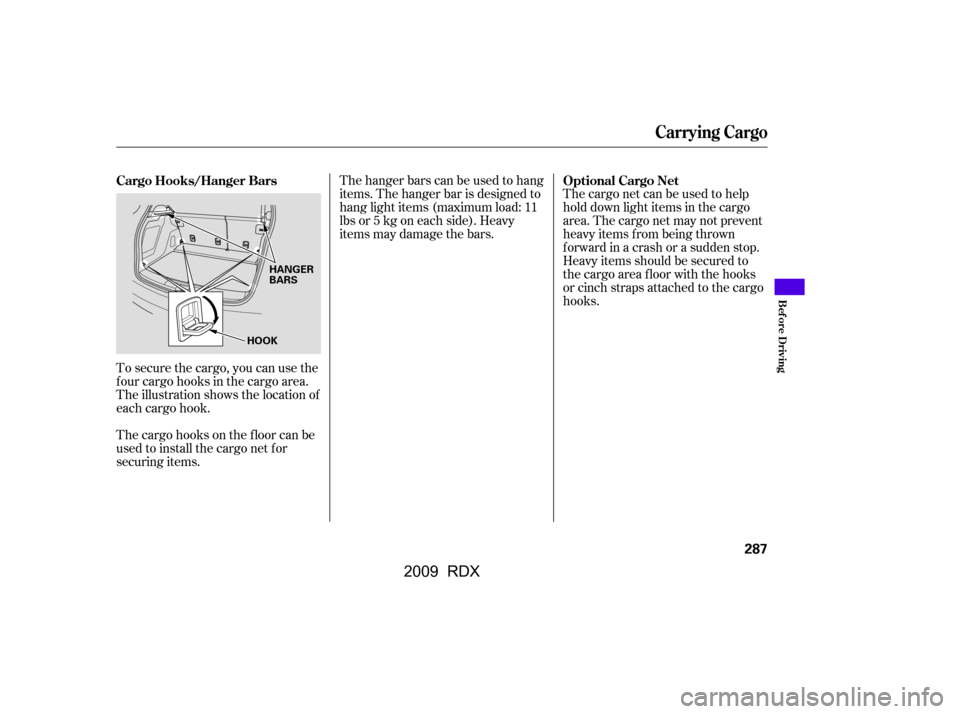
To secure the cargo, you can use the
f our cargo hooks in the cargo area.
The illustration shows the location of
each cargo hook.The cargo net can be used to help
hold down light items in the cargo
area. The cargo net may not prevent
heavy items f rom being thrown
f orward in a crash or a sudden stop.
Heavy items should be secured to
the cargo area floor with the hooks
or cinch straps attached to the cargo
hooks.
The hanger bars can be used to hang
items. The hanger bar is designed to
hang light items (maximum load: 11
lbs or 5 kg on each side). Heavy
items may damage the bars.
The cargo hooks on the f loor can be
used to install the cargo net f or
securing items.
Cargo Hooks/Hanger Bars Optional Cargo Net
Carrying Cargo
Bef ore Driving
287
HOOK HANGER
BARS
�\f���—�\f���—�
�
�y�
������
��
���y���
�(�)� �����\f�y�\f�������y
2009 RDX
Page 295 of 433

Check the seat adjustment (see
page ).
Check the adjustment of the
inside and outside mirrors (see
page ).
Check the steering wheel
adjustment (see page ).
Fasten your seat belt. Check that
your passengers have f astened
their seat belts (see page ). Make sure the doors and the
tailgate are securely closed and
locked.
Youshoulddothesechecksand
adjustments bef ore you drive your
vehicle:
Make sure all windows, mirrors,
and outside lights are clean and
unobstructed. Remove f rost, snow,
or ice.
Check that the hood is f ully closed.
Check that any items you may be
carrying are stored properly or
f astened down securely. Visually check the tires. If a tire
looks low, use a gauge to check its
pressure. When you start the engine, check
the gauges and indicators in the
instrument panel, and the
messages on the multi-inf ormation
display (see pages , and
).
1.
2.
3.
4. 5.
6.
7.
8.
9.
10.
119 14 61 71
77
131
143
Preparing to Drive
Driving
291
�����—�����—�
�
�y�
������
������y���
�(�)� �������y���������y
2009 RDX
Page 307 of 433

Always use the parking brake when
you park your vehicle. Make sure
the parking brake is set f irmly, or
your vehicle may roll if it is parked
on an incline.Make sure the moonroof and the
windows are closed.
If the vehicle is f acing uphill, turn
the front wheels away from the
curb.
If the vehicle is f acing downhill,
turn the front wheels toward the
curb.
Check the indicator on the
instrument panel to verif y that the
security system is set.
Make sure the parking brake is
f ully released bef ore driving away.
Driving with the parking brake
partially set can overheat or
damage the rear brakes.
Set the parking brake bef ore you put
the transmission in Park. This keeps
the vehicle from moving and putting
pressure on the parking mechanism
in the transmission.
Turn of f the lights.
Place any packages, valuables, etc.
in the cargo area or take them
with you.
Lock the doors and the tailgate.
Never park over dry leaves, tall
grass, or other f lammable
materials. The hot three way
catalytic converter could cause
these materials to catch on fire.
Parking T ips
Parking
Driving
303
�\f���—�\f���—�
�
�y�
���������
���y���
�(�)� �����\f�y�\f���\f���y
2009 RDX
Page 320 of 433

Trailer lights and equipment must
comply with f ederal, state/province,
and local regulations. Check with
your local trailer sales or rental
agencies f or the requirements in the
area where you plan to tow, and use
only equipment designed f or your
vehicle.
Acura requires that any trailer with a
total trailer weight of 1,000 lbs (455
kg) or more have its own brakes.
If you choose electric brakes, be
sure they are electronically actuated.
Do not attempt to tap into your
vehicle’s hydraulic system. No
matter how successf ul it may seem,
any attempt to attach trailer brakes
to your vehicle’s hydraulic system
will lower braking ef f ectiveness and
create a potential hazard.
Seeyourtrailerdealerorrental
agency f or more inf ormation on
installing electric brakes.
Any hitch used on your vehicle must
be properly bolted to the underbody.
Always use saf ety chains when you
tow a trailer. Make sure the chains
are secured to the trailer and hitch,
and that they cross under the tongue
and can catch the trailer if it
becomes unhitched. Leave enough
slack to allow the trailer to turn
corners easily, but do not let the
chains drag on the ground.
T railer L ights
Trailer Brakes
Hitches
Saf et y Chains
Towing a Trailer
316
�\f���—�\f���—�
�
�y�
���������\f���y���
�(�)� �����\f�y�\f�����
�y
2009 RDX
Page 322 of 433
The lights and brakes on your
vehicle and the trailer are working
properly.
When preparing to tow, and bef ore
driving away, be sure to check the
f ollowing: The trailer has been properly
serviced and is in good condition.
All weights and loads are within
limits.
Thehitch,safetychains,andany
other attachments are secure.
All items in or on the trailer are
properly secured and cannot shif t
while you drive.Your vehicle tires and spare are
properly inf lated, and the trailer
tires and spare are inflated as
recommended by the trailer
maker.
You may want to fill the fuel tank
with premium f uel. Premium f uel
provides improved perf ormance.
The vehicle has been properly
serviced, and the suspension,
cooling system, and lights are in
good operating condition.
Pre-T ow Checklist
Towing a Trailer
318
�\f���—�\f���—�
�
�y�
���������
���y���
�(�)� �����\f�y�\f�������y
2009 RDX