Page 120 of 148
8-37
1
2
3
4
5
6
78
9
10
11
WARNING
EWB02110
Operating with improperly serviced or adjust-
ed brakes could cause loss of braking ability,
which could lead to an accident.
After servicing:
�
Make sure the brakes operate smoothly and
that the brake pedal position is correct.
�
Make sure the brakes do not drag.
�
Make sure the brakes are not spongy. All air
must be bled from the brake system.
Replacement of brake components requires
professional knowledge. These procedures
should be performed by a Yamaha dealer.
EBU24710
Adjusting the parking brake free play
The parking brake free play must be checked and,
if necessary, adjusted at the intervals specified in
the periodic maintenance and lubrication chart.
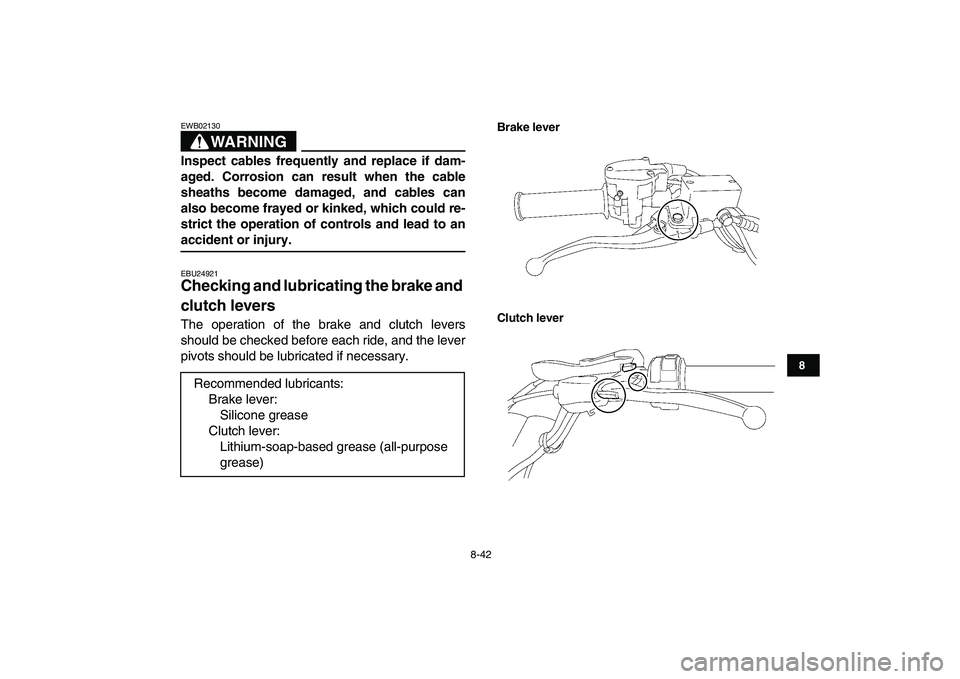
Cable length “A” should measure 47–51 mm (1.9–
2.0 in). Adjust the parking brake free play as fol-
lows.
1. Release the parking brake by moving the
1. Brake pedal position
1
1. Adjusting bolt
2. Cable length “A”
3. Locknut
2
3
1
Page 121 of 148
8-38
1
2
3
4
5
6
78
9
10
11
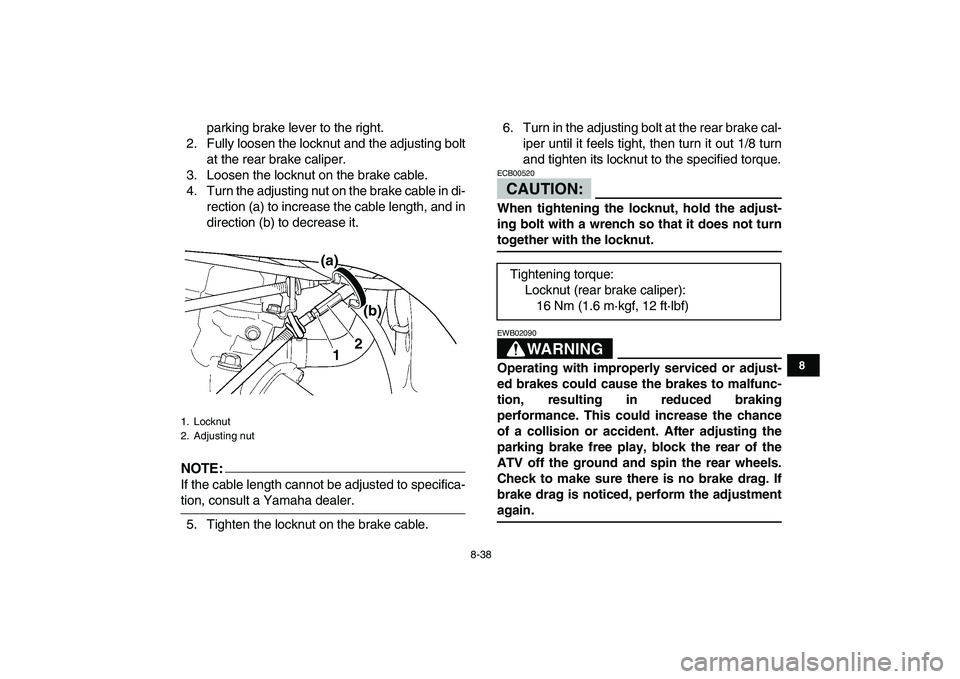
parking brake lever to the right.
2. Fully loosen the locknut and the adjusting bolt
at the rear brake caliper.
3. Loosen the locknut on the brake cable.
4. Turn the adjusting nut on the brake cable in di-
rection (a) to increase the cable length, and in
direction (b) to decrease it.
NOTE:
If the cable length cannot be adjusted to specifica-
tion, consult a Yamaha dealer.
5. Tighten the locknut on the brake cable.6. Turn in the adjusting bolt at the rear brake cal-
iper until it feels tight, then turn it out 1/8 turn
and tighten its locknut to the specified torque.CAUTION:
ECB00520
When tightening the locknut, hold the adjust-
ing bolt with a wrench so that it does not turn
together with the locknut.WARNING
EWB02090
Operating with improperly serviced or adjust-
ed brakes could cause the brakes to malfunc-
tion, resulting in reduced braking
performance. This could increase the chance
of a collision or accident. After adjusting the
parking brake free play, block the rear of the
ATV off the ground and spin the rear wheels.
Check to make sure there is no brake drag. If
brake drag is noticed, perform the adjustment
again.
1. Locknut
2. Adjusting nut
(a)
(b)
12
Tightening torque:
Locknut (rear brake caliper):
16 Nm (1.6 m·kgf, 12 ft·lbf)
Page 122 of 148
8-39
1
2
3
4
5
6
78
9
10
11
EBU24740
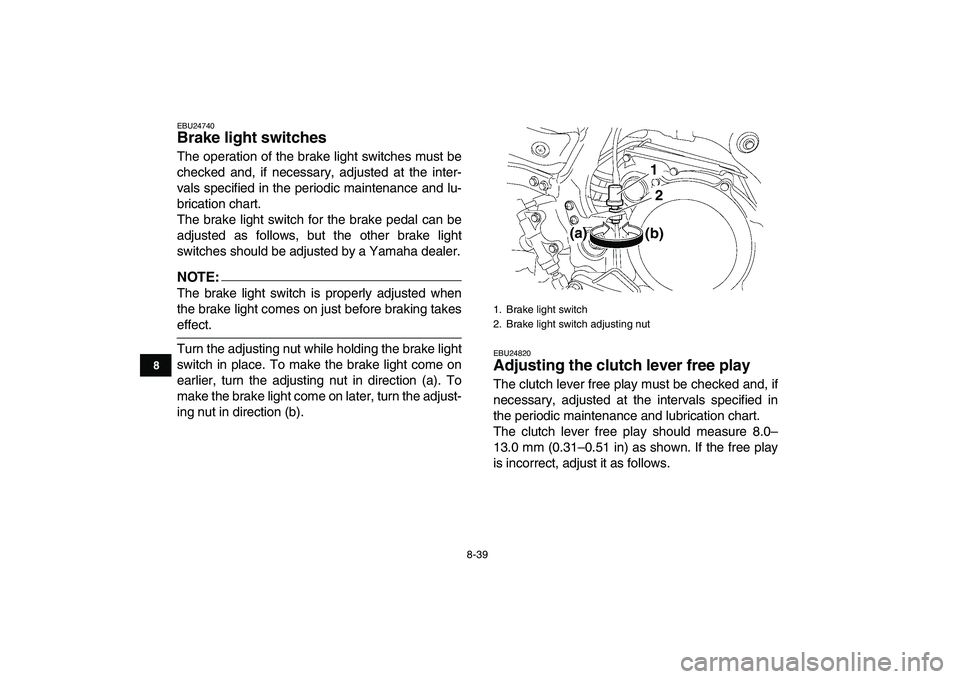
Brake light switches
The operation of the brake light switches must be
checked and, if necessary, adjusted at the inter-
vals specified in the periodic maintenance and lu-
brication chart.
The brake light switch for the brake pedal can be
adjusted as follows, but the other brake light
switches should be adjusted by a Yamaha dealer.
NOTE:
The brake light switch is properly adjusted when
the brake light comes on just before braking takes
effect.
Turn the adjusting nut while holding the brake light
switch in place. To make the brake light come on
earlier, turn the adjusting nut in direction (a). To
make the brake light come on later, turn the adjust-
ing nut in direction (b).
EBU24820
Adjusting the clutch lever free play
The clutch lever free play must be checked and, if
necessary, adjusted at the intervals specified in
the periodic maintenance and lubrication chart.
The clutch lever free play should measure 8.0–
13.0 mm (0.31–0.51 in) as shown. If the free play
is incorrect, adjust it as follows.
1. Brake light switch
2. Brake light switch adjusting nut
(a)
(b)1
2
Page 125 of 148
8-42
1
2
3
4
5
6
78
9
10
11
WARNING
EWB02130
Inspect cables frequently and replace if dam-
aged. Corrosion can result when the cable
sheaths become damaged, and cables can
also become frayed or kinked, which could re-
strict the operation of controls and lead to an
accident or injury.
EBU24921
Checking and lubricating the brake and
clutch levers
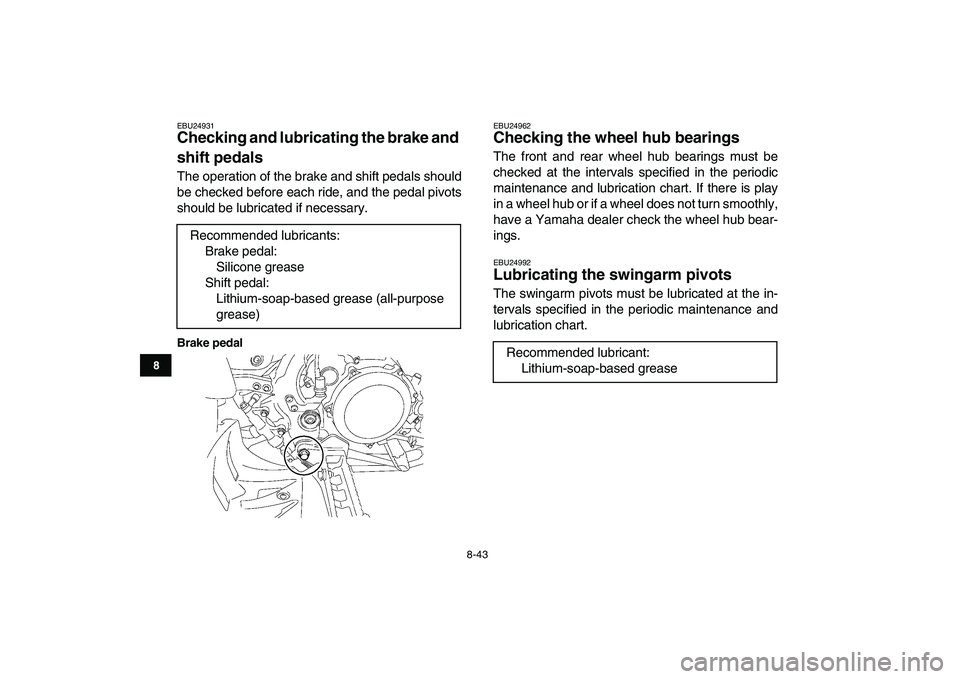
The operation of the brake and clutch levers
should be checked before each ride, and the lever
pivots should be lubricated if necessary.
Brake lever
Clutch lever
Recommended lubricants:
Brake lever:
Silicone grease
Clutch lever:
Lithium-soap-based grease (all-purpose
grease)
Page 126 of 148
8-43
1
2
3
4
5
6
78
9
10
11
EBU24931
Checking and lubricating the brake and
shift pedals
The operation of the brake and shift pedals should
be checked before each ride, and the pedal pivots
should be lubricated if necessary.
Brake pedal
EBU24962
Checking the wheel hub bearings
The front and rear wheel hub bearings must be
checked at the intervals specified in the periodic
maintenance and lubrication chart. If there is play
in a wheel hub or if a wheel does not turn smoothly,
have a Yamaha dealer check the wheel hub bear-
ings.
EBU24992
Lubricating the swingarm pivots
The swingarm pivots must be lubricated at the in-
tervals specified in the periodic maintenance and
lubrication chart. Recommended lubricants:
Brake pedal:
Silicone grease
Shift pedal:
Lithium-soap-based grease (all-purpose
grease)
Recommended lubricant:
Lithium-soap-based grease
Page 133 of 148
8-50
1
2
3
4
5
6
78
9
10
11
EBU25580
Replacing the tail/brake light bulb
If the tail/brake light bulb burns out, have a
Yamaha dealer replace it.
EBU25650
Removing a wheel
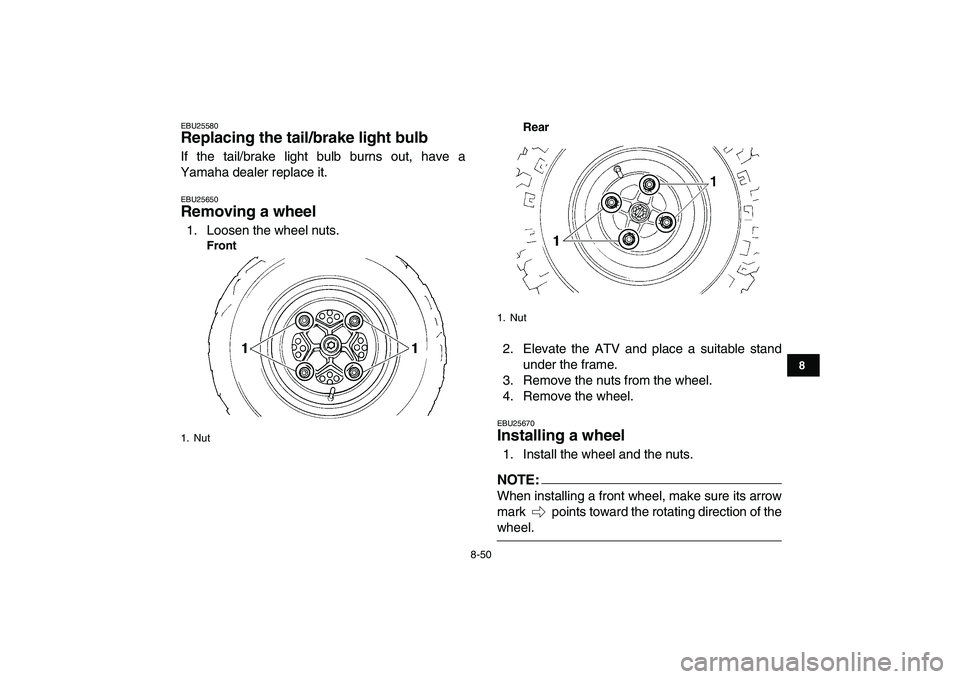
1. Loosen the wheel nuts.
FrontRear
2. Elevate the ATV and place a suitable stand
under the frame.
3. Remove the nuts from the wheel.
4. Remove the wheel.
EBU25670
Installing a wheel
1. Install the wheel and the nuts.
NOTE:
When installing a front wheel, make sure its arrow
mark points toward the rotating direction of the
wheel.
1. Nut
1. Nut
Page 137 of 148

9-1
1
2
3
4
5
6
7
89
10
11
EBU25860
CLEANING AND STORAGE
EBU25900
Cleaning
Frequent, thorough cleaning of your ATV will not
only enhance its appearance but will improve its
general performance and extend the useful life of
many components.
1. Before cleaning the ATV:
a. Block off the end of the exhaust pipe to
prevent water entry. A plastic bag and
strong rubber band may be used.
b. Make sure the spark plug and all filler caps
are properly installed.
2. If the engine case is excessively greasy, apply
degreaser with a paint brush. Do not apply de-
greaser to the chain, sprockets or wheel ax-
les.
3. Rinse the dirt and degreaser off with a garden
hose. Use only enough pressure to do the job.
CAUTION:
ECB00710
Excessive water pressure may cause water
seepage and deterioration of wheel bearings,
brakes, transmission seals and electrical de-
vices. Many expensive repair bills have result-ed from improper high-pressure detergent
applications such as those available in coin-
operated car washers.
4. Once most of the dirt has been hosed off,
wash all surfaces with warm water and mild,
detergent-type soap. An old toothbrush or bot-
tle brush is handy for hard-to-reach places.
5. Rinse the ATV off immediately with clean wa-
ter and dry all surfaces with a chamois, clean
towel or soft absorbing cloth.
6. Dry the chain and lubricate it to prevent it from
rusting.
7. Clean the seat with a vinyl upholstery cleaner
to keep the cover pliable and glossy.
8. Automotive type wax may be applied to all
painted and chrome plated surfaces. Avoid
combination cleaner-waxes. Many contain
abrasives which may mar the paint or protec-
tive finish. When finished cleaning, start the
engine and let it idle for several minutes.WARNING
EWB02310
Wet brakes may have reduced stopping ability,
Page 138 of 148
9-2
1
2
3
4
5
6
7
89
10
11
increasing the chance of an accident. Test the
brakes after washing. Apply the brakes several
times at slow speeds to let friction dry out the
linings.
EBU25932
Storage
Short-term
Always store your ATV in a cool, dry place and, if
necessary, protect it against dust with a porous
cover.
CAUTION:
ECB00720
�
Storing the ATV in a poorly ventilated room
or covering it with a tarp while it is still wet,
will allow water and humidity to seep in and
cause rust.
�
To prevent corrosion, avoid damp cellars,
stables (because of the presence of ammo-
nia) and areas where strong chemicals are
stored.
Long-term
Before storing your ATV for several months:
1. Follow all the instructions in the “Cleaning”section of this chapter.
2. Turn the fuel cock lever to “OFF”.
3. Drain the carburetor float chamber by loosen-
ing the drain bolt; this will prevent fuel deposits
from building up. Pour the drained fuel into the
fuel tank.
4. Fill up the fuel tank and add fuel stabilizer (if
available) to prevent the fuel from deteriorat-
ing.
5. Perform the following steps to protect the cyl-
inder, piston rings, etc. from corrosion.
a. Remove the spark plug cap and spark
plug.
b. Pour a teaspoonful of engine oil into the
spark plug bore.
c. Install the spark plug cap onto the spark
plug, and then place the spark plug on the
cylinder head so that the electrodes are
grounded. (This will limit sparking during
the next step.)
d. Turn the engine over several times with
the starter. (This will coat the cylinder wall Specified amount:
7.5 ml of stabilizer to each liter of fuel (or 1 oz
of stabilizer to each gallon of fuel)