Page 41 of 148
4-19
1
2
34
5
6
7
8
9
10
11
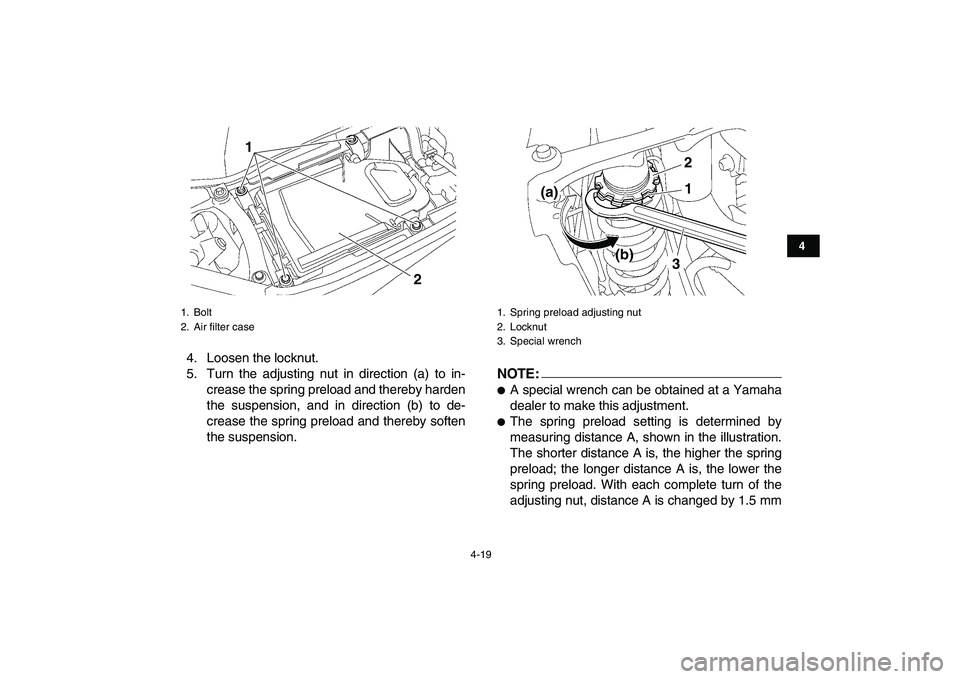
4. Loosen the locknut.
5. Turn the adjusting nut in direction (a) to in-
crease the spring preload and thereby harden
the suspension, and in direction (b) to de-
crease the spring preload and thereby soften
the suspension.NOTE:
�
A special wrench can be obtained at a Yamaha
dealer to make this adjustment.
�
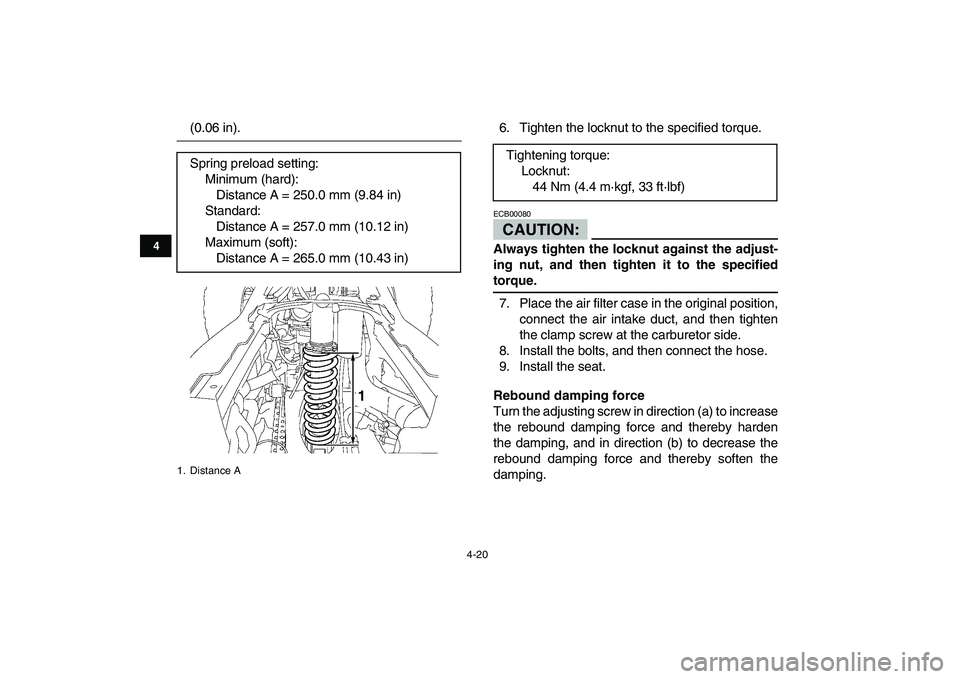
The spring preload setting is determined by
measuring distance A, shown in the illustration.
The shorter distance A is, the higher the spring
preload; the longer distance A is, the lower the
spring preload. With each complete turn of the
adjusting nut, distance A is changed by 1.5 mm
1. Bolt
2. Air filter case
2 1
1. Spring preload adjusting nut
2. Locknut
3. Special wrench
2
1
(a)
(b)
3
Page 42 of 148
4-20
1
2
34
5
6
7
8
9
10
11
(0.06 in). 6. Tighten the locknut to the specified torque.CAUTION:
ECB00080
Always tighten the locknut against the adjust-
ing nut, and then tighten it to the specified
torque.
7. Place the air filter case in the original position,
connect the air intake duct, and then tighten
the clamp screw at the carburetor side.
8. Install the bolts, and then connect the hose.
9. Install the seat.
Rebound damping force
Turn the adjusting screw in direction (a) to increase
the rebound damping force and thereby harden
the damping, and in direction (b) to decrease the
rebound damping force and thereby soften the
damping. Spring preload setting:
Minimum (hard):
Distance A = 250.0 mm (9.84 in)
Standard:
Distance A = 257.0 mm (10.12 in)
Maximum (soft):
Distance A = 265.0 mm (10.43 in)
1. Distance A
1
Tightening torque:
Locknut:
44 Nm (4.4 m·kgf, 33 ft·lbf)
Page 59 of 148
6-6
1
2
3
4
56
7
8
9
10
11
EBU20860
Parking on a slope
WARNING
EWB00850
Avoid parking on hills or other inclines. Park-
ing on a hill or other incline could cause the
ATV to roll out of control, increasing the
chance of an accident. If you must park on an
incline, place the ATV transversely across the
incline, shift into first gear, stop the engine, ap-
ply the parking brake, and then block the front
and rear wheels with rocks or other objects.
Do not park the ATV at all on hills that are so
steep you could not walk up them easily.
1. Bring the ATV to a stop by applying the brakes
in first gear.
2. Stop the engine and release the clutch lever.
3. With the rear brake applied, apply the parking
brake and slowly release the brake pedal.
EBU20910
Accessories and loading
EBU20920
Accessories
Accessories can affect the handling and control of
your ATV. Keep the following in mind when consid-
ering an accessory or operating an ATV which has
accessories.
1. Locked position
1
Page 67 of 148

7-6
1
2
3
4
5
67
8
9
10
11
Loading and accessories
As originally equipped, this ATV is not designed to
carry cargo or tow a trailer. If you choose to add ac-
cessories so that you can carry cargo or tow a trail-
er, you must use common sense and good
judgment.
Use extra caution when riding the ATV with addi-
tional loads, such as accessories or cargo. The
ATV’s handling may be adversely affected. Re-
duce your speed when adding additional loads.
WARNING
EWB01460
�
Never exceed the stated load capacity for
this ATV.
�
Cargo should be properly distributed and se-
curely attached.
�
Reduce speed when carrying cargo or pull-
ing a trailer. Allow greater distance for brak-
ing.
�
Always follow the instructions in your Own-
er’s Manual for carrying cargo or pulling a
trailer.
During operation
Always keep your feet on the footboards during op-
eration, otherwise they may contact the rear
wheels.
1. Adjusting screw
2. Locknut
2
1
MAXIMUM LOADING LIMIT
ATV loading limit (total weight of cargo, rider,
accessories, and tongue):
100.0 kg (220 lb)
Page 77 of 148
7-16
1
2
3
4
5
67
8
9
10
11
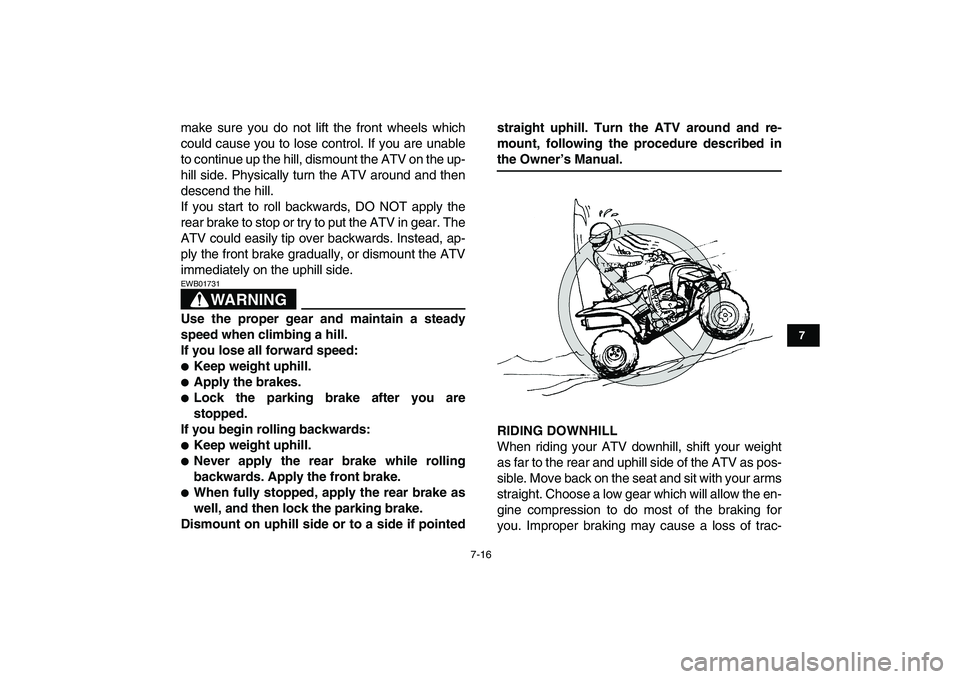
make sure you do not lift the front wheels which
could cause you to lose control. If you are unable
to continue up the hill, dismount the ATV on the up-
hill side. Physically turn the ATV around and then
descend the hill.
If you start to roll backwards, DO NOT apply the
rear brake to stop or try to put the ATV in gear. The
ATV could easily tip over backwards. Instead, ap-
ply the front brake gradually, or dismount the ATV
immediately on the uphill side.
WARNING
EWB01731
Use the proper gear and maintain a steady
speed when climbing a hill.
If you lose all forward speed:
�
Keep weight uphill.
�
Apply the brakes.
�
Lock the parking brake after you are
stopped.
If you begin rolling backwards:
�
Keep weight uphill.
�
Never apply the rear brake while rolling
backwards. Apply the front brake.
�
When fully stopped, apply the rear brake as
well, and then lock the parking brake.
Dismount on uphill side or to a side if pointedstraight uphill. Turn the ATV around and re-
mount, following the procedure described in
the Owner’s Manual.
RIDING DOWNHILL
When riding your ATV downhill, shift your weight
as far to the rear and uphill side of the ATV as pos-
sible. Move back on the seat and sit with your arms
straight. Choose a low gear which will allow the en-
gine compression to do most of the braking for
you. Improper braking may cause a loss of trac-
Page 94 of 148

8-11
1
2
3
4
5
6
78
9
10
11
dance with the periodic maintenance and lubrica-
tion chart. In addition, the condition of the spark
plug can reveal the condition of the engine.
To remove the spark plug
1. Remove the seat. (See page 4-11.)
2. Remove the bolts and the quick fastener
screws shown.
3. Remove the fuel tank cap by turning it coun-
terclockwise.
WARNING
EWB01870
�
Always turn off the engine before removing
the fuel tank cap.
�
Do not remove the fuel tank cap immediately
after the engine has been running and is still
very hot.
�
Do not spill gasoline on the engine, exhaust
pipe or muffler.
�
Never remove the fuel tank cap while smok-
ing, or in the vicinity of sparks, open flames,
or other sources of ignition such as the pilot
lights of water heaters and clothes dryers.
4. Pull the panel backward, and then remove the
panel.
5. Install the fuel tank cap by turning it clockwise.
6. Remove the bolt, lift the rear of the fuel tank,
and then tilt it back.
1. Panel
2. Bolt
3. Quick fastener screw
4. Fuel tank cap
2
4
3
1
Page 97 of 148

8-14
1
2
3
4
5
6
78
9
10
11
2. Clean the surface of the spark plug gasket
and its mating surface, and then wipe off any
grime from the spark plug threads.
3. Install the spark plug with the spark plug
wrench, and then tighten it to the specified
torque.
NOTE:
If a torque wrench is not available when installing
a spark plug, a good estimate of the correct torque
is 1/4–1/2 turn past finger tight. However, the spark
plug should be tightened to the specified torque as
soon as possible.
4. Install the spark plug cap.
5. Place the fuel tank in the original position, and
then install the bolt.
6. Remove the fuel tank cap by turning it coun-
terclockwise.
7. Place the panel in the original position.8. Install the fuel tank cap by turning it clockwise.
9. Install the bolts and the quick fastener screws.
10. Install the seat.
EBU23304
Engine oil and oil filter element
The engine oil level should be checked before
each ride. In addition, the oil must be changed and
the oil filter element replaced at the intervals spec-
ified in the periodic maintenance and lubrication
chart. Tightening torque:
Spark plug:
12.5 Nm (1.25 m·kgf, 9.0 ft·lbf)
1. Projection
2. Slot
21
Page 112 of 148

8-29
1
2
3
4
5
6
78
9
10
11
7. Start the engine and rev it up approximately
twenty times while momentarily creating ex-
haust system back pressure by blocking the
end of the muffler with a shop towel.
8. Stop the engine and allow the exhaust pipe to
cool.
9. Install the purging bolt and tighten it to the
specified torque.
WARNING
EWB02380
Never run the engine in an enclosed area when
purging the spark arrester, otherwise it could
cause injury to the eyes, burns, carbon monox-
ide poisoning, possibly leading to death, and
start a fire.
�
Always let the exhaust system cool prior to
touching exhaust components.
�
Always wear eye protection, and make sure
no one is behind the ATV.
�
Make sure there are no combustible materi-
als in the area.
EBU23940
Adjusting the carburetor
The carburetor should be checked and, if neces-
sary, adjusted at the intervals specified in the peri-
odic maintenance and lubrication chart. The
carburetor is an important part of the engine and
requires very sophisticated adjustment. Therefore,
most carburetor adjustments should be left to a
Yamaha dealer, who has the necessary profes-
sional knowledge and experience. The adjustment
described in the following section, however, may
be performed by the owner as part of routine main-
1. Purging bolt
2. Gasket
Tightening torque:
Purging bolt:
27 Nm (2.7 m·kgf, 20 ft·lbf)
1 2