2008 YAMAHA WR 250F lock
[x] Cancel search: lockPage 152 of 224

5-56
ENGINE REMOVAL
2. Install:• Lock washer "1"
• Nut (drive sprocket) "2"
Tighten the nut while applying the
rear brake.
3. Bend the lock washer tab to lock the nut.
4. Install: • Drive chain sprocket guide "1"
• Drive chain sp rocket cover "2"
• Screw (drive chain sprocket cov- er) "3"
INSTALLING THE NEUTRAL
SWITCH
1. Install: • Spring "1"
•Pin "2"
• O-ring "3"
• Neutral switch "4"
• Screw (neutral switch) "5"
Apply the lithium soap base grease
on the O-ring.
Nut (drive sprocket): 75 Nm (7.5 m•kg, 54
ft•lb)
Screw (drive chain
sprocket cover): 8 Nm (0.8 m•kg, 5.8
ft•lb)
Screw (neutral switch): 4 Nm (0.4 m•kg, 2.9
ft•lb)
Page 166 of 224

6-5
FRONT WHEEL AND REAR WHEEL
2. Install:• Brake disc "1"
• Bolt (brake disc) "2"
Tighten the bolts in stage, using a
crisscross pattern.
3. Install:• Rear wheel sprocket "1"
• Bolt (rear wheel sprocket) "2"
• Washer (rear wheel sprocket) "3"
• Nut (rear wheel sprocket) "4"
Tighten the nuts in stage, using a
crisscross pattern.
4. Install:•Collar "1"
Apply the lithium soap base grease
on the oil seal lip.
5. Install:• Wheel
Install the brake disc "1" between the
brake pads "2" correctly.
6. Install:• Drive chain "1"
Push the wheel "2" forward and install
the drive chain.
7. Install:
• Left drive chain puller "1"
• Wheel axle "2"
• Install the left drive chain puller, and insert the wheel axle from left side.
• Apply the lithium soap base grease
on the wheel axle.
8. Install:• Right drive chain puller "1"
• Washer "2"
• Nut (wheel axle) "3"
Temporarily tighten the nut (wheel
axle) at this point.
9. Adjust:• Drive chain slack "a"
Refer to "ADJUSTING THE
DRIVE CHAIN SLACK" section in
the CHAPTER 3. 10. Tighten:
• Nut (wheel axle) "1"
• Locknut "2"
Bolt (brake disc):
14 Nm (1.4 m•kg, 10
ft•lb)
Nut (rear wheel sprock-
et): 50 Nm (5.0 m•kg, 36
ft•lb)
Drive chain slack:48–58 mm (1.9–2.3 in)
Nut (wheel axle):
125 Nm (12.5 m•kg, 90
ft•lb)
Locknut: 19 Nm (1.9 m•kg, 13
ft•lb)
Page 171 of 224
6-10
FRONT BRAKE AND REAR BRAKE
HANDLING NOTE
Support the machine securely so
there is no danger of it falling over.
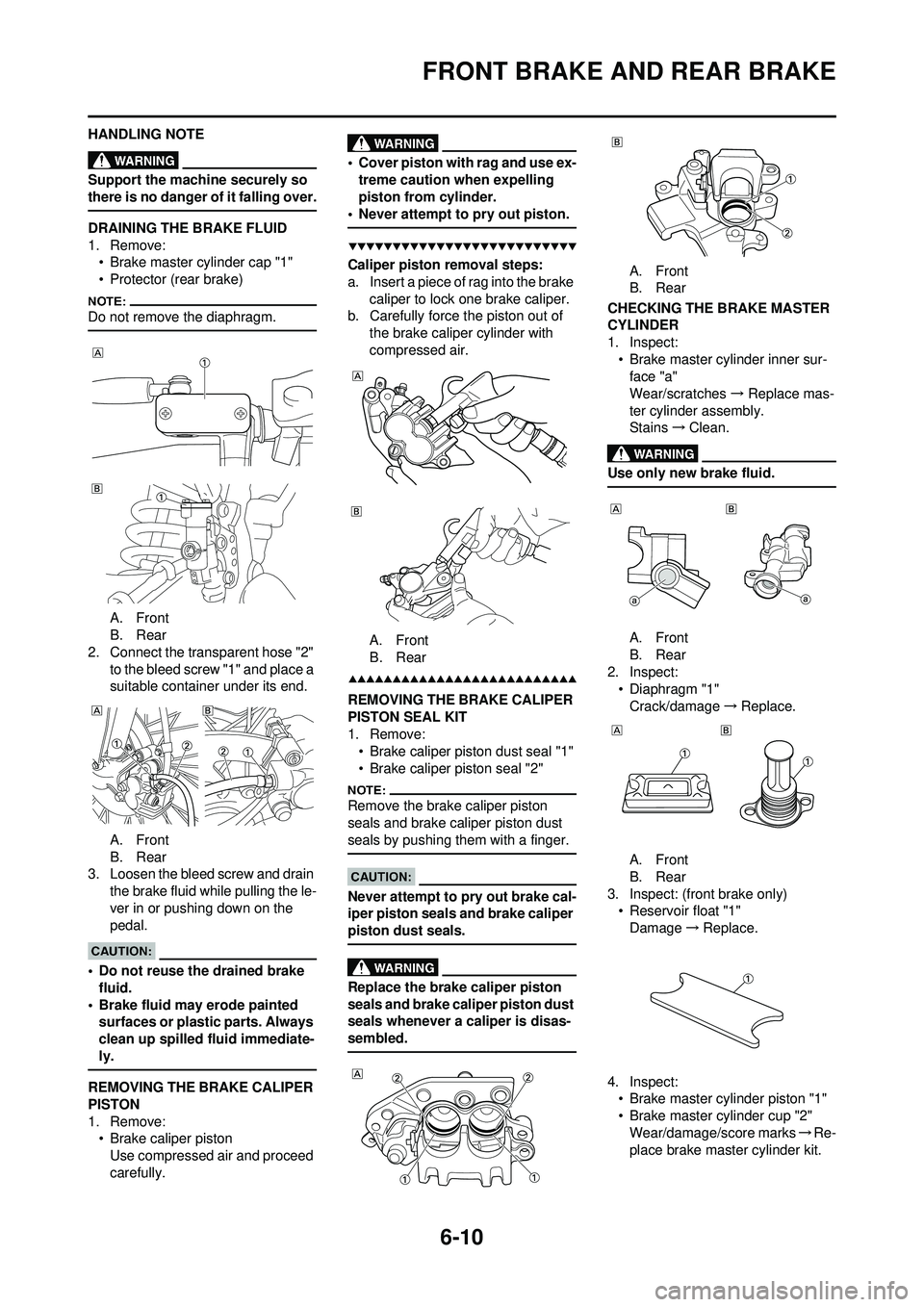
DRAINING THE BRAKE FLUID
1. Remove:• Brake master cylinder cap "1"
• Protector (rear brake)
Do not remove the diaphragm.
A. Front
B. Rear
2. Connect the transparent hose "2" to the bleed screw "1" and place a
suitable container under its end.
A. Front
B. Rear
3. Loosen the bleed screw and drain the brake fluid while pulling the le-
ver in or pushing down on the
pedal.
• Do not reuse the drained brake
fluid.
• Brake fluid may erode painted surfaces or plastic parts. Always
clean up spilled fluid immediate-
ly.
REMOVING THE BRAKE CALIPER
PISTON
1. Remove: • Brake caliper pistonUse compressed air and proceed
carefully.
• Cover piston with rag and use ex-treme caution when expelling
piston from cylinder.
• Never attempt to pry out piston.
Caliper piston removal steps:
a. Insert a piece of rag into the brake
caliper to lock one brake caliper.
b. Carefully force the piston out of the brake caliper cylinder with
compressed air.
A. Front
B. Rear
REMOVING THE BRAKE CALIPER
PISTON SEAL KIT
1. Remove:• Brake caliper piston dust seal "1"
• Brake caliper piston seal "2"
Remove the brake caliper piston
seals and brake caliper piston dust
seals by pushing them with a finger.
Never attempt to pry out brake cal-
iper piston seals and brake caliper
piston dust seals.
Replace the brake caliper piston
seals and brake caliper piston dust
seals whenever a caliper is disas-
sembled.
A. Front
B. Rear
CHECKING THE BRAKE MASTER
CYLINDER
1. Inspect: • Brake master cylinder inner sur-face "a"
Wear/scratches → Replace mas-
ter cylinder assembly.
Stains →Clean.
Use only new brake fluid.
A. Front
B. Rear
2. Inspect: • Diaphragm "1"Crack/damage →Replace.
A. Front
B. Rear
3. Inspect: (front brake only) • Reservoir float "1"
Damage →Replace.
4. Inspect: • Brake master cylinder piston "1"
• Brake master cylinder cup "2"Wear/damage/score marks →Re-
place brake master cylinder kit.
Page 175 of 224

6-14
FRONT BRAKE AND REAR BRAKE
3. Install:• Brake hose holder "1"
• Nut (brake hose holder) "2"
Align the top "a" of the brake hose
holder with the paint "b" of the brake
hose.
4. Pass the brake hose through the front brake hose guides "1".
5. Install: • Copper washer "1"
• Brake hose "2"
• Union bolt "3"
Always use new copper washers.
Install the brake hose so that it
contacts the brake master cylinder
projection "a" and that its bent
portion "b" faces downward.
INSTALLING THE REAR BRAKE
HOSE
1. Install:• Copper washer "1"
• Brake hose "2"
• Union bolt "3"
Always use new copper washers.
Install the brake hose so that its
pipe portion "a" directs as shown
and lightly touches the projection
"b" on the brake caliper.
2. Install:
• Brake hose holder "1"
• Screw (brake hose holder) "2"
After installing the brake hose
holders, make sure the brake hose
does not contact the spring (rear
shock absorber). If it does, correct
its twist.
FILLING THE BRAKE FLUID
1. Fill:• Brake fluidUntil the fluid level reaches
"LOWER" level line "a".
• Use only the designated quality brake fluid:
otherwise, the rubber seals may
deteriorate, causi ng leakage and
poor brake performance.
• Refill with the same type of brake fluid;
mixing fluids may result in a
harmful chemical reaction and
lead to poor performance.
• Be careful that water does not enter the master cylinder when
refilling. Water will significantly
lower the boiling point of the flu-
id and may result in vapor lock.
Brake fluid may erode painted sur-
faces or plastic parts. Always
clean up spilled fluid immediately.
A. Front
B. Rear
2. Air bleed: • Brake system
Refer to "BLEEDING THE HY-
DRAULIC BRAKE SYSTEM" sec-
tion in the CHAPTER 3.
Nut (brake hose holder):
7 Nm (0.7 m•kg, 5.1 ft
•lb)
Union bolt: 30 Nm (3.0 m•kg, 22
ft•lb)
Union bolt:30 Nm (3.0 m•kg, 22
ft•lb)
Screw (brake hose hold-
er): 2 Nm (0.2 m•kg, 1.4
ft•lb)
Recommended brake flu-
id: DOT #4
Page 179 of 224

6-18
FRONT FORK
HANDLING NOTE
Support the machine securely so
there is no danger of it falling over.
The front fork requires careful atten-
tion. So it is recommended that the
front fork be maintained at the deal-
ers.
To prevent an accidental explosion
of air, the following instructions
should be observed:
• The front fork with a built-in pis-ton rod has a very sophisticated
internal construction and is par-
ticularly sensitive to foreign ma-
terial. Use enough care not to
allow any foreign material to
come in when the oil is replaced
or when the front fork is disas-
sembled and reassembled.
• Before removing the cap bolts or front forks, be su re to extract the
air from the air chamber com-
pletely.
REMOVING THE FRONT FORK
CAP BOLT
1. Remove:
• Front fork cap bolt "1"From the outer tube.
Before removing the front fork from
the machine, loosen the front fork cap
bolt.
2. Remove:• Front fork cap bolt "1"
Hold the locknut "2" and remove the
front fork cap bolt.
REMOVING THE INNER TUBE
1. Remove:• Dust seal "1"
• Stopper ring "2"
Using slotted-head screwdriver.
Take care not to scratch the inner
tube.
2. Remove:• Inner tube "1"
Oil seal removal steps:
a. Push in slowly "a" the inner tube just before it bottoms out and then
pull it back quickly "b".
b. Repeat this step until the inner tube can be pulled out from the
outer tube.
REMOVING THE DAMPER ROD
1. Remove:• Base valve "1"
• Damper rod "2"
Use a damper rod holder "3" to lock
the damper rod.
CHECKING THE DAMPER ROD
1. Inspect:
• Damper rod "1"Bend/damage →Replace damper
rod.
The front fork with a built-in piston
rod has a very sophisticated inter-
nal construction and is particularly
sensitive to foreign material.
Use enough care not to allow any
foreign material to come in when
the oil is replaced or when the
front fork is disassembled and re-
assembled.
CHECKING THE BASE VALVE
1. Inspect: • Valve assembly "1"Wear/damage →Replace.
• O-ring "2" Damage → Replace.
CHECKING THE FORK SPRING
1. Measure: • Fork spring free length "a"Out of specification →Replace.
CHECKING THE INNER TUBE
1. Inspect: • Inner tube surface "a"Score marks →Repair or replace.
Use #1,000 grit wet sandpaper.
Damaged oil lock piece →Re-
place.
• Inner tube bends Out of specification →Replace.
Use the dial gauge "1".
Damper rod holder: YM-01494/90890-01494
Fork spring free length: 460 mm (18.1 in)
in)
Inner tube bending limit: 0.2 mm (0.008 in)
Page 180 of 224
6-19
FRONT FORK
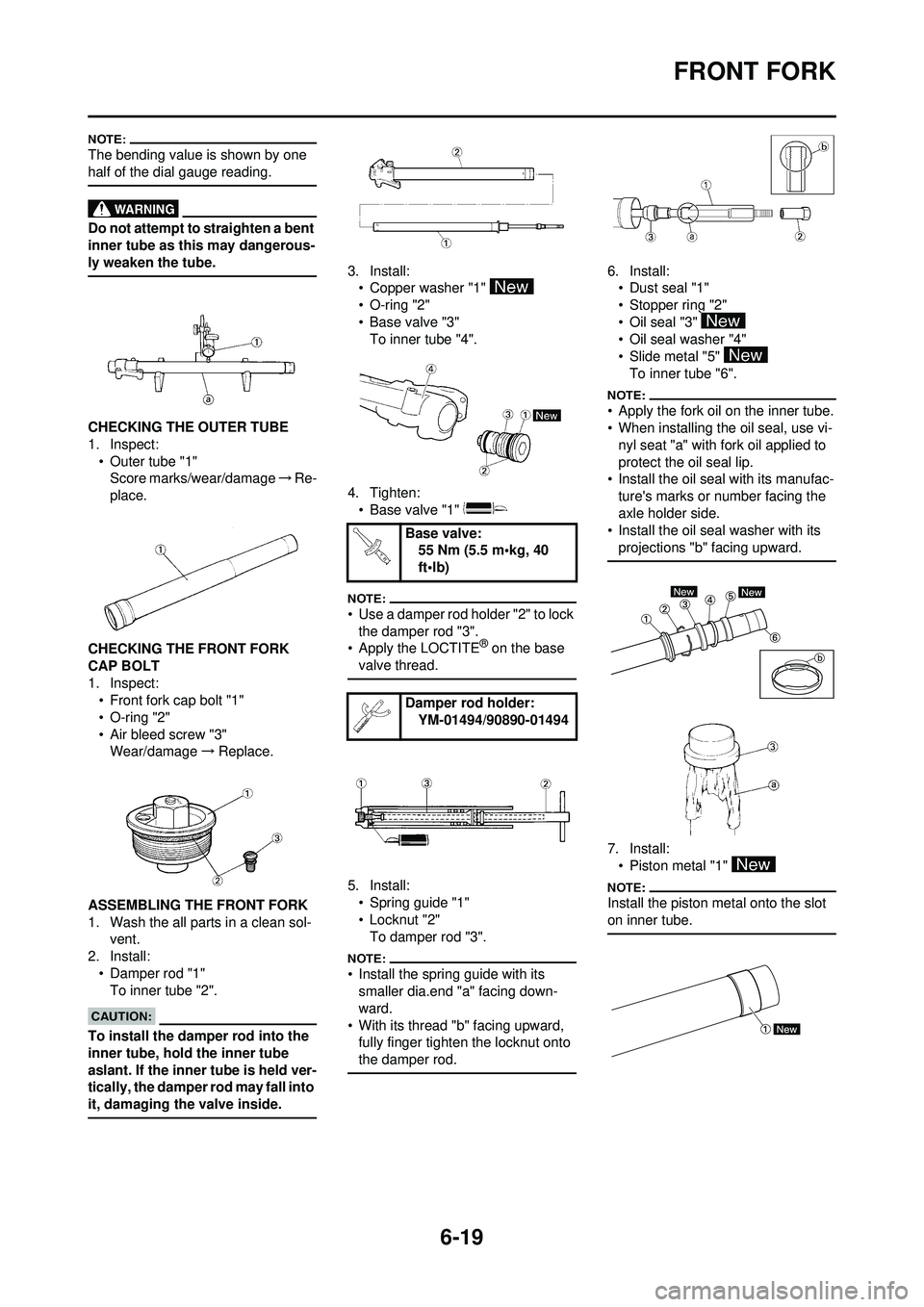
The bending value is shown by one
half of the dial gauge reading.
Do not attempt to straighten a bent
inner tube as this may dangerous-
ly weaken the tube.
CHECKING THE OUTER TUBE
1. Inspect:• Outer tube "1"Score marks/wear/damage →Re-
place.
CHECKING THE FRONT FORK
CAP BOLT
1. Inspect: • Front fork cap bolt "1"
• O-ring "2"
• Air bleed screw "3"Wear/damage →Replace.
ASSEMBLING THE FRONT FORK
1. Wash the all parts in a clean sol- vent.
2. Install: • Damper rod "1"To inner tube "2".
To install the damper rod into the
inner tube, hold the inner tube
aslant. If the inner tube is held ver-
tically, the damper rod may fall into
it, damaging the valve inside.
3. Install:• Copper washer "1"
• O-ring "2"
• Base valve "3"To inner tube "4".
4. Tighten: • Base valve "1"
• Use a damper rod holder "2" to lock the damper rod "3".
• Apply the LOCTITE
® on the base
valve thread.
5. Install: • Spring guide "1"
• Locknut "2"
To damper rod "3".
• Install the spring guide with its smaller dia.end "a" facing down-
ward.
• With its thread "b" facing upward, fully finger tighten the locknut onto
the damper rod.
6. Install:• Dust seal "1"
• Stopper ring "2"
• Oil seal "3"
• Oil seal washer "4"
• Slide metal "5" To inner tube "6".
• Apply the fork oil on the inner tube.
• When installing the oil seal, use vi-
nyl seat "a" with fork oil applied to
protect the oil seal lip.
• Install the oil seal with its manufac-
ture's marks or number facing the
axle holder side.
• Install the oil seal washer with its
projections "b" facing upward.
7. Install:• Piston metal "1"
Install the piston metal onto the slot
on inner tube.
Base valve: 55 Nm (5.5 m•kg, 40
ft•lb)
Damper rod holder: YM-01494/90890-01494
Page 182 of 224
6-21
FRONT FORK
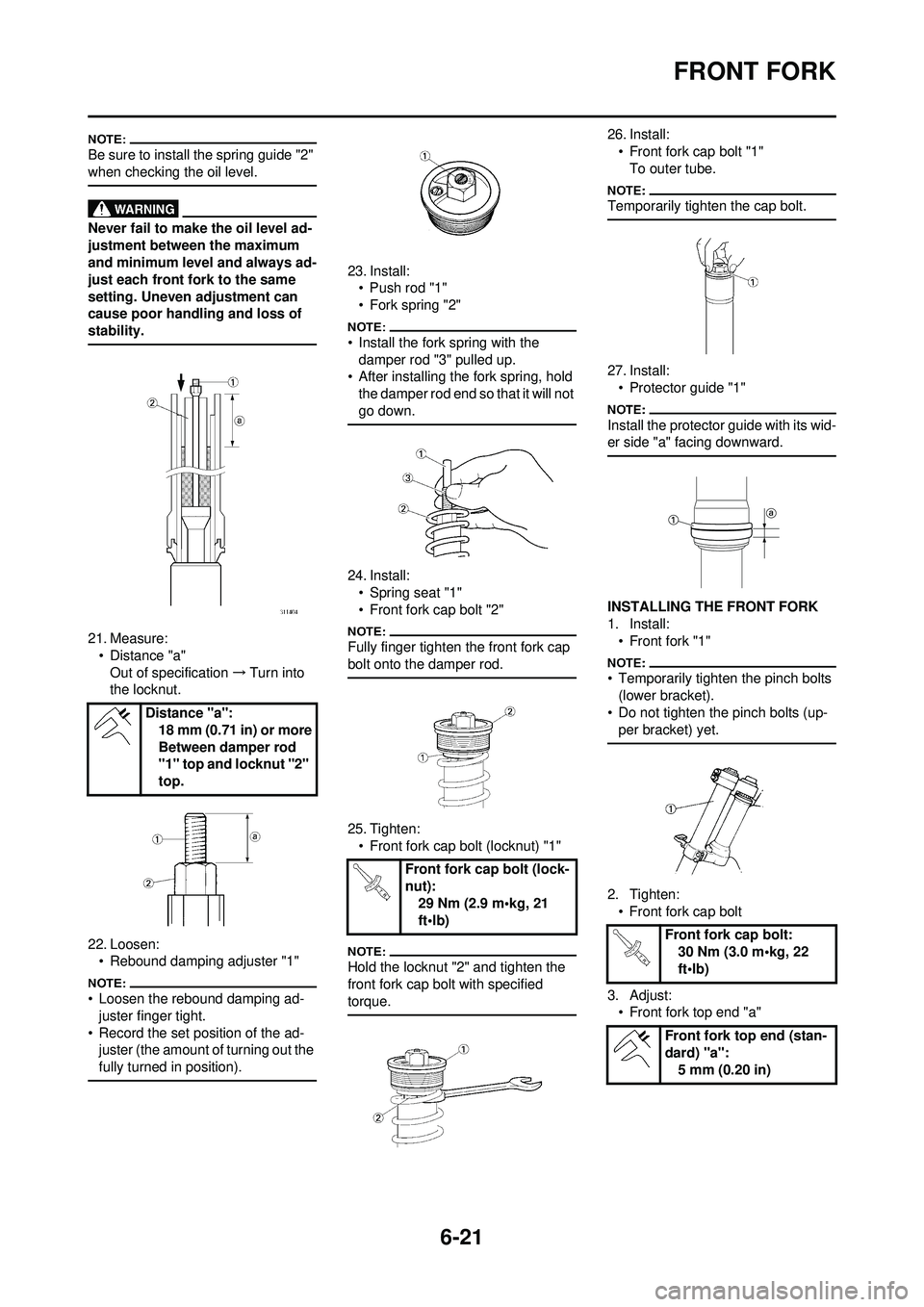
Be sure to install the spring guide "2"
when checking the oil level.
Never fail to make the oil level ad-
justment between the maximum
and minimum level and always ad-
just each front fork to the same
setting. Uneven adjustment can
cause poor handling and loss of
stability.
21. Measure: • Distance "a"
Out of specification →Turn into
the locknut.
22. Loosen: • Rebound damping adjuster "1"
• Loosen the rebound damping ad-juster finger tight.
• Record the set position of the ad- juster (the amount of turning out the
fully turned in position).
23. Install:• Push rod "1"
• Fork spring "2"
• Install the fork spring with the damper rod "3" pulled up.
• After installing the fork spring, hold
the damper rod end so that it will not
go down.
24. Install:• Spring seat "1"
• Front fork cap bolt "2"
Fully finger tighten the front fork cap
bolt onto the damper rod.
25. Tighten:• Front fork cap bolt (locknut) "1"
Hold the locknut "2" and tighten the
front fork cap bolt with specified
torque.
26. Install:
• Front fork cap bolt "1"To outer tube.
Temporarily tighten the cap bolt.
27. Install:
• Protector guide "1"
Install the protector guide with its wid-
er side "a" facing downward.
INSTALLING THE FRONT FORK
1. Install:• Front fork "1"
• Temporarily tighten the pinch bolts
(lower bracket).
• Do not tighten the pinch bolts (up- per bracket) yet.
2. Tighten:• Front fork cap bolt
3. Adjust: • Front fork top end "a"
Distance "a":
18 mm (0.71 in) or more
Between damper rod
"1" top and locknut "2"
top.
Front fork cap bolt (lock-
nut):29 Nm (2.9 m•kg, 21
ft•lb)
Front fork cap bolt: 30 Nm (3.0 m•kg, 22
ft•lb)
Front fork top end (stan-
dard) "a": 5 mm (0.20 in)
Page 190 of 224
6-29
STEERING
HANDLING NOTE
Support the machine securely so
there is no danger of it falling over.
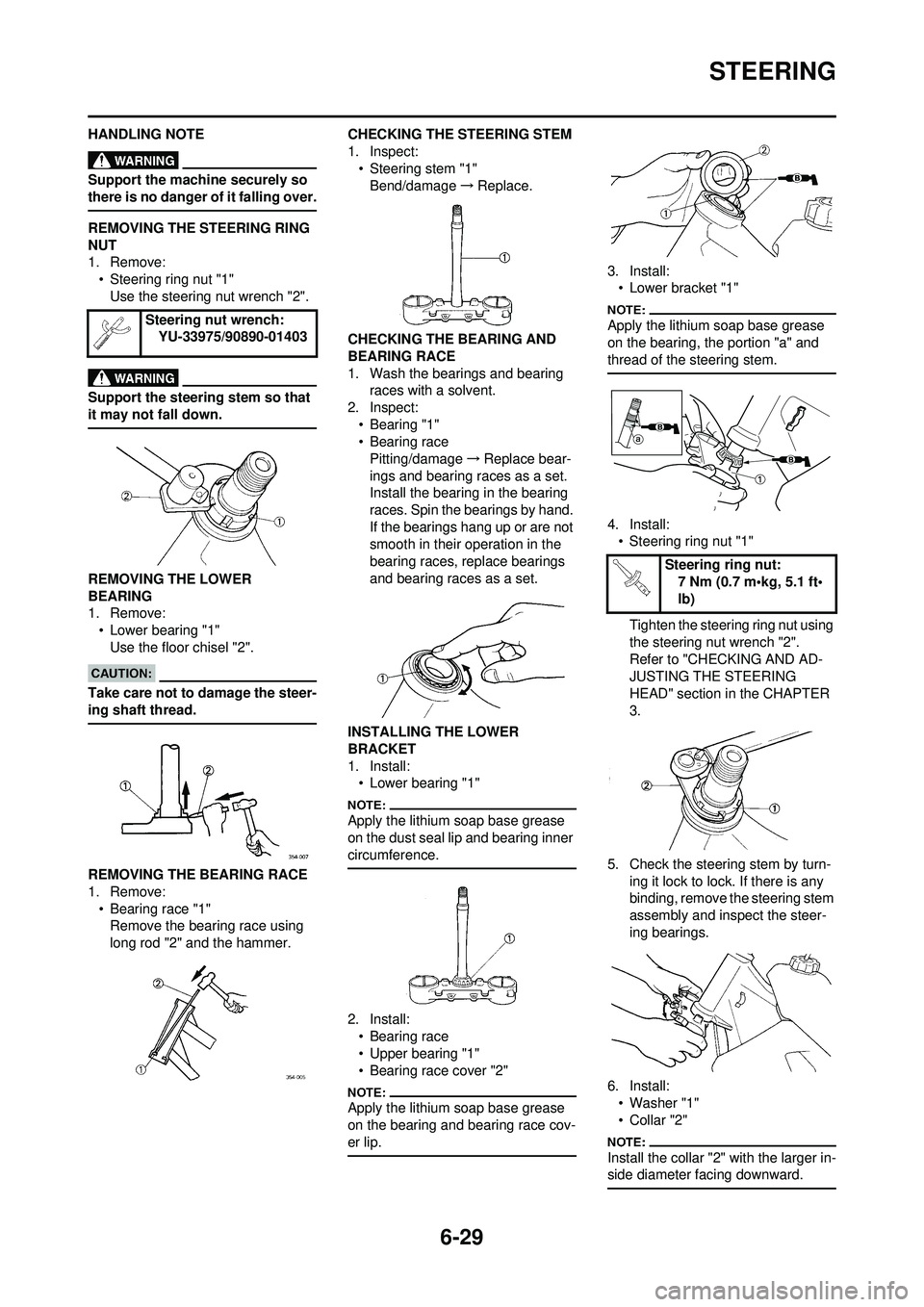
REMOVING THE STEERING RING
NUT
1. Remove:• Steering ring nut "1"Use the steering nut wrench "2".
Support the steering stem so that
it may not fall down.
REMOVING THE LOWER
BEARING
1. Remove:
• Lower bearing "1"Use the floor chisel "2".
Take care not to damage the steer-
ing shaft thread.
REMOVING THE BEARING RACE
1. Remove:
• Bearing race "1"Remove the bearing race using
long rod "2" and the hammer. CHECKING THE STEERING STEM
1. Inspect:
• Steering stem "1"Bend/damage →Replace.
CHECKING THE BEARING AND
BEARING RACE
1. Wash the bearings and bearing races with a solvent.
2. Inspect: •Bearing "1"
• Bearing race
Pitting/damage →Replace bear-
ings and bearing races as a set.
Install the bearing in the bearing
races. Spin the bearings by hand.
If the bearings hang up or are not
smooth in their operation in the
bearing races, replace bearings
and bearing races as a set.
INSTALLING THE LOWER
BRACKET
1. Install: • Lower bearing "1"
Apply the lithium soap base grease
on the dust seal lip and bearing inner
circumference.
2. Install:
• Bearing race
• Upper bearing "1"
• Bearing race cover "2"
Apply the lithium soap base grease
on the bearing and bearing race cov-
er lip.
3. Install:• Lower bracket "1"
Apply the lithium soap base grease
on the bearing, the portion "a" and
thread of the steering stem.
4. Install:• Steering ring nut "1"
Tighten the steering ring nut using
the steering nut wrench "2".
Refer to "CHECKING AND AD-
JUSTING THE STEERING
HEAD" section in the CHAPTER
3.
5. Check the steering stem by turn- ing it lock to lock. If there is any
binding, remove the steering stem
assembly and inspect the steer-
ing bearings.
6. Install: • Washer "1"
•Collar "2"
Install the collar "2" with the larger in-
side diameter facing downward.
Steering nut wrench: YU-33975/90890-01403
Steering ring nut:7 Nm (0.7 m•kg, 5.1 ft•
lb)