2008 YAMAHA WR 250F wheel
[x] Cancel search: wheelPage 79 of 224

3-24
CHASSIS
Do not force the adjuster past the
minimum or maximum extent of
adjustment. The adjuster may be
damaged.
CHECKING THE TIRE PRESSURE
1. Measure:• Tire pressure
Out of specification →Adjust.
• Check the tire while it is cold.
• Loose bead stoppers allow the tire
to slip off its position on the rim
when the tire pressure is low.
• A tilted tire valve stem indicates that
the tire slips off its position on the
rim.
• If the tire valve st em is found tilted,
the tire is considered to be slipping
off its position. Correct the tire posi-
tion.
CHECKING AND TIGHTENING THE
SPOKES
1. Inspect: • Spokes "1"Bend/damage →Replace.
Loose spoke →Retighten.
2. Tighten: • Spokes
Be sure to retighten these spokes be-
fore and after break-in. After a prac-
tice or a race check spokes for
looseness.
CHECKING THE WHEELS
1. Inspect:
• Wheel runoutElevate the wheel and turn it.
Abnormal runout → Replace.
2. Inspect: • Bearing free playExist play →Replace.
CHECKING AND ADJUSTING THE
STEERING HEAD
1. Elevate the front wheel by placing a suitable stand under the engine.
2. Check: • Steering stemGrasp the bottom of the forks and
gently rock the fork assembly
back and forth.
Free play →Adjust steering head.
3. Check: • Steering smooth actionTurn the handlebar lock to lock.
Unsmooth action →Adjust steer-
ing ring nut. 4. Adjust:
• Steering ring nut
Steering ring nut adjustment
steps:
a. Remove the headlight.
b. Remove the handlebar and upper bracket.
c. Loosen the steering ring nut "1" using the steering nut wrench "2".
d. Tighten the steering ring nut "3" using steering nut wrench "4".
• Apply the lithium soap base grease
on the thread of the steering stem.
• Set the torque wrench to the steer- ing nut wrench so that they form a
right angle.
e. Loosen the steering ring nut one turn.
f. Retighten the steering ring nut us- ing the steering nut wrench.
Avoid over-tightening.
Standard tire pressure:100 kPa (1.0 kgf/cm2,
15 psi)
Spokes: 3 Nm (0.3 m•kg, 2.2
ft•lb)
Steering nut wrench:YU-33975/90890-01403
Steering nut wrench: YU-33975/90890-01403
Steering ring nut (initial
tightening): 38 Nm (3.8 m•kg, 27
ft•lb)
Steering ring nut (final
tightening): 7 Nm (0.7 m•kg, 5.1
ft•lb)
Page 92 of 224

4-5
CHASSIS
CHASSIS
SELECTION OF THE SECONDARY
REDUCTION RATIO (SPROCKET)
• It is generally said that the second-ary gear ratio should be reduced for
a longer straight portion of a speed
course and should be increased for
a course with many corners. Actual-
ly, however, as the speed depends
on the ground condition of the day
of the race, be sure to run through
the circuit to set the machine suit-
able for the entire course.
• In actuality, it is very difficult to
achieve settings suitable for the en-
tire course and some settings may
be sacrificed. Thus, the settings
should be matched to the portion of
the course that has the greatest ef-
fect on the race result. In such a
case, run through the entire course
while making notes of lap times to
find the best balance; then, deter-
mine the secondary reduction ratio.
• If a course has a long straight por-
tion where a machine can run at
maximum speed, the machine is
generally set such that it can devel-
op its maximum revolutions toward
the end of the straight line, with care
taken to avoid the engine over-rev-
ving.
Riding technique varies from rider to
rider and the performance of a ma-
chine also vary fr om machine to ma-
chine. Therefore, do not imitate other
rider's settings from the beginning but
choose your own setting according to
the level of your riding technique.
DRIVE AND REAR WHEEL
SPROCKETS SETTING PARTS
TIRE PRESSURE
Tire pressure should be adjust to suit
the road surface condition of the cir-
cuit.
• Under a rainy, muddy, sandy, or slippery condition, the tire pressure
should be lower for a larger area of
contact with the road surface. • Under a stony or hard road condi-
tion, the tire pressure should be
higher to prevent a flat tire.
FRONT FORK SETTING
The front fork setting should be made
depending on the rider's feeling of an
actual run and the circuit conditions.
The front fork setting includes the fol-
lowing three factors:
1. Setting of air spring characteris- tics
• Change the fork oil level.
2. Setting of spring preload • Change the spring.
• Install the adjustment washer.
3. Setting of damping force • Change the compression damp-
ing.
• Change the rebound damping. The spring acts on the load and
the damping force acts on the
cushion travel speed.
CHANGE IN LEVEL AND
CHARACTERISTICS OF FORK OIL
Damping characteristic near the final
stroke can be changed by changing
the fork oil amount.
Adjust the oil level in 5 mm (0.2 in)
increments or decrements. Too
low oil level caus es the front fork
to produce a noise at full rebound
or the rider to feel some pressure
on his hands or body. Alternative-
ly, too high oil level will develop
unexpectedly early oil lock with
the consequent shorter front fork
travel and deteriorated perfor-
mance and characteristics. There-
fore, adjust the front fork within
the specified range.
Secondary reduction ratio =
Number of rear wheel sprocket
teeth/Number of drive sprocket
teeth
Standard secondary
reduction ratio 50/13
(3.846)
* 47/14
(3.357)
* For EUROPE
Part
name Size Part number
Drive
sprocket
"1" (STD) 13T 9383B-13218
** (STD) * 14T 9383B-14222
Rear
wheel
sprocket
"2" ** (STD) ** 47T 1C3-25447-00 48T 5GS-25448-50
* 48T 1C3-25448-00
* 49T 1C3-25449-00
(STD) 50T 5TJ-25450-80
* (STD) * 50T 1C3-25450-00 * 51T 1C3-25451-0052T 5TJ-25452-80
* 52T 1C3-25452-00
* For AUS and NZ
** For EUROPE
Standard tire pressure:100 kPa (1.0 kgf/cm
2,
15 psi)
Extent of adjustment: 60–80 kPa (0.6–0.8 kgf/
cm
2, 9.0–12 psi)
Extent of adjustment: 100–120 kPa (1.0–1.2
kgf/cm
2, 15–18 psi)
Standard oil level: 132 mm (5.20 in)
Extent of adjustment: 95–150 mm (3.74–5.91
in)
From top of outer tube
with inner tube and
damper rod fully com-
pressed without
spring.
Page 94 of 224

4-7
CHASSIS
CHOOSING SET LENGTH
1. Place a stand or block under the engine to put the rear wheel
above the floor, and measure the
length "a" between the rear wheel
axle center and the rear fender
holding bolt.
2. Remove the stand or block from the engine and with a rider astride
the seat, measure the sunken
length "b" between the rear wheel
axle center and the rear fender
holding bolt.
3. Loosen the locknut "1" and make adjustment by turning the spring
adjuster "2" to achieve the stan-
dard figure from the subtraction of
the length "b" from the length "a".
• If the machine is new and after it is broken in, the same set length of
the spring may change because of
the initial fatigue, etc. of the spring.
Therefore, be sure to make reeval-
uation.
• If the standard figure cannot be
achieved by adjusting the spring
adjuster and changing the spring
set length, replace the spring with
an optional one and make re-ad-
justment.
SETTING OF SPRING AFTER
REPLACEMENT
After replacement, be sure to adjust
the spring to the set length [sunken
length 90–100 mm (3.5–3.9 in)] and
set it.
1. Use of soft spring• Set the soft sp ring for less re-
bound damping to compensate
for its less spring load. Run with
the rebound damping adjuster
one or two clicks on the softer
side and readjust it to suit your
preference.
2. Use of stiff spring • Set the soft spri ng for more re-
bound damping to compensate
for its greater spring load. Run
with the rebound damping adjust-
er one or two clicks on the stiffer
side and readjust it to suit your
preference.
Adjusting the rebound damping will
be followed more or less by a change
in the compression damping. For cor-
rection, turn th e low compression
damping adjuster on the softer side.
When using a rear shock absorber
other than currently installed, use
the one whose overall length "a"
does not exceed the standard as it
may result in faul ty performance.
Never use one whose overall
length is greater than standard.
REAR SHOCK ABSORBER
SETTING PARTS
• Rear shock spring "1"
The I.D. color "a" is marked at the end
of the spring.
• Extent of adjustment (spring length)
Standard figure:
90–100 mm (3.5–3.9 in)
Length "a" of standard
shock:
488.5 mm (19.23 in)
TY
PE SPR
ING
RAT E SPRIN
G
PART NUM-
BER (-
22212-) I.D.
COLOR/ POINT SPRI
NG
FRE E
LEN
GTH
SO FT 4.3 5UN-00 Brown/1 260
4.5 5UN-10 Green/1 260
4.7 5UN-20 Red/1 260
4.9 5UN-30 Black/1 260
5.1 5UN-40 Blue/1 260
ST D 5.3 5UN-50 Yellow/
1 260
STI FF 5.5 5UN-60 Pink/1 260
5.7 5UN-70 White/1 260
SPRING FREE
LENGTH EXTENT OF AD-
JUSTMENT "b"
260 mm (10.24 in) 238.5–258.5
mm (9.39–10.18 in)
Page 139 of 224
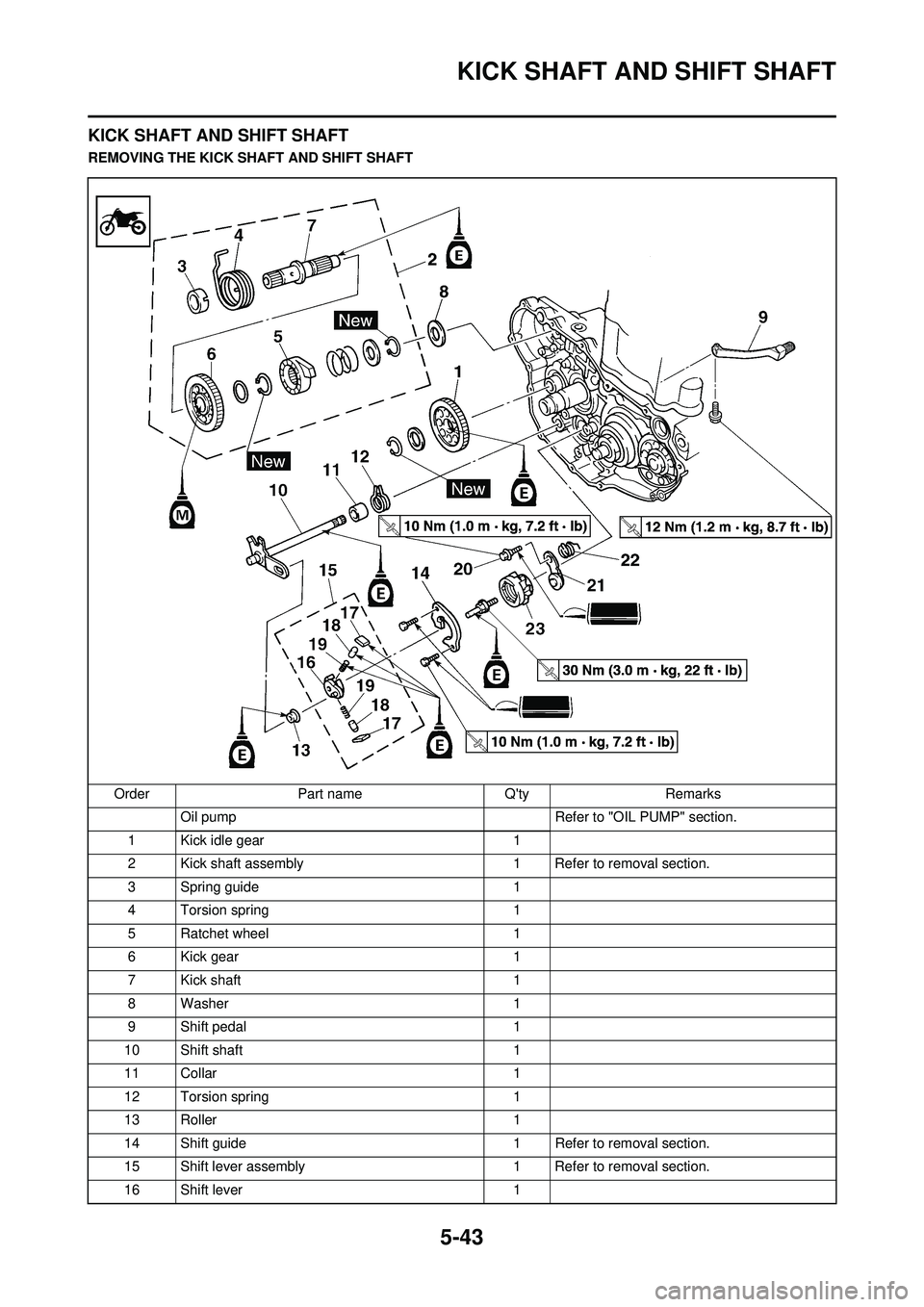
5-43
KICK SHAFT AND SHIFT SHAFT
KICK SHAFT AND SHIFT SHAFT
REMOVING THE KICK SHAFT AND SHIFT SHAFTOrder Part name Q'ty Remarks Oil pump Refer to "OIL PUMP" section.
1 Kick idle gear 1
2 Kick shaft assembly 1 Refer to removal section.
3 Spring guide 1
4 Torsion spring 1
5 Ratchet wheel 1
6 Kick gear 1
7 Kick shaft 1
8 Washer 1
9 Shift pedal 1
10 Shift shaft 1
11 Collar 1
12 Torsion spring 1
13 Roller 1
14 Shift guide 1 Refer to removal section.
15 Shift lever assembly 1 Refer to removal section.
16 Shift lever 1
Page 141 of 224
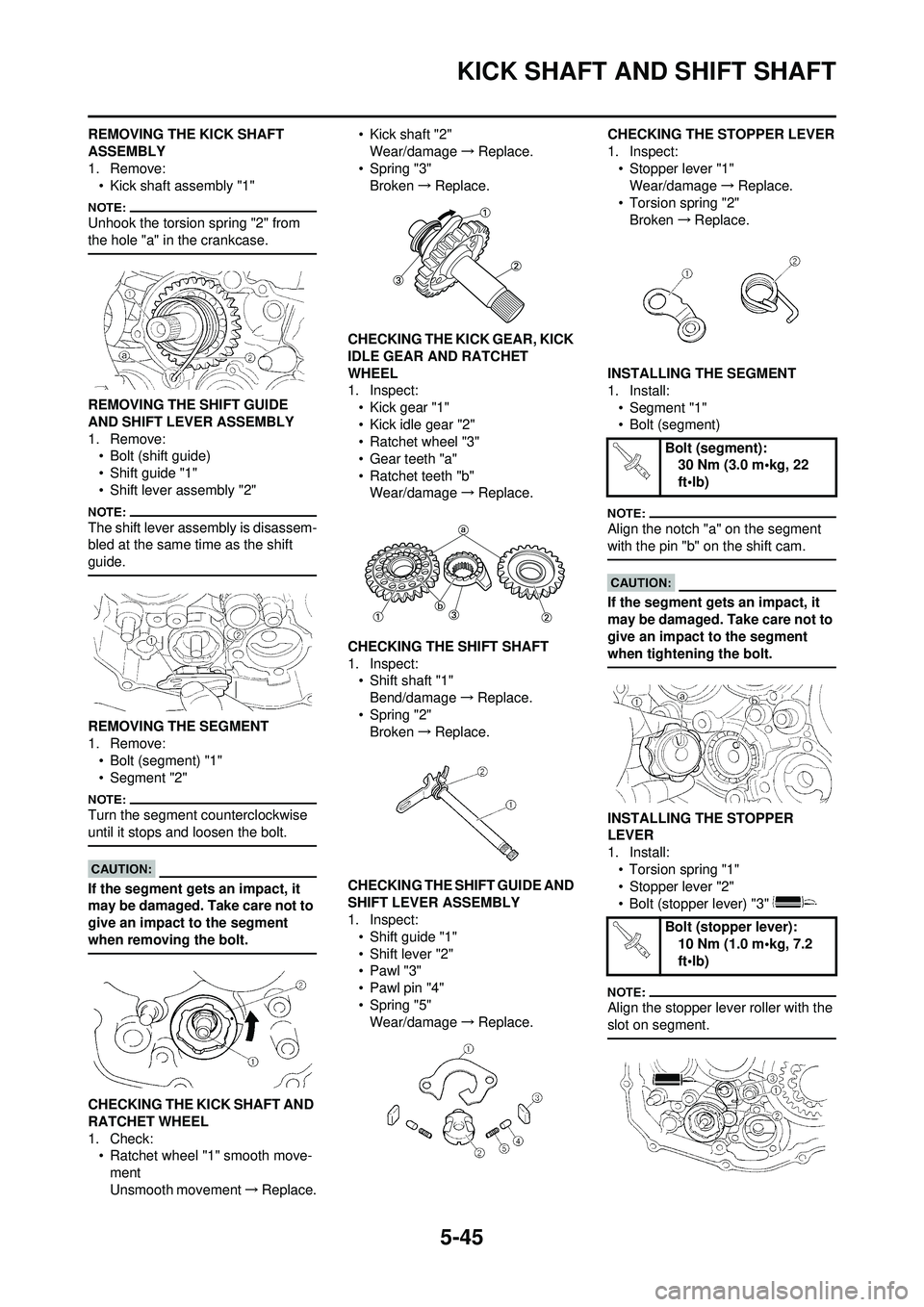
5-45
KICK SHAFT AND SHIFT SHAFT
REMOVING THE KICK SHAFT
ASSEMBLY
1. Remove:• Kick shaft assembly "1"
Unhook the torsion spring "2" from
the hole "a" in the crankcase.
REMOVING THE SHIFT GUIDE
AND SHIFT LEVER ASSEMBLY
1. Remove:• Bolt (shift guide)
• Shift guide "1"
• Shift lever assembly "2"
The shift lever assembly is disassem-
bled at the same time as the shift
guide.
REMOVING THE SEGMENT
1. Remove:
• Bolt (segment) "1"
• Segment "2"
Turn the segment counterclockwise
until it stops and loosen the bolt.
If the segment gets an impact, it
may be damaged. Take care not to
give an impact to the segment
when removing the bolt.
CHECKING THE KICK SHAFT AND
RATCHET WHEEL
1. Check:• Ratchet wheel "1" smooth move-
ment
Unsmooth movement →Replace. • Kick shaft "2"
Wear/damage →Replace.
• Spring "3" Broken →Replace.
CHECKING THE KICK GEAR, KICK
IDLE GEAR AND RATCHET
WHEEL
1. Inspect: • Kick gear "1"
• Kick idle gear "2"
• Ratchet wheel "3"
• Gear teeth "a"
• Ratchet teeth "b"Wear/damage →Replace.
CHECKING THE SHIFT SHAFT
1. Inspect: • Shift shaft "1"
Bend/damage →Replace.
• Spring "2" Broken →Replace.
CHECKING THE SHIFT GUIDE AND
SHIFT LEVER ASSEMBLY
1. Inspect: • Shift guide "1"
• Shift lever "2"
• Pawl "3"
• Pawl pin "4"
• Spring "5"Wear/damage →Replace. CHECKING THE STOPPER LEVER
1. Inspect:
• Stopper lever "1"Wear/damage →Replace.
• Torsion spring "2" Broken →Replace.
INSTALLING THE SEGMENT
1. Install: • Segment "1"
• Bolt (segment)
Align the notch "a" on the segment
with the pin "b" on the shift cam.
If the segment gets an impact, it
may be damaged. Take care not to
give an impact to the segment
when tightening the bolt.
INSTALLING THE STOPPER
LEVER
1. Install:• Torsion spring "1"
• Stopper lever "2"
• Bolt (stopper lever) "3"
Align the stopper lever roller with the
slot on segment.
Bolt (segment): 30 Nm (3.0 m•kg, 22
ft•lb)
Bolt (stopper lever): 10 Nm (1.0 m•kg, 7.2
ft•lb)
Page 142 of 224

5-46
KICK SHAFT AND SHIFT SHAFT
INSTALLING THE SHIFT GUIDE
AND SHIFT LEVER ASSEMBLY
1. Install:• Spring "1"
• Pawl pin "2"
•Pawl "3"To shift lever "4".
Apply the engine oil on the spring,
pawl pin and pawl.
2. Install:• Shift lever assembly "1"
To shift guide "2".
3. Install: • Shift lever assembly "1"
• Shift guide "2"
• The shift lever assembly is installed at the same time as the shift guide.
• Apply the engine oil on the bolt
(segment) shaft.
4. Install:• Bolt (shift guide) "1" INSTALLING TH
E SHIFT SHAFT
1. Install: • Roller "1"
• Collar "2"
• Torsion spring "3"
• Shift shaft "4"
Apply the engine oil on the roller and
shift shaft.
2. Install:• Shift pedalRefer to "AC MAGNETO AND
STARTER CLUTCH" section.
INSTALLING THE KICK SHAFT
ASSEMBLY
1. Install: • Kick gear "1"
• Washer "2"
• Circlip "3"
• Ratchet wheel "4"
• Spring "5"
• Washer "6"
• Circlip "7" To kick shaft "8".
• Apply the molybdenum disulfide oil on the inner circumferences of the
kick gear and ratchet wheel.
• Align the punch mark "a" on the ratchet wheel with the punch mark
"b" on the kick shaft.
2. Install:• Torsion spring "1"
To kick shaft "2".
Make sure the stopper "a" of the tor-
sion spring fits into the hole "b" on the
kick shaft.
3. Install:• Spring guide "1"
Slide the spring guide into the kick
shaft, make sure the groove "a" in the
spring guide fits on the stopper of the
torsion spring.
4. Install:• Kick shaft assembly "1"
• Washer "2"
• Apply the molybdenum disulfide
grease on the contacting surfaces
of the kick shaft stopper "a" and kick
shaft ratchet wheel guide "3".
• Apply the engine oil on the kick shaft.
• Slide the kick shaft assembly into the crankcase and make sure the
kick shaft stopper "a" fits into the
kick shaft ratchet wheel guide.
5. Hook:• Torsion spring "1"
Turn the torsion spring clockwise and
hook into the proper hole "a" in the
crankcase.Bolt (shift guide):
10 Nm (1.0 m•kg, 7.2
ft•lb)
Page 160 of 224
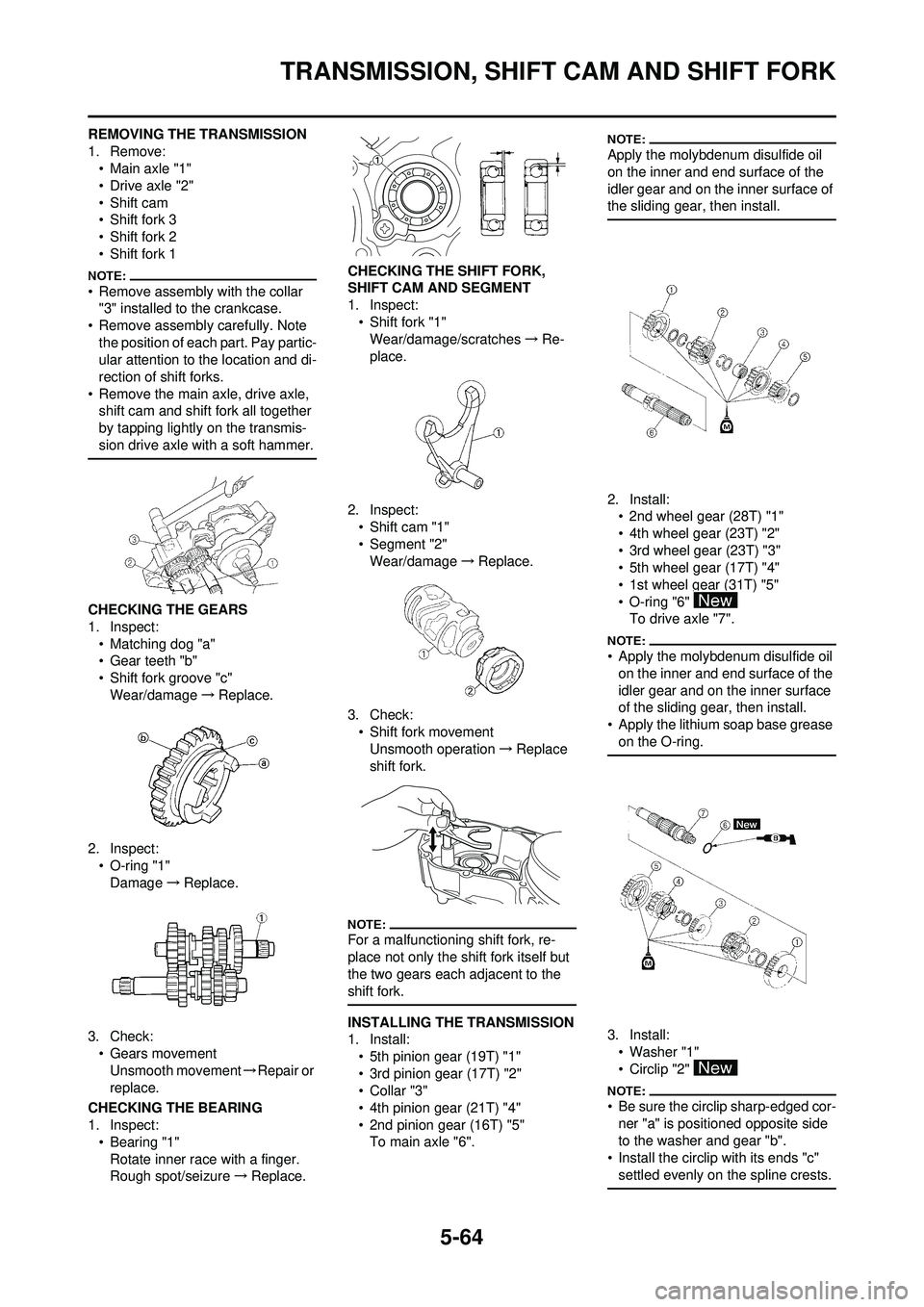
5-64
TRANSMISSION, SHIFT CAM AND SHIFT FORK
REMOVING THE TRANSMISSION
1. Remove:• Main axle "1"
• Drive axle "2"
• Shift cam
• Shift fork 3
• Shift fork 2
• Shift fork 1
• Remove assembly with the collar "3" installed to the crankcase.
• Remove assembly carefully. Note
the position of each part. Pay partic-
ular attention to the location and di-
rection of shift forks.
• Remove the main axle, drive axle, shift cam and shift fork all together
by tapping lightly on the transmis-
sion drive axle with a soft hammer.
CHECKING THE GEARS
1. Inspect:
• Matching dog "a"
• Gear teeth "b"
• Shift fork groove "c"Wear/damage →Replace.
2. Inspect: • O-ring "1"
Damage →Replace.
3. Check: • Gears movementUnsmooth movement →Repair or
replace.
CHECKING THE BEARING
1. Inspect: • Bearing "1"
Rotate inner race with a finger.
Rough spot/seizure →Replace. CHECKING THE SHIFT FORK,
SHIFT CAM AND SEGMENT
1. Inspect:
• Shift fork "1"Wear/damage/scratches →Re-
place.
2. Inspect: • Shift cam "1"
• Segment "2"Wear/damage →Replace.
3. Check: • Shift fork movement
Unsmooth operation →Replace
shift fork.
For a malfunctioning shift fork, re-
place not only the shift fork itself but
the two gears each adjacent to the
shift fork.
INSTALLING THE TRANSMISSION
1. Install:
• 5th pinion gear (19T) "1"
• 3rd pinion gear (17T) "2"
• Collar "3"
• 4th pinion gear (21T) "4"
• 2nd pinion gear (16T) "5"To main axle "6".
Apply the molybdenum disulfide oil
on the inner and end surface of the
idler gear and on the inner surface of
the sliding gear, then install.
2. Install:• 2nd wheel gear (28T) "1"
• 4th wheel gear (23T) "2"
• 3rd wheel gear (23T) "3"
• 5th wheel gear (17T) "4"
• 1st wheel gear (31T) "5"
• O-ring "6" To drive axle "7".
• Apply the molybdenum disulfide oil on the inner and end surface of the
idler gear and on the inner surface
of the sliding gear, then install.
• Apply the lithium soap base grease
on the O-ring.
3. Install:• Washer "1"
• Circlip "2"
• Be sure the circlip sharp-edged cor-ner "a" is positioned opposite side
to the washer and gear "b".
• Install the circlip with its ends "c" settled evenly on the spline crests.
Page 161 of 224
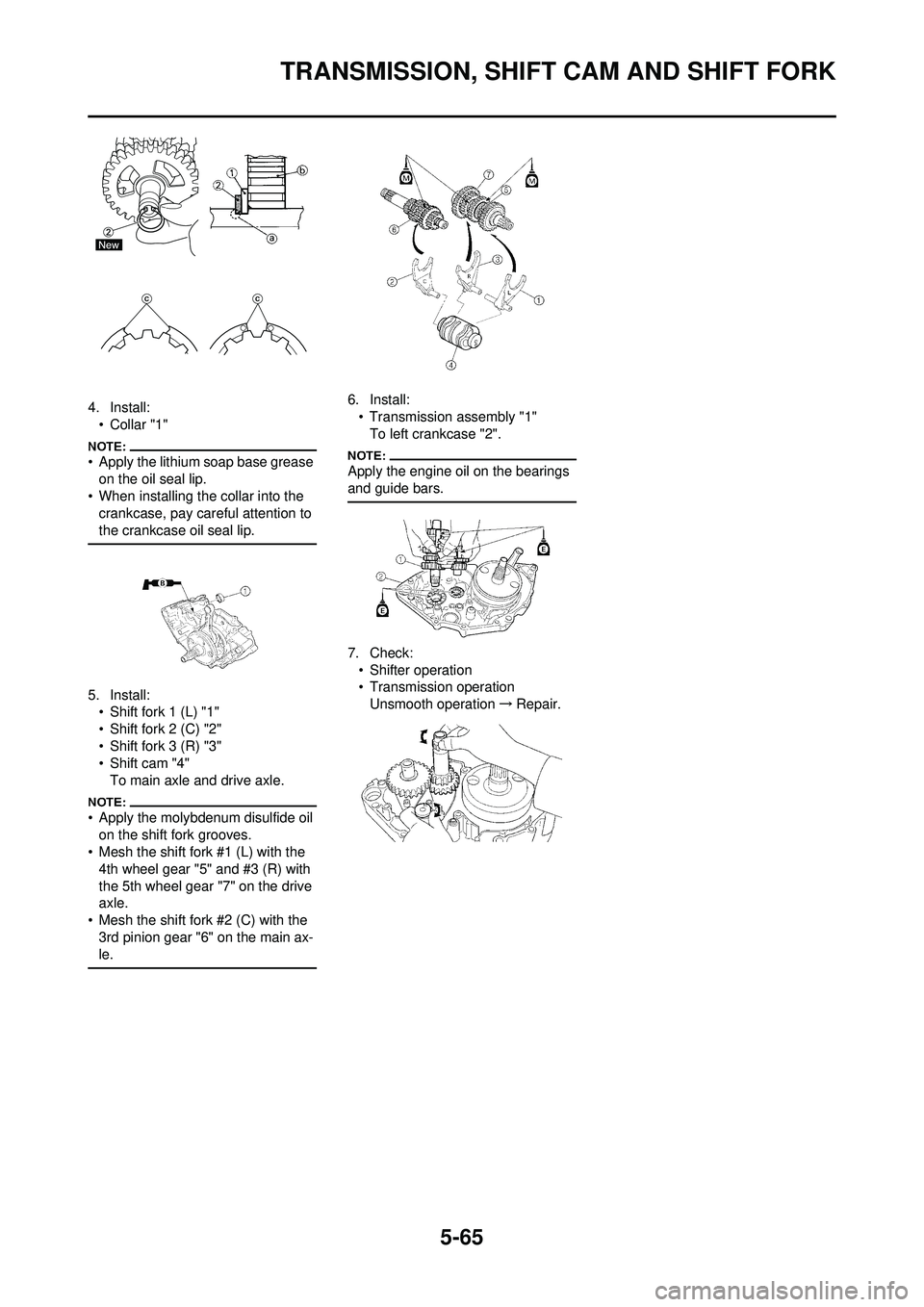
5-65
TRANSMISSION, SHIFT CAM AND SHIFT FORK
4. Install:•Collar "1"
• Apply the lithium soap base grease on the oil seal lip.
• When installing the collar into the crankcase, pay careful attention to
the crankcase oil seal lip.
5. Install:• Shift fork 1 (L) "1"
• Shift fork 2 (C) "2"
• Shift fork 3 (R) "3"
• Shift cam "4"
To main axle and drive axle.
• Apply the molybdenum disulfide oil on the shift fork grooves.
• Mesh the shift fork #1 (L) with the
4th wheel gear "5" and #3 (R) with
the 5th wheel gear "7" on the drive
axle.
• Mesh the shift fork #2 (C) with the 3rd pinion gear "6" on the main ax-
le.
6. Install:
• Transmission assembly "1"To left crankcase "2".
Apply the engine oil on the bearings
and guide bars.
7. Check:• Shifter operation
• Transmission operation
Unsmooth operation →Repair.