Page 61 of 96

PERIODIC MAINTENANCE AND MINOR REPAIR
6-14
2
3
4
5
67
8
9
periodic oil change to be indicated at
the correct time.
EAU19995
Chain drive oil
The chain drive oil should be changed
as follows at the intervals specified in
the periodic maintenance and lubrica-
tion chart.
1. Place the vehicle on a level sur-
face.
2. Remove panel E. (See page 6-7.)
3. Place an oil pan under the chain
drive case to collect the used oil.
4. Remove the oil filler cap and drain
bolt to drain the oil from the chain
drive case.
5. Install the chain drive oil drain bolt,
and then tighten it to the specifiedtorque.
6. Add the specified amount of the
recommended oil.
7. Wipe the dipstick clean, insert it
into the oil filler hole (without
screwing it in), and then remove it
to check the oil level.
NOTE:
The chain drive oil should be between
the minimum and maximum level
marks.
1. Chain drive oil filler cap
2. Chain drive oil drain bolt
1
2
Tightening torque:
Chain drive oil drain bolt:
20 Nm (2.0 m·kgf, 14.5 ft·lbf)
Recommended chain drive oil:
See page 8-1.
Oil quantity:
0.70 L (0.74 US qt) (0.62 Imp.qt)
Page 62 of 96

PERIODIC MAINTENANCE AND MINOR REPAIR
6-15
1
2
3
4
5
6
7
8
9
8. If the chain drive oil is below the
minimum level mark, add sufficient
oil of the recommended type to
raise it to the correct level.
9. Insert the dipstick into the oil filler
hole, and then tighten the oil filler
cap.
CAUTION:
ECA15010
�
Make sure that no foreign mate-
rial enters the chain drive case.
�
Make sure that no oil gets on the
tire or wheel.
10. Check the chain drive case for oil
leakage. If leakage is found, check
for the cause.11. Install the panel.
EAU20070
Coolant
The coolant level should be checked
before each ride. In addition, the cool-
ant must be changed at the intervals
specified in the periodic maintenance
and lubrication chart.
EAU42831
To check the coolant level
1. Place the vehicle on a level sur-
face and hold it in an upright posi-
tion.
NOTE:
�
The coolant level must be checked
on a cold engine since the level
varies with engine temperature.
�
Make sure that the vehicle is posi-
tioned straight up when checking
the coolant level. A slight tilt to the
side can result in a false reading.
2. Check the coolant level through
the check window.
NOTE:
The coolant should be between the
minimum and maximum level marks.
1. Maximum level mark
2. Minimum level mark
1
2
Page 66 of 96

PERIODIC MAINTENANCE AND MINOR REPAIR
6-19
1
2
3
4
5
6
7
8
9
EAU21401
Valve clearance
The valve clearance changes with use,
resulting in improper air-fuel mixture
and/or engine noise. To prevent this
from occurring, the valve clearance
must be adjusted by a Yamaha dealer
at the intervals specified in the periodic
maintenance and lubrication chart.
EAU33600
Tires
To maximize the performance, durabil-
ity, and safe operation of your vehicle,
note the following points regarding the
specified tires.
Tire air pressure
The tire air pressure should be checked
and, if necessary, adjusted before each
ride.
WARNING
EWA10500
�
The tire air pressure must be
checked and adjusted on cold
tires (i.e., when the temperature
of the tires equals the ambient
temperature).
�
The tire air pressure must be ad-
justed in accordance with the
riding speed and with the total
weight of rider, passenger, car-
go, and accessories approved
for this model.
WARNING
EWA11200
Because loading has an enormous
impact on the handling, braking,
performance and safety characteris-
tics of your vehicle, you should keep
the following precautions in mind.
�
NEVER OVERLOAD THE VEHI-
CLE! Operation of an overload-
ed vehicle may result in tire
damage, loss of control, or se-
vere injury. Make sure that the
total weight of rider, passenger,
cargo, and accessories does
Tire air pressure (measured on cold
tires):
0–90 kg (0–198 lb):
Front:
225 kPa (33 psi) (2.25 kgf/cm
2
)
Rear:
250 kPa (36 psi) (2.50 kgf/cm
2
)
90–190 kg (198–419 lb):
Front:
225 kPa (33 psi) (2.25 kgf/cm
2
)
Rear:
280 kPa (41 psi) (2.80 kgf/cm
2
)
Maximum load*:
190 kg (419 lb)
* Total weight of rider, passenger, car-
go and accessories
Page 68 of 96
PERIODIC MAINTENANCE AND MINOR REPAIR
6-21
1
2
3
4
5
6
7
8
9
EAU21960
Cast wheels
To maximize the performance, durabil-
ity, and safe operation of your vehicle,
note the following points regarding the
specified wheels.
�
The wheel rims should be checked
for cracks, bends or warpage be-
fore each ride. If any damage is
found, have a Yamaha dealer re-
place the wheel. Do not attempt
even the smallest repair to the
wheel. A deformed or cracked
wheel must be replaced.
�
The wheel should be balanced
whenever either the tire or wheel
has been changed or replaced. An
unbalanced wheel can result in
poor performance, adverse han-
dling characteristics, and a short-
ened tire life.
�
Ride at moderate speeds after
changing a tire since the tire sur-
face must first be “broken in” for it
to develop its optimal characteris-
tics.
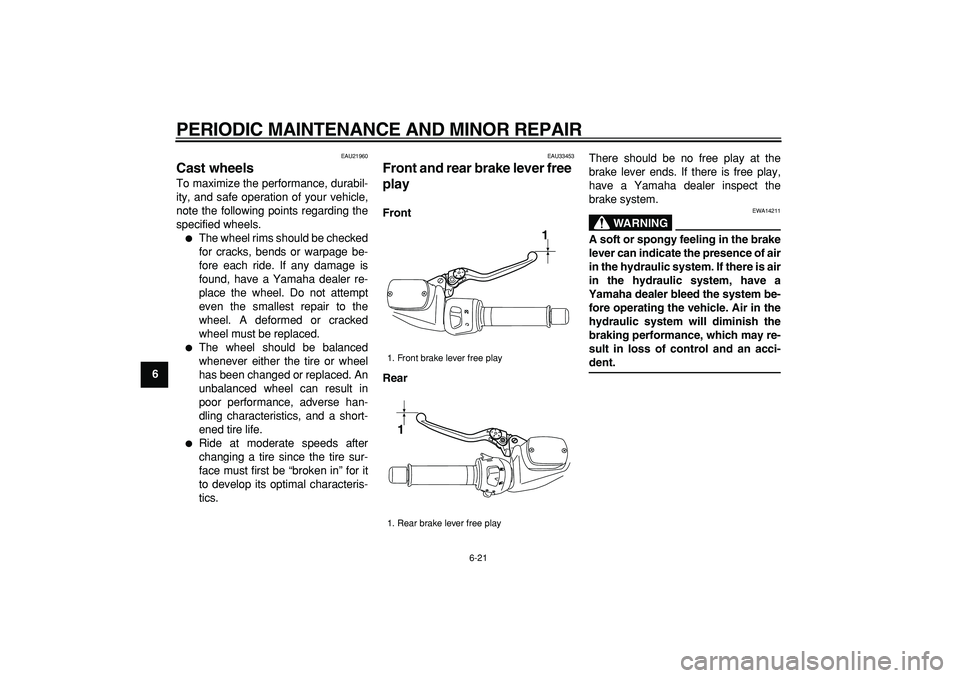
EAU33453
Front and rear brake lever free
play
Front
Rear
There should be no free play at the
brake lever ends. If there is free play,
have a Yamaha dealer inspect the
brake system.
WARNING
EWA14211
A soft or spongy feeling in the brake
lever can indicate the presence of air
in the hydraulic system. If there is air
in the hydraulic system, have a
Yamaha dealer bleed the system be-
fore operating the vehicle. Air in the
hydraulic system will diminish the
braking performance, which may re-
sult in loss of control and an acci-
dent.
1. Front brake lever free play
1. Rear brake lever free play
1
1
Page 71 of 96

PERIODIC MAINTENANCE AND MINOR REPAIR
6-24
2
3
4
5
67
8
9
enter the brake system, possibly caus-
ing it to become ineffective.
Before riding, check that the brake fluid
is above the minimum level mark and
replenish if necessary. A low brake fluid
level may indicate worn brake pads
and/or brake system leakage. If the
brake fluid level is low, be sure to check
the brake pads for wear and the brake
system for leakage.
Observe these precautions:
�
When checking the fluid level,
make sure that the top of the brake
fluid reservoir is level.
�
Use only the recommended quality
brake fluid, otherwise the rubber
seals may deteriorate, causing
leakage and poor braking perfor-
mance.
�
Refill with the same type of brake
fluid. Mixing fluids may result in a
harmful chemical reaction and
lead to poor braking performance.
�
Be careful that water does not en-
ter the brake fluid reservoir whenrefilling. Water will significantly
lower the boiling point of the fluid
and may result in vapor lock.
�
Brake fluid may deteriorate paint-
ed surfaces or plastic parts. Al-
ways clean up spilled fluid
immediately.
�
As the brake pads wear, it is nor-
mal for the brake fluid level to grad-
ually go down. However, if the
brake fluid level goes down sud-
denly, have a Yamaha dealer
check the cause.
EAU22730
Changing the brake fluid
Have a Yamaha dealer change the
brake fluid at the intervals specified in
the NOTE after the periodic mainte-
nance and lubrication chart. In addition,
have the oil seals of the master cylin-
ders and calipers as well as the brake
hoses replaced at the intervals listed
below or whenever they are damaged
or leaking.
�
Oil seals: Replace every two
years.
�
Brake hoses: Replace every four
years.
Recommended brake fluid:
DOT 4
Page 83 of 96

PERIODIC MAINTENANCE AND MINOR REPAIR
6-36
2
3
4
5
67
8
9 Engine overheating
WARNING
EWAT1040
�
Do not remove the radiator cap when the engine and radiator are hot. Scalding hot fluid and steam may be
blown out under pressure, which could cause serious injury. Be sure to wait until the engine has cooled.
�
Place a thick rag, like a towel, over the radiator cap, and then slowly rotate the cap counterclockwise to the de-
tent to allow any residual pressure to escape. When the hissing sound has stopped, press down on the cap
while turning it counterclockwise, and then remove the cap.
NOTE:
If coolant is not available, tap water can be temporarily used instead, provided that it is changed to the recommended coolant
as soon as possible.
Wait until the
engine has cooled.
Check the coolant level in the
reservoir and radiator.
The coolant level
is OK.The coolant level is low.
Check the cooling system
for leakage.
Have a Yamaha dealer checkand repair the cooling system.Add coolant. (See NOTE.)
Start the engine. If the engine overheats again,
have a
Yamaha dealer check
and repair the cooling system.
There is
leakage.
There is
no leakage.
Page:
< prev 1-8 9-16 17-24