Page 36 of 92
4-1
1
2
3
4
5
6
7
8
9
PRE-OPERATION CHECKS
EAU15593
The condition of a vehicle is the owner’s responsibility. Vital components can start to deteriorate quickly and unexpectedly,
even if the vehicle remains unused (for example, as a result of exposure to the elements). Any damage, fluid leakage or loss
of tire air pressure could have serious consequences. Therefore, it is very important, in addition to a thorough visual inspec-
tion, to check the following points before each ride.
NOTE:
Pre-operation checks should be made each time the vehicle is used. Such an inspection can be accomplished in a very short
time; and the added safety it assures is more than worth the time involved.
WARNING
EWA11150
If any item in the Pre-operation check list is not working properly, have it inspected and repaired before operating
the vehicle.
Page 39 of 92

5-1
2
3
4
56
7
8
9
OPERATION AND IMPORTANT RIDING POINTS
EAU15950
WARNING
EWA10270
�
Become thoroughly familiar
with all operating controls and
their functions before riding.
Consult a Yamaha dealer re-
garding any control or function
that you do not thoroughly un-
derstand.
�
Never start the engine or oper-
ate it in a closed area for any
length of time. Exhaust fumes
are poisonous, and inhaling
them can cause loss of con-
sciousness and death within a
short time. Always make sure
that there is adequate ventila-
tion.
�
Before starting out, make sure
that the sidestand is up. If the
sidestand is not raised com-
pletely, it could contact the
ground and distract the opera-
tor, resulting in a possible loss
of control.
EAU39891
Starting the engine
In order for the ignition circuit cut-off
system to enable starting, one of the
following conditions must be met:
�
The transmission is in the neutral
position.
�
The transmission is in gear with
the clutch lever pulled and the sid-
estand up.
WARNING
EWA10290
�
Before starting the engine,
check the function of the igni-
tion circuit cut-off system ac-
cording to the procedure
described on page 3-20.
�
Never ride with the sidestand
down.
1. Turn the key to “ON” and make
sure that the engine stop switch is
set to “”.
CAUTION:
ECA15450
The following warning lights and in-
dicator light should come on for a
few seconds, then go off.
�
Oil level warning light
�
Engine trouble warning light
�
Immobilizer system indicator
light
�
ABS warning light
If a warning or indicator light does
not go off, see page 3-4 for the corre-
sponding warning and indicator
light circuit check.
2. Shift the transmission into the neu-
tral position.
NOTE:
When the transmission is in the neutral
position, the neutral indicator light
should be on, otherwise have a
Yamaha dealer check the electrical cir-
cuit.
3. Start the engine by pushing the
start switch.
NOTE:
If the engine fails to start, release the
start switch, wait a few seconds, and
then try again. Each starting attempt
should be as short as possible to pre-
serve the battery. Do not crank the en-
gine more than 10 seconds on any one
attempt.
Page 42 of 92
OPERATION AND IMPORTANT RIDING POINTS
5-4
1
2
3
4
5
6
7
8
9
EAU17212
Parking
When parking, stop the engine, and
then remove the key from the main
switch.
WARNING
EWA10310
�
Since the engine and exhaust
system can become very hot,
park in a place where pedestri-
ans or children are not likely to
touch them.
�
Do not park on a slope or on soft
ground, otherwise the vehicle
may overturn.
CAUTION:
ECA10380
Never park in an area where there
are fire hazards such as grass or
other flammable materials.
Page 43 of 92
6-1
2
3
4
5
67
8
9
PERIODIC MAINTENANCE AND MINOR REPAIR
EAU17240
Safety is an obligation of the owner. Pe-
riodic inspection, adjustment and lubri-
cation will keep your vehicle in the
safest and most efficient condition pos-
sible. The most important points of in-
spection, adjustment, and lubrication
are explained on the following pages.
The intervals given in the periodic
maintenance and lubrication chart
should be simply considered as a gen-
eral guide under normal riding condi-
tions. However, DEPENDING ON THE
WEATHER, TERRAIN, GEOGRAPHI-
CAL LOCATION, AND INDIVIDUAL
USE, THE MAINTENANCE INTER-
VALS MAY NEED TO BE SHORT-
ENED.
WARNING
EWA10320
If you are not familiar with mainte-
nance work, have a Yamaha dealer
do it for you.
EAU17520
Owner’s tool kit
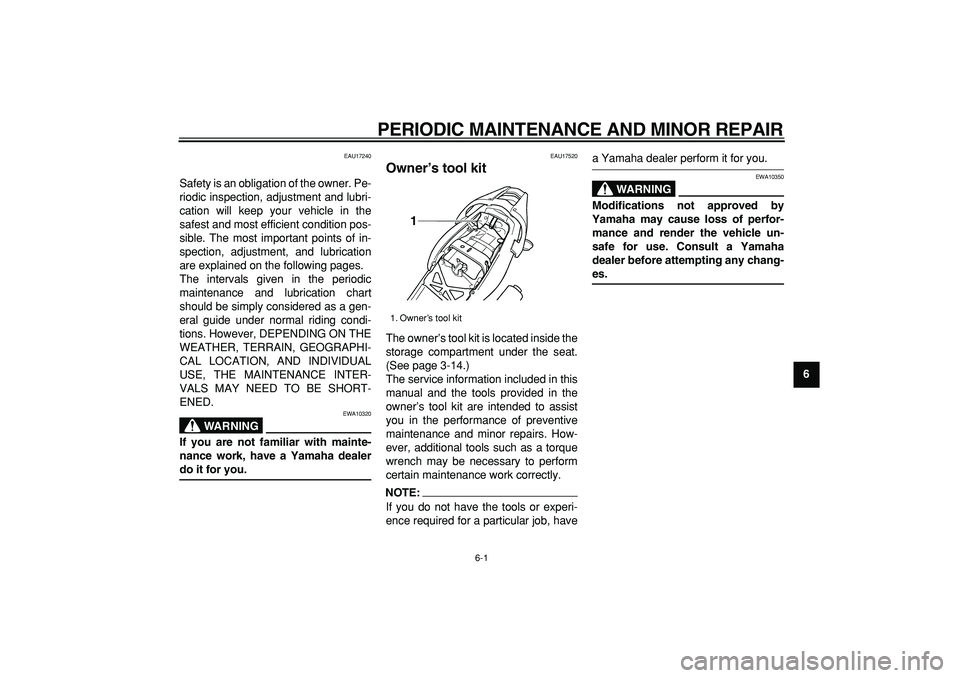
The owner’s tool kit is located inside the
storage compartment under the seat.
(See page 3-14.)
The service information included in this
manual and the tools provided in the
owner’s tool kit are intended to assist
you in the performance of preventive
maintenance and minor repairs. How-
ever, additional tools such as a torque
wrench may be necessary to perform
certain maintenance work correctly.
NOTE:
If you do not have the tools or experi-
ence required for a particular job, have
a Yamaha dealer perform it for you.
WARNING
EWA10350
Modifications not approved by
Yamaha may cause loss of perfor-
mance and render the vehicle un-
safe for use. Consult a Yamaha
dealer before attempting any chang-
es.
1. Owner’s tool kit
1
Page 51 of 92
PERIODIC MAINTENANCE AND MINOR REPAIR
6-9
2
3
4
5
67
8
9
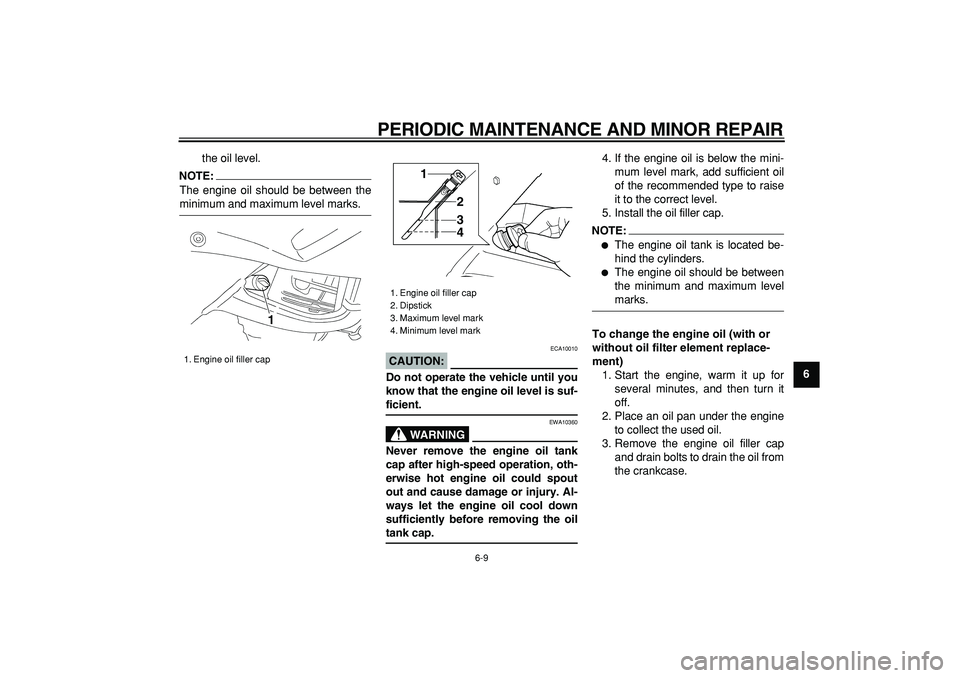
the oil level.
NOTE:
The engine oil should be between the
minimum and maximum level marks.
CAUTION:
ECA10010
Do not operate the vehicle until you
know that the engine oil level is suf-
ficient.
WARNING
EWA10360
Never remove the engine oil tank
cap after high-speed operation, oth-
erwise hot engine oil could spout
out and cause damage or injury. Al-
ways let the engine oil cool down
sufficiently before removing the oil
tank cap.
4. If the engine oil is below the mini-
mum level mark, add sufficient oil
of the recommended type to raise
it to the correct level.
5. Install the oil filler cap.
NOTE:
�
The engine oil tank is located be-
hind the cylinders.
�
The engine oil should be between
the minimum and maximum level
marks.
To change the engine oil (with or
without oil filter element replace-
ment)
1. Start the engine, warm it up for
several minutes, and then turn it
off.
2. Place an oil pan under the engine
to collect the used oil.
3. Remove the engine oil filler cap
and drain bolts to drain the oil from
the crankcase.
1. Engine oil filler cap
1
1. Engine oil filler cap
2. Dipstick
3. Maximum level mark
4. Minimum level mark
1
2
3
4
Page 54 of 92

PERIODIC MAINTENANCE AND MINOR REPAIR
6-12
1
2
3
4
5
6
7
8
9
3. If the coolant is at or below the
minimum level mark, remove pan-
el A (See page 6-6.), remove the
reservoir cap, add coolant to the
maximum level mark, and then in-
stall the reservoir cap and the pan-
el.
CAUTION:
ECA10471
�
If coolant is not available, use
distilled water or soft tap water
instead. Do not use hard water
or salt water since it is harmful
to the engine.
�
If water has been used instead
of coolant, replace it with cool-
ant as soon as possible, other-
wise the cooling system will not
be protected against frost and
corrosion.
�
If water has been added to thecoolant, have a Yamaha dealer
check the antifreeze content of
the coolant as soon as possible,
otherwise the effectiveness of
the coolant will be reduced.
WARNING
EWA10380
Never attempt to remove the radiator
cap when the engine is hot.
NOTE:
�
The radiator fan is automatically
switched on or off according to the
coolant temperature in the radia-
tor.
�
If the engine overheats, see page
6-35 for further instructions.
1. Maximum level mark
2. Coolant reservoir
3. Minimum level mark
3 1
2
1. Coolant reservoir cap
Coolant reservoir capacity (up to the
maximum level mark):
0.25 L (0.26 US qt) (0.22 Imp.qt)
1
Page 55 of 92
PERIODIC MAINTENANCE AND MINOR REPAIR
6-13
2
3
4
5
67
8
9
EAU42350
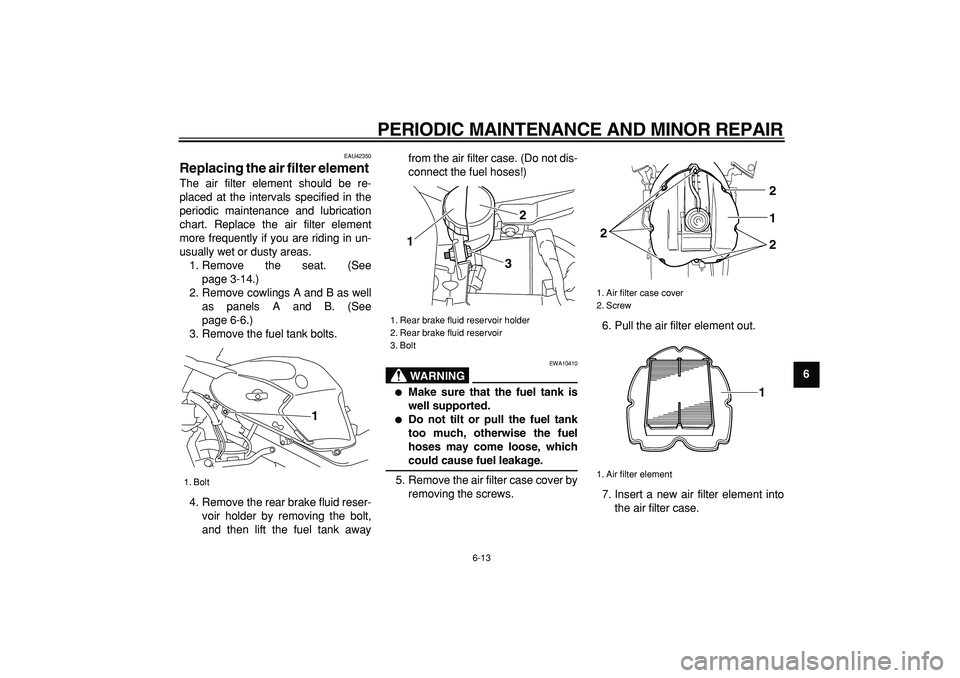
Replacing the air filter element
The air filter element should be re-
placed at the intervals specified in the
periodic maintenance and lubrication
chart. Replace the air filter element
more frequently if you are riding in un-
usually wet or dusty areas.
1. Remove the seat. (See
page 3-14.)
2. Remove cowlings A and B as well
as panels A and B. (See
page 6-6.)
3. Remove the fuel tank bolts.
4. Remove the rear brake fluid reser-
voir holder by removing the bolt,
and then lift the fuel tank awayfrom the air filter case. (Do not dis-
connect the fuel hoses!)
WARNING
EWA10410
�
Make sure that the fuel tank is
well supported.
�
Do not tilt or pull the fuel tank
too much, otherwise the fuel
hoses may come loose, which
could cause fuel leakage.
5. Remove the air filter case cover by
removing the screws.6. Pull the air filter element out.
7. Insert a new air filter element into
the air filter case.
1. Bolt
1
1. Rear brake fluid reservoir holder
2. Rear brake fluid reservoir
3. Bolt
12
3
1. Air filter case cover
2. Screw
1. Air filter element
1 2
2 21
Page 56 of 92
PERIODIC MAINTENANCE AND MINOR REPAIR
6-14
1
2
3
4
5
6
7
8
9
CAUTION:
ECA10480
�
Make sure that the air filter ele-
ment is properly seated in the
air filter case.
�
The engine should never be op-
erated without the air filter ele-
ment installed, otherwise the
piston(s) and/or cylinder(s) may
become excessively worn.
8. Install the air filter case cover by in-
stalling the screws.
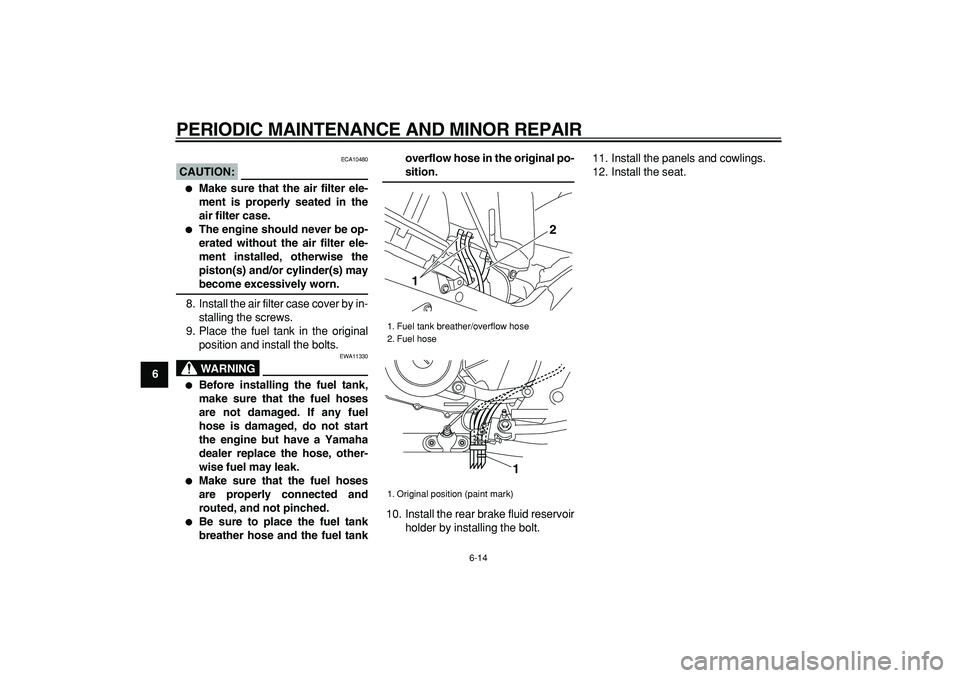
9. Place the fuel tank in the original
position and install the bolts.
WARNING
EWA11330
�
Before installing the fuel tank,
make sure that the fuel hoses
are not damaged. If any fuel
hose is damaged, do not start
the engine but have a Yamaha
dealer replace the hose, other-
wise fuel may leak.
�
Make sure that the fuel hoses
are properly connected and
routed, and not pinched.
�
Be sure to place the fuel tank
breather hose and the fuel tankoverflow hose in the original po-
sition.
10. Install the rear brake fluid reservoir
holder by installing the bolt.11. Install the panels and cowlings.
12. Install the seat.
1. Fuel tank breather/overflow hose
2. Fuel hose
1. Original position (paint mark)
12
1