2008 VOLVO C30 warning
[x] Cancel search: warningPage 18 of 234

WARNING
No objects or accessory equipment, e.g. dashboard covers, may be placed on, attached to, or installed near the air
bag hatch (the area above the glove compartment) or the area affected by airbag deployment ( see the illustration on
page 18
).
There should be no loose articles, e.g. coffee cups, on the floor, seat, or dashboard area.
Never try to open the airbag cover on the steering wheel or the passenger's side dashboard. This should only be
done by a trained and qualified Volvo service technician.
Failure to follow these instructions can result in injury to the vehicle occupants.
22 01 Safety
Occupant Weight Sensor (OWS)
Disabling the passenger's side front airbag
Volvo recommends that ALL occupants (adults and children) shorter than 4 feet 7 inches ( 140 cm) be seated in the
rear seat of any vehicle with a passenger's side front airbag, and be properly restrained. Children should always be
seated in child restraints appropriate for their size and weight. See also the child safety recommendations beginning on
page 32
.
The Occupant Weight Sensor (OWS) is designed to meet the regulatory requirements of Federal Motor Vehicle Safety
Standard (FMVSS) 208 and is designed to disable (will not inflate) the passenger's side front airbag under certain
conditions.
The OWS works with sensors that are part of the front passenger's seat and seat belt. The sensors are designed to
Page 19 of 234
detect the presence of a properly seated occupant and determine if the passenger's side front airbag should be enabled
(may inflate) or disabled (will not inflate).
The OWS will disable (will not inflate) the passenger's side front airbag when:
the front passenger's seat is unoccupied, or has small/medium objects in the front seat,
the system determines that an infant is present in a rear-facing infant seat that is installed according to the
manufacturer's instructions,
the system determines that a small child is present in a forward-facing child restraint that is installed according to
the manufacturer's instructions,
the system determines that a small child is present in a booster seat,
a front passenger takes his/her weight off of the seat for a period of time,
a child or a small person occupies the front passenger's seat.
The OWS uses a PASSENGER AIRBAG OFF indicator lamp which will illuminate and stay on to remind you that the
passenger's side front airbag is disabled. The PASSENGER AIRBAG OFF indicator lamp is located in the overhead
console, near the base of the rearview mirror.
NOTE
When the ignition is switched on, the OWS indicator light will go on for up to 10 seconds while the system performs
a self -diagnostic test.
However, if a fault is detected in the system:
The OWS indicator light will stay on
The SRS warning light (see page 18) will come on and stay on
23 01 Safety
Occupant Weight Sensor (OWS)
The message PASS. AIRBAG OFF SERVICE URGENT will be displayed in the information display.
WARNING
If a fault in the system is detected and indicated as explained on the preceding page, be aware that the passenger's
side front airbag will not deploy in the event of a collision. In this case, the SRS system and Occupant Weight
Sensor should be inspected by a trained and qualified Volvo service technician as soon as possible.
WARNING
Never try to open, remove, or repair any components in the OWS system. This could result in system malfunction.
Maintenance or repairs should only be carried out by an a trained and qualified Volvo service technician.
The front passenger's seat should not be modified in any way. This could reduce pressure on the seat cushion,
which might interfere with the OWS system's function.
The OWS is designed to disable ( will not inflate) the passenger's side front airbag when a rear facing infant seat, a
forward-facing child restraint, or a booster seat is detected. The PASSENGER AIRBAG OFF indicator lamp will
illuminate and stay on to remind you that the passenger's side front airbag is disabled (see the following table).
Page 21 of 234
National Customer Service
175 Gordon Baker Road
North York, Ontario M2H 2N7
1-800-663-8255
WARNING
No objects that add to the total weight on the seat should be placed on the front passenger's seat. If a child is
seated in the front passenger's seat with any additional weight, this extra weight could cause the OWS system to
enable the airbag, which might cause it to deploy in the event of a collision, thereby injuring the child.
The seat belt should never be wrapped around an object on the front passenger's seat. This could interfere with the
OWS system's function.
The front passenger's seat belt should never be used in a way that exerts more pressure on the passenger than
normal. This could increase the pressure exerted on the weight sensor by a child, and could result in the airbag being
enabled, which might cause it to deploy in the event of a collision, thereby injuring the child.
WARNING
Keep the following points in mind with respect to the OWS system. Failure to follow these instructions could
adversely affect the system's function and result in serious injury to the occupant of the front passenger's seat:
The full weight of the front seat passenger should always be on the seat cushion. The passenger should never lift
him/herself off the seat cushion using the armrest in the door or the center console, by pressing the feet on the floor,
by sitting on the edge of the seat cushion, or by pressing against the backrest in a way that reduces pressure on the
seat cushion. This could cause OWS to disable the passenger's side front airbag.
Do not place any type of object on the front passenger's seat in such a way that jamming, pressing, or squeezing
occurs between the object and the front seat, other than as a direct result of the correct use of the Automatic Locking
Retractor/Emergency Locking Retractor (ALR/ELR) seat belt (see page 32
).
No objects should be placed under the front passenger's seat. This could interfere with the OWS system's function.
25 01 Safety
Side impact protection airbags
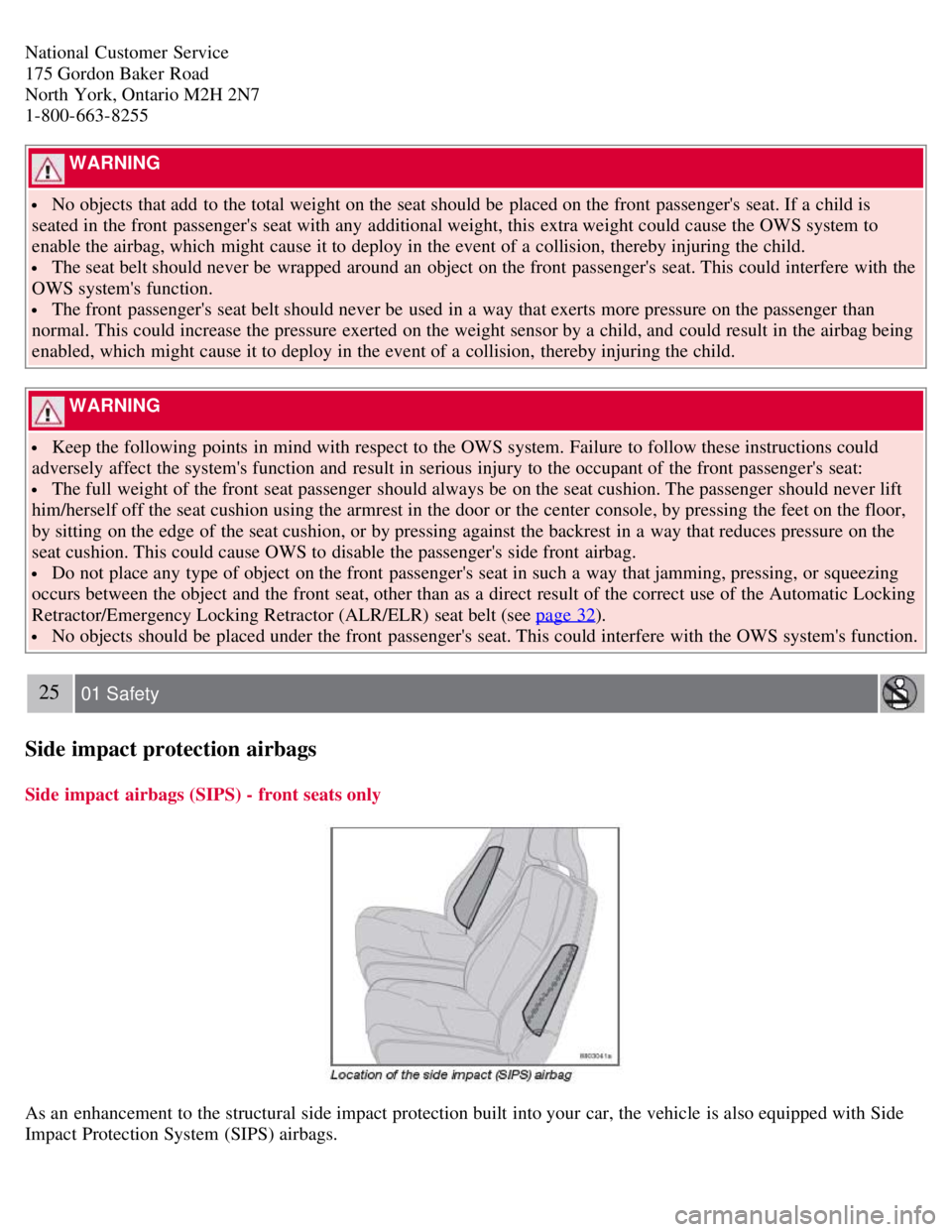
Side impact airbags (SIPS) - front seats only
As an enhancement to the structural side impact protection built into your car, the vehicle is also equipped with Side
Impact Protection System (SIPS) airbags.
Page 22 of 234

The SIPS airbag system is designed to help increase occupant protection in the event of certain side impact collisions.
The SIPS airbags are designed to deploy only during certain side-impact collisions, depending on the crash severity,
angle, speed and point of impact.
NOTE
SIPS airbag deployment (one airbag) occurs only on the side of the vehicle affected by the impact. The airbags are
not designed to deploy in all side impact situations.
Components in the SIPS airbag system
This SIPS airbag system consists of gas generators and side airbag modules built into the outboard sides of both front
seat backrests.
WARNING
The SIPS airbag system is a supplement to the structural Side Impact Protection System and the three-point seat
belt system. It is not designed to deploy during collisions from the front or rear of the vehicle or in rollover
situations.
The use of seat covers on the front seats may impede SIPS airbag deployment.
No objects, accessory equipment or stickers may be placed on, attached to or installed near the SIPS airbag system
or in the area affected by SIPS airbag deployment.
Never try to open or repair any components of the SIPS airbag system. This should be done only by a trained and
qualified Volvo service technician.
In order for the SIPS airbag to provide its best protection, both front seat occupants should sit in an upright
position with the seat belt properly fastened.
Failure to follow these instructions can result in injury to the occupants of the vehicle in the event of an accident.
26 01 Safety
Volvo Inflatable Curtain (VIC)
The Volvo Inflatable Curtain system
Page 23 of 234

This system consists of inflatable curtains located along the sides of the roof liners, stretching from the center of both
front side windows to the rear edge of the rear side windows. It is designed to help protect the heads of the occupants
of the front and rear seats in certain side impact collisions.
In certain side impacts, both the Inflatable Curtain (VIC) and the Side Impact Airbag System (SIPS airbag) will
deploy. The VIC and the SIPS airbag deploy simultaneously.
NOTE
If the inflatable curtain deploys, it remains inflated for approximately 3 seconds.
WARNING
The VIC system is a supplement to the Side Impact Protection System. It is not designed to deploy during
collisions from the front or rear of the vehicle or in rollover situations.
Never try to open or repair any components of the VIC system. This should be done only by a trained and
qualified Volvo service technician.
27 01 Safety
Volvo Inflatable Curtain (VIC)
WARNING
In order for the VIC to provide its best protection, both front seat occupants and rear seat occupants should sit in an
upright position with the seat belt properly fastened; adults using the seat belt and children using the proper child
Page 24 of 234

restraint system. Only adults should sit in the front seats. Children must never be allowed in the front passenger's
seat. See page 32 for guidelines. Failure to follow these instructions can result in injury to the vehicle occupants in
an accident.
28 01 Safety
Whiplash Protection System
Whiplash Protection System (WHIPS) - front seats only
The WHIPS system consists of specially designed hinges and brackets on the front seat backrests designed to help
absorb some of the energy generated in a collision from the rear (when the vehicle is "rear-ended").
In the event of a collision of this type, the hinges and brackets of the front seat backrests are designed to change
position slightly to allow the backrest/head restraint to help support the occupant's head before moving slightly
rearward. This movement helps absorb some of the forces that could result in whiplash.
WARNING
The WHIPS system is designed to supplement the other safety systems in your car. For this system to function
properly, the three-point seat belt must be worn. Please be aware that no system can prevent all possible injuries that
may occur in an accident.
The WHIPS system is designed to function in certain collisions from the rear, depending on the crash severity,
angle and speed.
WARNING
Occupants in the front seats must never sit out of position. The occupant's back must be as upright as comfort allows
and be against the seat back with the seat belt properly fastened.
29 01 Safety
Whiplash Protection System
WARNING
If your vehicle has been involved in a rear-end collision, the front seat backrests must be inspected by a trained
Page 25 of 234
and qualified Volvo service technician, even if the seats appear to be undamaged. Certain components in the WHIPS
system may need to be replaced.
Do not attempt to service any component in the WHIPS system yourself.
WARNING
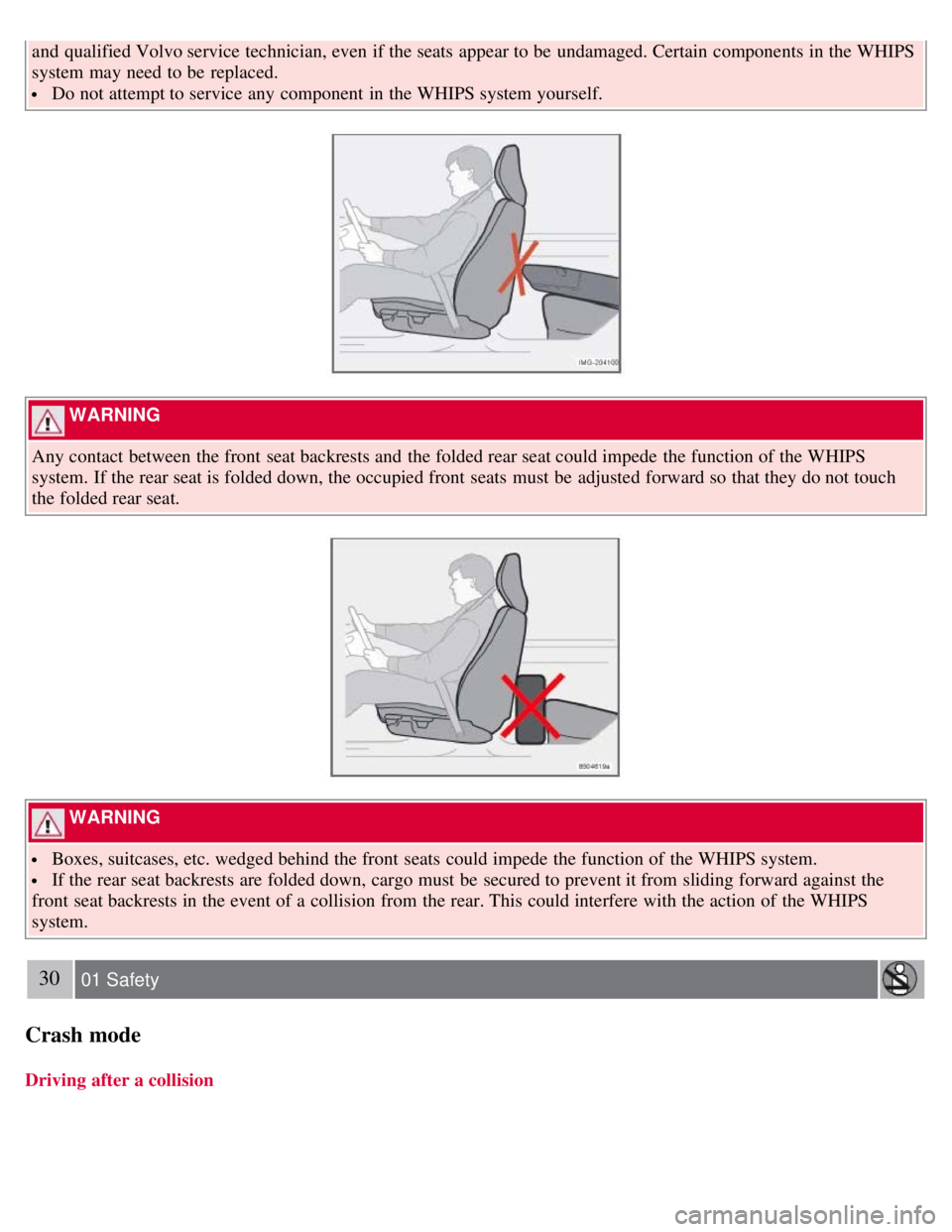
Any contact between the front seat backrests and the folded rear seat could impede the function of the WHIPS
system. If the rear seat is folded down, the occupied front seats must be adjusted forward so that they do not touch
the folded rear seat.
WARNING
Boxes, suitcases, etc. wedged behind the front seats could impede the function of the WHIPS system.
If the rear seat backrests are folded down, cargo must be secured to prevent it from sliding forward against the
front seat backrests in the event of a collision from the rear. This could interfere with the action of the WHIPS
system.
30 01 Safety
Crash mode
Driving after a collision
Page 26 of 234

If the vehicle has been involved in a collision, the text CRASH MODE SEE MANUAL may appear in the information
display. This indicates that the vehicle's functionality has been reduced.
This text can only be shown if the display is undamaged and the vehicle's electrical system is intact.
CRASH MODE is a feature that is triggered if one or more of the safety systems (for example, front or side airbags,
an inflatable curtain, or one or more of the seat belt pretensioners) has deployed. The collision may have damaged an
important function in the vehicle, such as the fuel lines, sensors for one of the safety systems, the brake system, etc.
WARNING
Never attempt to repair the vehicle yourself or to reset the electrical system after the vehicle has displayed
CRASH MODE SEE MANUAL. This could result in injury or improper system function.
Restoring the vehicle to normal operating mode should only be done by a trained and qualified Volvo service
technician.
After CRASH MODE SEE MANUAL has been displayed, if you detect the odor of fuel vapor, or see any signs of
fuel leakage, do not attempt to start the vehicle. Leave the vehicle immediately.
Attempting to start the vehicle
If damage to the vehicle is minor and there is no fuel leakage, you may attempt to start the vehicle. To do so:
1. Remove the ignition key or optional keyless drive start control (see page 143
).
2. Reinsert the key or start control in the ignition switch. The vehicle will then attempt to reset CRASH MODE to
normal mode.
3. Try to start the vehicle.
Moving the vehicle
If the electrical system is able to reset system status to normal (CRASH MODE SEE MANUAL will no longer be
displayed), the vehicle may be moved carefully from its present position, if for example, it is blocking traffic. It
should, however, not be moved farther than is absolutely necessary.
WARNING
Even if the vehicle appears to be drivable after CRASH MODE has been set, it should not be driven or towed
(pulled by another vehicle). There may be concealed damage that could make it difficult or impossible to control.
The vehicle should be transported on a flatbed tow truck to a trained and qualified Volvo service technician for
inspection/ repairs.
31 01 Safety