Page 243 of 392

Reverse (manual transmission) or in Drive (D), Sport Drive (S), or Reverse (R) (automatic transmission) and you must use the foot brake to hold the vehicle before starting to move.
Hill Hold keeps the brake applied for not quite 2 seconds with the same force you used to prevent the vehicle from moving. This gives you time to take your foot off the brake, let the clutch out on a manual transmission vehicle, and gently depress the accelerator to get the vehicle moving again. If you do not depress the accelerator pedal and get the vehicle moving again within this time, the brakes will release and the vehicle will roll downhill. Furthermore, if any requirement for engaging Hill Hold is no longer met while the vehicle is stopped, Hill Hold disengages and the brakes are automatically released and will no longer hold the vehicle.
Hill Hold is activated automatically when points 1 to 3 are met at the same time:
Manual transmissionAutomatic transmission
1. Hold the stopped vehicle on an incline with the foot or parking brake.
2. The engine must be running “smoothly.”
3. A manual transmission vehicle must be in 1st gear (1) if headed up a hill or in Reverse (R) if backing up a hill; you must hold the clutch down and the foot brake must be depressed to keep the vehicle from moving.
An automatic transmission vehicle must be in Reverse (R), Drive (D), or Sport Drive (S) and the foot brake must be depressed to keep the vehicle from moving.
4. To drive off take your foot off the brake pedal as you let the clutch out and gently depress the accelerator within 2 seconds.
To drive off take your foot off the brake pedal and gently depress the accelerator within 2 seconds.
Hill Hold is immediately deactivated:
x If any requirement listed in the table above is no longer met (see ⇒ page 244, Hill Hold is activated automatically when points 1 to 3 are met at the same time:).
x If the engine is not running smoothly or the engine malfunctions.
x If the engine stalls or is switched off.
x Automatic transmission vehicles: If the transmission is in Neutral (N).
x Automatic transmission vehicles: If a tire does not have enough road contact (such as when the vehicle is tipped or at an angle).
WARNING
The intelligent technology of Hill Hold cannot overcome the laws of physics. Never let the increased convenience provided by Hill Hold tempt you into taking risks.
x The Hill Hold feature cannot hold the vehicle in all hill start situations (for example, if the surface is icy or slippery).
x Hill Hold can only help keep the vehicle from moving for less than 2 seconds. After that, the brakes will be released and the vehicle can roll down the hill.
Page 283 of 392
Checklist
Before any work in the engine compartment, carry out the following steps in the order in which they
are listed ⇒ :
¥ Park the vehicle in a safe place on a firm, level surface.
¥ Hold the brake pedal down until the engine is switched off.
¥ Apply the parking brake to help prevent the vehicle from moving, Braking and parking.
¥ Shift the transmission into Park (P) (automatic) or Neutral (manual only), Shifting.
¥ Stop the engine and remove the key from the ignition switch, Starting and stopping the engine.
¥ Let the engine cool down sufficiently.
¥ Keep children and others away from the vehicle.
¥ Make sure the vehicle cannot move unexpectedly.
WARNING
Disregarding the safety-related checklist may result in serious injuries.
x Always review and follow the checklist. Follow accepted safety practices and use common sense.
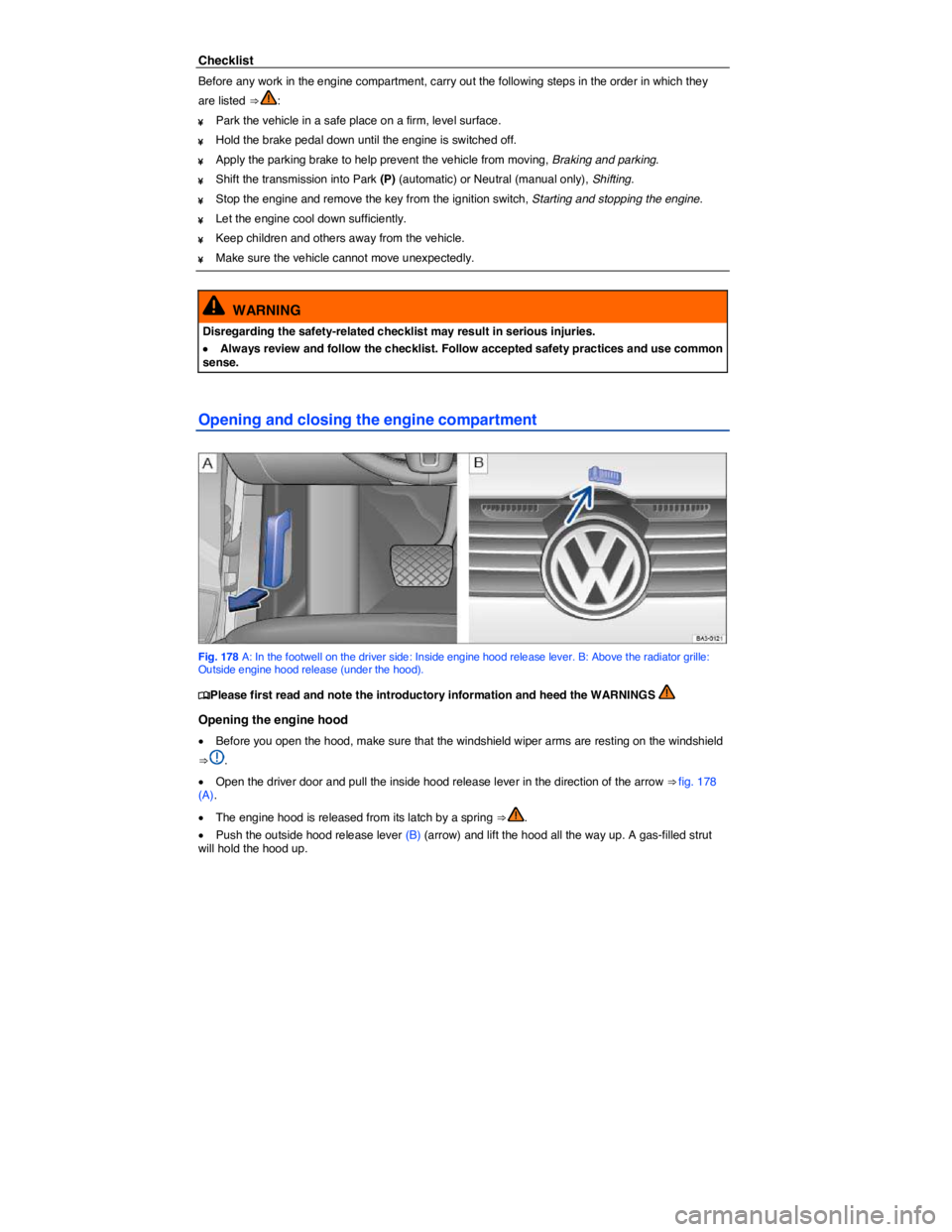
Opening and closing the engine compartment
Fig. 178 A: In the footwell on the driver side: Inside engine hood release lever. B: Above the radiator grille: Outside engine hood release (under the hood).
Page 351 of 392
353
x Slip the cover up and over the selector lever ⇒ .
Emergency release for the selector lever
x Push the release lever ⇒ fig. 203 in the direction of the arrow and hold it in this position.
x Press the release button in the selector lever handle and shift the selector lever to Neutral (N).
x Carefully press the selector gate cover back in place, making sure that the electrical wiring stays in the correct position and is not pinched or damaged
WARNING
Never shift the transmission out of Park (P) without first firmly applying the parking brake. Otherwise, the vehicle can start to roll unexpectedly, especially on hills or inclines, and cause an accident and serious injuries.
NOTICE
Even with the selector lever is in N (Neutral), the automatic transmission will be damaged if the vehicle is towed (or you let it coast) for an extended period or at high speed with the engine shut off.
Page 390 of 392

Towing manual transmission vehicles
x Release the parking brake.
x Shift the transmission into Neutral (N).
x If possible, have the vehicle towed with the front wheels off the ground.
x If necessary, the vehicle can also be towed with the rear wheels off the ground ⇒ .
Towing automatic transmission vehicles
x Release the parking brake.
x Shift the transmission into Neutral (N).
x Tow the vehicle only with its front wheels off the ground ⇒ .
When not to tow your vehicle
If there is little or no oil in the transmission because of damage to your vehicle, it must be moved with the drive wheels off the ground. The vehicle can only be towed if its ignition is switched on and its electrical system is operating. In the following situations, the vehicle cannot be towed at all and must be transported on a flatbed truck or trailer:
x If the front and rear wheels cannot turn.
x If the vehicle battery is dead (because the electronic steering column lock engages and cannot be released).
x If you have to tow an automatic transmission vehicle more than 30 miles (50 km).
WARNING
It is not safe for children or other persons to ride in a vehicle that is being towed.
x Never let children or anyone else remain in the vehicle while it is being towed.
NOTICE
The drive axle rotates while the vehicle is being towed with its rear wheels off the ground. This can damage the automatic transmission.
x Never tow automatic transmission vehicle with the rear wheels off the ground.
x Tow manual transmission vehicles with the rear wheels off the ground only if it is certain that no transmission fluid can leak out.
heed the information and WARNINGS in the owner's manual of the vehicle being towed.