2008 VOLKSWAGEN JETTA ground point
[x] Cancel search: ground pointPage 393 of 477

Booklet 3 .2 Tips and Advic e
Raising the vehicle
Raise the vehicle only on the appropriate jack points for vehicle jack.
Fig. 25 The jock points fo r the vehicle jock
Do not jack up th e vehicle until all the
w heel bolt s on t he w he el be ing changed
ha ve been loo sened
71
Jacking up the vehicle
1. Locate the jack point 25 (arrow )
closest to the whee l that has to b e
c h anged.
2 . Ra ise the jack u nder the jack point until
it fits under the ve hicle.
3. Make sur e th at the stand of the jack is in
full contact with th e gro und.
4. A djust th e jack and cont inue cranking
up the handle until i t is in position around
th e vertica l rib und ern eat h the vehicle
5. Cra nk up the jack until the whee l is off
th e gro und.
T he jack must be po sitioned only at th e jack
po ints fo r th e ve hicle jack sh ow n 25 . A l
ways use the jack p oin t closest to the wheel you
are wo rking on.
WARNING
Improp er use of yo ur vehicle jack ca n ca use
th e ve hicle to fa ll th e jack lea ding to se riou s
72 What do I do now?
Fig . 2 6 Jock ot le ft reor
WARNING (continued)
p erso nal inju ry. To r edu ce the risk of in jur y
caused by the ve hicle fa lling off the jac k:
• Always set up the jack o n firm , leve l
grou nd. Soft ground under the jac k m ay cause
th e ve hicle to s lip
the jack. If nece ssary use
a large , stron g board or sim ilar su pport. On a
h ard , slipp ery su rface (such as tile s) use a
ru bber mat or something simil ar to pre vent
th e jack from slippi ng.
• Always position the jack on ly at the jack
p oin ts for t he ve hicle jack
25 .
• Before you
your vehicl e, always make
s ur e th e jack claw properl y grasps the ver tica l
rib und er th e s ill so that the jack docs no t slip
ofTw hen yo u are ra is in g th e ve hicl e
26 .
• If yo u are tow ing a tra iler, unhit ch it from
yo ur vehicle before ra is ing the veh icle. Always
appl y the tra iler brakes firml y and make s ure
th e tra iler ca nn ot mo ve unint enti ona lly.
• Alw ays keep children at a safe di stanc e
wh ile usin g th e veh icle jac k an d also make
s ure there are no per sons under the ve hicl e.
Children at p lay cou ld knock the ve hicle off
the jack or hide un der a veh icle.
• Never supp ort yo ur body we ig ht on the ve
hi cle w hen it is up on t he jac k.
• Never allow a nyone to sta y in the veh icle
whe n raising the ve hicle
the jac k or when
it is up on th e jack.
Page 409 of 477

Booklet 3.2 Tips and Ad vic e
Attach the tow-rope or the tow-bar only to th e
tow ing eyes provid ed .
D riv in g s ty le
T ow ing require s some exper ie nc e, es pecia lly
when using a tow -rope. Both driv ers should be
familiar w it h th e tec hn iqu es required for tow ing.
In ex perienced drivers should not try to tow an
o th er ve hicle.
Do not pu ll to o hard w ith th e towing vehicle and
a vo id j erking the tow- rope . When tow in g on an
unpa ved road, there i s alway s
risk of over
l oad ing and damaging the an ch orage points .
T he ignition oft he ve hicle be in g towed must be
s witched on to prevent the stee ring whee l fro111
lo ck ing. Also ensur e that the turn signals, horn,
windshield wipers and wash ers work properl y.
Keep in mind that the brake b ooste r d oes not
work when th e e ngine is not running. You will
hav e to apply considerably more pressure to th e
brak e pedal than you wou ld nor111a lly.
A lso the pow er stee rin g do es not work when the
e n g in e is not running. You will n eed m ore for ce
to stee r than you would norma lly.
Tow in g ve hicl es w it h an aut om atic tran smi ssio n
• Move the se lec tor leve r to N. •
Do not drive fa ster than 30 mph (50 km/h)
wh en towing a ve hicl e.
• Do not tow further t han
3 0 111iles (50 km ).
• lfa tow tru ck i s use d, th e ve hicle must be
tow ed with a ll w heels off the ground .
WARNING
Towing a vehicle c hange s th e way yo ur vehi cle
h an dles a nd br akes. To help re du ce t he risk of
an acci den t lead ing to se rious persona l injury,
no te th e fo llow ing:
• T he dr ive r of t he ve hicle t hat is be ing
towe d:
- Will h ave to p ress th e bra ke peda l con
s id era bly harder than no rm al beca use th e
b ra ke boos te r i s not a cti ve. Always be alert
no t to rear-end the tow ing ve hicle .
- Will h ave to use cons idera bly more fo rce
t o t urn th e steerin g w hee l, b eca use th e
power steer ing is not active.
• The driver o f the ve hicle that is tow ing:
- Must accelera te grad ually a nd ge ntle,
avo id je rkin g m oveme nts.
- Must b ra ke ear lier a nd more gentle t han
yo u wo uld norm ally
When can your vehicle not be towed?
Yo ur ve hicle m ay no t be towe d un der the fo l
l ow ing con ditions:
• If th e tran sm iss ion mal fun cti o ns and there is
no tran smis sion flui d.
• I f th e veh icle e lectr ical sys tem is not func
ti o nin g beca use the s tee ring will lock up.
• If yo u ha ve to driv e fu rth er th an 30 mile s (5 0
• If the front or rea r axl e is off th e ground
because you dama ge th e gea r.
In the se cases the vehicl e mu st be transport ed
o n a car c arrie r or trailer.
WARNING
If you still tow your ve hicle un der these co ndi
tio ns, you could ca use an acci dent or ca use
d am age to th e ve hicle. Thi s w ill n ot b e covere d
by your Limit ed New Ve hicle Warra nty .
88 Wha t do I do no w?
Do no t tow your ve hicl e beh ind a re cre a tional
vehicle . The Automatic transmi ssio n can be se
ve re ly damaged. This can happ en even if these
l ec to r lever is in th e N (Ne utral) pos ition.
• If th ere is no oil in th e tra nsmi ssio n because
o f dama ge to yo ur vehicle , th e veh icl e s hould b e
mo ved with a ca r carrier .
• If th e front or rear axle is lift ed off th e grou nd,
thi s will serio us dama ge the dr ive gea r.
• If th e veh icl e ha s to be towe d more than 30
mi les (5 0
all whee ls must be rai sed to tow
t he vehicle. The vehicle should be m oved with a
car carrier .
• If vehicle has no e lec trica l po we r, th e
s te erin g will be locked. The ve hicle must
Page 410 of 477
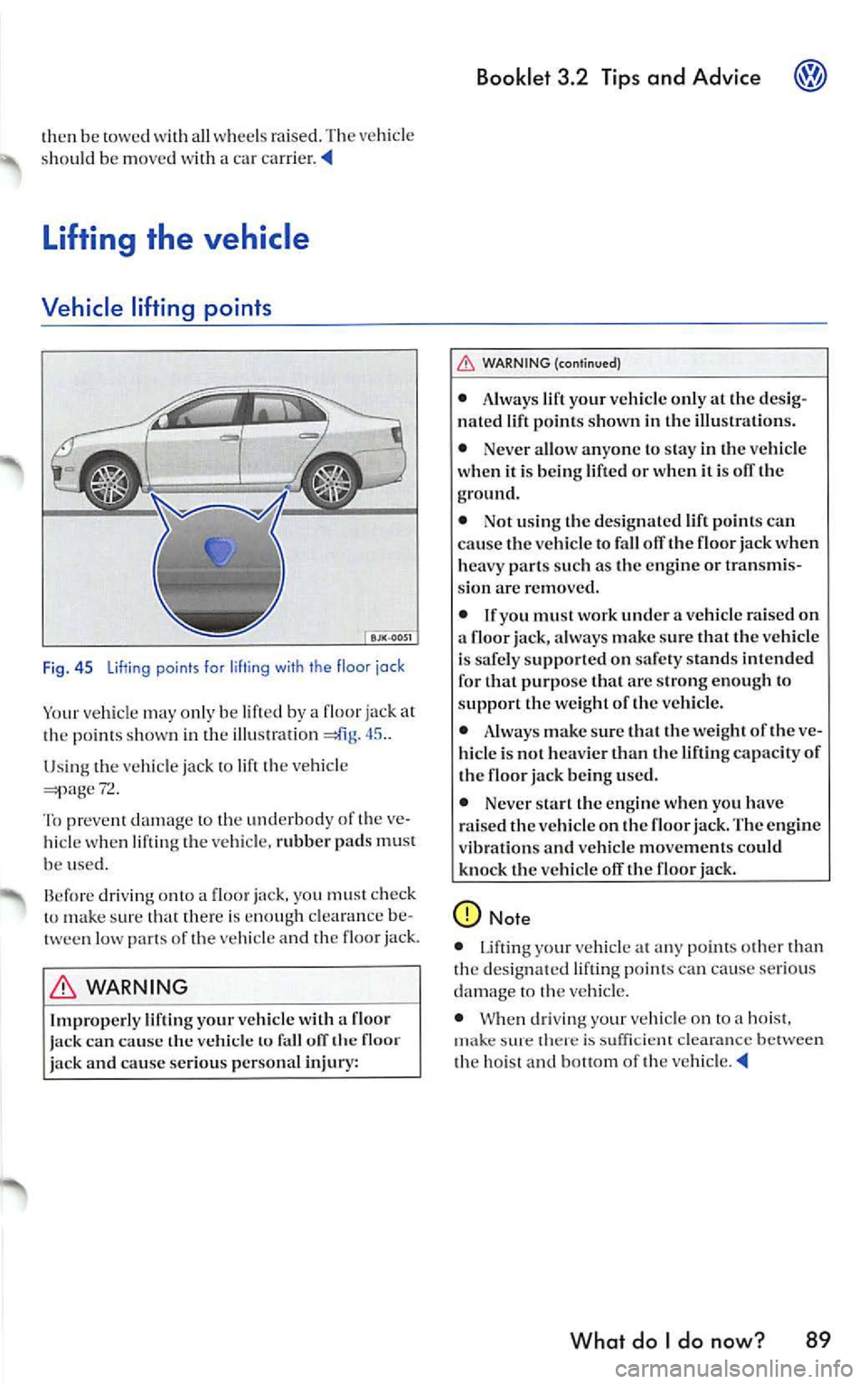
then be towe d w ith all w hee ls rai sed. The ve hicle
s h ould be m ove d with a car
45 ..
Usin g th e ve hicle jack lift the vehi cle 72 .
To p reve nt damage to the un derbo dy of the ve
hicl e when lifting th e vehicl e, rubber pads must
be used.
B efo re driv ing o nto a flo or jack. yo u mu st chec k
make s ure that there is enou gh clea rance be
tw een low of the vehicle and the floor jack.
WARNING
Improp erl y your vehicl e with a floor
ja ck can cause the fl oor
j ac k and cause seriou s perso nal inju ry:
Booklet 3.2 Tips and Advice
WARNING (continued)
• Always lift your vehicle on ly at th e des ig
nated lift point s shown in the illu strations.
• Neve r allo w anyone to sta y in the ve hicle
when it is bein g lif ted or when it is
the
ground.
• Not u sin g the des ig nated lift point s can
ca use the vehicle to fall
the floor j ack when
hea vy part s such as the en gine or tran smi s
s ion are rem oved.
• If yo u must work under a veh icle rai sed on
a floor j ack, alway s mak e sure that the vehicle
i s sa fely supp orted on safety stands int end ed
for that purpose that arc strong e nough to
s upport th e we ight of the ve hicle.
•
mak e sure th at th e weight of th e ve
hicl e is not h eav ier than th e liftin g capac ity of
th e floor jack bein g used.
• Never start the engine when you have
rai sed th e vehicle on the floor jack. The engin e
v ibration s and vehicle move ment s co uld
knock the vehicle
the floor jac k.
Note
• Lifting yo ur vehicle at any point s oth er than
th e de signated lifting po int s c an cause se rious
damage
th e veh icle.
• When drivi ng yo ur vehicle on
10 hoist, m ake there is suffici ent cl earanc e betwee n
th e ho is t a nd bot1om of the
What do I do now? 89