2008 VOLKSWAGEN JETTA Gas light
[x] Cancel search: Gas lightPage 9 of 477

® Booklet 0.1 General Index
Engine oil 3.2: 37
Adding 3.2: 40 Additives 3.2: 40
Checking level 3.2: 39
Consumption 3.2: 38
D iesel eng ine 3.2: 41
D ipstick 3.2: 39
Grades 3.2: 38
How do I know how much oil my engine is
co nsumin g? 3.2: 38
Identifi cation symbol 3.2: 39
Oil c hange 3.2: 42
Specificatio ns 3 .2: 37
Specifications Diesel engine 3.2: 37, 41
S p ecifications gasoline engine 3.2: 37
Wha t kind of engine oil shou ld I put in my
ve hicle? 3.2: 37
When should I check the eng ine oil leve l?
3.2: 38
Where is the oil dipstick 3.2: 39
Engine
pr essure
Warning light 3.
l: 11, 25
Environ ment
Avoid ing pollution 3.2: 18, 31
C leaning the engine comp artm ent 3.2: 22
Driving economicall y 3.2: 14
Vehicle care products 3.2: 16
Env ironm ental information
Fuel economy 3.1: 6
Env ironmental tip
Fue l economy 3.1: 77
ESP 3.1: 9 1, 3.2: 5
Eve nt Da ta Recorde r 3.2: 6
Examples of im proper seating position s 2.1:
8
Exha ust warni ng ligh t
Warning light 3.1: 22
Exte nder for the safety belts 2. 1: 22
Exte rnal ae rial 3.2: 29
F
Fabric trim
C leani ng 3.2: 23
Fa ste nin g
Boo ste r se ats 2. 1: 59
Co nver tibl e child seats 2.1: 57
Infant seats 2.1: 56
Safety belt extender 2.1: 23
Safety belts 2.1: 19
6 Alphabetical index
First-aid kit 3.1: 74
Floor mats 2.1: 9
F o g lights 3.1: 46
Foo t brake
Warn ing lig ht 3.1: 30
Front airbag system 2.1: 31
Airbag deployment zone 2.1: 37
T he basic s 2.1: 31
Fro nt airbag s
De scription 2.1: 31
Front center armrest 3.1: 70
Fro nt passe nger seat backr est
Fo ld ing forward 3. 1: 61
Front seats 3.1: 60 Electrical adjustable 3.1: 62
Manual adjustable 3.1: 60
Fronta l collision s an d the laws of physics 2.1:
15
fu el filler cap
Warning light 3.1: 29
Fue l ga uge
D isplay 3.1: 7
Fuel level 3.1: 7
Fue l reserve
Warning light 3.1: 26
Wa rnin g mes sage 3.1: 11
Fuel tank 3.1: 7
Fuse box 3.2: 79
Fuses 3.2: 77
G
Garage door opener 3.1 : 44
Gaske ts 3 .2: 20
Gaso line 3.2 : 32
Blend s 3.2: 32
Co ntainin g alco hol 3.2: 32
Oc tan e rating 3.2: 32
Petro l 3.2: 32
Premi um 3.2: 32
Regular 3.2: 32
Unleaded 3.2: 32
What if! purchase poor qu al ity fuel? 3.2:
32
W hat wo uld happen i f I pu t leaded gaso
l in e i n m y car? 3.2: 32
W inter or summ er lips 3.2: 32
Gaso line additives 3.2: 33
Genera l illu strati on 3.1: 3
Page 12 of 477

Parking 3.1: 10 8
Drive r 2.1: 4
Front pa ssenge r 2.1: 5
Occ upant s 2. 1: 4
R ear passe nge rs 2.1 : 6
Park ing aid 3.1: 106
Parki ng Ass is tance
C lea ning senso rs 3 .2: 18
Parking brake 3. 1: 10 4
Warn ing light 3 .1: 28, 104 l
Parki ng di sta nce warnin g sys te m 3.1: 106
Parts 3.2: 27
P ASS EN GER AIR BAG OFF light 2.l: 39
Pe dal s 2.l: 9
Phys ica l p rinci ple s o f a fr ontal colli sion 2.l:
1 5
P in ch prot ection
Power roof 3.l: 43
Window s 3.l: 4 1
Plastic parts 3.2: 1 9
C le aning 3.2: 23
Po lle n filter 3.1: 88
Pollution filter 3.1: 88
Powe r
Roo f3.l:4 2
Power outlet 3.l: 73
Pow er roof 3.1 : 42
Po we r ste ering
Wa rnin g light 3.1 : 29
Power steering 3.2: 6
Pow er was her 3.2: 18
Power windows 3.l : 39
Pr egna nt women
Spec ia l co nsideration s when wea ring a
safety belt 2. 1: 2 1
Premium Gasoline 3.2: 32
Pre ssure mark s 2.l: 67
Prop er adju stm ent of head rest raint s 2.l : 7
Proper occupa nt sea ting pos itions 2.1: 4
Proper safety belt p os iti on 2.l : 2 0
R
Rain sensor 3.l : 54
Raising the vehicl e with th e ja ck 3.2: 72
R eading light s
Fro nt 3.1: 51
Rear armr est 3. 1: 70
Booklet 0 .1 General Index
Rear interior light 3.1: 52
R ea r lid 3.l: 37
Clo sing 3.l: 38
Esc ape handl e 3.2: 76
W arnin g light 3.l : 26
R ea r sea t b ackres t
Fo lding forward 3.1: 66
Rai sing in to place 3.l: 67
R ea r seat ben ch 3.1 : 66
R ea r v entilation 3.l: 86
R ear view mirro r 3. 1: 55
R ea r wi ndo w 3.1: 3 7
Re ar window heat ing
H ea ting ele m en t w ires 3 .2: 2 0
R ea r window heat ing 3.1: 80, 81
R ea r wi per 3.l: 53
R ef uelin g 3.2 : 30
R eg ular Gasoline 3.2: 32
R emote control
Ve hicl e3.1:32
R em ote contro l key
Button s 3. 1: 32
Repl acing th e b attery 3 .l: 32
S yn chroni zin g 3.1 : 33
R emo vin g t he ignition key 3.l : 94
R epa irs
sy stem 2.1: 42
Repair s 3.2: 28
R eplac em ent keys 3.1: 31
R eplacing th e batt ery
Remote co ntrol key 3.1: 32
Re porti ng safety defects 2.1: 12
C an ada 3.2: 90
Uni ted Sta tes 3 .2: 90
Re tracto r 2.1: 19
R eve rse
A utoma tic tran sm iss ion 3.1: 102
Roof carrier mounts 3.1: 7 6
Roof load 3.l: 77
Roo f rack 3.1 : 76, 77
Rubber gaskets 3. 2: 20
s
Sa fe drivin g 2.1: 2
Sa fety belt exte nder 2. 1: 22
Sa fety belt h eight adjustm ent 2.1: 24
Alphabetical index 9
Page 15 of 477

® Booklet 0.1 General Index
Unplea sant odo r 3.1: 83
Upho ls tery
Pr ess ure marks 2.1: 67
V
Veh. sta tus 3.1: 15
Veh icle
Lift ing 3.2: 89
Ve hicle battery 3.2 : 49
Ve hicle care
Exterior 3.2: 17
Ve hicle care products 3 .2: 16
Vehicle contro l module s 3.2: 6
Ve hicl e electric syste m 3.1: 24
Ve hicle phon e 3.2: 29
Ve hicle sta tu s 3.1: 15
Ve hicle tool kit 3.2: 67
Ven tilati on slots 2.1: 11
V olk swagen Service Rep air Manuals 3.2: 91
w
Warning light
E lectro nic Power Co ntrol (EPC) 3. 1: 23
Warning li gh ts 3.1: 20
Emergency flasher 3.1 : 48
P ASS EN GER AIR BAG OFF 2. 1: 39
Sa fety bel ts 2.1: 14
Turn signals 3 .1: 49
Warn ing texts in the dis pl ay 3.1: 11
Warn ing triang le 3. 1: 74
War ranty cove rages 3.2: 15
Wa sh er fluid 3.2: 45
Wa shin g by hand 3.2 : 17
Was hing the vehicle 3.2: 1 7
Was hing wit h pow er cl eaners 3 .2 : 18
Waxing How often sh o uld I wax my car? 3.2: 19
Wear indicator 3.2: 59
What does it m ean w hen I fee l a sli ght vibra
ti on on the bra ke pedal? 3.2: 3
What hap pens if yo u do not wea r your safety
belt ? 2.1: 16
W hat happen s if you wea r yo ur safety belt too
l oose? 2.1: 20
W hat happe ns to occu pants not wear ing
sa fety
2. 1: 16
12 Alphabetical inde x
What if I p urch ase poor quality f uel? 3 .2: 32
W hat impair s driv ing safety? 2.1: 3
Wha t is LATCH? 2 .1: 64
What is the correct brake fluid leve l?. 3.2 : 47
What is the right way
to brea k-in my vehicle?
3.2:7
What kind of brake fluid sho uld I use? 3.2: 48
What kind of engine oil sh ou ld I put in my ve
hi cle? 3.2: 37
What should I do af ter ch an ging a whee l? 3.2:
57, 74
W hat s hould I do after replac ing w hee ls? 3.2 :
57
What sh ould I do if I want to add an accessory
to my ve hicl e? 3.2: 27
W hat should I do if I want to modify my vehi
cle? 3.2: 28
What sh ould I do if I want to repair my ve hi
cle? 3.2: 28
What sho uld I do if the brake warning light
comes on? 3.2: 47
Wha t types ofCRS a nchor s are availab le and
how are they related to child safety? 2. 1:
64
Wha t wo uld happ en if I put lead ed gaso line
in my ca r? 3.2: 32
What you m ust do after reconnec t th e batt ery
3.2: 49
What you should know when driving with
chi ld ren? 2.1: 51
Whee l b olt caps 3.2: 69
W hee l b olt s 3.2: 71
To rque 3.2: 66
W heel c hangin g 3.2: 68
Wheel s 3.2: 51
When can yo ur vehicl e not be towed? 3.2: 88
When must a safety belt be re pl ace d? 2.1: 17
When must the airbag system be in spected?
2 .1: 39
When parking on slopes 3.1 : 10 5
When sh ou ld I adju st the tire pressures? 3.2 :
57
W hen sho uld I ch eck the en gin e o il leve l? 3.2 :
38
W hen should I check the tire press ures? 3.2:
57
W hen sh ou ld I re fuel the tank of the ve hicle?
3 .1: 7
Page 157 of 477

Booklet 2.1 Safety first
WARN ING (cont inued)
justm ent ran ge, as far away from th e a irbag as
po ssi ble before insta llin g th e fo rwar d-facin g
c hild re straint. The backr est mu st be adju sted
t o a n u prig ht po sition .
• Alway s make sure that nothing pr events
the front p assenger's sea t from being moved
to the rea rm ost positi on in it s fo re and aft ad
ju stm ent range .
• Neve r pl ace add itional it em s on th e s eat
that can in crease the tota l we ight regis tered b y
WARN ING (cont inu ed)
the weig ht-se nsi ng m at and can cause injury
in a cras h.
• Make sure that the PASS ENGER AIR BAG
OFF light come s on and stays on all th e time
w henever the ig niti on i s sw itched on.
• l fthe PASSENGER AIR BAG OFF light docs
not come on an d stay o n, imm edia tely insta ll
th e fo rwa rd-faci ng child seat in a rea r sea ting
position and have the a irb ag sys te m inspec ted
by your Volk swage n dealer. •
Advanced Airbag System components
The front passe nger seat in you r ve hicle has lot
of ve ry im por tant parts of th e Adva nce d Airbag
Syste m in it. The se parts includ e 1he weight
se nsing mat , senso rs, wir in g, bracke ts, a nd
more. The functio n of the sys te m in th e front
passenger seat is chec ked by th e e lectron ic con
t rol unit when th e ig niti on i s on. The contro l uni1
monitor s th e A dva nce d Airbag Syste m and turn s
th e a irbag indicator lig h t on when a malfun ction
in th e syste m co mp on ent s is det ected. The func
t ion o f th e airb ag indica tor lig ht i s desc ribed in
g reater detail below. Beca use the front pas
se nge r sea t co ntain s imp ort ant parts of the Ad
va nc ed Airbag System, you must t ake care to
p reve nt it from being damaged. Damage to 1h c
sea t ma y pre vent th e A dva nce d Airb ag for
fron t passenge r se at f rom doing it s job in a
c ras h.
Th e front Advanced A irbag Syste m consis ts of
the following:
• Cras h se nsors in th e front o f 1h e ve hicle 1hat
m eas ure vehicle acce lera tion/d ecelera tio n to prov ide inform arion to the Advanced Airbag
Sys te m abou t th e seve rity of t he crash.
• An electro nic co ntrol unit, wit h in tegra te d
cras h se nsor s for fron t an d side impacts. The
co ntro l uni t "'decides ·· w hether to
just o ne or
bot h stages of the fron t airbags based on th e
form atio n receive d from the crash sensors . T he
contro l unit also "decides·· whether the safe ry
belt pretens io ners s ho uld b e act ivated .
• A dual -stage Advanced Airbag
g en
era tor for th e dr ive r in sid e the stee ring whe el
h ub.
34 Airbag system
• A dua l-stage Advanced A irbag and gas ge nerin side t he instrument panel fo r the fro nt
pass enger .
•
we ig ht-sens ing m at und er the upholster y
padding of the front passenge r sc at cushion that
m easures th e tot al we igh t o n the scat. The info r
mation registe red is se nt cont inuousl y to the
e lectro nic contro l unit to re g ul ate deployment
of t he front Advance d Airbag on the passenger
si de.
•
airbag monitoring system and indicator
li ght in the in stru ment clus te r 39 .
• The PASSENGER AIR BAG OFF light in the
cente r of the instrument pa nel
39 , 25) that te lls yo u when th e fro nt Adva nced
A irb ag on the passe nger si de ha s been turned
off.
• A se nso r below the safety be lt lat ch for the
fro nt sca t pa ssenger to m eas ure the tens io n on
t h e safe ty belt. The
on t he safe ty be lt and
the weig ht reg is te re d by 1h e we igh t-se nsi ng m at
h elp t he control unit "'d ec ide" whe th er the fr ont
airbag fo r th e fro nt p assenger seat sh ould be
t urned off or no t
29, "Ch ild restra int s on
t h e fr o nt sea t - so me impo rtan t thin gs to kn ow··.
• A se nso r in the sa fety belt la tc h for the driver
an d for the front sca t passenger that senses
whe th er that safety belt is latc hed or
and
t ransm its thi s in form ation to t he e lectroni c con
tro l unit.
Lr!, WARNING
Damage to the fron t pa sse nger se a t ca n pre
ve nt the airba g from worki ng pr oper ly.
Page 226 of 477

Booklet 3.1 Control s and Equipm ent @
Applies to vehicles: with gasoline engine
Electronic Power Control (EPC}
This warning light monitors the engine management system on gasoline eng ines.
The warn ing light £ C (Electron ic Power Contr ol)
li ght s up whe n th e ig niti on is switched o n to
show that the light i s work ing prope rly.
It sh ould
go out when the e ngine has s tarted running.
! fa ma lf un ction develo ps in th e engine manage·
m ent sys tem whil e yo u are dr iv ing, thi s warning
Applies to vehicles: with o diesel engine li
ght wi ll light up. Ha ve the e ngin e checked by an
au thori zed Vo lkswage n dea ler or qua lified shop as soo n as po ssible.
Th e followi ng tex t is disp laye d on the
m en t c lu ster: Engine
Glow plug system I Engine malfunction
The indicator l amp lights up to show that the glow plugs are preheating . It flashes
if the re is an engine malfunction.
Warning light
stays lit up
Th e wa rning light lights up whil e th e
plug s are prehea ting. Whe n the warnin g light
goes off, the en gine sh ould be s tarted right away.
The warn ing light do es not light up if th e en ·
gi ne is at opera tin g te mperature . Th e eng ine
ca n be s tart ed imm ediate ly.
There is a fault in the
plu g sys te m if the
wa rnin g ligh t does not li ght up when the en ·
Electronic immobilizer -
gine is cold. Co ntact an au thorized Volkswage n
d ea le r or a qualifi ed workshop.
Warning lig ht
flash es
lfa mal func tion deve lops in th e eng ine manag e
m ent sys te m whil e yo u are drivin g, th e glow plug
light will flas h . The engine sh ou ld be checked
b y an author ize d Volkswagen dea le r or
quali·
fi ed wo rksh op as soo n as possib le .
Th e fo llow ing te xt is di spla yed on the instru·
m ent cluster: Engine
This wa rning light flashes if an unauthoriz ed key is used.
T here is a ch ip in th e key. It a u tomatica lly deac·
ti vat es the imm obilize r when th e key is in se rted
in to th e igniti on lock. T he immobili zer will be
a cti vated again aut oma tica lly as s oo n as you
p ull th e ke y out of the ig nit ion lock.
T his wa rning lig ht will light up for appro xi
m ate ly 3 seconds wh en th e ignit ion is switc hed
on . Thi s warni ng ligh t fl ashes if an un auth orized
k ey is use d . The in format io n text displayed in t
h e in strument clu ste r di spla y is: Imm obilizer
active ! Th e ve hicle cannot b e used in th at case .
The en gin e c an , h oweve r, be sta rt ed i f th e
pria te co ded genu ine Vo lksw age n ke y is used.
Tip s
Th e veh ic le ca nnot be opera te d proper ly if you
d o not h ave
genuine Vo lk swagen
In strum ent panel 23
Page 228 of 477
Booklet 3.1 Controls and Equipment
If the warning light ligh ts up again after d rivi ng
o n for a sh o rt dis tan ce, stop the vehicle and
swi tch off the engine. C onta ct an authorized
V olk swa gen deal er or a qualifi ed wor ksh op.
WARNING
Stop! Before working in the engine compart
ment, always read and heed all WARNINGS
3.2 "Working in the engine com
partment. " The engine compartment of any
motor vehicle is a pot entially dangerou s area
and can cause serious personal injury.
WARNING
Hot steam or coo lant can cause serious burns.
• Never open the engine hood if you sec
steam or coo lant escapi ng from the engine
compartment. Always wa it until you no longer
sec or hea r steam or coo lant escap ing from the
engi ne.
• Always let the en gi ne to cool down com
pletely before carefully open ing the engine
h ood. Hot components w ill burn skin on co n
tact.
• When the engine has cooled down and you
are ready to open the engine hood:
R emove the key from the ignition.
Engine oil pressure 9=:7:
WARNING (continued)
Apply the parking brake firmly and put
the selector in P (Park, automatic trans
mis sion) or Neutral (manual transmis
s ion) .
Keep c hildren a nd oth ers away from the
vehicle.
• Never reach into the area around or touch
the radiato r fan. Contact with the blades can
re sult in serious persona l injury.
• Alway s remember that the radiator fan is
temperature-contro lled and can t urn on sud
den ly - even when the engine has been
switched
for a longer period of tim e and the
k ey has been removed from the ignition.
• Never unscrew the coolant expansio n tank
ca p when the engine is hot. A hot engine will
h eat the coolant and put it under pressure . Re
moving a ca p that is under pressure can result
in serious personal injury and/or burns.
• Alw ays protect face, hands and arms from
h ot escap ing coo lant or steam by cover ing the
cap w ith a large, thick rag.
• Turn the cap slowly and very carefully in a
co unt er-clockwise direction while applying
light downward pres sure on the top of the cap.
• Never sp ill antifreeze or coo lant on the ex
haust system or hot engine parts. Under some
co ndit ions, the ethylene g lyco l in engine
coo lant can catch fire.
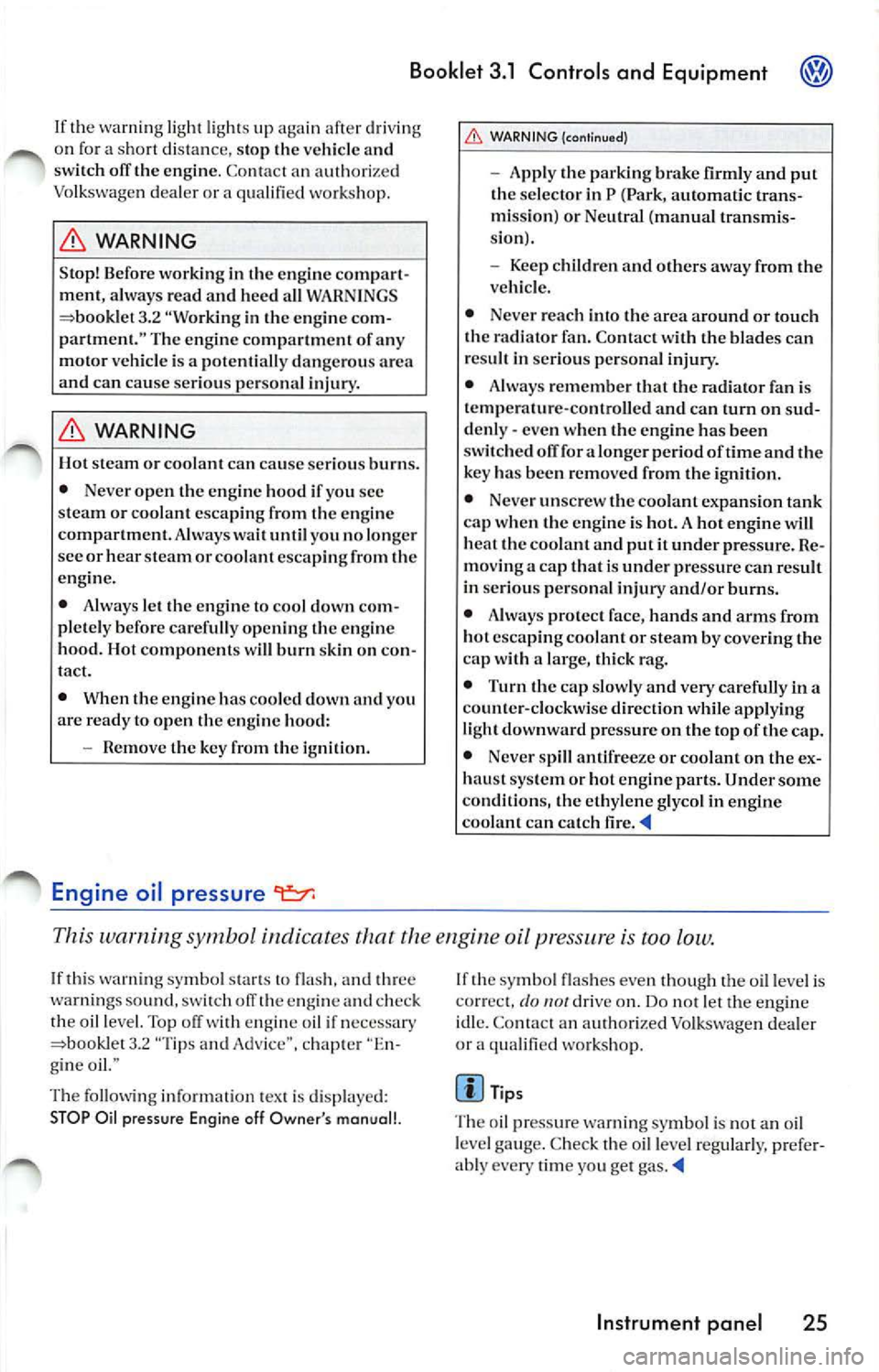
This warning symbol indicat es that the en gin e oil pressure is low.
I f thi s wa rning symbo l s tart s to flas h. an d thr ee
w arning s sound , sw itch th e e ngin e and ch ec k
th e oi l leve l. Top off with en gin e oil if necessary
3.2 "Tip s an d Adv ic e" , ch ap te r "E n
g in e o il."
The follo win g inform ation text is disp la ye d:
ST OP Oil p ressure Engin e off Owner 's manual!.
If th e sy mb ol fl as hes eve n though the oil l eve l is
co rrec t, do 11 01 drive on. D o not le t th e engine
idl e. Co nta ct a n authori zed Vo lksw age n d eale r
or a qua lified wo rksh op .
Tip s
Th e oil pre ssure wa rnin g symbol is not an oil
l eve l ga uge. Check the o il leve l reg ularl y, pre fe r
a bl y every time you get gas .
Instrument panel 25
Page 251 of 477
Booklet 3 .1 Control s and Equipment
Instrument cluster illumination
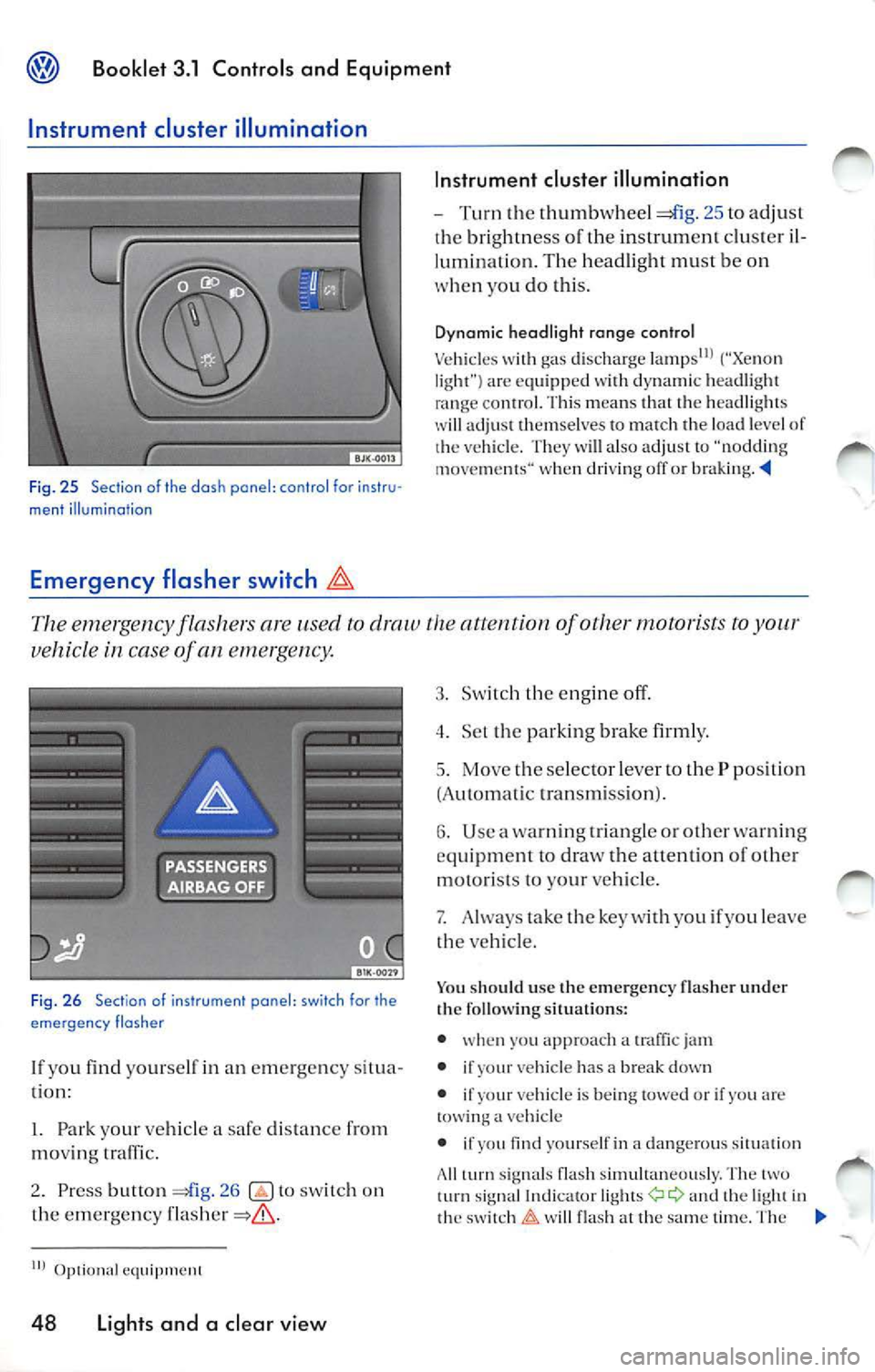
Fig. 25 Section of the dash pane l: co ntr ol fo r instr u·
ment illumination
Emergency flasher switch
In strument cluster illumination
- Turn the thumbwh eel 25 to adju st
bri ghtne ss of the in strum ent clu ste r il
lum inatio n. Th e hea dlig ht mu st be on
w hen yo u do this .
Dyn amic hea dligh t ra nge con tro l
Ve hicl es gas discharge ("Xe non
l ig ht ") are eq uipped wit h dynami c head light
ra nge con trol. Thi s m ea ns th at the head lig ht s
wi ll adju st th em se lves to match th e load leve l of
ve hicl e. T hey will also adju st "noddi ng
m ove ments " when driving off or braking . -'4
The emergency fla sher s are used to draw the attention of other motorists
vehicl e in case of an eme,ge ncy .
Fig . 26 Section of ins trument panel: switch for the
eme rgen cy flasher
lf yo u find yourself in an em erge ncy situ a
tion:
l. Park your ve hicl e a safe distance from
moving traffic.
2. Press button
26 to sw itch on
the emergency
IIJ
48 Light s and a cl ea r vi ew
3. Sw it c h th e eng in e off.
4 . Set th e par king brake firml y.
5. Move t he se lec tor l ever to the P position
(A utomatic transmis sion ).
6. Use a warn ing tr ia ngle or other wa rning
equ ipm en t to draw the allen tion of other
motori sts to y our vehicle.
7. Always take the key with you if you le ave
t h e ve hicle.
Yo u sh oul d use th e em ergency flash er under
the fo llow ing situation s:
• whe n yo u approach a
jam
• if
vehicle has a break down
• if
vehi cle is being tow ed or if yo u arc a vehicle
• if
yourself in a dangero us s itua tion
A ll
sig nal s fla sh simultaneou sly. The turn signal a nd the ligh t in
t h e w ill fla sh at the same time . T he
Page 299 of 477
Booklet 3.1 Controls and Equipment
Ap plies to ve hicles : with a di esel engine
Starting the diesel engine
The engine can only be started a genuine Volkswagen key the correct
code.
- Move the se lector lever to P (Park) or N
(Ne utral )
98.
- Dep ress the foot brake. In vehicles with
manual transm iss ion d epress th e clutch
pedal.
- Turn the igni tion key to position
93, 76 The g low plug
warni ng light light s up while the glow
plug s are warm ing up.
- When the warning light goes out, turn
the key to pos ition
93, fig. 76
sta rt the engine. Do not press the acc eler
ator.
- Release the ign itio n key as soon as the
e ngin e starts to avoid damaging the
start er.
When start ing a cold eng ine, it may be a litt le
nois y for the fir st few se conds until oil pre ssur e
h as bui lt up in the hydrauli c
valve lift ers . This is
normal and no cause for conce rn.
When staring a warm engine, the pre -glow
warning light will no t li ght up. You can sta rt the
e n gi ne immed iate ly
If yo u ha ve problems sta rtin g
3.2 "Tip s
and Advice", chapt er "J ump startin g."
Di ese l e ngin e pre-glow system
Wh ile pre- glow is acti ve , n o major elec trical
lo ad s s hou ld be switched on -oth erwise unnec
ess ary load is pla ce d on the vehicle battery.
You should start the engine immediate ly after
th e pr e-g low indica tor lig ht has gone out.
96 Driving
To start the diesel engine after the fuel tank has
been run dry
If the fuel tank was run comp lete ly dr y, the
s tartin g proc ess after refueling with die sel fuel
can take long er th an usual -up t o one minute.
Th is is be cause th e fu el sys tem fir st ha s to be
vented of a ir wh ile starting.
WARNING
H edu ce the risk of ser ious per sonal injur y
when startin g and running the vehicl e's en
g in e.
• Never start or le t the engine run in a con
fined or enclosed are a. Exha ust from the en
gi ne contain s carbon mono xide , a poisonous,
co lor less and odo rless gas. Carbo n monoxide
ca n cause unconsci ousness and death .
• Neve r leave the vehicle unatt ended with
the eng ine runnin g. The vehicle could mo ve
s udd enly or an unusual operating condition
co uld occur res ultin g in prop erty damage or
personal injury.
• Neve r use "sta rting ass is t fluid s." They arc
po tentia lly exp los ive and can ca use a " run
away" vehicl e co ndition .
Note
You can
the eng ine if you drive hi gh en
g ine speeds, at full th rottle or by overloading the
en gin e whe n it i s cold.
For the sake of environment
Do not warm up the engine by running it with
th e ve hicl cstandin gstill. Drive off as soo n as yo u
s tart the e ngin e. T hi s help s th e e ngin e
o p
e ra tin g temperature fa ster and r edu ces
emissions .
--4