Page 3 of 384
1
OVERVIEW
FEATURES/OPERATIONS
SAFETY AND EMERGENCY FEATURES
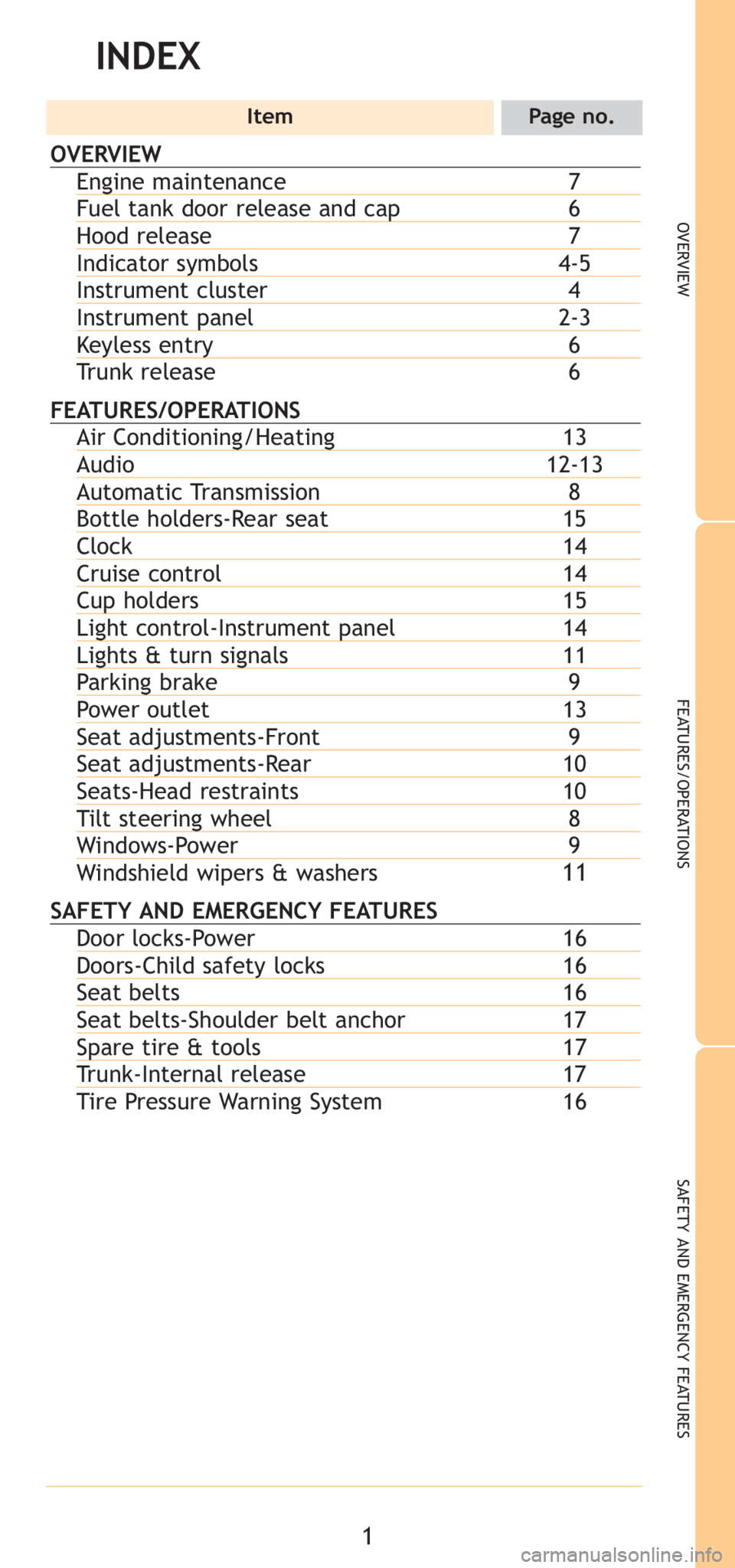
INDEX
ItemPage no.
OVERVIEW
Engine maintenance7Fuel tank door release and cap6Hood release 7Indicator symbols4-5Instrument cluster 4Instrument panel2-3Keyless entry 6
Trunk release 6
FEATURES/OPERATIONSAir Conditioning/Heating 13Audio 12-13 Automatic Transmission 8Bottle holders-Rear seat15Clock 14Cruise control14Cup holders15Light control-Instrument panel14Lights & turn signals11Parking brake9Power outlet 13Seat adjustments-Front 9Seat adjustments-Rear10Seats-Head restraints 10Tilt steering wheel8Windows-Power 9
Windshield wipers & washers11
SAFETY AND EMERGENCY FEATURESDoor locks-Power 16Doors-Child safety locks16Seat belts16Seat belts-Shoulder belt anchor17Spare tire & tools17Trunk-Internal release 17
Tire Pressure Warning System 16
Page 7 of 384
5
OVERVIEW
FEATURES/OPERATIONS
SAFETY AND EMERGENCY FEATURES
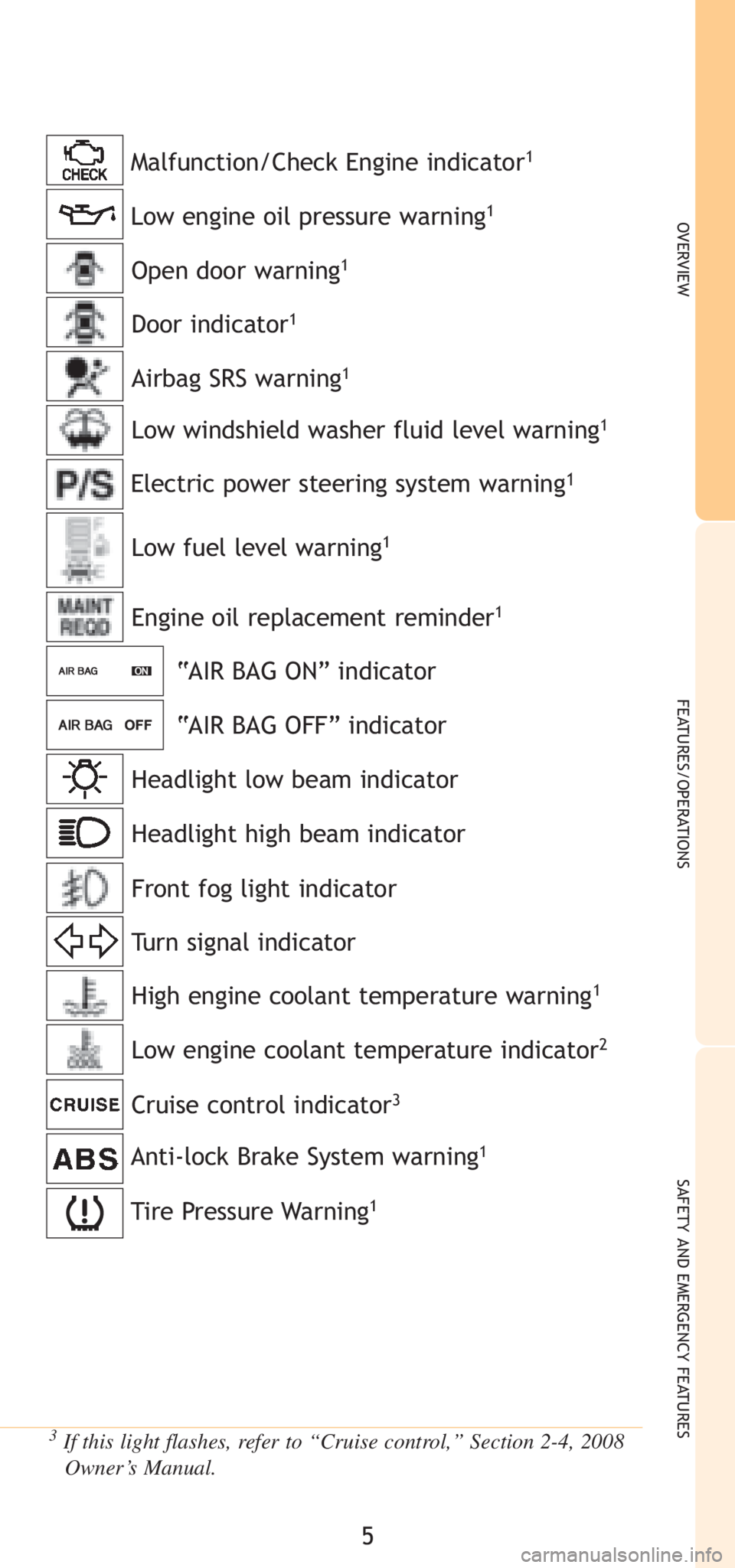
Low engine oil pressure warning1
Anti-lock Brake System warning1
Malfunction/Check Engine indicator1
3If this light flashes, refer to “Cruise control,” Section 2-4, 2008Owner’s Manual.
Open door warning1
Low windshield washer fluid level warning1
Engine oil replacement reminder1
“AIR BAG ON” indicator
“AIR BAG OFF” indicator
Headlight low beam indicator
Turn signal indicator
High engine coolant temperature warning1
Low engine coolant temperature indicator2
Headlight high beam indicator
Cruise control indicator
3
Front fog light indicator Airbag SRS warning
1
Low fuel level warning1
Door indicator1
Electric power steering system warning1
Tire Pressure Warning1
Page 29 of 384
7
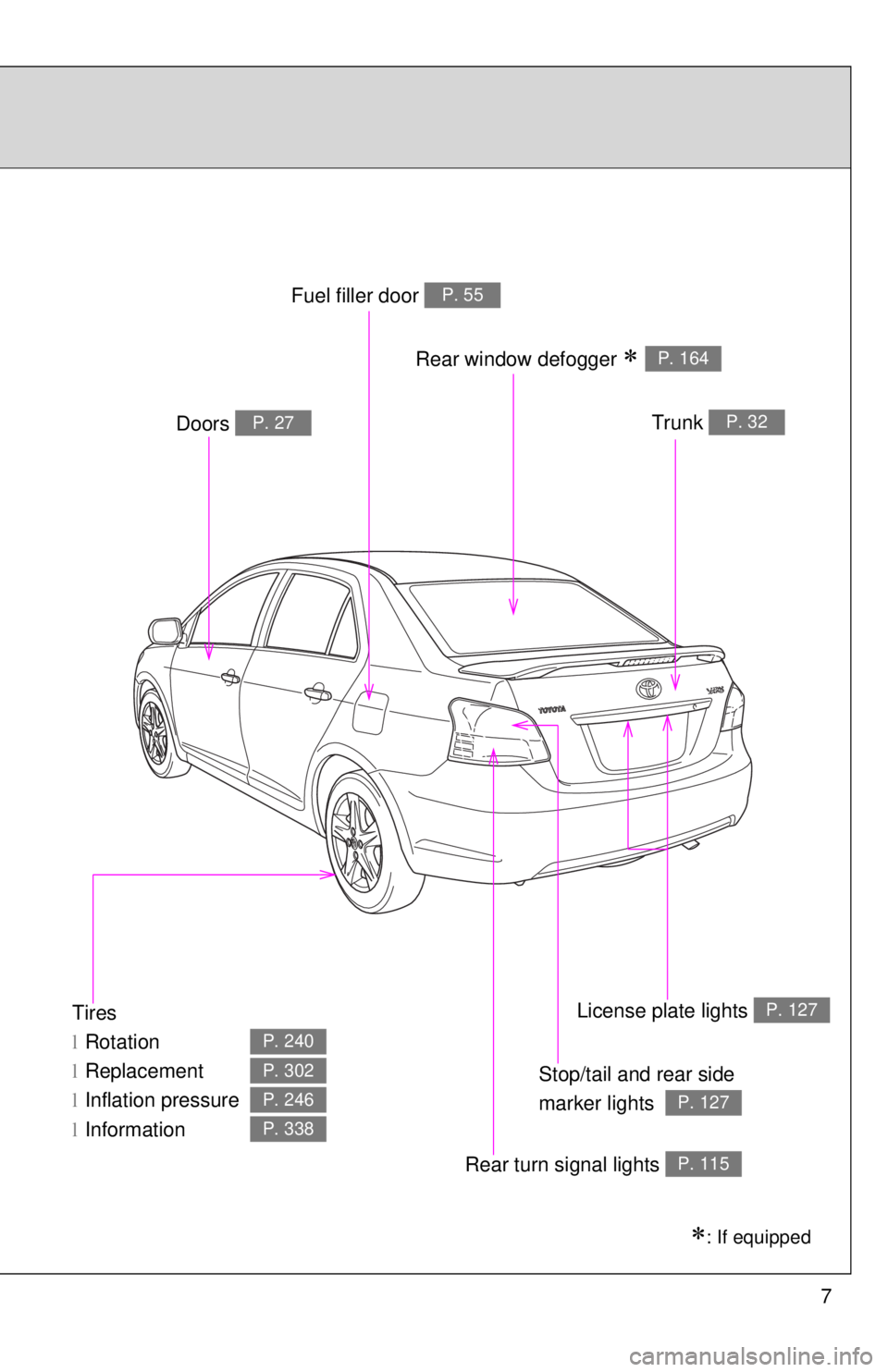
Tires
lRotation
l Replacement
l Inflation pressure
l Information
P. 240
P. 302
P. 246
P. 338
∗: If equipped
Trunk P. 32Doors P. 27
Fuel filler door P. 55
Rear turn signal lights P. 115
Rear window defogger ∗ P. 164
License plate lights P. 127
Stop/tail and rear side
marker lights
P. 127
Page 221 of 384
208
4-1. Maintenance and care
Cleaning and protecting the vehicle exterior
nAutomatic car washes
lFold the mirrors back before washing the vehicle.
l Brushes used in automatic car washes may scratch the vehicle surface
and harm your vehicle’s paint.
n High pressure car washes
Do not allow the nozzles of the car wash to come within close proximity \
of
the windows. Before entering an automatic car wash, check that the fuel filler
door on your vehicle is closed properly.
n Aluminum wheels (if equipped)
Remove any dirt immediately by using a neutral detergent. Do not use har\
d
brushes or abrasive cleaners. Do not use strong or harsh chemical cleaners.
Use the same mild detergent and wax as used on the point.
n Bumpers and side moldings
Do not scrub with abrasive cleaners.
Perform the following to protect the vehicle and maintain it in prime
condition.
l Working from top to bottom, liber ally apply water to the vehicle
body, wheel wells and underside of the vehicle to remove any
dirt and dust.
Wash the vehicle body using a sponge or soft cloth, such as a
chamois.
l For hard-to-remove marks, use car wash soap and rinse thor-
oughly with water.
l Wipe away any water.
l Wax the vehicle when the waterproof coating deteriorates.
If water does not bead on a clean surface, apply wax when the vehicle
body is cool.
Page 261 of 384

248 4-3. Do-it-yourself maintenance
nTire inflation pressure check interval
You should check tire pressure every two weeks, or at least once a
month.
Do not forget to check the spare tire.
nEffects of incorrect tire inflation pressure
Driving with incorrect tire inflation pressure ma y result in the following:
lReduced fuel efficiency
lReduced driving comfort and tire life
lReduced safety
lDamage to the drive train
If a tire needs frequent re filling, have it checked by your Toyota dealer.
nInstructions for checking tire inflation pressure
When checking tire inflation pressure, observe the following:
lCheck only when the tires are cold.
If your vehicle has been parked for at least 3 hours and has not been
driven for more than 1 mile or 1.5 km, you will get an accurate cold
tire inflation pressure reading.
lAlways use a tire pressure gauge.
The appearance of the tire can be mi sleading. In addition, tire infla-
tion pressures that are even just a few pounds off can degrade ride
and handling.
lDo not bleed or reduce tire inflation pressure after driving. It is normal
for the tire inflation pressure to be higher after driving.
lNever exceed the vehicle capacity weight.
Passengers and luggage weight should be placed so that the vehicle
is balanced.
Page 310 of 384

298 5-2. Steps to take in an emergency
nKey reminder buzzer
The buzzer indicates that the key has not been removed (with the engine
switch in the ACC or LOCK position and the driver’s door opened).
n Light reminder buzzer
The buzzer indicates that the headlight switch is left on (with the key
removed and the driver’s door opened).
n If the malfunction indicator lamp comes on while driving
First check the following:
l Is your vehicle low on gas?
If it is, refuel the vehicle immediately.
l Is the fuel tank cap loose?
If it is, tighten it securely.
The light will go off after taking several driving trips.
If the light does not go off even after several trips, contact your Toyota dealer
as soon as possible.
n Front passenger detect ion sensor and passenger seat belt reminder
If luggage or other load is placed on the front passenger seat, depending on
its weight, the reminder light to flash and buzzer to sound.
n
When the tire pressure warning light comes on
Check the tire inflation pressure and adjust to the appropriate level.
nThe tire pressure warning light ma y turn on due to natural causes
The tire pressure warning light may turn on due to natural causes such
as natural air leaks or tire inflation pressure changes caused by temper-
ature. In this case, adjusting the ti re inflation pressure will turn off the
warning light after a few minutes.
nWhen a tire is replaced with a compact spare tire
The compact spare tire is not equipped with the tire pressure warning
valve and transmitter. If a tire goes flat, the warning light will not turn off
even though the flat tire is replac ed with the compact spare tire. Replace
the compact spare tire with the repaired tire and adjust the proper tire
inflation pressure. The ti re pressure warning light will turn off after a few
minutes.
Page 312 of 384

300 5-2. Steps to take in an emergency
CAUTION
nMaintenance of the tire
Each tire, including the spare (if provided), should be checked monthly
when cold and inflated to the inflation pressure recommended by the
vehicle manufacturer on the vehicle placard or tire inflation pressure
label (tire and load information label). (If your vehicle has tires of a differ-
ent size than the size indicated on the vehicle placard or tire inflation
pressure label [tire and load information label], you should determine the
proper tire inflation pr essure for those tires.)
As an added safety feature, your vehicle has been equipped with a tire
pressure monitoring system (TPMS-ti re pressure warning system) that
illuminates a low tire pressure telltal e (tire pressure warning light) when
one or more of your tires is significantly under-inflated. Accordingly,
when the low tire pressu re telltale (tire pressure warning light) illumi-
nates, you should stop and check your tires as soon as possible, and
inflate them to the proper pressure. Driving on a significantly under-
inflated tire causes the tire to overheat and can lead to tire failure.
Under-inflation also reduces fuel effi ciency and tire tread life, and may
affect the vehicle’s handling and stopping ability.
Please note that the TPMS (tire pressure warning system) is not a sub-
stitute for proper tire main tenance, and it is the driver’s responsibility to
maintain correct tire pressure, even if under-inflation has not reached the
level to trigger illu mination of the TPMS low tire pressure telltale (tire
pressure warning light).
Your vehicle has also been equipped with a TPMS (tire pressure warning
system) malfunction indicator to indi cate when the system is not operat-
ing properly. The TPMS (tire pressure warning system) malfunction indi-
cator is combined with the low tire pressure telltale (tire pressure
warning light). When the system det ects a malfunction, the telltale will
flash for approximately one minute an d then remain continuously illumi-
nated. This sequence will continue upon subsequent vehicle start-ups as
long as the malfunction exists. When the malfunction indi cator is illumi-
nated, the system may not be able to detect or signal low tire pressure
as intended.
Page 316 of 384
304 5-2. Steps to take in an emergency
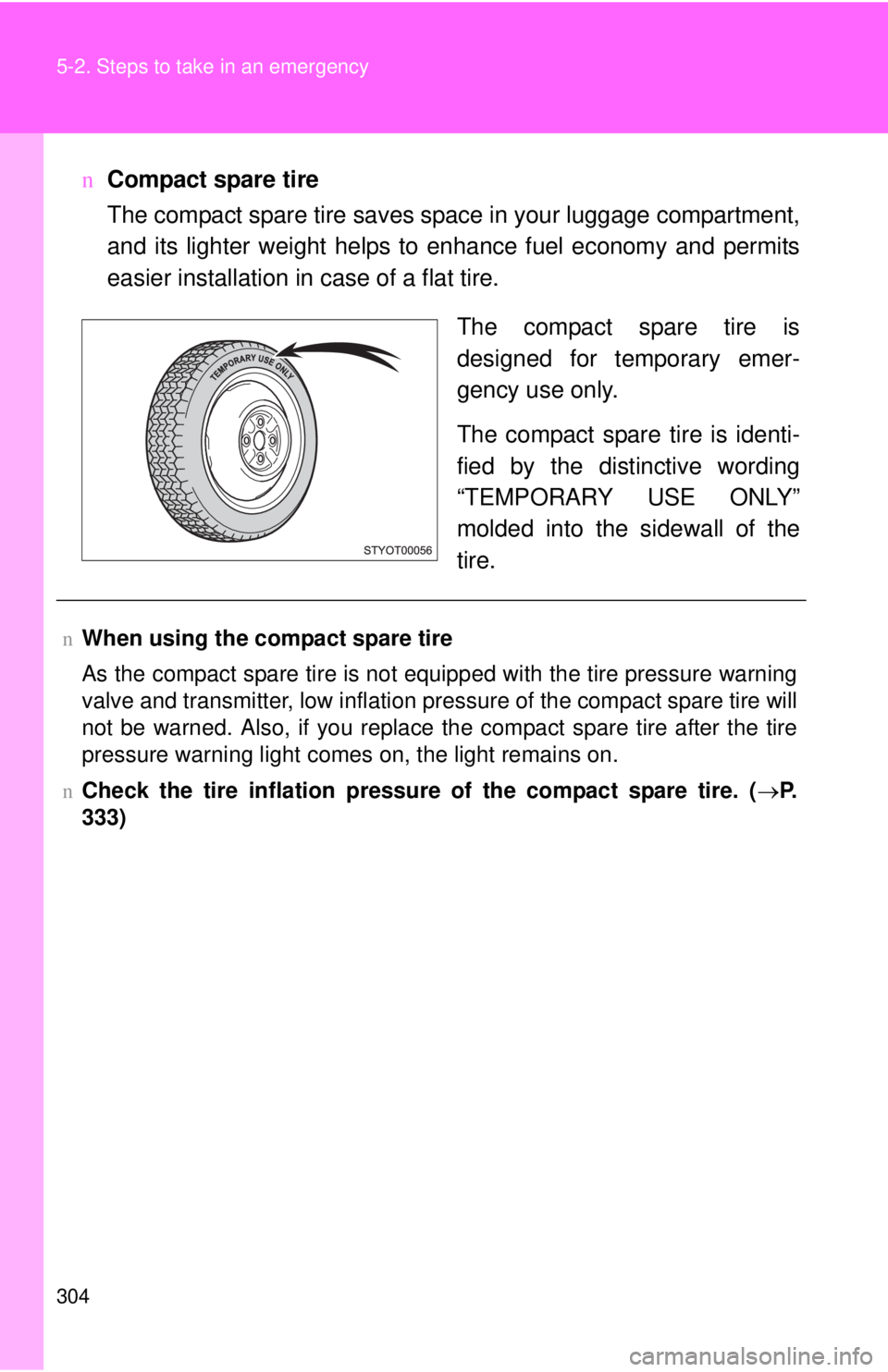
nCompact spare tire
The compact spare tire saves space in your luggage compartment,
and its lighter weight helps to enhance fuel economy and permits
easier installation in case of a flat tire.
The compact spare tire is
designed for temporary emer-
gency use only.
The compact spare tire is identi-
fied by the distinctive wording
“TEMPORARY USE ONLY”
molded into the sidewall of the
tire.
nWhen using the compact spare tire
As the compact spare tire is not equipped with the tire pressure warning
valve and transmitter, low inflation pr essure of the compact spare tire will
not be warned. Also, if you replace the compact spare tire after the tire
pressure warning light comes on, the light remains on.
nCheck the tire inflation pressure of the compact spare tire. ( →P.
333)