Page 4 of 388

TABLE OF CONTENTSIndex
4
4-3. Do-it-yourself maintenance ................... 233
Do-it-yourself service precautions ...................... 233
Hood................................... 236
Positioning a floor jack ....... 237
Engine compartment .......... 239
Tires ................................... 252
Tire inflation pressure......... 258
Wheels ............................... 262
Air conditioning filter ........... 264
Key battery ......................... 267
Checking and replacing fuses ................................ 269
Light bulbs .......................... 280
5-1. Essential information....... 290 If your vehicle needs to be towed ............................... 290
If you think something is wrong ............................... 296
Fuel pump shut off system .............................. 297
Event data recorder............ 298
5-2. Steps to take in an emergency ...................... 300
If a warning light turns on or a warning buzzer
sounds... .......................... 300
If you have a flat tire ........... 310
If the engine will not start ... 323
If the shift lever cannot be shifted from P ................... 325
If you lose your keys .......... 326 If the vehicle battery is
discharged ........................ 327
If your vehicle overheats..... 332
If the vehicle becomes stuck ................................. 335
6-1. Specifications ................... 338 Maintenance data (fuel, oil level, etc.) ........... 338
Fuel information .................. 347
Tire information................... 350
6-2. Customization ................... 363 Customizable features ........ 363
Items to initialize ................. 365
Reporting safety defects for U.S. owners ...................... 368
Seat belt instructions for Canadian owners
(in French) ......................... 369
Abbreviation list ........................ 374
Alphabetical index .................... 375
What to do if... ........................... 383
5When trouble arises
6Vehicle specifications
7For owners
Index
Page 221 of 388
Maintenance and care4
221
4-1. Maintenance and care ... 222Cleaning and protecting the vehicle exterior............... 222
Cleaning and protecting the vehicle interior................ 224
4-2. Maintenance ................... 227 Maintenance requirements .................. 227
General maintenance....... 229
Emission inspection and maintenance (I/M)
programs........................ 232 4-3. Do-it-yourself
maintenance ................. 233
Do-it-yourself service precautions .................... 233
Hood ................................ 236
Positioning a floor jack ..... 237
Engine compartment ........ 239
Tires ................................. 252
Tire inflation pressure ...... 258
Wheels ............................. 262
Air conditioning filter......... 264
Key battery ....................... 267
Checking and replacing fuses .............................. 269
Light bulbs........................ 280
Page 227 of 388
227
4
Maintenance and care
4-2. Maintenance
Maintenance requirements
■Repair and replacement
It is recommended that genuine Toyota parts be used for repair to ensure
performance of each system. If non-Toyota parts are used in replacement or
if a repair shop other than Toyota deal er performs repairs, confirm the war-
ranty coverage.
To ensure safe and economical driv ing, day-to-day care and regular
maintenance is essential. It is the owner’s responsibility to perform
regular checks. Toyota recommen ds the following maintenance.
■General maintenance
Should be performed on a daily basis. This can be done by your-
self or by a Toyota dealer.
■ Scheduled maintenance
Should be performed at specified intervals according to the
maintenance schedule.
For details about maintenance items and schedules, refer to the
“Scheduled Maintenance Guide” or “Owner’s Manual Supplement”.
■Do-it-yourself maintenance
You can perform some maintenance procedures yourself.
Please be aware that do-it-yourself maintenance may affect war-
ranty coverage.
The use of Toyota Repair Manuals is recommended.
For details about warranty coverage, see the separate “Owner’s
Warranty Information Booklet”, “Owner’s Manual Supplement”.
Page 233 of 388
233
4
Maintenance and care
4-3. Do-it-yourself maintenance
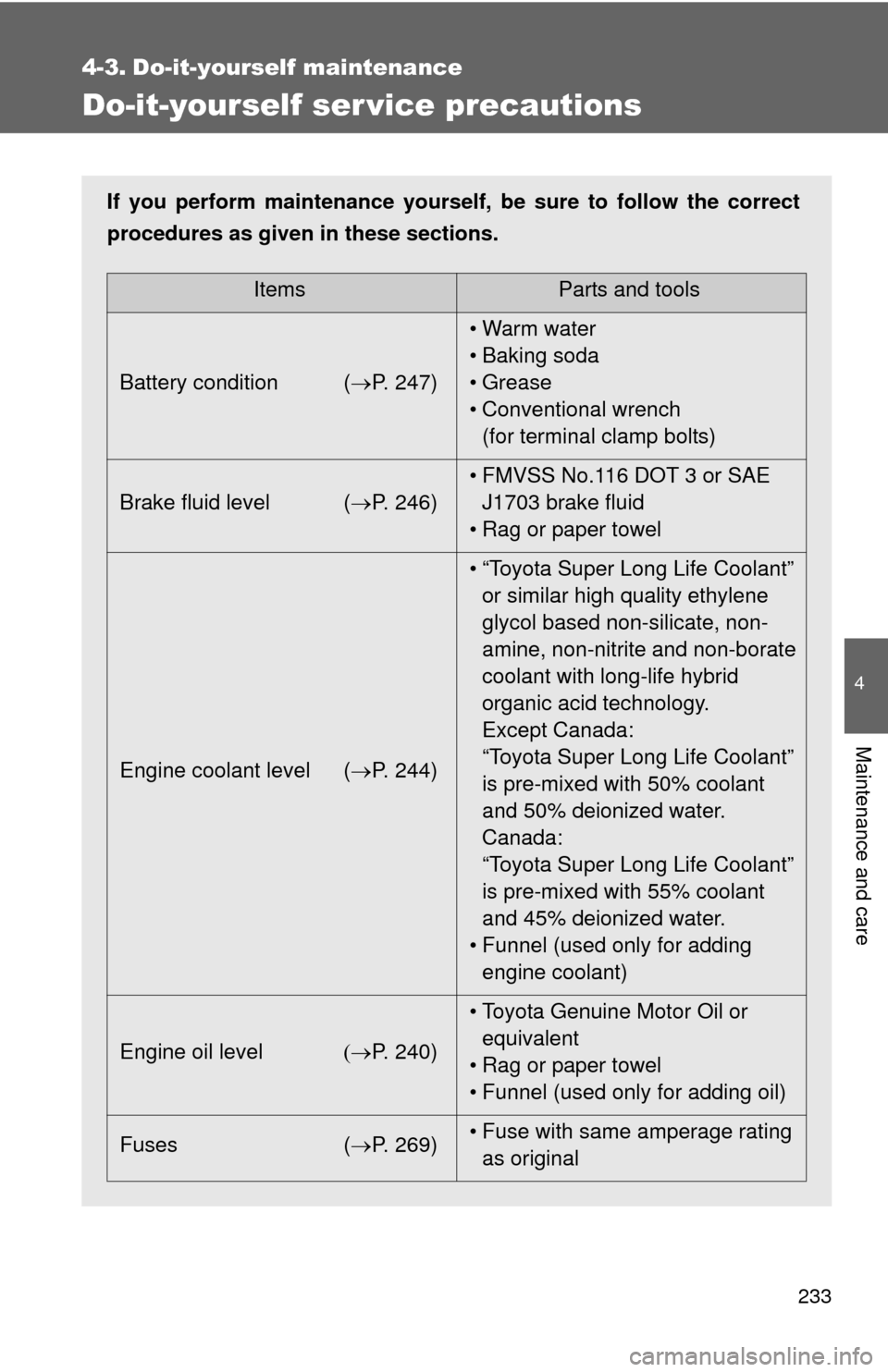
Do-it-yourself ser vice precautions
If you perform maintenance yourself, be sure to follow the correct
procedures as given in these sections.
ItemsParts and tools
Battery condition ( P. 247)•Warm water
• Baking soda
• Grease
• Conventional wrench
(for terminal clamp bolts)
Brake fluid level ( P. 246)• FMVSS No.116 DOT 3 or SAE
J1703 brake fluid
• Rag or paper towel
Engine coolant level ( P. 244)• “Toyota Super Long Life Coolant”
or similar high quality ethylene
glycol based non-silicate, non-
amine, non-nitrite and non-borate
coolant with long-life hybrid
organic acid technology.
Except Canada:
“Toyota Super Long Life Coolant”
is pre-mixed with 50% coolant
and 50% deionized water.
Canada:
“Toyota Super Long Life Coolant”
is pre-mixed with 55% coolant
and 45% deionized water.
• Funnel (used only for adding engine coolant)
Engine oil level P. 240) • Toyota Genuine Motor Oil or
equivalent
• Rag or paper towel
• Funnel (used only for adding oil)
Fuses ( P. 269)• Fuse with same amperage rating
as original
Page 234 of 388
234 4-3. Do-it-yourself maintenance
CAUTION
The engine compartment contains many mechanisms and fluids that may
move suddenly, become hot, or become electrically energized. To avoid death
or serious injury observe the following precautions.
■When working on the engine compartment
●Keep hands, clothing, and tools away from the moving fan and engine
drive belt.
● Be careful not to touch the engine, radiator, exhaust manifold, etc. right
after driving as they may be hot. Oil and other fluids may also be hot.
● Do not leave anything that may burn easily, such as paper or rags, in the
engine compartment.
● Do not smoke, cause sparks or expose an open flame to fuel or the bat-
tery. Fuel and battery fumes are flammable.
● Be extremely cautious when working on the battery. It contains poisonous
and corrosive sulfuric acid.
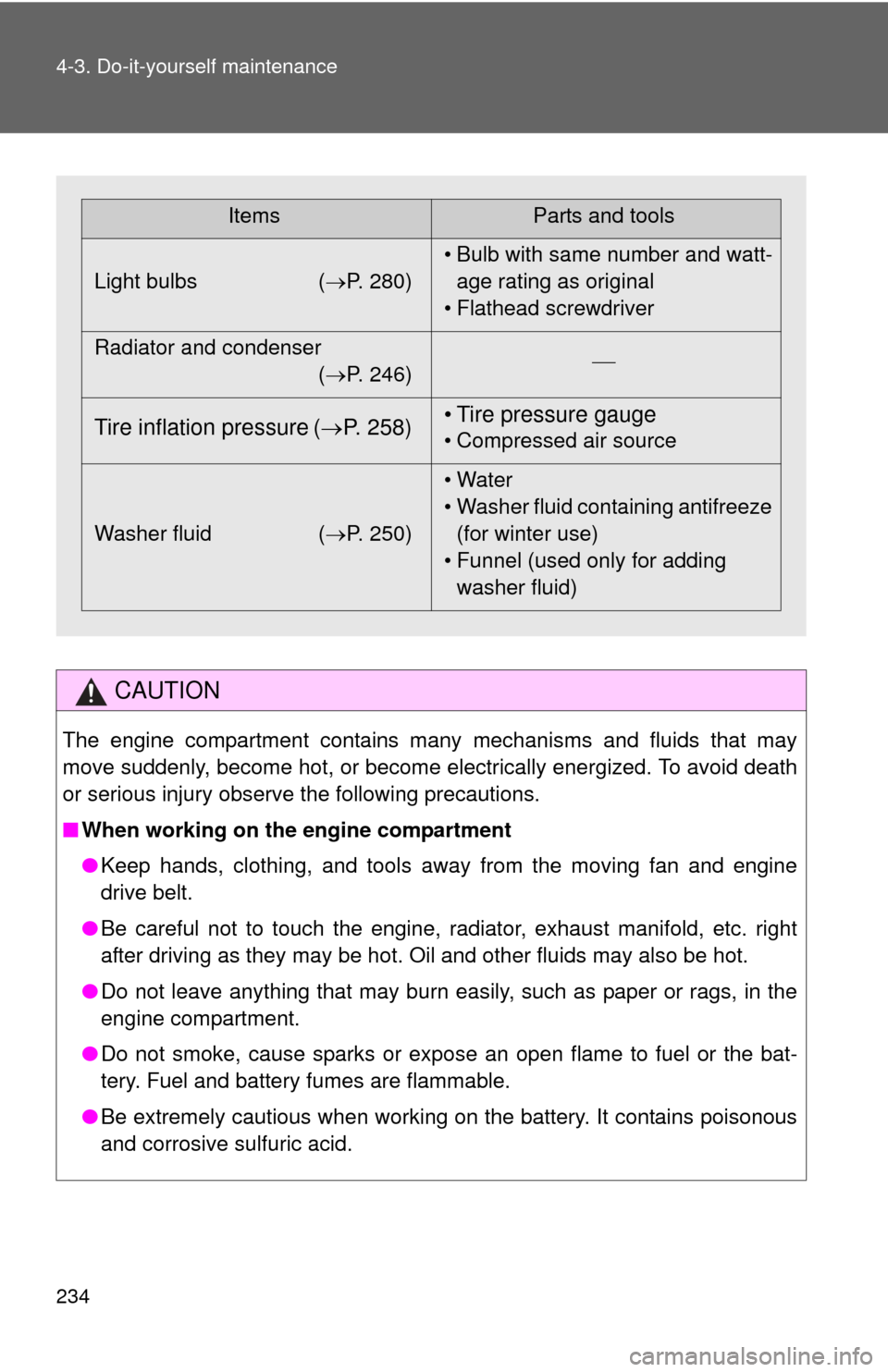
ItemsParts and tools
Light bulbs ( P. 280)• Bulb with same number and watt-
age rating as original
• Flathead screwdriver
Radiator and condenser (P. 246)
Tire inflation pressure (
P. 258) • Tire pressure gauge• Compressed air source
Washer fluid ( P. 250)• Water
• Washer fluid containing antifreeze
(for winter use)
• Funnel (used only for adding washer fluid)
Page 235 of 388

235
4-3. Do-it-yourself maintenance
4
Maintenance and care
CAUTION
■
When working on the engine compartment
●Take care because brake fluid can harm your hands or eyes and damage
painted surfaces.
If fluid gets on your hands or in your eyes, flush the affected area with
clean water immediately.
If you still experience discomfort, see a doctor.
■ When working near the electric cooling fan or radiator grille
Be sure the engine switch is off.
With the engine switch on, the electric cooling fan may automatically start to
run if the air conditioning is on and/or the coolant temperature is high.
■ Safety glasses
Wear safety glasses to prevent flying or falling material, fluid spray, etc. from
getting in the eyes.
NOTICE
■If you remove the air cleaner
Driving with the air cleaner removed may cause excessive engine wear due
to dirt in the air. Also a backfire could cause a fire in the engine compart-
ment.
■ If the brake fluid level is low or high
It is normal for the brake fluid level to go down slightly as the brake pads
wear or when the fluid level in the accumulator is high.
If the reservoir needs frequent refilling, it may indicate a serious pro\
blem.
Page 236 of 388
236
4-3. Do-it-yourself maintenance
Hood
CAUTION
■Pre-driving check
Check that the hood is fully closed and locked.
If the hood is not locked properly, it may open while the vehicle is in motion
and cause an accident, which may result in death or serious injury.
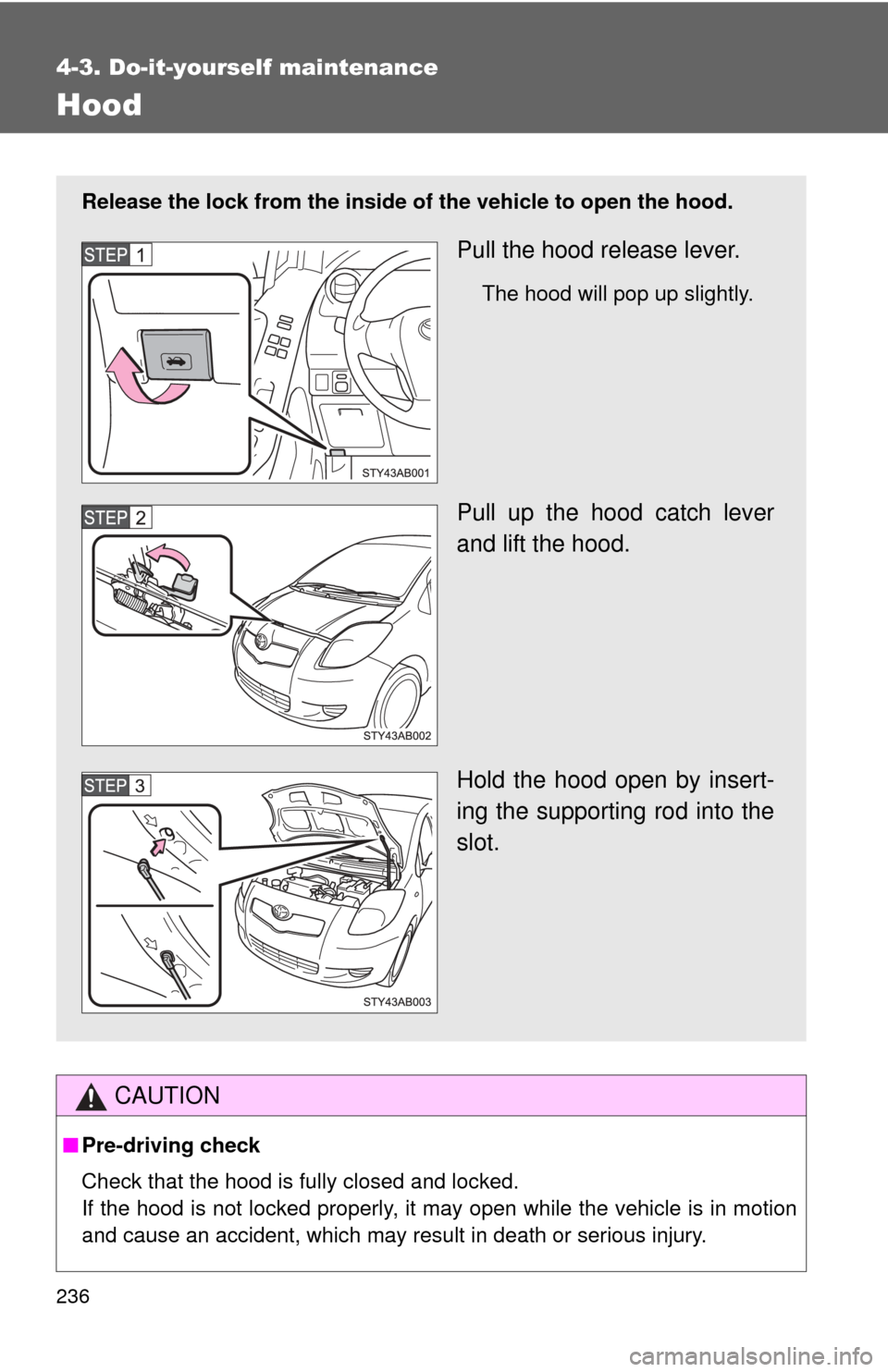
Release the lock from the inside of the vehicle to open the hood.
Pull the hood release lever.
The hood will pop up slightly.
Pull up the hood catch lever
and lift the hood.
Hold the hood open by insert-
ing the supporting rod into the
slot.
Page 237 of 388
237
4-3. Do-it-yourself maintenance
4
Maintenance and care
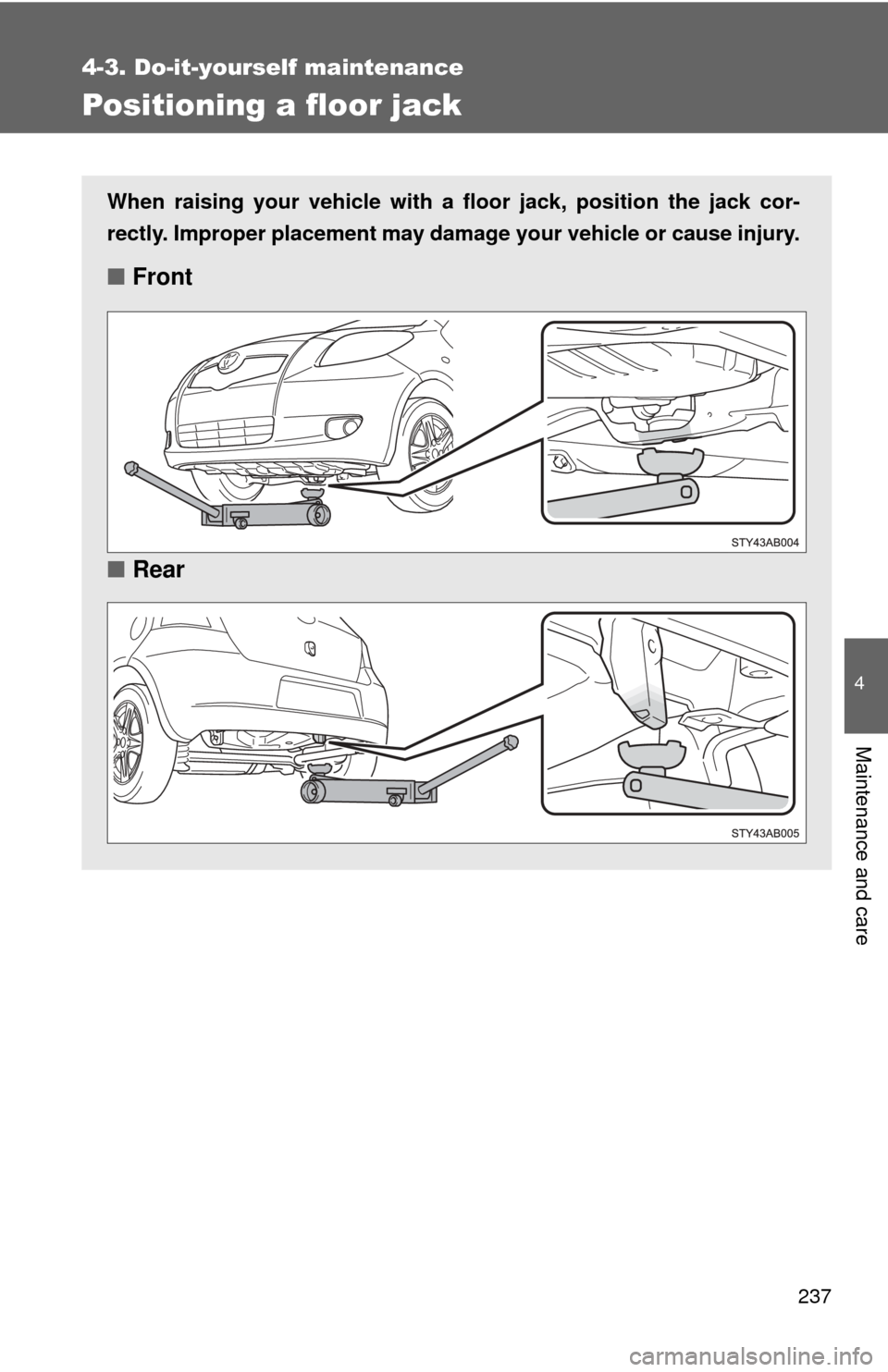
Positioning a floor jack
When raising your vehicle with a floor jack, position the jack cor-
rectly. Improper placement may damage your vehicle or cause injury.
■Front
■ Rear