Page 109 of 621
99
2008 TUNDRA from Apr. ’08 Prod. (OM 34477U)
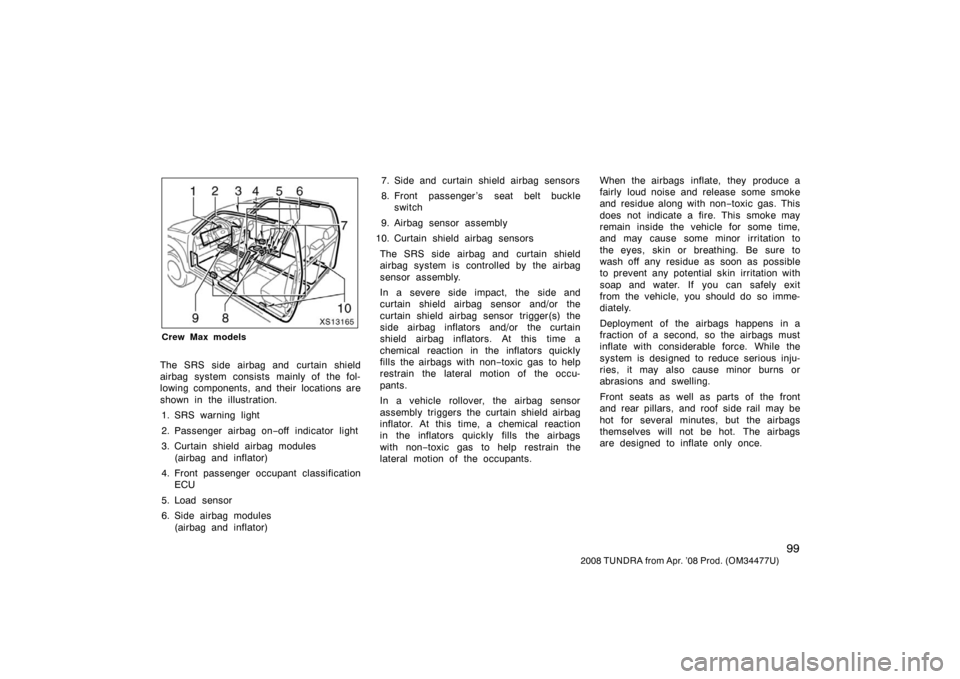
XS13165
Crew Max models
The SRS side airbag and curtain shield
airbag system consists mainly of the fol-
lowing components, and their locations are
shown in the illustration.
1. SRS warning light
2. Passenger airbag on −off indicator light
3. Curtain shield airbag modules (airbag and inflator)
4. Front passenger occupant classification ECU
5. Load sensor
6. Side airbag modules (airbag and inflator) 7. Side and curtain shield airbag sensors
8. Front passenger ’s seat belt buckle
switch
9. Airbag sensor assembly
10. Curtain shield airbag sensors
The SRS side airbag and curtain shield
airbag system is controlled by the airbag
sensor assembly.
In a severe side impact, the side and
curtain shield airbag sensor and/or the
curtain shield airbag sensor trigger(s) the
side airbag inflators and/or the curtain
shield airbag inflators. At this time a
chemical reaction in the inflators quickly
fills the airbags with non −toxic gas to help
restrain the lateral motion of the occu-
pants.
In a vehicle rollover, the airbag sensor
assembly triggers the curtain shield airbag
inflator. At this time, a chemical reaction
in the inflators quickly fills the airbags
with non −toxic gas to help restrain the
lateral motion of the occupants. When the airbags inflate, they produce a
fairly loud noise and release some smoke
and residue along with non
−toxic gas. This
does not indicate a fire. This smoke may
remain inside the vehicle for some time,
and may cause some minor irritation to
the eyes, skin or breathing. Be sure to
wash off any residue as soon as possible
to prevent any potential skin irritation with
soap and water. If you can safely exit
from the vehicle, you should do so imme-
diately.
Deployment of the airbags happens in a
fraction of a second, so the airbags must
inflate with considerable force. While the
system is desi gned to reduce serious inju-
ries, it may also cause minor burns or
abrasions and swelling.
Front seats as well as parts of the front
and rear pillars, and roof side rail may be
hot for several minutes, but the airbags
themselves will not be hot. The airbags
are designed to inflate only once.
Page 114 of 621
104
2008 TUNDRA from Apr. ’08 Prod. (OM 34477U)
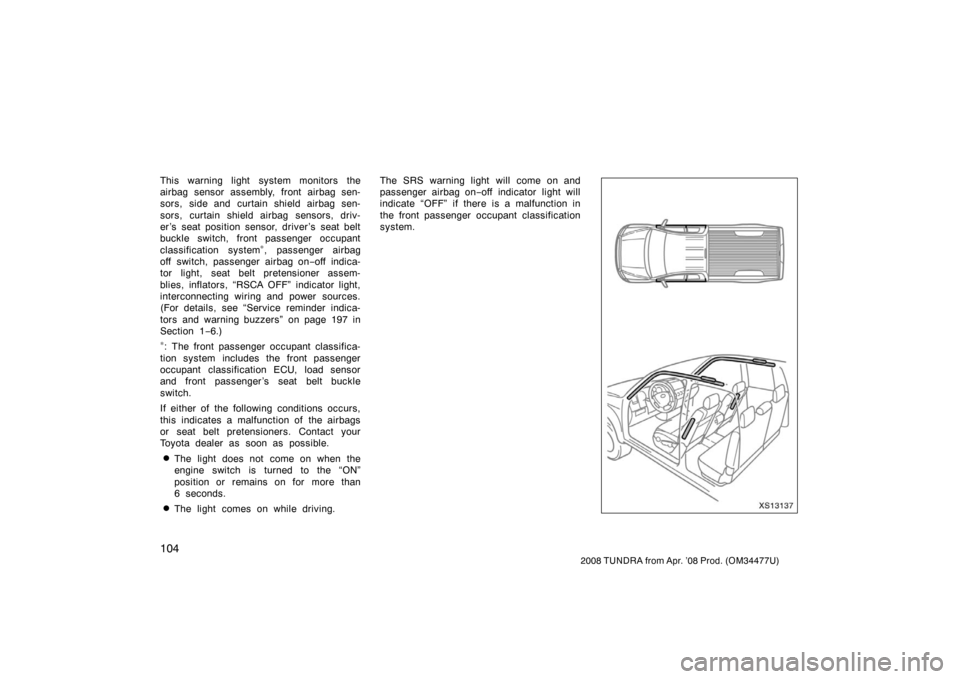
This warning light system monitors the
airbag sensor assembly, front airbag sen-
sors, side and curtain shield airbag sen-
sors, curtain shield airbag sensors, driv-
er ’s seat position sensor, driver ’s seat belt
buckle switch, front passenger occupant
classification system
∗, passenger airbag
off switch, passenger airbag on −off indica-
tor light, seat belt pretensioner assem-
blies, inflators, “RSCA OFF” indicator light,
interconnecting wiring and power sources.
(For details, see “Service reminder indica-
tors and warning buzzers” on page 197 in
Section 1 −6.)
∗: The front passenger occupant classifica-
tion system includes the front passenger
occupant classification ECU, load sensor
and front passenger ’s seat belt buckle
switch.
If either of the following conditions occurs,
this indicates a malfunction of the airbags
or seat belt pretensioners. Contact your
Toyota dealer as soon as possible.
�The light does not come on when the
engine switch is turned to the “ON”
position or remains on for more than
6 seconds.
�The light comes on while driving. The SRS warning light will come on and
passenger airbag on
−off indicator light will
indicate “OFF” if there is a malfunction in
the front passenger occupant classification
system.
XS13137
Page 127 of 621
11 7
2008 TUNDRA from Apr. ’08 Prod. (OM 34477U)
�Do not use the seat belt extender
when installing a child restraint
system on the front or rear passen-
ger seat. If installing a child re-
straint system with the seat belt
extender connected to the seat belt,
the seat belt will not securely hold
the child restraint system, which
could cause death or serious injury
to the child or other passengers in
the event of collision.
�Make sure you have complied with
all installation instructions provided
by the child restraint manufacturer
and that the system is properly se-
cured. If it is not secured properly,
it may cause death or serious injury
to the child in the event of a sud-
den stop or accident.
A child restraint system for a small
child or baby must itself be properly
restrained on the seat with the lap por-
tion of the lap/shoulder belt. You must
carefully consult the manufacturer ’s
instructions which accompany the child
restraint system.
To provide proper restraint, use a child
restraint system following the manufactur-
er ’s instructions about the appropriate age
and size of the child for the child restraint
system.
Install the child restraint system correctly
following the instructions provided by its
manufacturer. General directions are also
provided under the following illustrations.
The child restraint system should be
installed in the rear seat if your vehicle
is equipped with rear seats. According to
accident statistics, the child is safer when
properly restrained in the rear seat than
in the front seat.
When not using the child restraint system,
keep it secured with the seat belt or place
it somewhere other than the passenger
compartment. This will prevent it from in-
juring passengers in the event of a sud-
den stop or accident. Child restraint systems are classified into
the following 3 types depending on the
child’s age and size.
(A) Infant seat
(B) Convertible seat
(C) Booster seat
Install the child restraint system following
the instructions provided by its manufac-
turer.
Your vehicle has anchor brackets for se-
curing the top strap of a child restraint
system.
For instructions about how to use the an-
chor bracket, see “—Using a top strap” on
page 139, 142 or 145 in this Section.
The child restraint lower anchorages
approved for your vehicle may also be
used. See “—Installation with child
restraint lower anchorages” on page 147,
149 or 151 in this Section.
—Child restraint system
—Types of child restraint
system
Page 131 of 621
121
2008 TUNDRA from Apr. ’08 Prod. (OM 34477U)
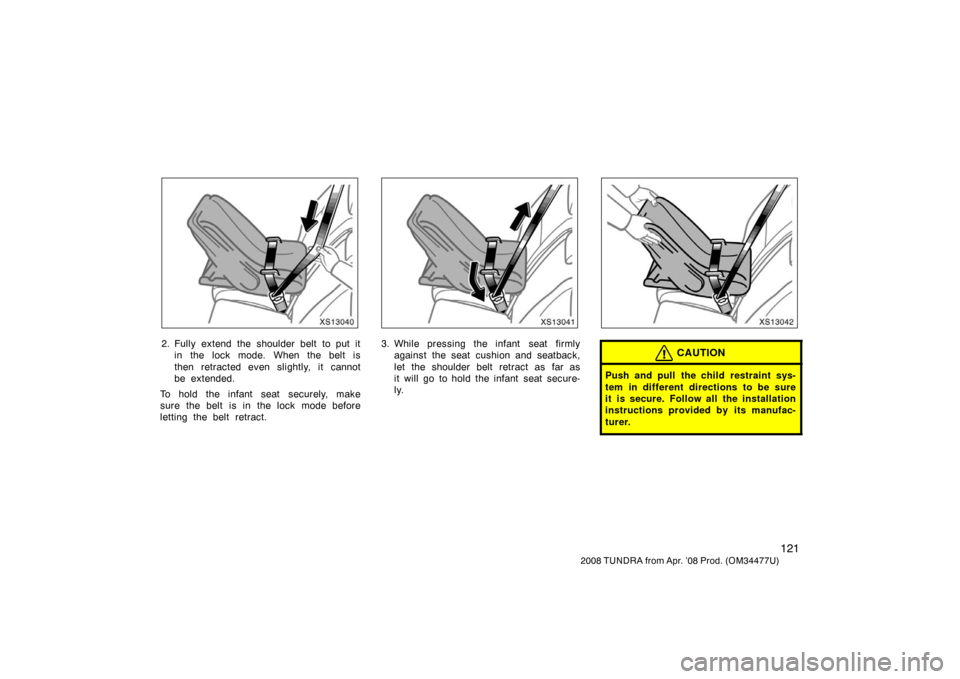
XS13040
2. Fully extend the shoulder belt to put it
in the lock mode. When the belt is
then retracted even slightly, it cannot
be extended.
To hold the infant seat securely, make
sure the belt is in the lock mode before
letting the belt retract.
XS13041
3. While pressing the infant seat firmly against the seat cushion and seatback,
let the shoulder belt retract as far as
it will go to hold the infant seat secure-
ly.
XS13042
CAUTION
Push and pull the child restraint sys-
tem in different directions to be sure
it is secure. Follow all the installation
instructions provided by its manufac-
turer.
Page 134 of 621
124
2008 TUNDRA from Apr. ’08 Prod. (OM 34477U)
XS13151
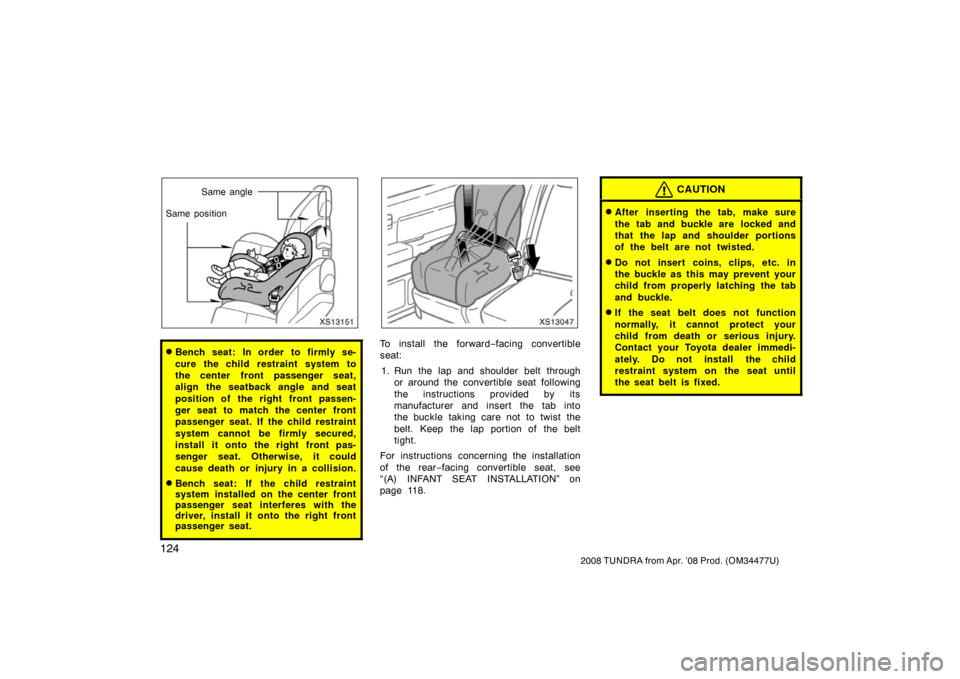
Same angle
Same position
�Bench seat: In order to firmly se-
cure the child restraint system to
the center front passenger seat,
align the seatback angle and seat
position of the right front passen-
ger seat to match the center front
passenger seat. If the child restraint
system cannot be firmly secured,
install it onto the right front pas-
senger seat. Otherwise, it could
cause death or injury in a collision.
�Bench seat: If the child restraint
system installed on the center front
passenger seat interferes with the
driver, install it onto the right front
passenger seat.
XS13047
To install the forward−facing convertible
seat:
1. Run the lap and shoulder belt through or around the convertible seat following
the instructions provided by its
manufacturer and insert the tab into
the buckle taking care not to twist the
belt. Keep the lap portion of the belt
tight.
For instructions concerning the installation
of the rear −facing convertible seat, see
“(A) INFANT SEAT INSTALLATION” on
page 118.
CAUTION
�After inserting the tab, make sure
the tab and buckle are locked and
that the lap and shoulder portions
of the belt are not twisted.
�Do not insert coins, clips, etc. in
the buckle as this may prevent your
child from properly latching the tab
and buckle.
�If the seat belt does not function
normally, it cannot protect your
child from death or serious injury.
Contact your Toyota dealer immedi-
ately. Do not install the child
restraint system on the seat until
the seat belt is fixed.
Page 135 of 621
125
2008 TUNDRA from Apr. ’08 Prod. (OM 34477U)
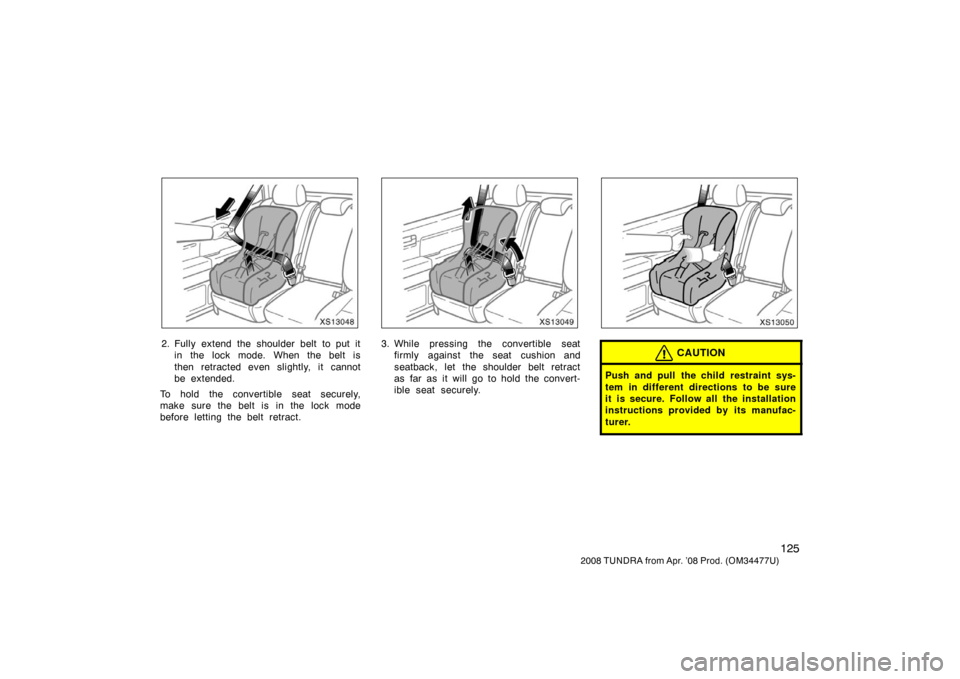
XS13048
2. Fully extend the shoulder belt to put it
in the lock mode. When the belt is
then retracted even slightly, it cannot
be extended.
To hold the convertible seat securely,
make sure the belt is in the lock mode
before letting the belt retract.
XS13049
3. While pressing the convertible seat firmly against the seat cushion and
seatback, let the shoulder belt retract
as far as it will go to hold the convert-
ible seat securely.
XS13050
CAUTION
Push and pull the child restraint sys-
tem in different directions to be sure
it is secure. Follow all the installation
instructions provided by its manufac-
turer.
Page 139 of 621
129
2008 TUNDRA from Apr. ’08 Prod. (OM 34477U)
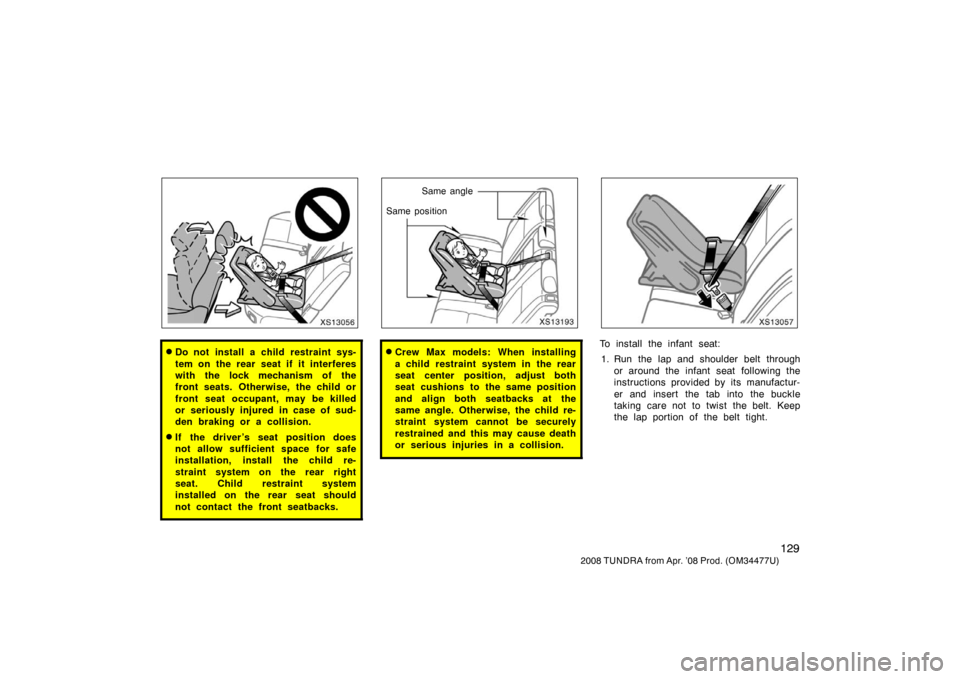
XS13056
�Do not install a child restraint sys-
tem on the rear seat if it interferes
with the lock mechanism of the
front seats. Otherwise, the child or
front seat occupant, may be killed
or seriously injured in case of sud-
den braking or a collision.
�If the driver ’s seat position does
not allow sufficient space for safe
installation, install the child re-
straint system on the rear right
seat. Child restraint system
installed on the rear seat should
not contact the front seatbacks.
XS13193
Same angle
Same position
�Crew Max models: When installing
a child restraint system in the rear
seat center position, adjust both
seat cushions to the same position
and align both seatbacks at the
same angle. Otherwise, the child re-
straint system cannot be securely
restrained and this may cause death
or serious injuries in a collision.
XS13057
To install the infant seat: 1. Run the lap and shoulder belt through or around the infant seat following the
instructions provided by its manufactur-
er and insert the tab into the buckle
taking care not to twist the belt. Keep
the lap portion of the belt tight.
Page 140 of 621
130
2008 TUNDRA from Apr. ’08 Prod. (OM 34477U)
CAUTION
�After inserting the tab, make sure
the tab and buckle are locked and
that the lap and shoulder portions
of the belt are not twisted.
�Do not insert coins, clips, etc. in
the buckle as this may prevent your
child from properly latching the tab
and buckle.
�If the seat belt does not function
normally, it cannot protect your
child from death or serious injury.
Contact your Toyota dealer immedi-
ately. Do not install the child
restraint system on the seat until
the seat belt is fixed.
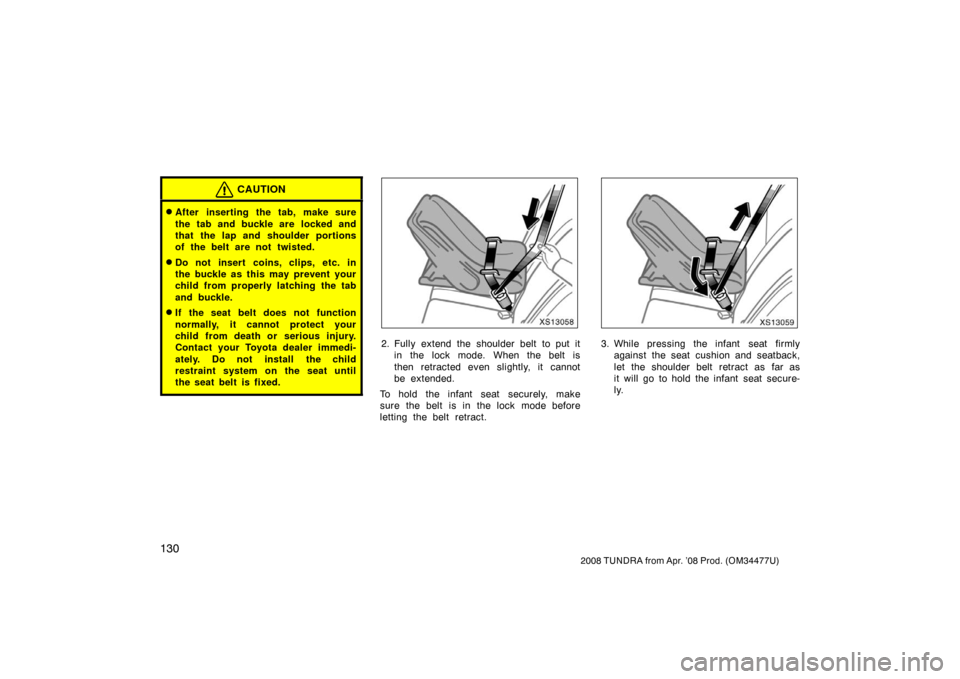
XS13058
2. Fully extend the shoulder belt to put it
in the lock mode. When the belt is
then retracted even slightly, it cannot
be extended.
To hold the infant seat securely, make
sure the belt is in the lock mode before
letting the belt retract.
XS13059
3. While pressing the infant seat firmly against the seat cushion and seatback,
let the shoulder belt retract as far as
it will go to hold the infant seat secure-
ly.