Page 577 of 621
567
2008 TUNDRA from Apr. ’08 Prod. (OM 34477U)
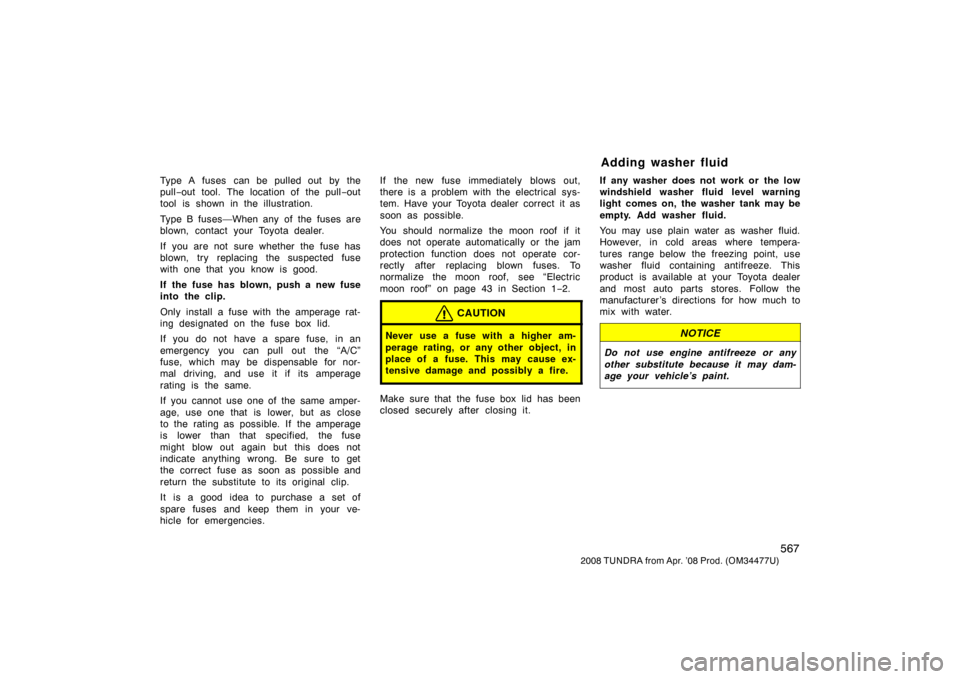
Type A fuses can be pulled out by the
pull−out tool. The location of the pull −out
tool is shown in the illustration.
Type B fuses—When any of the fuses are
blown, contact your Toyota dealer.
If you are not sure whether the fuse has
blown, try replacing the suspected fuse
with one that you know is good.
If the fuse has blown, push a new fuse
into the clip.
Only install a fuse with the amperage rat-
ing designated on the fuse box lid.
If you do not have a spare fuse, in an
emergency you can pull out the “A/C”
fuse, which may be dispensable for nor-
mal driving, and use it if its amperage
rating is the same.
If you cannot use one of the same amper-
age, use one that is lower, but as close
to the rating as possible. If the amperage
is lower than that specified, the fuse
might blow out again but this does not
indicate anything wrong. Be sure to get
the correct fuse as soon as possible and
return the substitute to its original clip.
It is a good idea to purchase a set of
spare fuses and keep them in your ve-
hicle for emergencies. If the new fuse immediately blows out,
there is a problem with the electrical sys-
tem. Have your Toyota dealer correct it as
soon as possible.
You should normalize the moon roof if it
does not operate automatically or the jam
protection function does not operate cor-
rectly after replacing blown fuses. To
normalize the moon roof, see “Electric
moon roof” on page 43 in Section 1
−2.
CAUTION
Never use a fuse with a higher am-
perage rating, or any other object, in
place of a fuse. This may cause ex-
tensive damage and possibly a fire.
Make sure that the fuse box lid has been
closed securely after closing it. If any washer does not work or the low
windshield washer fluid level warning
light comes on, the washer tank may be
empty. Add washer fluid.
You may use plain water as washer fluid.
However, in cold areas where tempera-
tures range below the freezing point, use
washer fluid containing antifreeze. This
product is available at your Toyota dealer
and most auto parts stores. Follow the
manufacturer ’s directions for how much to
mix with water.
NOTICE
Do not use engine antifreeze or any
other substitute because it may dam-
age your vehicle’s paint.
Adding washer fluid
Page 578 of 621
568
2008 TUNDRA from Apr. ’08 Prod. (OM 34477U)
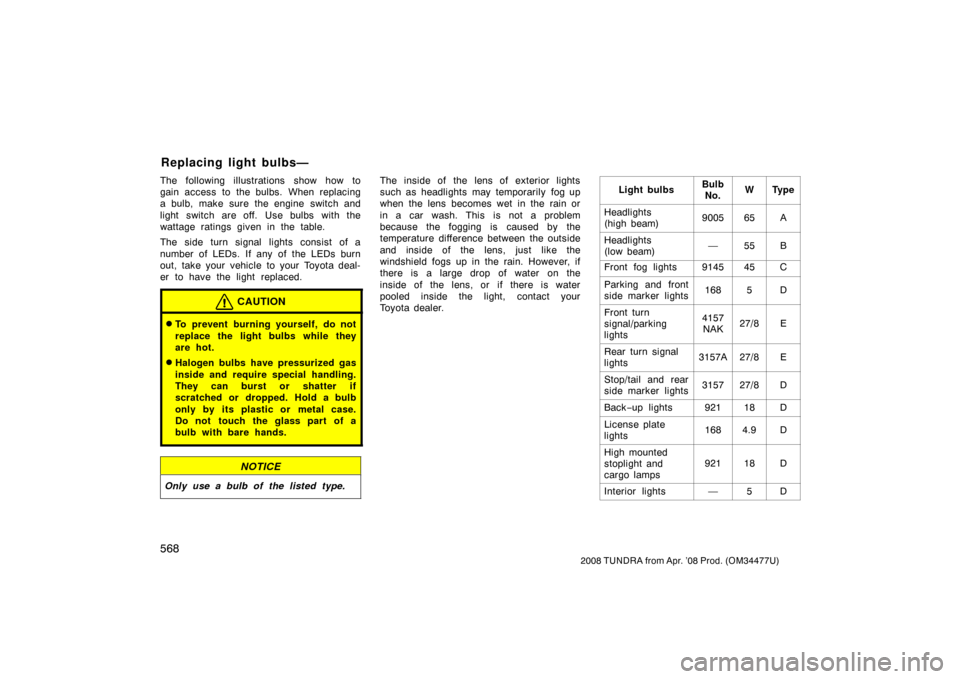
The following illustrations show how to
gain access to the bulbs. When replacing
a bulb, make sure the engine switch and
light switch are off. Use bulbs with the
wattage ratings given in the table.
The side turn signal lights consist of a
number of LEDs. If any of the LEDs burn
out, take your vehicle to your Toyota deal-
er to have the light replaced.
CAUTION
�To prevent burning yourself, do not
replace the light bulbs while they
are hot.
�Halogen bulbs have pressurized gas
inside and require special handling.
They can burst or shatter if
scratched or dropped. Hold a bulb
only by its plastic or metal case.
Do not touch the glass part of a
bulb with bare hands.
NOTICE
Only use a bulb of the listed type.
The inside of the lens of exterior lights
such as headlights may temporarily fog up
when the lens becomes wet in the rain or
in a car wash. This is not a problem
because the fogging is caused by the
temperature difference between the outside
and inside of the lens, just like the
windshield fogs up in the rain. However, if
there is a large drop of water on the
inside of the lens, or if there is water
pooled inside the light, contact your
Toyota dealer. Light bulbsBulb
No.WTy p e
Headlights
(high beam)900565A
Headlights
(low beam)—55B
Front fog lights914545C
Par k i ng and fr ont
side marker lights1685D
Front turn
signal/parking
lights4157NAK27/8E
Rear turn signal
lights3157A27/8E
Stop/tail and rear
side marker lights315727/8D
Back −up lights92118D
License plate
lights1684.9D
High mounted
stoplight and
cargo lamps92118D
Interior lights—5D
Replacing light bulbs—
Page 587 of 621

SPECIFICATIONS
Specifications
Dimensions 578
. . . . . . . . . . . . . . . . . . . . . . . . . . . . . . . . . . . . \
. . . . . . . . . . . .
Vehicl")
577
2008 TUNDRA from Apr. ’08 Prod. (OM 34477U)
SPECIFICATIONS
Specifications
Dimensions 578
. . . . . . . . . . . . . . . . . . . . . . . . . . . . . . . . . . . . \
. . . . . . . . . . . .
Vehicle capacity weight 580
. . . . . . . . . . . . . . . . . . . . . . . . . . . . . . . . . . . . \
.
Towing capacity 586
. . . . . . . . . . . . . . . . . . . . . . . . . . . . . . . . . . . . \
. . . . . . . .
Engine 589
. . . . . . . . . . . . . . . . . . . . . . . . . . . . . . . . . . . . \
. . . . . . . . . . . . . . . .
Fuel 589
. . . . . . . . . . . . . . . . . . . . . . . . . . . . . . . . . . . . \
. . . . . . . . . . . . . . . . . . .
Service specifications 589
. . . . . . . . . . . . . . . . . . . . . . . . . . . . . . . . . . . . \
. . .
Tires 594
. . . . . . . . . . . . . . . . . . . . . . . . . . . . . . . . . . . . \
. . . . . . . . . . . . . . . . . .
Fuses 595
. . . . . . . . . . . . . . . . . . . . . . . . . . . . . . . . . . . . \
. . . . . . . . . . . . . . . . .
SECTION 8
Page 590 of 621
580
2008 TUNDRA from Apr. ’08 Prod. (OM 34477U)
Vehicle capacity weight
kg (lb.)
Cab type
EngineDriving systemBed typeModel code∗ 2Vehicle capacity weight
Regular
4.0 L V6 (1GR −FE)Tw o −wheel drive models
StandardGSK50L− TRADKA675 (1495)
LongGSK51L−THADKA710 (1575)
4.7 L V8 (2UZ −FE)
Tw o −wheel drive models
StandardUCK50L− TRADKA
780 (1730)
750 (1655)∗
1
LongUCK51L− THADKA
830 (1830)
795 (1755)∗
1
Four −wheel drive models
StandardUCK55L− TRADKA
755 (1670)
720 (1595)∗
1
LongUCK56L− THADKA
800 (1765)
765 (1690)∗
1
∗1: With towing package∗ 2: The model code is indicated on the Certification Label. See “Your Toyota’s identification” on page 455 in Section 2 for the Ce rtifica-
tion Label location.
Page 591 of 621
581
2008 TUNDRA from Apr. ’08 Prod. (OM 34477U)
kg (lb.)
Cab type
EngineDriving systemBed typeModel code∗ 3Vehicle capacity weight
Regular5.7 L V8 (3UR −FE)
Tw o −wheel drive models
StandardUSK50L− TRTDKA
750 (1660)
715 (1585)∗
1
LongUSK51L− THTDKA
895 (1975)
860 (1900)∗
1
925 (2045)∗ 2
Four −wheel drive models
StandardUSK55L− TRTDKA
725 (1605)
690 (1530)∗
1
LongUSK56L− THTDKA
865 (1910)
830 (1835)∗
1
∗1: With towing package∗ 2: Without option∗3: The model code is indicated on the Certification Label. See “Your Toyota’s identification” on page 455 in Section 2 for the Ce rtifica-
tion Label location.
Page 592 of 621
582
2008 TUNDRA from Apr. ’08 Prod. (OM 34477U)
kg (lb.)
Cab type
EngineDriving systemBed typeModel code∗ 2Vehicle capacity weight
Double
4.0 L V6 (1GR −FE)Tw o −wheel drive modelsStandardGSK51L− CRASKA585 (1300)
4.7 L V8 (2UZ −FE)
Tw o −wheel drive models
Standard
UCK51L− CRASKA
640 (1415)
605 (1340)∗1
UCK51L−CRALKA
655 (1450)
620 (1375)∗1
LongUCK52L−CHASKA590 (1305)∗1
Four−wheel drive models
Standard
UCK56L− CRASKA
600 (1330)
565 (1255)∗1
UCK56L−CRALKA
615 (1360)
580 (1285)∗1
LongUCK57L−CHASKA550 (1220)∗1
∗
1: With towing package∗ 2: The model code is indicated on the Certification Label. See “Your Toyota’s identification” on page 455 in Section 2 for the Ce rtifica-
tion Label location.
Page 593 of 621
583
2008 TUNDRA from Apr. ’08 Prod. (OM 34477U)
kg (lb.)
Cab type
EngineDriving systemBed typeModel code∗ 2Vehicle capacity weight
Double5.7 L V8 (3UR −FE)
Tw o −wheel drive models
Standard
USK51L− CRTSKA
700 (1550)
665 (1475)∗1
USK51L−CRTLKA
720 (1590)
685 (1515)∗1
LongUSK52L−CHTSKA655 (1455)∗1
Four−wheel drive models
Standard
USK56L− CRTSKA
665 (1470)
630 (1395)∗1
USK56L−CRTLKA
680 (1505)
645 (1430)∗1
LongUSK57L−CHTSKA615 (1365)∗1
∗
1: With towing package∗ 2: The model code is indicated on the Certification Label. See “Your Toyota’s identification” on page 455 in Section 2 for the Ce rtifica-
tion Label location.
Page 594 of 621
584
2008 TUNDRA from Apr. ’08 Prod. (OM 34477U)
kg (lb.)
Cab type
EngineDriving systemBed typeModel code∗ 3Vehicle capacity weight
Crew Max4.7 L V8 (2UZ −FE)
Tw o −wheel drive models
Short
UCK51L− PSASKA
605 (1335)
570 (1260)∗1
555 (1225)∗2
UCK51L−PSALKA
615 (1360)
580 (1285)∗1
565 (1250)∗2
Four−wheel drive models
UCK56L− PSASKA
570 (1260)
535 (1185)∗1
520 (1150)∗2
UCK56L−PSALKA
580 (1280)
545 (1205)∗1
530 (1170)∗2
∗
1: With towing package or electric moon roof∗ 2: With towing package and electric moon roof∗3: The model code is indicated on the Certification Label. See “Your Toyota’s identification” on page 455 in Section 2 for the Ce rtifica-
tion Label location.