Page 360 of 572
08 SIENNA_U (L/O 0801)
352
2008 SIENNA from Aug. ’08 Prod. (OM45455U)
�If following another vehicle on a dusty
road, or driving in windy and dusty
conditions, it is recommended that the
air intake selector be temporarily set to
RECIRCULATE, which will close off the
outside passage and prevent outside
air and dust from entering the vehicle
interior.Heating
For best results, set controls to:
Fan speed— Any setting except “OFF”
Temperature— To w a r d s WARM
(red zone)
Air intake—FRESH (outside air)
Air flow—FLOOR
Air conditioning—OFF
�For quick heating, select recirculated
air for a few minutes. To keep the
windows from fogging, select fresh af-
ter the vehicle interior has been
warmed.
�Press the “A/C” button on for dehumidi-
fied heating.
�Choose floor/windshield air flow to heat
the vehicle interior while defrosting or
defogging the windshield.
Air conditioning
For best results, set controls to:
Fan speed— Any setting except “OFF”
Temperature— To w a r d s COLD
(blue zone)
Air intake—FRESH (outside air)
Air flow—PANEL
Air conditioning—ON
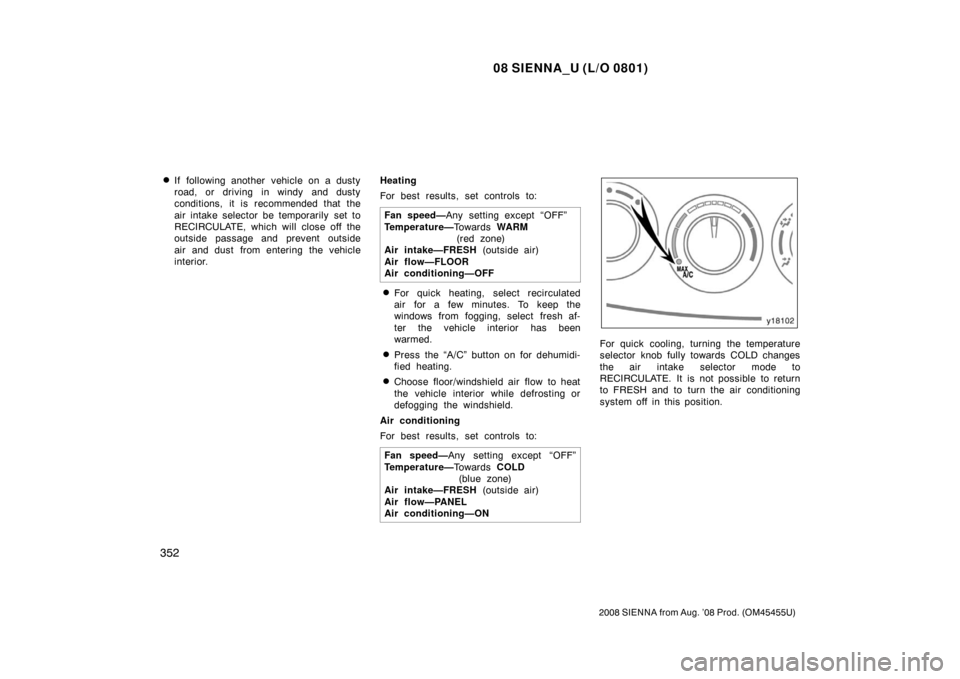
For quick cooling, turning the temperature
selector knob fully towards COLD changes
the air intake selector mode to
RECIRCULATE. It is not possible to return
to FRESH and to turn the air conditioning
system off in this position.
Page 383 of 572
08 SIENNA_U (L/O 0801)
375
2008 SIENNA from Aug. ’08 Prod. (OM45455U)
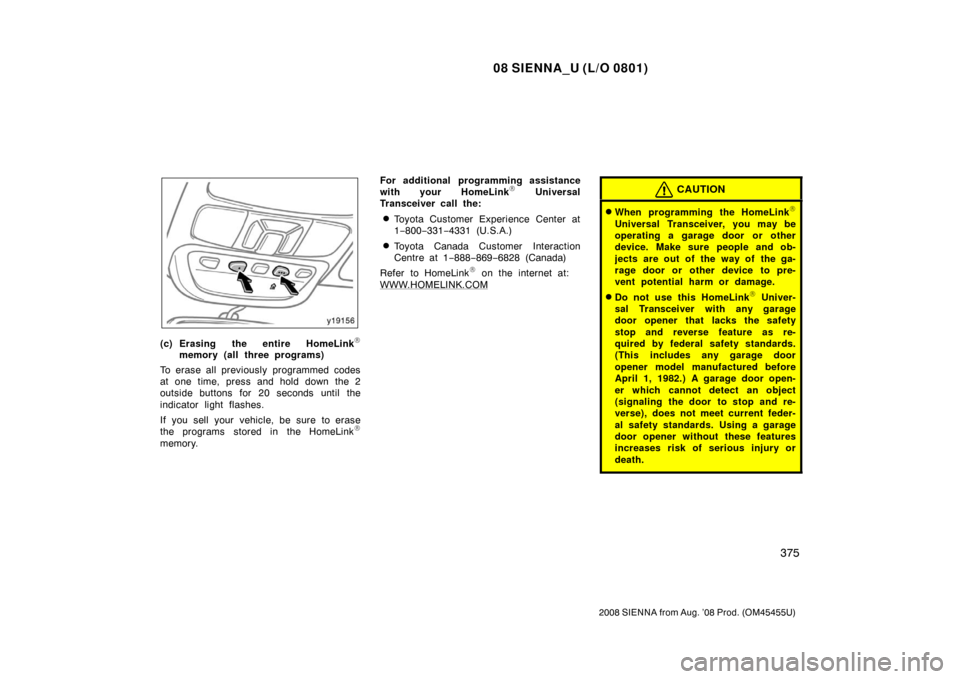
(c) Erasing the entire HomeLink\b
memory (all three programs)
To erase all previously programmed codes
at one time, press and hold down the 2
outside buttons for 20 seconds until the
indicator light flashes.
If you sell your vehicle, be sure to erase
the programs stored in the HomeLink
\b
memory. For additional programming assistance
with your HomeLink
\b Universal
Transceiver call the:
�Toyota Customer Experience Center at
1 −800− 331−4331 (U.S.A.)
�Toyota Canada Customer Interaction
Centre at 1 −888− 869−6828 (Canada)
Refer to HomeLink
\b on the internet at:
WWW.HOMELINK.COM
CAUTION
�When programming the HomeLink\b
Universal Transceiver, you may be
operating a garage door or other
device. Make sure people and ob-
jects are out of the way of the ga-
rage door or other device to pre-
vent potential harm or damage.
�Do not use this HomeLink\b Univer-
sal Transceiver with any garage
door opener that lacks the safety
stop and reverse feature as re-
quired by federal safety standards.
(This includes any garage door
opener model manufactured before
April 1, 1982.) A garage door open-
er which cannot detect an object
(signaling the door to stop and re-
verse), does not meet current feder-
al safety standards. Using a garage
door opener without these features
increases risk of serious injury or
death.
Page 385 of 572

08 SIENNA_U (L/O 0801)
377
2008 SIENNA from Aug. ’08 Prod. (OM45455U)
1. Outside temperature (“OUTSIDE �C”
or “OUTSIDE �F”)
The outside temperature display indi-
cates the outside air temperature.
The displayed value is updated every 1
second.
The displayed temperature ranges from
− 30 �C ( −22 �F) up to 50 �C (122 �F).
If an abnormality exists in the connection
of the outside air temperature sensor,
“ −− �C” (“ −−�F”) will appear on the display.
If “ −−�C” (“ −−�F”) appears on the display,
contact your Toyota dealer.
There may be a case that “−− �C” (“ −−�F”)
appears momentarily when the engine
switch is quickly turned to “ON”. It is
normal if it goes out soon.
2. Average fuel consumption (“AVG MPG” or “AVG L/100 km”)
Average fuel consumption is calculated
and displayed based on total driving
distance and total fuel consumption
with the engine running.
The displayed value is updated every 1
seconds.
To reset the calculations, return the mode
to “AVG” and push and hold the “MODE”
and “E/M” button simultaneously for 2 sec-
onds. 3. Instantaneous fuel consumption
(“INST MPG” or “INST L/100 km”)
The instantaneous fuel consumption is
calculated and displayed based on dis-
tance and fuel consumption for 1 sec-
onds with the engine running.
The displayed value is updated every 2
seconds.
Note that an accurate figure may not be
shown in the following cases.
�The vehicle is stopped with the engine
running. (The display will indicate the
extremely high fuel consumption.)
�The vehicle is driving down a long
slope applying the engine brake. (The
display will indicate the extremely low
fuel consumption.)
The calculation is reset when the engine
switch is turned off. 4. Distance to empty (“DTE MI” or “DTE km”)
The distance the vehicle can travel with
the remaining fuel is calculated and
displayed based on the quantity of re-
maining fuel and past fuel consumption.
The displayed value is updated every 1
second. Every time you refuel the vehicle, the cal-
culation is reset. However, when only a
small amount of fuel is added to the tank,
the display may not be reset.
The actual driving range varies with driv-
ing habits and road conditions. If fuel con-
sumption is good, the driving range will be
longer. If fuel consumption is poor, the
driving range will be shorter.
Page 388 of 572
08 SIENNA_U (L/O 0801)
380
2008 SIENNA from Aug. ’08 Prod. (OM45455U)
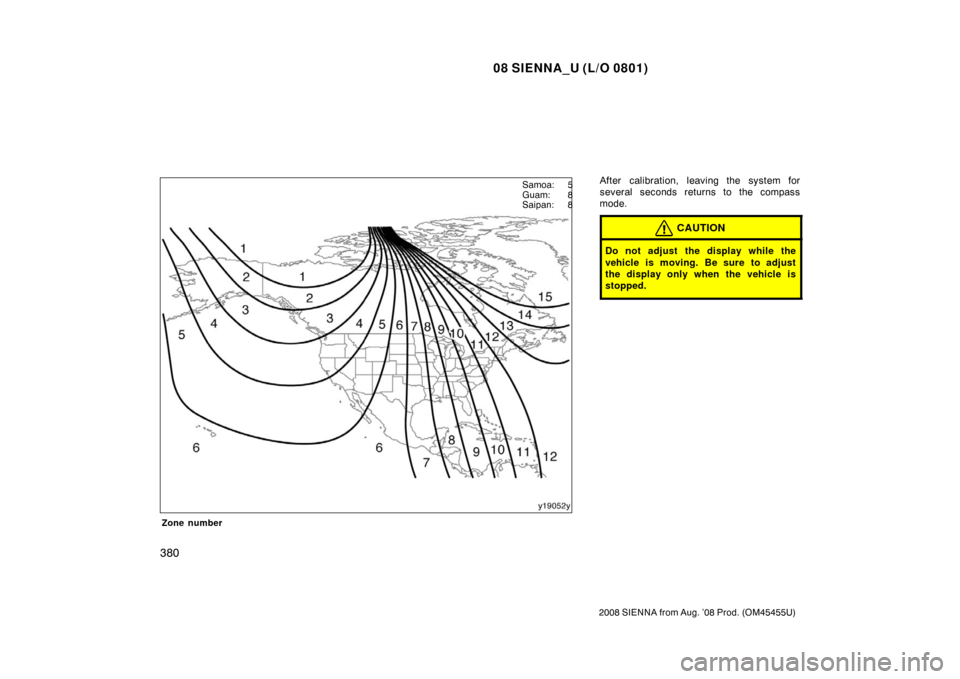
Zone number
After calibration, leaving the system for
several seconds returns to the compass
mode.
CAUTION
Do not adjust the display while the
vehicle is moving. Be sure to adjust
the display only when the vehicle is
stopped.
Samoa: 5
Guam: 8
Saipan: 8
Page 389 of 572
08 SIENNA_U (L/O 0801)
381
2008 SIENNA from Aug. ’08 Prod. (OM45455U)
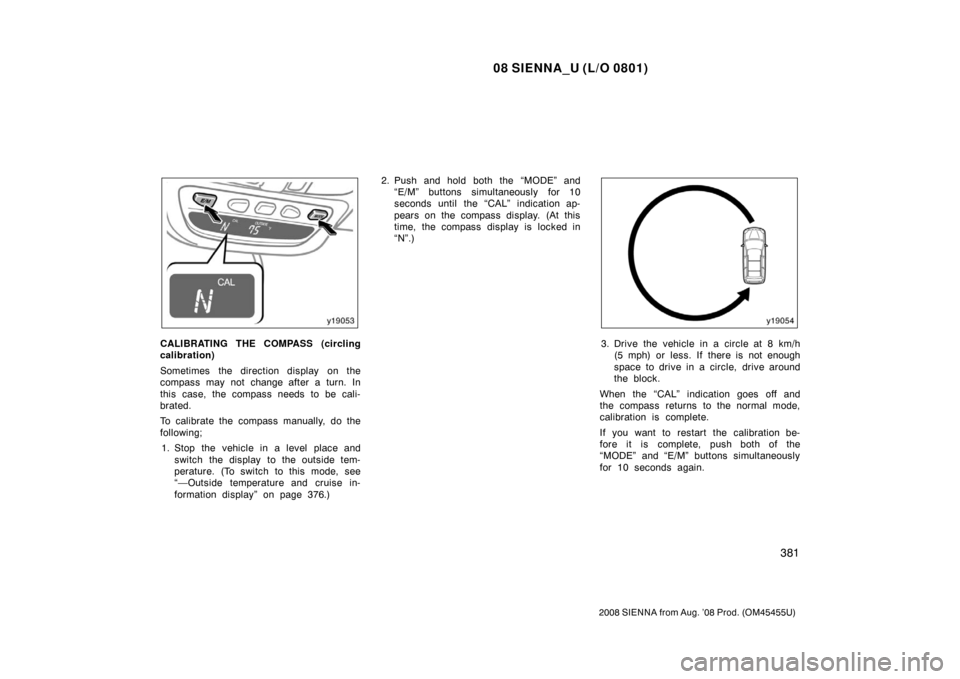
CALIBRATING THE COMPASS (circling
calibration)
Sometimes the direction display on the
compass may not change after a turn. In
this case, the compass needs to be cali-
brated.
To calibrate the compass manually, do the
following;1. Stop the vehicle in a level place and switch the display to the outside tem-
perature. (To switch to this mode, see
“—Outside temperature and cruise in-
formation display” on page 376.) 2. Push and hold both the “MODE” and
“E/M” buttons simultaneously for 10
seconds until the “CAL” indication ap-
pears on the compass display. (At this
time, the compass display is locked in
“N”.)3. Drive the vehicle in a circle at 8 km/h(5 mph) or less. If there is not enough
space to drive in a circle, drive around
the block.
When the “CAL” indication goes off and
the compass returns to the normal mode,
calibration is complete.
If you want to restart the calibration be-
fore it is complete, push both of the
“MODE” and “E/M” buttons simultaneously
for 10 seconds again.
Page 435 of 572
08 SIENNA_U (L/O 0801)
427
2008 SIENNA from Aug. ’08 Prod. (OM45455U)
CAUTION
�Do not pump the brake pedal if the
engine stalls. Each push on the
pedal uses up your reserved vacu-
um.
�Even if the power assist is com-
pletely lost, the brakes will still
work. But you will have to push the
pedal hard, much harder than nor-
mal. And your braking distance will
increase.
ANTILOCK BRAKE SYSTEM (with
“ABS” warning light)
The antilock brake system is designed
to help prevent lockup of the wheels
during a sudden braking or braking on
slippery road surfaces. This assists in
providing directional stability and steer-
ing performance of the vehicle under
these circumstances.
Effective way to press the ABS brake
pedal: When the anti −lock brake system
function is in action, you may feel the
brake pedal pulsating and hear a noise.
In this situation, to let the anti −lock
brake system work for you, just hold the
brake pedal down more firmly. Do not
pump the brake in a panic stop. This
will result in reduced braking performan-
ce.
The anti −lock brake system becomes op-
erative after the vehicle has accelerated
to a speed in excess of approximately 10
km/h (6 mph). It stops operating when the
vehicle decelerates to a speed below
approximately 5 km/h (3 mph).
Depressing the brake pedal on slippery
road surfaces such as on a manhole cov-
er, a steel plate at a construction site,
joints in a bridge, etc. on a rainy day
tends to activate the anti −lock brake sys-
tem.
You may hear a click or motor sound in
the engine compartment for a few seconds
when the engine is started or just after
the vehicle begins to move. This means
that the anti −lock brake system is in the
self −check mode, and does not indicate a
malfunction. When the antilock brake system is ac-
tivated, the following conditions may
occur. They do not indicate a malfunc-
tion of the system:
�You may hear the anti
−lock brake sys-
tem operating and feel the brake pedal
pulsating and the vibrations of the ve-
hicle body and steering wheel. You
may also hear the motor sound in the
engine compartment even after the ve-
hicle is stopped.
�At the end of the anti −lock brake sys-
tem activation, the brake pedal may
move a little forward.
Page 451 of 572

08 SIENNA_U (L/O 0801)
443
2008 SIENNA from Aug. ’08 Prod. (OM45455U)
Ti r e relat ed ter mMeaning
Innerliner separationthe parting of the innerliner from cord material in the carcass
Intended outboard sidewall
(A) the sidewall that contains a whitewall, bears white lettering or bearsmanufacturer, brand, and/or model name molding that is higher or
deeper than the same molding on th e other sidewall of the tire, or
(B) the outward facing sidewall of an asymmetrical tire that has a particular side that must always face outward when mounted on a vehicle
Light truck (LT) tirea tire designated by its manufacturer as primarily intended for use on lightweight
trucks or multipurpose passenger vehicles
Load ratingthe maximum load that a tire is rated to carry for a given inf lat ion pr es s ur e
Maximum load ratingthe load rating for a tire at the maximu m permissible inflation pressure for that
tire
Maximum permissible inflation
pressurethe maximum cold inflat ion pressure to which a tire may be inflated
Measuring rimthe rim on which a tire is fitted for physical dimension requirements
Open spliceany parting at any junction of tread, sidewall, or innerliner that extends to cord
material
Outer diameterthe overall diameter of an inflated new tire
Overall widththe linear distance between the exteriors of the sidewalls of an inflated tire,
including elevations due to labeling, decorations, or protective bands or ribs
Page 457 of 572
08 SIENNA_U (L/O 0801)
449
2008 SIENNA from Aug. ’08 Prod. (OM45455U)
CAUTION
Even if the total load of occu-
pant’s weight and the cargo load
is less than the total load capac-
ity, do not apply the load uneven-
ly. That may cause not only dam-
age to the tire but also deteriora-
tion to the steering ability due to
unbalance of the vehicle, causing
an accident.
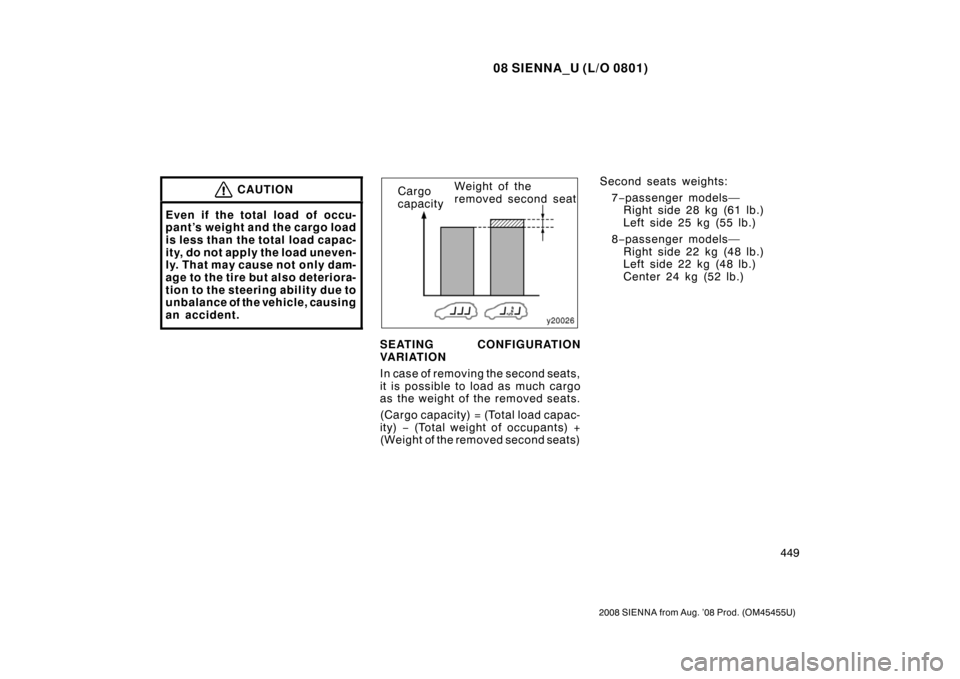
Cargo
capacityWeight of the
removed second seat
SEATING CONFIGURATION
VARIATION
In case of removing the second seats,
it is possible to load as much cargo
as the weight of the removed seats.
(Cargo capacity) = (Total load capac-
ity) − (Total weight of occupants) +
(Weight of the removed second seats) Second seats weights:
7−passenger models—
Right side 28 kg (61 lb.)
Left side 25 kg (55 lb.)
8 −passenger models—
Right side 22 kg (48 lb.)
Left side 22 kg (48 lb.)
Center 24 kg (52 lb.)