08 SIENNA_U (L/O 0801)
522
2008 SIENNA from Aug. ’08 Prod. (OM45455U)
If the level is low, add SAE J1703 or
FMVSS No.116 DOT 3 brake fluid to the
brake reservoir.
Remove and replace the reservoir cap by
hand. Fill the brake fluid to the dotted
line. This brings the fluid to the correct
level when you put the cap back on.
Use only newly opened brake fluid. Once
opened, brake fluid absorbs moisture from
the air, and excess moisture can cause a
dangerous loss of braking.
When the brake fluid must be replaced,
contact your Toyota dealer.
CAUTION
Take care when filling the reservoir
because brake fluid can harm your
hands or eyes. If fluid gets on your
hands or in your eyes, flush the af-
fected area with clean water immedi-
ately. If you still feel uncomfortable
with your hands or eyes, go to the
doctor.
NOTICE
If you spill some of the fluid, be sure
to wipe it off to prevent it from dam-
aging the parts or paintwork.
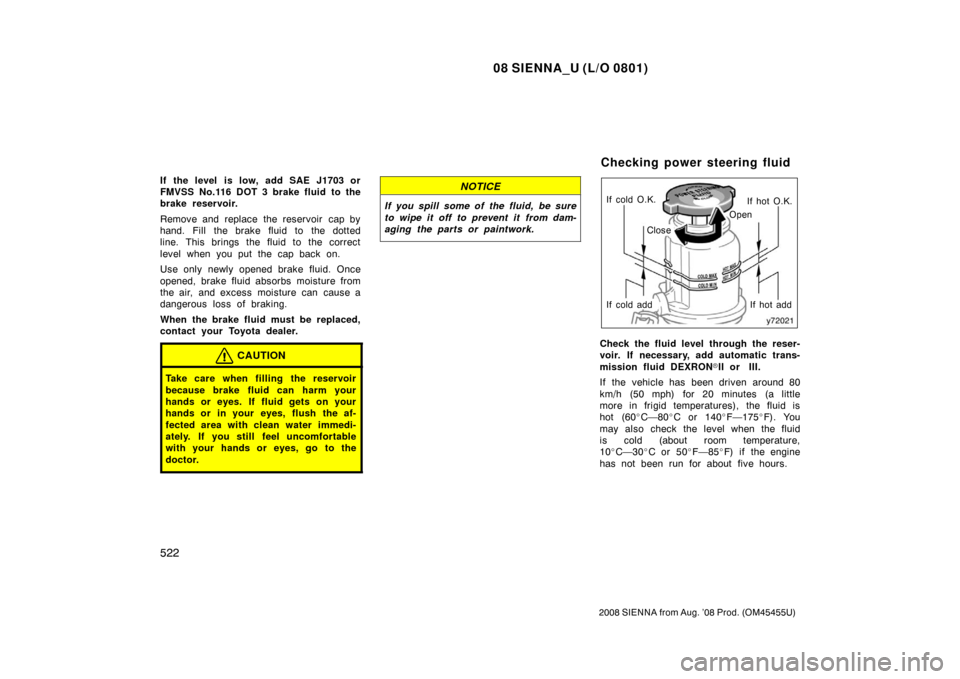
If cold add If cold O.K.
If hot add
If hot O.K.
Open
Close
Check the fluid level through the reser-
voir. If necessary, add automatic trans-
mission fluid DEXRON �II or III.
If the vehicle has been driven around 80
km/h (50 mph) for 20 minutes (a little
more in frigid temperatures), the fluid is
hot (60 �C—80 �C or 140 �F—175 �F). You
may also check the level when the fluid
is cold (about room temperature,
10 �C—30 �C or 50 �F—85 �F) if the engine
has not been run for about five hours.
Checking power steering fluid
08 SIENNA_U (L/O 0801)
523
2008 SIENNA from Aug. ’08 Prod. (OM45455U)
Clean all dirt from the outside of the res-
ervoir tank and look at the fluid level. If
the fluid is cold, the level should be in the
“COLD” range. Similarly, if it is hot, the
fluid level should be in the “HOT” range.
If the level is at the low side of either
range, add automatic transmission fluid
DEXRON�II or III to bring the level within
the range.
To remove the reservoir cap, turn it coun-
terclockwise and lift up. To reinstall it,
turn it clockwise. After replacing the reser-
voir cap, visually check the steering box
case, vane pump and hose connections
for leaks or damage.
CAUTION
The reservoir tank may be hot so be
careful not to burn yourself.
NOTICE
Avoid overfilling, or the power steer-
ing could be damaged.
Keep your tire inflation pressures
at the proper level.
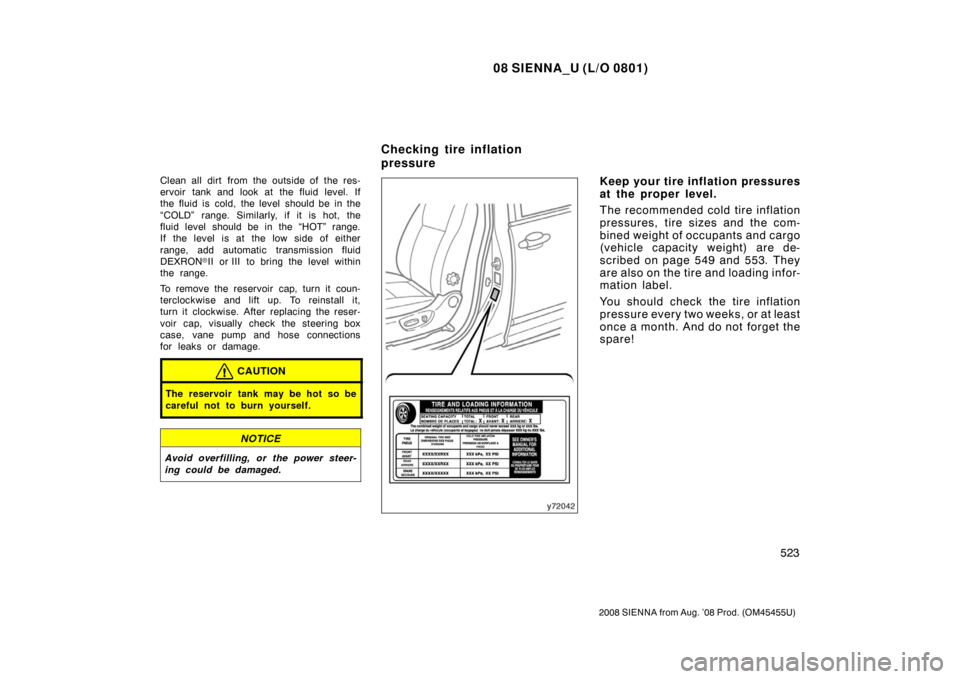
The recommended cold tire inflation
pressures, tire sizes and the com-
bined weight of occupants and cargo
(vehicle capacity weight) are de-
scribed on page 549 and 553. They
are also on the tire and loading infor-
mation label.
You should check the tire inflation
pressure every two weeks, or at least
once a month. And do not forget the
spare!
Checking tire inflation
pressure
08 SIENNA_U (L/O 0801)
552
2008 SIENNA from Aug. ’08 Prod. (OM45455U)
TRANSFER
(allwheel drive models)
Oil capacity, L (qt., Imp. qt.):0.9 (1.0, 0.8)
Oil type: Hypoid gear oil API GL −5
Recommended oil viscosity: Above −18 �C (0 �F)
SAE 90
Below −18 �C (0 �F)
SAE 80W or 80W −90
REAR DIFFERENTIAL
(allwheel drive models)
Oil capacity, L (qt., Imp. qt.): 0.9 (1.0, 0.8)
Oil type: Hypoid gear oil API GL −5
Recommended oil viscosity: Above −18 �C (0 �F)
SAE 90
Below −18 �C (0 �F)
SAE 80W or 80W −90 BRAKES
Minimum pedal clearance when depressed
with the force of 490 N (50 kgf, 110 lbf)
with the engine running, mm (in.):
52 (2.0)
Pedal free play, mm (in.): 1—6 (0.04—0.24)
Pad wear limit, mm (in.): 1.0 (0.04)
Lining wear limit, mm (in.): 1.0 (0.04)
Parking brake adjustment when depressed
with the force of 294 N (30 kgf, 66 lbf): 3—5 clicks
Fluid type: SAE J1703 or FMVSS No.116 DOT 3
STEERING
Wheel free play: Less than 30 mm (1.2 in.)
Power steering fluid type: Automatic transmission fluid DEXRON �II
or III
08 SIENNA_U (L/O 0801)
555
2008 SIENNA from Aug. ’08 Prod. (OM45455U)
13. DOME 10 A: Personal lights, vanity
lights, door courtesy lights, luggage
compartment light, engine switch light,
multi −information display
14. ECUB 10 A: Power sliding door, air
conditioning system, power windows,
multiplex communication system, meter
and gauge, wireless remote control
system
15. RAD NO. 1 15 A: Audio system
16. SPARE 15 A: Spare fuse
17. SPARE 20 A: Spare fuse
18. SPARE 30 A: Spare fuse
19. SPARE 30 A: Spare fuse
20. SPARE 7.5 A: Spare fuse
21. HLP RH 10 A: Right−hand headlight
22. HLP LH 10 A: Left−hand headlight
23. RSE 7.5 A: Rear seat entertainment
system
24. INJ 10 A: Multiport fuel injection sys-
tem/sequential multiport fuel injection
system
25. MIR HTR 10 A: Outside rear view mir-
ror heaters 26. RAD2 7.5 A:
Audio system, navigation
system, rear seat entertainment system
27. PWR OUTLET 15 A: Power outlets
28. CIG 15 A: Cigarette lighter
29. ECU ACC 7.5 A: Shift lock control
system, air c onditioning system, power
rear view mirror control
30. GAUGE2 7.5 A: Meter and gauge
31. IGN 7.5 A: Multiport fuel injection sys-
tem/sequential multiport fuel injection
system, SRS airbag system, multiplex
communication system
32. IG2 7.5 A: Multiport fuel injection sys-
tem/sequential multiport fuel injection
system
33. RR WIP 15 A: Rear window wiper
34. WIP 30 A: Windshield wiper and rear
window wiper
35. GAUGE1 10 A: Back−up lights, turn
signal lights, emergency flashers
36. SHTR 15 A: Seat heaters
37. WSH 20 A: Windshield washer and
rear window washer
38. HTR 10 A: Air conditioning system 39. ECUIG 10 A:
Toyota park assist sys-
tem, rear view monitor system, multi-
plex communication system, multiport
fuel injection system/sequential multi-
port fuel injection system, anti −lock
brake system, traction control system,
vehicle stability control system, shift
lock control system, dynamic laser
cruise control system, seat heaters,
power back door, electronic moon roof,
multi −information display, auto anti−
glare inside rear view mirror, power
windows, power outlets (115 V), power
third seat, driving position memory sys-
tem
40. PANEL 10 A: Air conditioning system,
seat heaters, audio system, navigation
system, power sliding door, power back
door
, multi −information display, rear
window defogger, emergency flashers,
instrument panel lights, steering switch
lights
41. TAIL 10 A: Stop/tail lights, license
plate lights, parking lights, side marker
lights
42. S/ROOF 25 A: Electronic moon roof
43. AC INV 15 A: Power outlets (115 V)
44. FR DEF 15 A: Windshield wiper de−
icer