Page 425 of 572
08 SIENNA_U (L/O 0801)
417
2008 SIENNA from Aug. ’08 Prod. (OM45455U)
CAUTION
When you load cargo on the roof lug-
gage carrier, observe the following:
�Place the cargo so that its weight
is distributed evenly between the
front and rear axles.
�If loading long or wide cargo, never
exceed the vehicle overall length or
width. (See “Dimensions and
weights” on page 548 in Section 8
for information on your vehicle
overall length and width.)
�Before driving, make sure the cargo
is securely fastened on the roof
luggage carrier.
�Loading cargo on the roof luggage
carrier will make the center of the
vehicle gravity higher. Avoid high
speeds, sudden starts, sharp turns,
sudden braking or abrupt maneu-
vers, otherwise it may result in loss
of control or vehicle rollover due to
failure to operate this vehicle cor-
rectly.
�If driving for a long distance, on
rough roads, or at high speeds,
stop the vehicle now and then dur-
ing the trip to make sure the cargo
remains in its place.
�Do not exceed 68 kg (150 lb.) cargo
weight on the roof luggage carrier.
NOTICE
When loading the luggages, be careful
not to scratch the surface of the
moon roof.
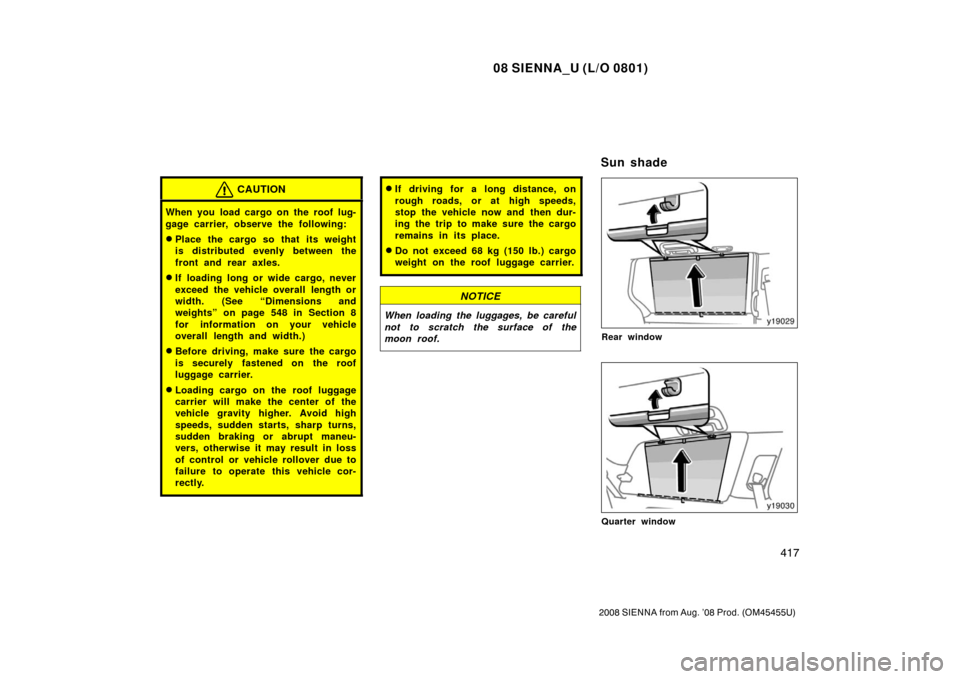
Rear window
Quarter window
Su n sh ad e
Page 469 of 572

08 SIENNA_U (L/O 0801)
461
2008 SIENNA from Aug. ’08 Prod. (OM45455U)
TRAILER TOWING TIPS
When towing a trailer, your vehicle will
handle differently than when not tow-
ing. The three main causes of vehicle
trailer accidents are driver error, exces-
sive speed and improper trailer loading.
Keep these in mind when towing:
�Before starting out, check operation of
the lights and all vehicle−trailer connec-
tions. After driving a short distance,
stop and recheck the lights and con-
nections. Before actually towing a trail-
er, practice turning, stopping and back-
ing with a trailer in an area away from
traffic until you learn the feel.
�Backing with a trailer is difficult and
requires practice. Grip the bottom of
the steering wheel and move your hand
to the left to move the trailer to the
left. Move your hand to the right to
move the trailer to the right. (This pro-
cedure is generally opposite to that
when backing without a trailer.) Also,
just turn the steering wheel a little at
a time, avoiding sharp or prolonged
turning. Have someone guide you when
backing to reduce the risk of an acci-
dent.
�Because stopping distance may be in-
creased, following distance should be
increased when towing a trailer. For
each 16 km/h (10 mph) of speed, allow
at least one vehicle and trailer length
between you and the vehicle ahead.
Avoid sudden braking as you may skid,
resulting in jackknifing and loss of con-
trol. This is especially true on wet or
slippery surfaces.
�Avoid jerky starts or sudden accelera-
tion.
�Avoid jerky steering and sharp turns.
The trailer could hit your vehicle in a
tight turn. Slow down before making a
turn to avoid the necessity of sudden
braking.
�Remember that when making a turn,
the trailer wheels will be closer than
the vehicle wheels to the inside of the
turn. Therefore, compensate for this by
making a larger than normal turning
radius with your vehicle.
�Crosswinds and rough roads will ad-
versely affect handling of your vehicle
and trailer, causing sway. Pay attention
to the rear from time to time to pre-
pare yourself for being passed by large
trucks or buses, which may cause your
vehicle and trailer to sway. If swaying
happens, firmly grip the steering wheel
and reduce speed immediately but
gradually. Never increase speed. Steer
straight ahead. If you make no extreme
correction with the steering or brakes,
the vehicle and trailer will stabilize.
�Be careful when passing other ve-
hicles. Passing requires considerable
distance. After passing a vehicle, do
not forget the length of your trailer and
be sure you have plenty of room be-
fore changing lanes.
�In order to maintain engine braking effi-
ciency, do not place the transmission
in “D”.
Page 471 of 572

08 SIENNA_U (L/O 0801)
463
2008 SIENNA from Aug. ’08 Prod. (OM45455U)
Improving fuel economy is easy—just take
it easy. It will help make your vehicle last
longer, too. Here are some specific tips
on how to save money on both fuel and
repairs:
�Keep your tires inflated at the cor-
rect pressure. Underinflation causes
tire wear and wastes fuel. See page
523 in Section 7 −2 for instructions.
�Do not carry unneeded weight in
your vehicle. Excess weight puts a
heavier load on the engine, causing
greater fuel consumption.
�Avoid lengthy warmup idling. Once
the engine is running smoothly, begin
driving—but gently. Remember, howev-
er, that on cold winter days this may
take a little longer.
�Put the selector lever into the “D”
when engine braking is not required.
Driving with the selector lever in “4”
will reduce the fuel economy. (For de-
tails, see “Automatic transmission” on
page 205 in Section 1 −7.)
�Accelerate slowly and smoothly.
Avoid jackrabbit starts. Get into high
gear as quickly as possible.
�Avoid long engine idling. If you have
a long wait and you are not in traffic,
it is better to turn off the engine and
start again later.
�Avoid engine lugging or overrev-
ving. Use a gear position suitable for
the road on which you are travelling.
�Avoid continuous speeding up and
slowing down. Stop−and− go driving
wastes fuel.
�Avoid unnecessary stopping and
braking. Maintain a steady pace. Try
to time the traffic signals so you only
need to stop as little as possible or
take advantage of through streets to
avoid traffic lights. Keep a proper dis-
tance from other vehicles to avoid sud-
den braking. This will also reduce wear
on your brakes.
�Avoid heavy traffic or traffic jams
whenever possible.
�Do not rest your foot on the brake
pedal. This causes premature wear,
overheating and poor fuel economy.
�Maintain a moderate speed on high-
ways. The faster you drive, the greater
the fuel consumption. By reducing your
speed, you will cut down on fuel con-
sumption.
�Keep the front wheels in proper
alignment. Avoid hitting the curb and
slow down on rough roads. Improper
alignment not only causes faster tire
wear but also puts an extra load on
the engine, which, in turn, wastes fuel.
�Keep the bottom of your vehicle free
from mud, etc. This not only lessens
weight but also helps prevent corro-
sion.
�Keep your vehicle tunedup and in
top shape. A dirty air cleaner, improp-
er valve clearance, dirty plugs, dirty oil
and grease, brakes not adjusted, etc.
all lower engine performance and con-
tribute to poor fuel economy. For longer
life of all parts and lower operating
costs, keep all maintenance work on
schedule, and if you often drive under
severe conditions, see that your vehicle
receives more frequent maintenance.
(For scheduled maintenance informa-
tion, please refer to the “Scheduled
Maintenance Guide” or “Owner ’s Manu-
al Supplement”.)
How to save fuel and make
your vehicle last longer
Page 556 of 572
08 SIENNA_U (L/O 0801)
548
2008 SIENNA from Aug. ’08 Prod. (OM45455U)
Dimensions and weights
Overall widthmm (in.)
3030 (119.3)
Overall height
mm (in.)
1700 (66.9)
∗2
1710 (67.3)∗3
Wheelbase mm (in.)
Front tread mm (in.)1665 (65.6)
∗
2
1675 (65.9)∗3
Rear tread mm (in.)
∗
1: Unladen vehicle∗2: With P215/65R16 tires∗3: With P225/60R17 tires
Overall length mm (in.)
5105 (201.0)
1965 (77.4)
1750 (68.9)
∗
1
Towing capacity
(trailer weight +
cargo weight) kg (lb.) Vehicle without towing package
Vehicle with towing package
544 (1200)
1587 (3500)