Page 5 of 596

1
2
3
4
5
6
7
5
4-1. Maintenance and care ...... 422Cleaning and protecting the vehicle exterior............ 422
Cleaning and protecting the vehicle interior............. 424
4-2. Maintenance ...................... 427 Maintenance requirements . 427
General maintenance.......... 429
Emission inspection and maintenance (I/M)
programs........................... 432
4-3. Do-it-yourself maintenance .................... 433
Do-it-yourself service precautions ....................... 433
Hood ................................... 437
Engine compartment ........... 438
Tires .................................... 454
Tire inflation pressure ......... 461
Wheels ................................ 465
Air conditioning filter............ 467
Wireless remote control battery ............................... 470
Checking and replacing fuses ................................. 472
Light bulbs........................... 483 5-1. Essential information ....... 496
If your vehicle needs to be towed........................... 496
If you think something is wrong ............................... 501
Fuel pump shut off system .............................. 502
Event data recorder ............ 503
5-2. Steps to take in an emergency ...................... 505
If a warning light turns on or a warning buzzer
sounds.............................. 505
If a warning message is displayed (vehicles with
multi-information
display) ............................. 514
If you have a flat tire ........... 519
If the engine will not start.... 529
If the shift lever cannot be shifted from P ................... 530
If you lose your keys........... 531
If the vehicle battery is discharged........................ 532
If your vehicle overheats .... 536
If the vehicle becomes stuck ................................. 539
4Maintenance and care5When trouble arises
Page 9 of 596
9
Tires
●Rotation
● Replacement
● Inflation pressure
● Information
P. 454
P. 519
P. 461
P. 558
Fuel filler door P. 92
Rear turn signal
lights
P. 155
Stop/tail and rear side
marker lights
P. 175
Side doors
P. 37
: If equipped
Back door P. 41
License plate
lights
P. 175
Tail lights P. 175
Rear window defogger
P. 262
Rear window
wiper
P. 181
Roof luggage
carrier
P. 83
Back window
P. 87
Page 421 of 596
Maintenance and care4
421
4-1. Maintenance and care ... 422Cleaning and protecting the vehicle exterior......... 422
Cleaning and protecting the vehicle interior.......... 424
4-2. Maintenance ................... 427 Maintenance requirements .................. 427
General maintenance....... 429
Emission inspection and maintenance (I/M)
programs........................ 432 4-3. Do-it-yourself
maintenance ................. 433
Do-it-yourself service precautions .................... 433
Hood ................................ 437
Engine compartment ........ 438
Tires ................................. 454
Tire inflation pressure ...... 461
Wheels ............................. 465
Air conditioning filter......... 467
Wireless remote control battery ............................ 470
Checking and replacing fuses .............................. 472
Light bulbs........................ 483
Page 431 of 596
431
4-2. Maintenance
4
Maintenance and care
Vehicle exterior
ItemsCheck points
Door • Operate smoothly?
Engine hood • The lock system works properly?
Fluid leaks • Is there any leakage after park-
ing?
Tire • Inflation pressure is correct?
• Tire surfaces not worn or dam-
aged?
• Tires rotated according to the maintenance schedule?
• Wheel nuts are not loose?
CAUTION
■ If the engine is running
Turn the engine off and ensure that there is adequate ventilation before per-
forming maintenance checks.
Page 434 of 596
434 4-3. Do-it-yourself maintenance
ItemsParts and tools
Light bulbs ( P. 483)• Bulb with same number and watt-
age rating as original
• Phillips-head screwdriver
• Flathead screwdriver
Power steering fluid level (P. 448) • Automatic transmission fluid
DEXRON
® II or III
• Rag or paper towel
• Funnel (used only for adding power steering fluid)
Radiator and condenser (P. 446)
Tire inflation pressure (
P. 461) • Tire pressure gauge
• Compressed air source
Washer fluid
(P. 452) • Water
• Washer fluid containing antifreeze
(for winter use)
• Funnel (used only for adding washer fluid)
Page 454 of 596
454
4-3. Do-it-yourself maintenance
Tires
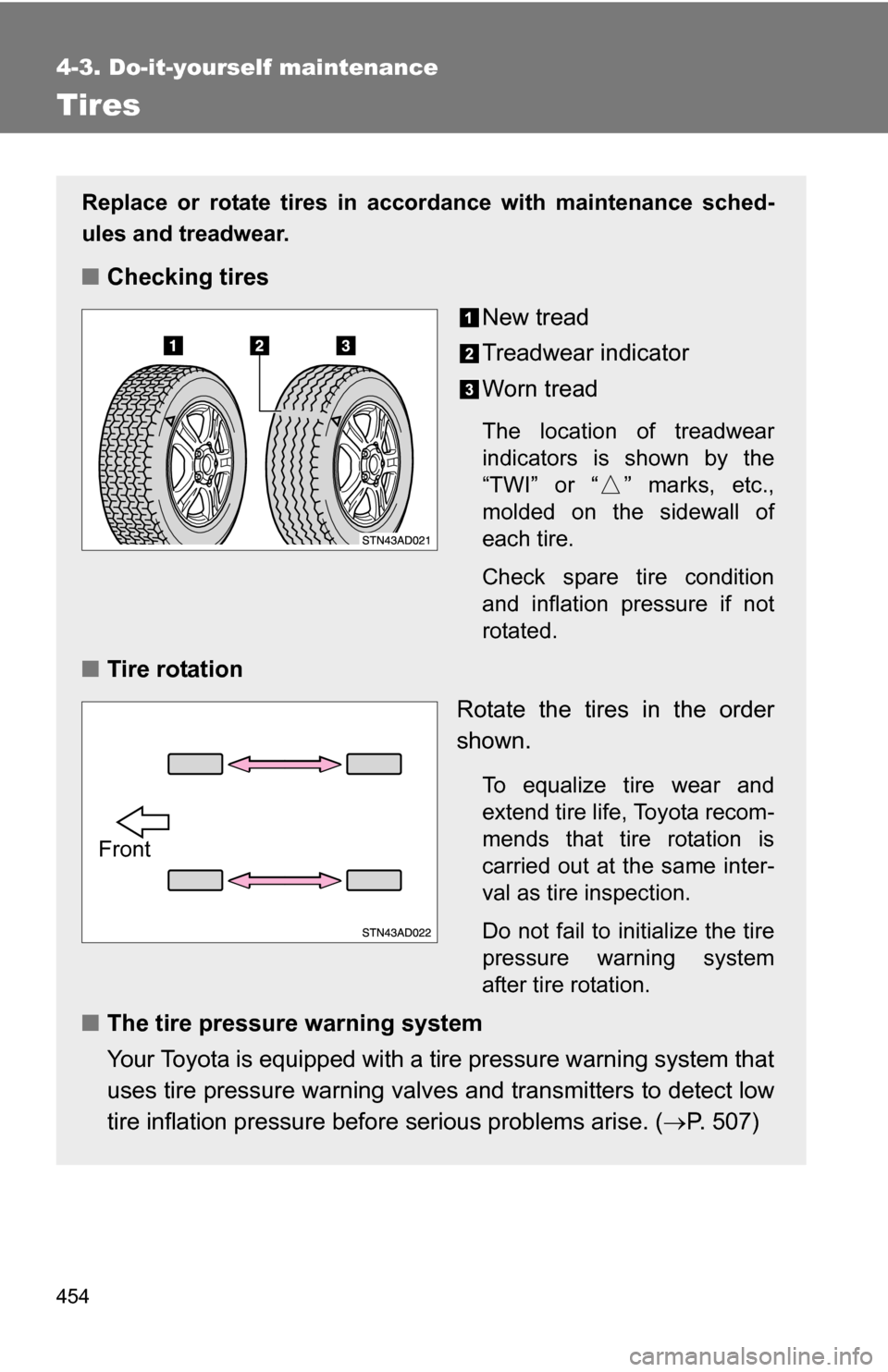
Replace or rotate tires in accordance with maintenance sched-
ules and treadwear.
■Checking tires
New tread
Treadwear indicator
Worn tread
The location of treadwear
indicators is shown by the
“TWI” or “ ” marks, etc.,
molded on the sidewall of
each tire.
Check spare tire condition
and inflation pressure if not
rotated.
■Tire rotation
Rotate the tires in the order
shown.
To equalize tire wear and
extend tire life, Toyota recom-
mends that tire rotation is
carried out at the same inter-
val as tire inspection.
Do not fail to initialize the tire
pressure warning system
after tire rotation.
■The tire pressure warning system
Your Toyota is equipped with a tire pressure warning system that
uses tire pressure warning valves and transmitters to detect low
tire inflation pressure before serious problems arise. (P. 507)
Front
Page 455 of 596

455
4-3. Do-it-yourself maintenance
4
Maintenance and care
Installing tire pressure warning valves and transmitters
When replacing tires or wheels, tire pressure warning valves and
transmitters must also be installed.
When new tire pressure warning valves and transmitters are installed,
new tire pressure warning valve and transmitter ID codes must be regis-
tered in the tire pressure warning computer and tire pressure warning
system must be initialized. Have tire pressure warning valve and trans-
mitter ID codes registered by your Toyota dealer. ( P. 456)
Initializing the tire pressure warning system
■ The tire pressure warning system must be initialized in the fol-
lowing circumstances:
●When rotating the tires on vehicles differing with front and rear
tire inflation pressures.
● When changing the tire size.
When the tire pressure warning system is initialized, the current
tire inflation pressure is set as the pressure benchmark.
■ How to initialize the tire pressure warning system
Park the vehicle in safe place and turn the engine switch off.
While the vehicle is moving, in itialization is not performed.
Adjust the tire inflation pressure to the specified cold tire infla-
tion pressure level. ( P. 553)
Make sure to adjust the tire pressure to the specified cold tire
inflation pressure level. The ti re pressure warning system will
operate based on this pressure
level.
Turn the engine switch to the ON position.
Page 457 of 596

457
4-3. Do-it-yourself maintenance
4
Maintenance and care
■Replacing tires and wheels
If the ID code of the tire pressure warning valve and transmitter is not
registered, the tire pre
ssure warning system will not work properly. After
driving for about 20 minutes, the ti re pressure warning light comes on
after blinking for 1 minute to indicate a system malfunction.
■Tire life
Any tire over 6 years old must be checked by a qualified technician even
if they have seldom or never been used or damage is not obvious.
■If the tread wears down below 0.16 in. (4 mm) on snow tires
The effectiveness of snow tires is lost.
■Low profile tires
Generally, low profile tires will wear more rapidly and tire grip perfor-
mance will be reduced on snowy and/or icy roads when compared to
standard tires. Be sure to use snow tires or snow chains on snowy and/
or icy roads and drive carefully at a speed appropriate for road and
weather conditions.
■Maximum load of tire
Check that the maximum load of the re placed tire is greater than 1/2 of
the Gross Axle Weight Ratings (GAWR) of either the front axle or the
rear axle, whichever is greater.
As for the maximum load of the tire, see the load limit at maximum cold
tire inflation pressure mentioned on the sidewall of the tire, and as for the
Gross Axle Weight Ratings (GAWR) , see the Certification Label.
( P. 461, 558).
■Tire types
1 Summer tires
Summer tires are high-speed performance tires best suited to highway
driving under dry conditions. Since summer tires do not have the same
traction performance as snow tire s, summer tires are inadequate for
driving on snow-covered or icy roads. For driving on snow-covered
roads or icy roads, the use of snow tires is recommended. When
installing snow tires, be sure to replace all four tires.