Page 457 of 596

457
4-3. Do-it-yourself maintenance
4
Maintenance and care
■Replacing tires and wheels
If the ID code of the tire pressure warning valve and transmitter is not
registered, the tire pre
ssure warning system will not work properly. After
driving for about 20 minutes, the ti re pressure warning light comes on
after blinking for 1 minute to indicate a system malfunction.
■Tire life
Any tire over 6 years old must be checked by a qualified technician even
if they have seldom or never been used or damage is not obvious.
■If the tread wears down below 0.16 in. (4 mm) on snow tires
The effectiveness of snow tires is lost.
■Low profile tires
Generally, low profile tires will wear more rapidly and tire grip perfor-
mance will be reduced on snowy and/or icy roads when compared to
standard tires. Be sure to use snow tires or snow chains on snowy and/
or icy roads and drive carefully at a speed appropriate for road and
weather conditions.
■Maximum load of tire
Check that the maximum load of the re placed tire is greater than 1/2 of
the Gross Axle Weight Ratings (GAWR) of either the front axle or the
rear axle, whichever is greater.
As for the maximum load of the tire, see the load limit at maximum cold
tire inflation pressure mentioned on the sidewall of the tire, and as for the
Gross Axle Weight Ratings (GAWR) , see the Certification Label.
( P. 461, 558).
■Tire types
1 Summer tires
Summer tires are high-speed performance tires best suited to highway
driving under dry conditions. Since summer tires do not have the same
traction performance as snow tire s, summer tires are inadequate for
driving on snow-covered or icy roads. For driving on snow-covered
roads or icy roads, the use of snow tires is recommended. When
installing snow tires, be sure to replace all four tires.
Page 458 of 596

458 4-3. Do-it-yourself maintenance
2 All season tiresAll season tires are designed to provide better traction in snow and to
be adequate for driving in most winter conditions, as well as for use
year round. All season tires, however, do not have adequate traction
performance compared with snow tires in heavy or loose snow. Also,
all season tires fall short in acceleration and handling performance
compared with summer tires in highway driving.
3Snow tires For driving on snow-covered roads or icy roads, we recommend using
snow tires. If you need snow tires, select tires of the same size, con-
struction and load capacity as the or iginally installed tires. Since your
vehicle has radial tires as original equipment, make sure your snow
tires also have radial construction. Do not install studded tires without
first checking local regulations for possible restriction. Snow tires
should be installed on all wheels. ( P. 229)
■Initializing the tire pr essure warning system
Initialize the tires with the tire inflati on pressure adjusted to the specified
level.
■If you push the tire pressure warning reset switch accidentally
If initialization is performed, adjust the tire in flation pressure to the speci-
fied level and initialize the tire pressure warning system again.
■When the initialization of the tire pressure warning system has
failed
Initialization can be completed in se veral minutes. However, in the fol-
lowing cases, the settings have not been recorded and the system will
not operate properly. If repeated attempts to record tire inflation pressure
settings are unsuccessful, have the vehicle inspected by your Toyota
dealer.
●When operating the tire pressure warning reset switch, the tire pres-
sure warning light does not flash 3 times.
●After carrying out the initialization procedure, the tire pressure warn-
ing light blinks for 1 minute and then stays on after driving for about
20 minutes.
Page 460 of 596

460 4-3. Do-it-yourself maintenance
CAUTION
■When inspecting or replacing tires
Observe the following precautions to prevent accidents. Failure to do so
may cause damage to parts of the drive train, as well as dangerous han-
dling characteristics, which may le ad to fatal or injury accidents.
●Do not mix tires of different makes, models, tread patterns or tread-
wear.
●Do not use tire sizes other than those recommended by Toyota.
●Do not mix radial, bias-belted, or bias-ply tires.
●Do not mix summer, all season and winter tires.
■When initializing the tire pressure warning system
Do not push the tire pressure warnin g reset switch without first adjusting
the tire inflation pressure to the spec ified level. Otherwise, the tire pres-
sure warning light may not come on ev en if the tire inflation pressure is
low, or it may come on when the tire inflation pressure is actually normal.
NOTICE
■Repairing or replacing tires, wheels and tire pressure warning
valves and transmitters
When removing or fitting the wheels, tires or the tire pressure warning
valve and transmitter, contact your Toyota dealer as the tire pressure
warning valve and transmitter may be damaged if not handled correctly.
■To avoid damaging the tire pressure warning valves and transmit-
ters
Do not use liquid sealants on flat tires.
Page 480 of 596
480 4-3. Do-it-yourself maintenance
15 ECU-IG No.1 7.5 AAnti-lock brake system, vehicle sta-
bility control system, multiplex com-
munication system, intuitive
parking assist system, power front
driver’s seat, power tilt and power
telescopic, shift lock, tire pressure
warning system, accessory meter,
trailer towing, power outlet, electric
moon roof, power back door, head
light cleaner
16 AIR SUS IG 20 A Electronically modulated air sus-
pension system
17 LH-IG 7.5 A Back-up lights, charging system,
gauge and meters, turn signal
lights, air conditioning system, seat
heaters, rear window defogger
18 4WD 20 A Four-wheel drive control system
19 RR SEAT-HTR
LH 10 A Seat heaters
20 WSH 20 A Window washer
21 WIPER 30 A Wiper and washer
22 ECU-IG No.2 7.5 A Multiplex communication system
23 TAIL 15 A Tail lights, trailer lights (tail lights),
parking lights
24 A/C IG 10 A Air conditioning system
25 SEAT-HTR 20 A Seat heater or Heated and venti-
lated seats
FuseAmpereCircuit
Page 495 of 596
When trouble arises5
495
5-1. Essential information .... 496If your vehicle needs to be towed ........................ 496
If you think something is wrong ............................. 501
Fuel pump shut off system ........................... 502
Event data recorder ......... 503 5-2. Steps to take in an
emergency .................... 505
If a warning light turns on or a warning buzzer
sounds... ........................ 505
If a warning message is displayed (vehicles with
multi-information
display) .......................... 514
If you have a flat tire......... 519
If the engine will not start ................................ 529
If the shift lever cannot be shifted from P................. 530
If you lose your keys ........ 531
If the vehicle battery is discharged ..................... 532
If your vehicle overheats ....................... 536
If the vehicle becomes stuck .............................. 539
Page 505 of 596
5
When trouble arises
505
5-2. Steps to take in an emergency
If a war ning light turns on or a war ning buzzer sounds...
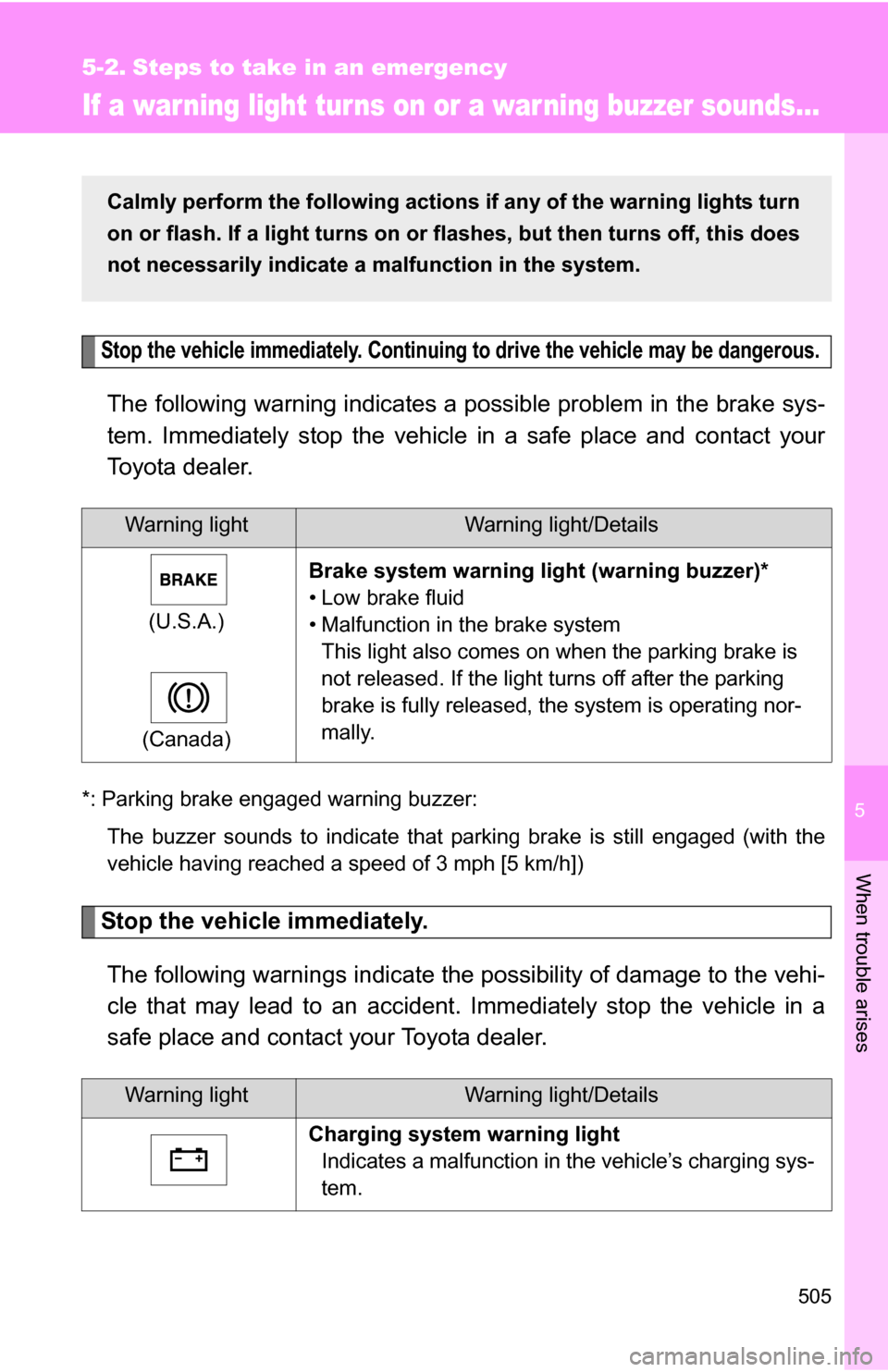
Stop the vehicle immediately. Continuing to drive the vehicle may be dangerous.
The following warning indicates a possible problem in the brake sys-
tem. Immediately stop the vehicle in a safe place and contact your
Toyota dealer.
*: Parking brake engaged warning buzzer:
The buzzer sounds to indicate that parking brake is still engaged (with the
vehicle having reached a speed of 3 mph [5 km/h])
Stop the vehicle immediately.
The following warnings indicate the possibility of damage to the vehi-
cle that may lead to an accident. Immediately stop the vehicle in a
safe place and contact your Toyota dealer.
Warning lightWarning light/Details
(U.S.A.)
(Canada) Brake system warning li
ght (warning buzzer)*
• Low brake fluid
• Malfunction in the brake system This light also comes on when the parking brake is
not released. If the light turns off after the parking
brake is fully released, the system is operating nor-
mally.
Warning lightWarning light/Details
Charging system warning light Indicates a malfunction in the vehicle’s charging sys-
tem.
Calmly perform the following actions if any of the warning lights turn
on or flash. If a light turns on or flashes, but then turns off, this does
not necessarily indicate a malfunction in the system.
Page 506 of 596
506 5-2. Steps to take in an emergency
Have the vehicle inspected immediately.Failing to investigate the cause of the following warnings may lead to
the system operating abnormally and possibly cause an accident.
Have the vehicle inspected by your Toyota dealer immediately.
Warning lightWarning light/Details
Malfunction indicator lamp Indicates a malfunction in:
• The electronic engine control system;
• The electronic throttle control system;
• The electronic automatic transmission control sys-tem; or
• The emission control system.
SRS warning light Indicates a malfunction in:
• The SRS airbag system;
• The front passenger occupant classification system; or
• The seat belt pretensioner system.
(U.S.A.)
(Canada) ABS warning light
Indicates a malfunction in:
• The ABS; or
• The brake assist system.
(Flashing) and VSC OFF and slip indicators
Indicates a malfunction in:
• The VSC;
• The TRAC; or
• The AUTO LSD system.
Page 507 of 596
5
When trouble arises
507
5-2. Steps to take in an emergency
Follow the correction procedures.
After taking the specified steps to correct the suspected problem,
check that the warning light turns off.
Automatic transmission fluid temperature warn-
ing light Indicates that the automatic transmission fluid tem-
perature is too high.
Power steering warning light Indicates a malfunction in the variable flow control
power steering system.
Warning lightWarning light/DetailsCorrection procedure
Open door warning light
(warning buzzer)
*1
Indicates that a door or
back door is not fully
closed. Check that all doors
are closed.
(On the instrument cluster) Driver’s seat belt
reminder light
(warning buzzer)
*2
Warns the driver to fas-
ten his/her seat belt.
Fasten the seat belt.
(On the center panel) Front passenger’s seat
belt reminder light
(warning buzzer)
*3
Warns the front passen-
ger to fasten his/her seat
belt.
Fasten the seat belt.
Warning lightWarning light/Details


