Page 216 of 596
216 2-4. Using other driving systems
To disable VSC or TRAC (4H and 4L mode on 4WD models)If the vehicle gets stuck in fresh snow or mud, VSC or TRAC may
reduce power from the engine to the wheels. You may need to turn
the system off to enable you to rock the vehicle in order to free it.
■ TRAC OFF mode
Press the VSC OFF switch
briefly.
The slip indicator should come
on.
The system is in TRAC of engine
control off and VSC on mode.
This mode can be used when the
transfer mode is 4H mode and
the center differential is unlocked.
Push the switch again to turn the
system back on.
■VSC OFF mode
Stop the vehicle completely, and
press the VSC OFF switch for
more than 3 seconds.
The slip and VSC OFF indicators
should come on.
The system is all off mode.
Page 223 of 596

223
2-5. Driving information
2
When driving
NOTICE
■
To prevent the water damage
●Take all necessary safety measures to ensure that water damage to the
engine or other components does not occur.
● Water entering the engine air intake will cause severe engine damage.
● Water entering the automatic transmission will cause deterioration in shift
quality, locking up of your transmission accompanied by vibration, and ulti-
mately damage.
● Water can wash the grease from wheel bearings, causing rusting and pre-
mature failure, and may also enter the differentials, transmission and
transfer case, reducing the gear oil’s lubricating qualities.
■ When you drive through water
If driving through water, such as when crossing shallow streams, first check
the depth of the water and the bottom of the river bed for firmness. Drive
slowly and avoid deep water.
■ Inspection after off-road driving
●Sand and mud that has accumulat ed in brake drums and around brake
discs may affect braking efficiency and may damage brake system compo-
nents.
● Always perform a maintenance inspection after each day of off-road driv-
ing that has taken you through rough terrain, sand, mud, or water. For
scheduled maintenance information, refer to the “Scheduled Maintenance
Guide” or “Owner’s Manual Supplement”.
Page 243 of 596

243
2-5. Driving information
2
When driving
■
Before towing
Check that the following conditions are met:
●Ensure that your vehicle’s tires are properly inflated. ( P. 553)
● Trailer tires should be inflated according to the trailer manufacturer’s rec-
ommendation.
● All trailer lights work to be legal.
● All lights work each time you connect them.
● The trailer ball is set up at the proper height for the coupler on the t\
railer.
● The vehicle remains level when a loaded or unloaded trailer is hitched.
Do not drive if the vehicle is not level, and check for improper tongue
load, overloading, worn suspension, or other possible causes.
● The trailer cargo is securely loaded.
● The rear view mirrors conform to all applicable federal, state/provincial or
local regulations. If they do not, instal l rear view mirrors appropriate for
towing purposes.
● Depress TOW/HAUL button (if equipped)
■ When connecting and disconnecting a trailer
Set the electronically modulated air suspension system to MAN., or turn off
the engine, when the system is in N mode. (if equipped)
■ AVS (adaptive variable suspension system) (if equipped)
The suspension can be switched for improvement in driveability. ( P. 207)
■ Break-in schedule
●Toyota recommends that you do not use a new vehicle or a vehicle with
any new power train components (engine, transmission, differential,
wheel bearings, etc.) to tow a trailer for the first 500 miles (800 km) of
driving.
● Drive the vehicle at a speed of less than 50 mph (80 km/h) when towing a
trailer for another 500 miles (800 km/h).
● Avoid full throttle acceleration.
■ Maintenance
●If you tow a trailer, your vehicle will require more frequent maintenance
due to the additional load. (See “Scheduled Maintenance Guide” or
“Owner’s Manual Supplement”.)
Page 539 of 596

5
When trouble arises
539
5-2. Steps to take in an emergency
If the vehicle becomes stuck
CAUTION
■When attempting to free a stuck vehicle
If you choose to rock the vehicle back and forth to free it, make sure the sur-
rounding area is clear, to avoid striking other vehicles, objects or persons.
The vehicle may also lunge forward or lunge back suddenly as it becomes
free. Use extreme caution.
■ When shifting the shift lever
Be careful not to shift the shift lever with the accelerator pedal depressed.
This may lead to unexpected rapid acceleration of the vehicle that may
cause an accident and result in death or serious injury.
NOTICE
■To avoid damaging the transmission and other components
●Avoid spinning the wheels and do not rev the engine.
● If the vehicle remains stuck after trying these procedures, the vehicle may
require towing to be freed.
Carry out the following procedures if the tires spin or the vehicle
becomes stuck in mud, dirt, or snow.
Stop the engine. Set the parking brake and put the shift
lever in P.
Remove the mud, snow, or sand from around the stuck tire.
Place wood, stones or some other material to help provide
traction under the tires.
2WD models: Activate the AUTO LSD. ( P. 212)
4WD models: Shift the front wh eel drive control switch to
4L.
Then push the center differential lock switch. ( P. 209)
Carefully apply the accelerator to free the vehicle.
Page 550 of 596
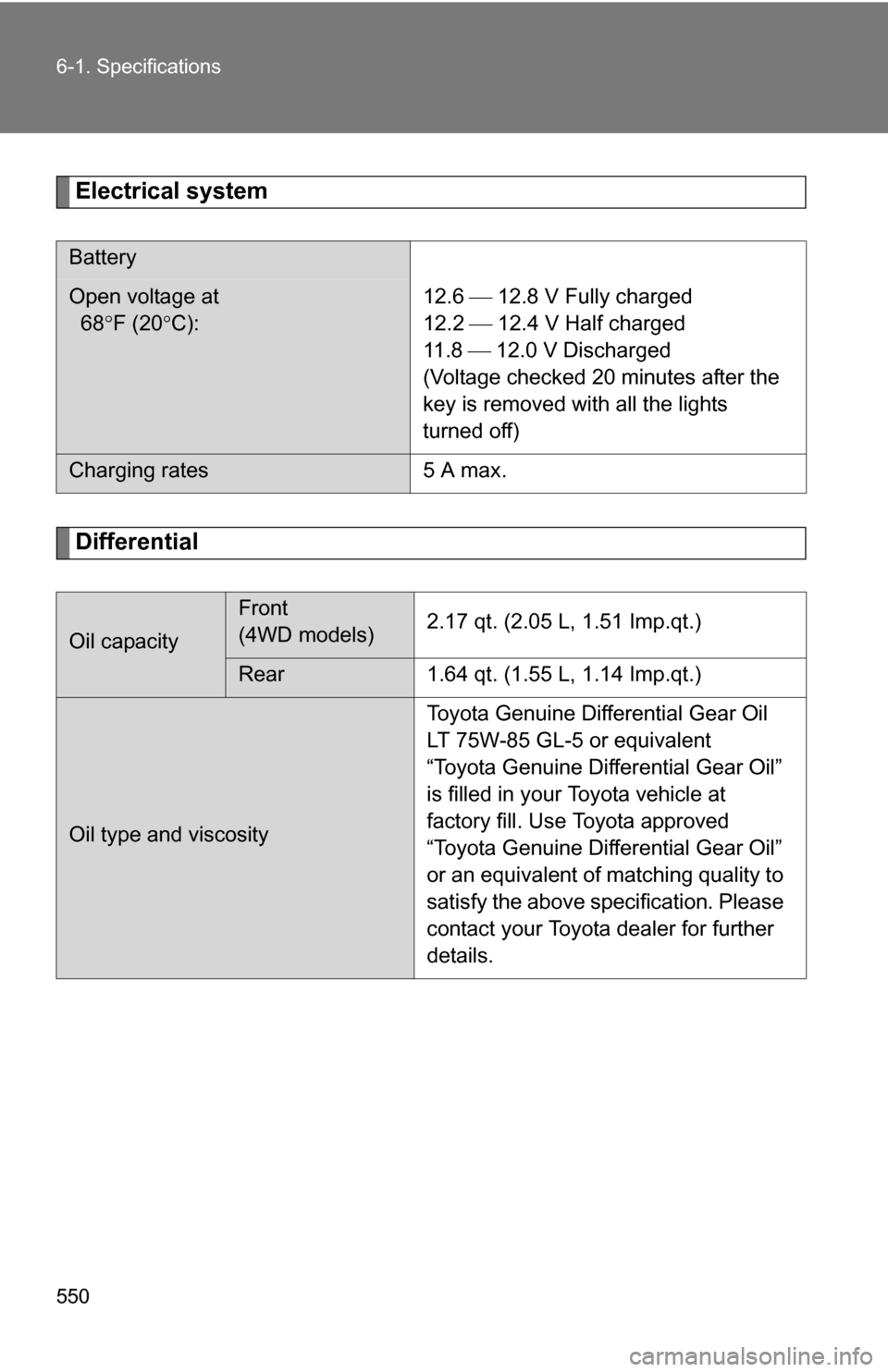
550 6-1. Specifications
Electrical system
Differential
Battery
Open voltage at
68F (20 C): 12.6 12.8 V Fully charged
12.2 12.4 V Half charged
11 . 8
12.0 V Discharged
(Voltage checked 20 minutes after the
key is removed with all the lights
turned off)
Charging rates 5 A max.
Oil capacity
Front
(4WD models)2.17 qt. (2.05 L, 1.51 Imp.qt.)
Rear
1.64 qt. (1.55 L, 1.14 Imp.qt.)
Oil type and viscosity Toyota Genuine Differential Gear Oil
LT 75W-85 GL-5 or equivalent
“Toyota Genuine Differential Gear Oil”
is filled in your Toyota vehicle at
factory fill. Use Toyota approved
“Toyota Genuine Differential Gear Oil”
or an equivalent of matching quality to
satisfy the above specification. Please
contact your Toyota dealer for further
details.
Page 582 of 596
582
Abbreviation list
Abbreviation/Acronym list
ABBREVIATIONSMEANING
2WDTwo Wheel Drive
4WD Four Wheel Drive ABS Anti-Lock Brake System
ACC Accessory
AI-SHIFT Artificial Intelligence shifting ALR Automatic Locking Retractor
A-TRAC Active Traction Control
AUTO LSD Automatic Limited Slip Differential AVS Adaptive Variable Suspension System
CRS Child Restraint System
ECU Electronic Control Unit
EDR Event Data Recorder ELR Emergency Locking Retractor
GAWR Gross Axle Weight Rating
GCWR Gross Combination Weight Rating GVWR Gross Vehicle Weight Rating
I/M Emission inspection and maintenance
INT Intermittent
INFO Information
LED Light Emitting Diode LT Light truck
M + S Mud + Snow
MMT Methylcy clopentadienyl Manganese Tricarbonyl
MTBE Methyl Tertiary Butyl Ether OBD On Board Diagnostics
PWR Power RES Resume