Page 516 of 596
516 5-2. Steps to take in an emergency
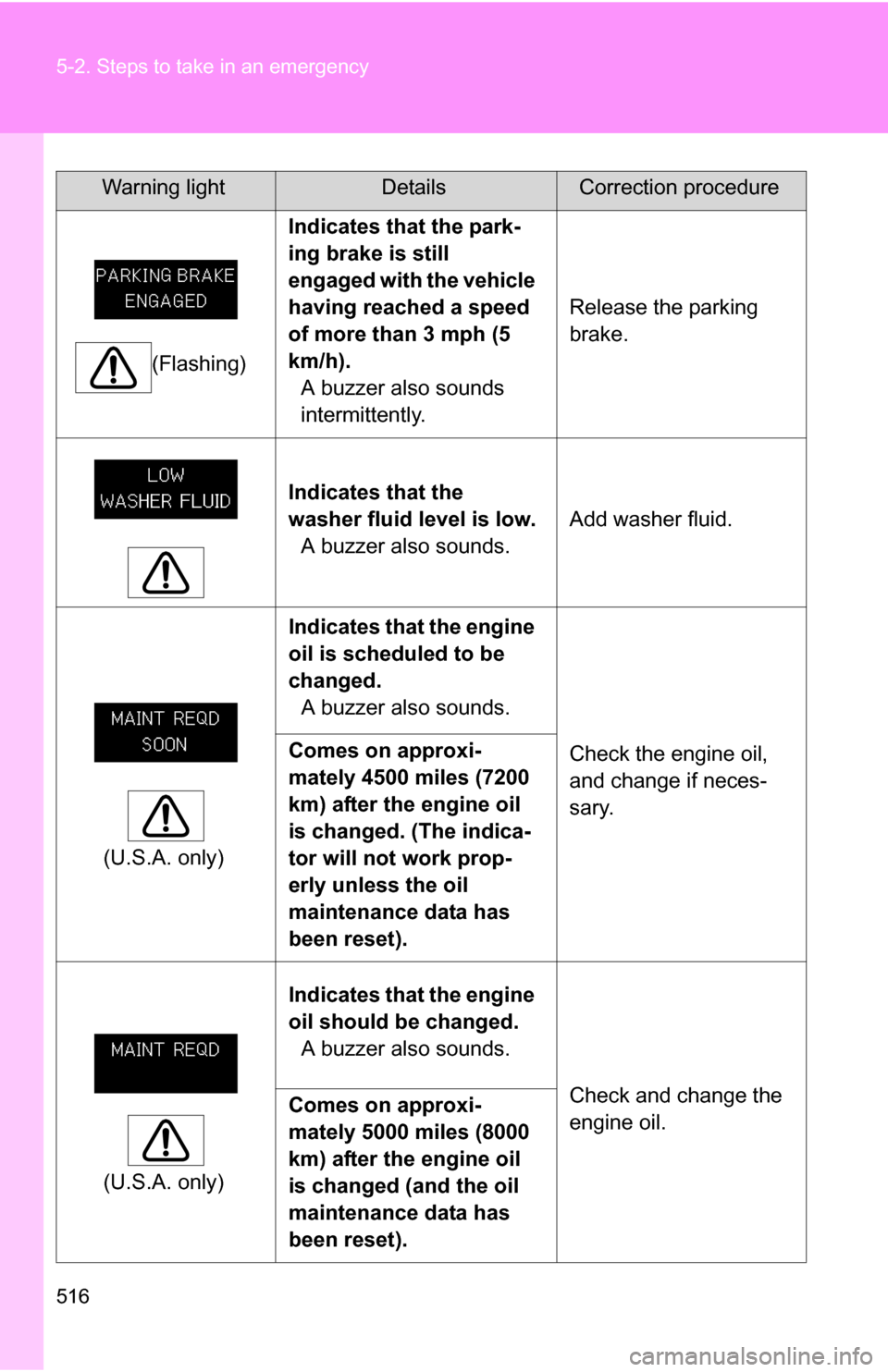
(Flashing)Indicates that the park-
ing brake is still
engaged with the vehicle
having reached a speed
of more than 3 mph (5
km/h).
A buzzer also sounds
intermittently. Release the parking
brake.
Indicates that the
washer fluid level is low. A buzzer also sounds. Add washer fluid.
(U.S.A. only) Indicates that the engine
oil is scheduled to be
changed.
A buzzer also sounds.
Check the engine oil,
and change if neces-
sary.
Comes on approxi-
mately 4500 miles (7200
km) after the engine oil
is changed. (The indica-
tor will not work prop-
erly unless the oil
maintenance data has
been reset).
(U.S.A. only) Indicates that the engine
oil should be changed.
A buzzer also sounds.
Check and change the
engine oil.
Comes on approxi-
mately 5000 miles (8000
km) after the engine oil
is changed (and the oil
maintenance data has
been reset).
Warning lightDetailsCorrection procedure
Page 517 of 596

5
When trouble arises
517
5-2. Steps to take in an emergency
Indicates that the fuel
level is low.
A buzzer also sounds
and the low fuel level
warning light comes on. Fill up the tank as soon
as possible.
(if equipped) Indicates that the laser
radar sensor is dirty or
covered with ice.
A buzzer also sounds. Clean the sensor.
(if equipped) Indicates that the
dynamic laser cruise
control system is unable
to judge vehicle-to-vehi-
cle distance.
A buzzer also sounds. If the windshield wipers
are on, turn them off or
set them to either the
intermittent.
(Flashing)
(if equipped) Indicates that your vehi-
cle is nearing the vehicle
ahead (in vehicle-to-
vehicle distance control
mode).
Slow the vehicle by
applying the brakes.
(if equipped) (Flashing) Indicates that the
dynamic laser cruise
control system is mal-
function.
A buzzer also sounds. Press the ON-OFF but-
ton to turn the cruise
control system off. And
then turn the system
on again.
Warning lightDetailsCorrection procedure
Page 518 of 596
518 5-2. Steps to take in an emergency
■Changing the engine oil (U.S.A. only)
Make sure to reset the oil change system. ( P. 443)
■ Warning light display in vehicle -to-vehicle distance control mode
In the following cases, the warning light may not be displayed even if vehi-
cle-to-vehicle distance closes.
● When your vehicle and the vehicle ahead are traveling at the same
speed or the vehicle ahead is traveling more quickly than your vehicle
● When the vehicle ahead is traveling at a very low speed
● Immediately after cruise control speed is set
● At the instant the accelerator pedal is depressed
Page 522 of 596
522 5-2. Steps to take in an emergency
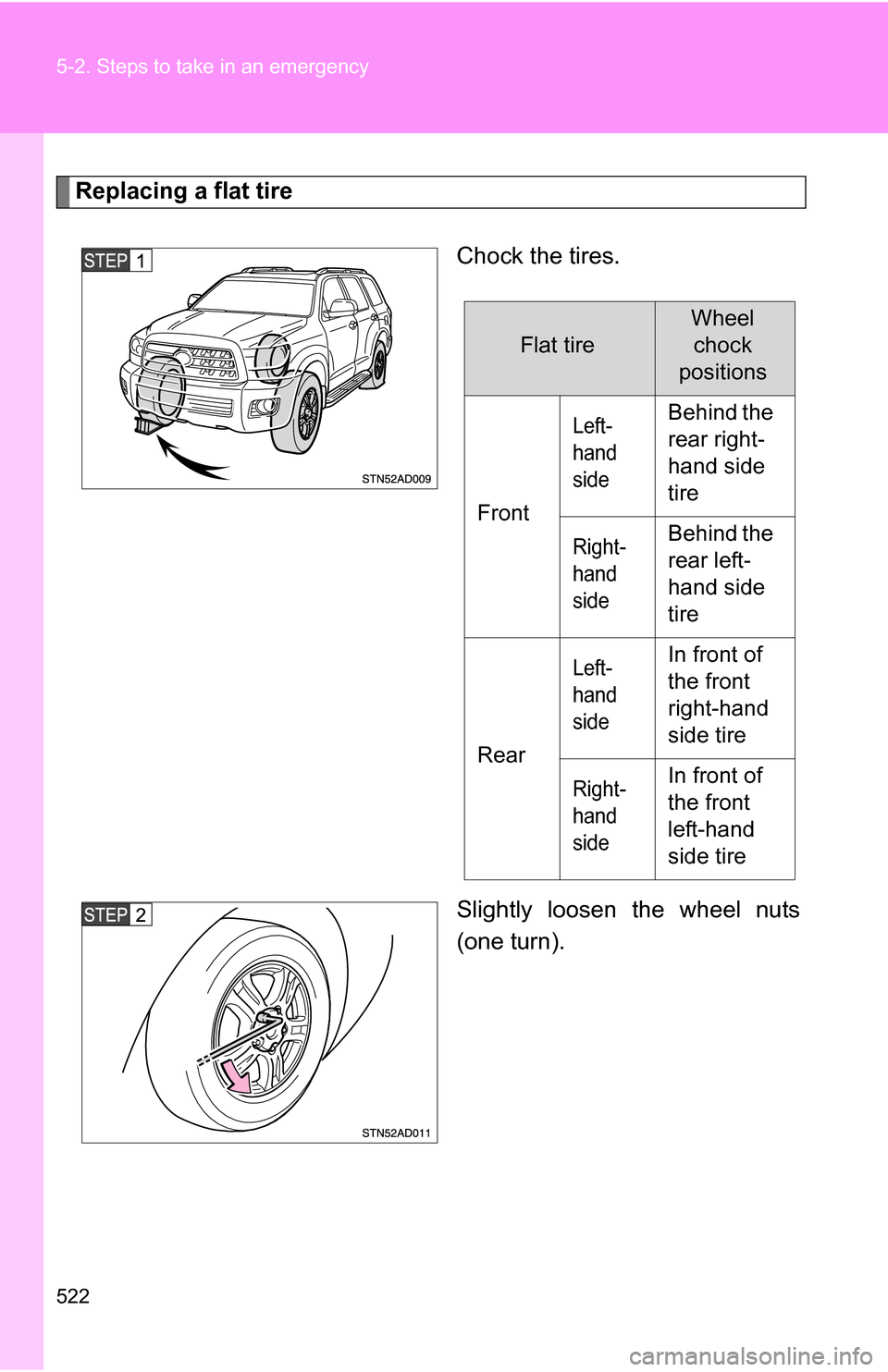
Replacing a flat tireChock the tires.
Slightly loosen the wheel nuts
(one turn).
Flat tire
Wheelchock
positions
Front
Left-
hand
sideBehind the
rear right-
hand side
tire
Right-
hand
sideBehind the
rear left-
hand side
tire
Rear
Left-
hand
sideIn front of
the front
right-hand
side tire
Right-
hand
sideIn front of
the front
left-hand
side tire
Page 523 of 596
5
When trouble arises
523
5-2. Steps to take in an emergency
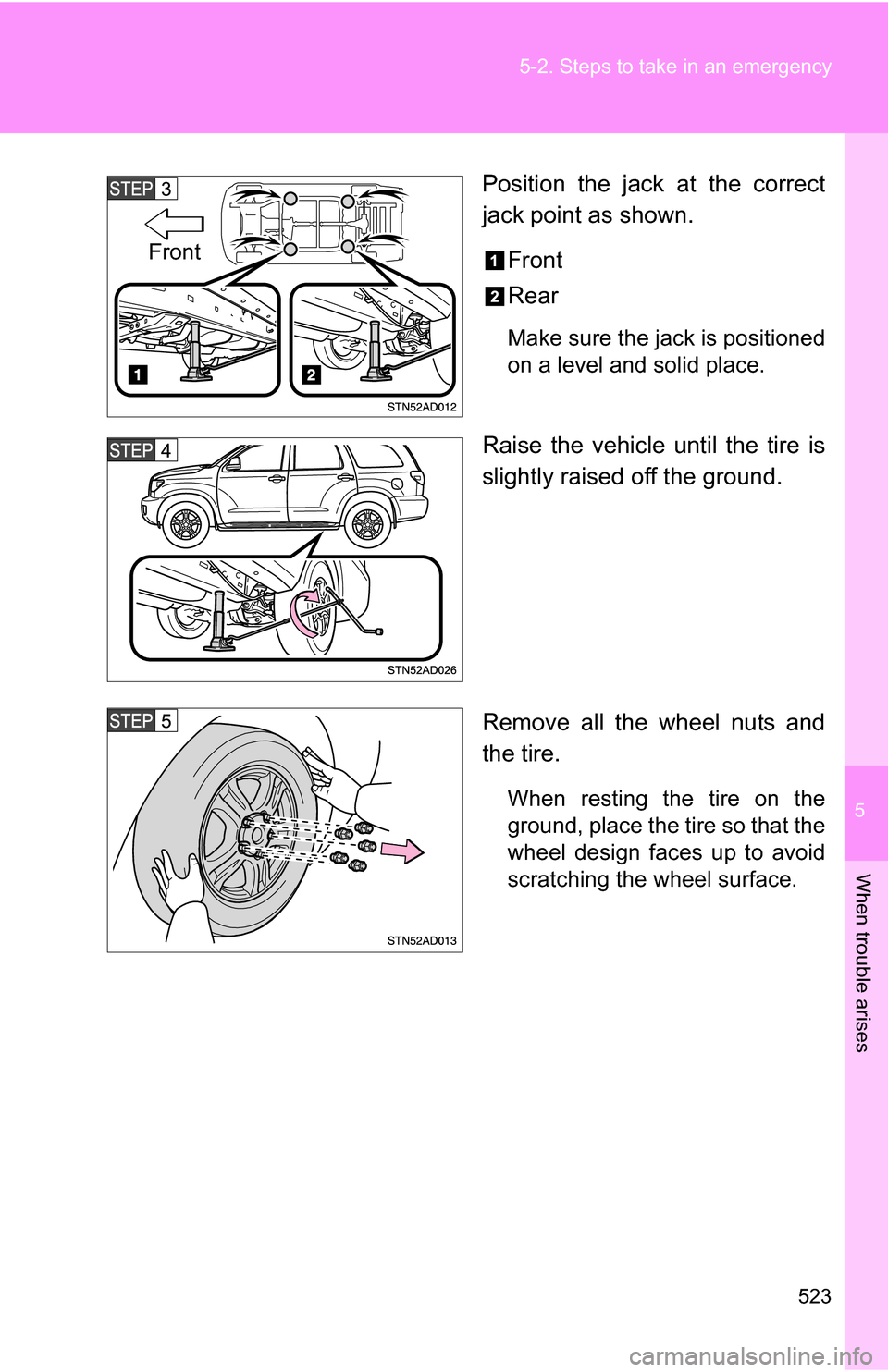
Position the jack at the correct
jack point as shown.
Front
Rear
Make sure the jack is positioned
on a level and solid place.
Raise the vehicle until the tire is
slightly raised off the ground.
Remove all the wheel nuts and
the tire.
When resting the tire on the
ground, place the tire so that the
wheel design faces up to avoid
scratching the wheel surface.
Front
Page 525 of 596
5
When trouble arises
525
5-2. Steps to take in an emergency
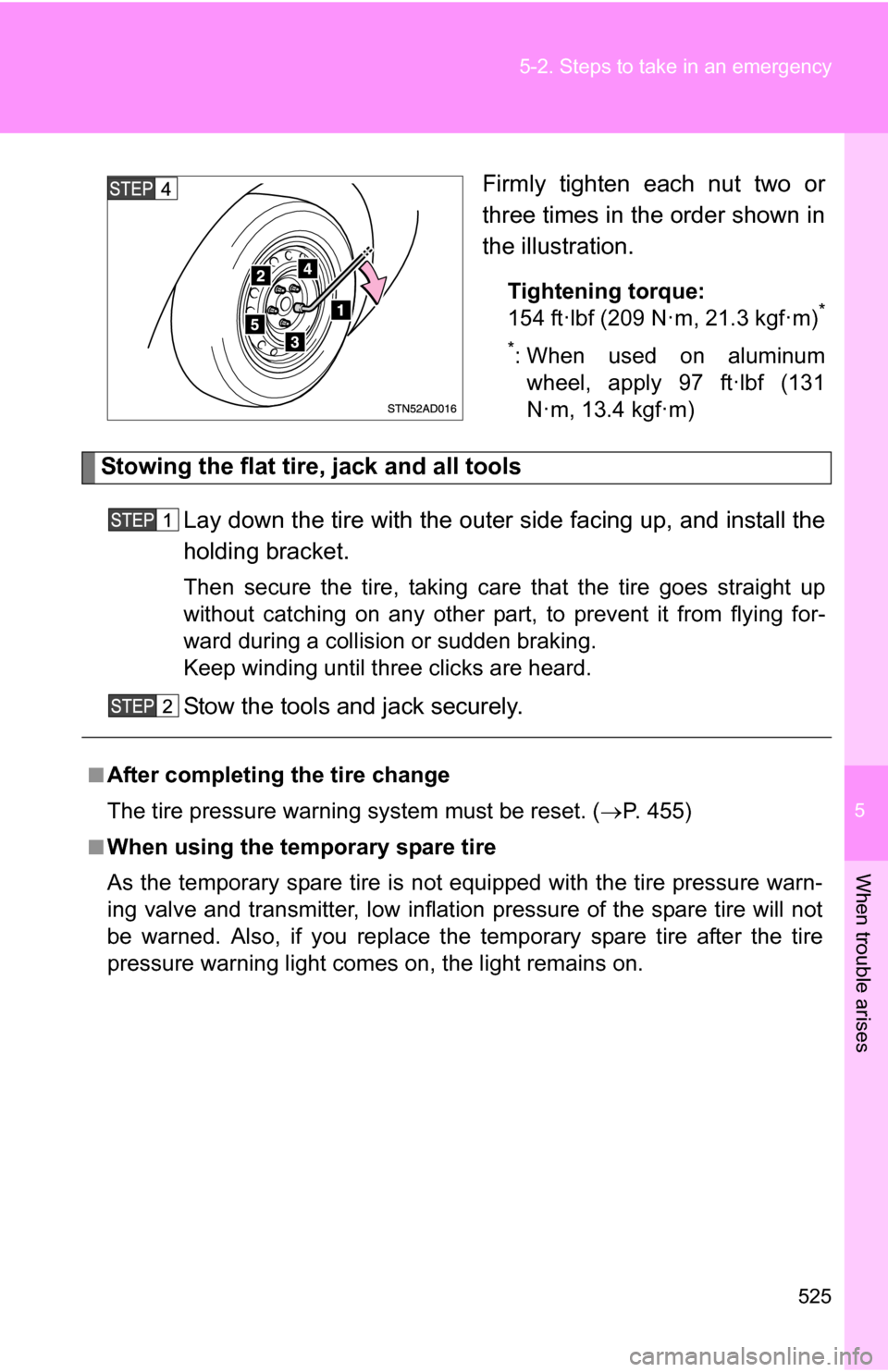
Firmly tighten each nut two or
three times in the order shown in
the illustration.
Tightening torque:
154 ft·lbf (209 N·m, 21.3 kgf·m)*
*
: When used on aluminum wheel, apply 97 ft·lbf (131
N·m, 13.4 kgf·m)
Stowing the flat tire, jack and all tools
Lay down the tire with the outer side facing up, and install the
holding bracket.
Then secure the tire, taking care that the tire goes straight up
without catching on any other part, to prevent it from flying for-
ward during a collision or sudden braking.
Keep winding until three clicks are heard.
Stow the tools and jack securely.
■After completing the tire change
The tire pressure warning system must be reset. (P. 455)
■When using the temporary spare tire
As the temporary spare tire is not equipped with the tire pressure warn-
ing valve and transmitter, low inflation pressure of the spare tire will not
be warned. Also, if you replace the temporary spare tire after the tire
pressure warning light comes on, the light remains on.
Page 529 of 596

5
When trouble arises
529
5-2. Steps to take in an emergency
If the engine will not star t
If the engine still does not start after following the correct starting
procedure ( P. 145) or releasing the steering lock (P. 146), confirm
the following points.
■ The engine will not start even when the starter motor oper-
ates normally.
One of the following may be the cause of the problem.
●There may not be sufficient fuel in the vehicle’s tank.
Refuel the vehicle.
● The engine may be flooded.
Try to restart the engine once more following correct starting
procedures.
● There may be a malfunction in the engine immobilizer system.
( P. 9 6 )
■ The starter motor turns over slowly, the interior lights and
headlights are dim, or the horn does not sound or sounds at
a low volume.
One of the following may be the cause of the problem.
●The battery may be discharged. ( P. 532)
● The battery terminal connec tions may be loose or corroded.
■ The starter motor does not turn over, the interior lights and
headlights do not turn on, or the horn does not sound.
One of the following may be the cause of the problem.
● One or both of the battery terminals may be disconnected.
● The battery may be discharged. ( P. 532)
Contact your Toyota dealer if the problem cannot be repaired, or if
repair procedures are unknown.
Page 534 of 596

534 5-2. Steps to take in an emergency
■Avoiding a discharged battery
●Turn off the headlights and the audio system while the engine is turned
off.
● Turn off any unnecessary electrical components when the vehicle is run-
ning at a low speed for an extended period, such as in heavy traffic, etc.
CAUTION
■Avoiding battery fires or explosions
Observe the following precautions to prevent accidentally igniting the flam-
mable gas that may be emitted from the battery.
●Make sure the jumper cable is connected to the correct terminal and that it
is not unintentionally in contact with any part other than the intended termi-
nal.
● Do not allow the jumper cables to come into contact with the “+” and “-” ter-
minals.
● Do not smoke, use matches, cigarette lighters or allow open flame near
the battery.
Start the engine of the second vehicle. Increase the engine
speed slightly and maintain at that level for approximately 5
minutes to recharge the battery of your vehicle.
Maintain the engine speed of the second vehicle and start
the vehicle's engine.
Once the vehicle’s engine has started, remove the jumper
cables in the exact reverse order in which they were con-
nected.
If removed, replace all the battery vent plugs.
Once the engine starts, have the vehicle checked at your Toyota
dealer as soon as possible.