Page 106 of 512
106 1-8. Safety information
PRIUS_U_(L/O_0802)
CAUTION
■Front passenger occupant cl assification system precautions
● When it is unavoidable to install the forward-facing child restraint system
on the front passenger seat, install the child restraint system on the front
passenger seat in the proper order. ( P. 110)
● Do not modify or remove the front seats.
● Do not kick the front passenger seat or subject it to severe impact. Other-
wise, the SRS warning light may come on to indicate a malfunction on the
detection system. In this case, contact your Toyota dealer immediately.
● Child restraint systems installed on the rear seat should not contact the
front seatbacks.
● Do not use a seat accessory, such as a cushion or seat cover, that covers
the seat cushion surface.
● Do not modify or replace the upholstery of the front seat.
Page 110 of 512
110
1-8. Safety information
PRIUS_U_(L/O_0802)
Installing child restraints
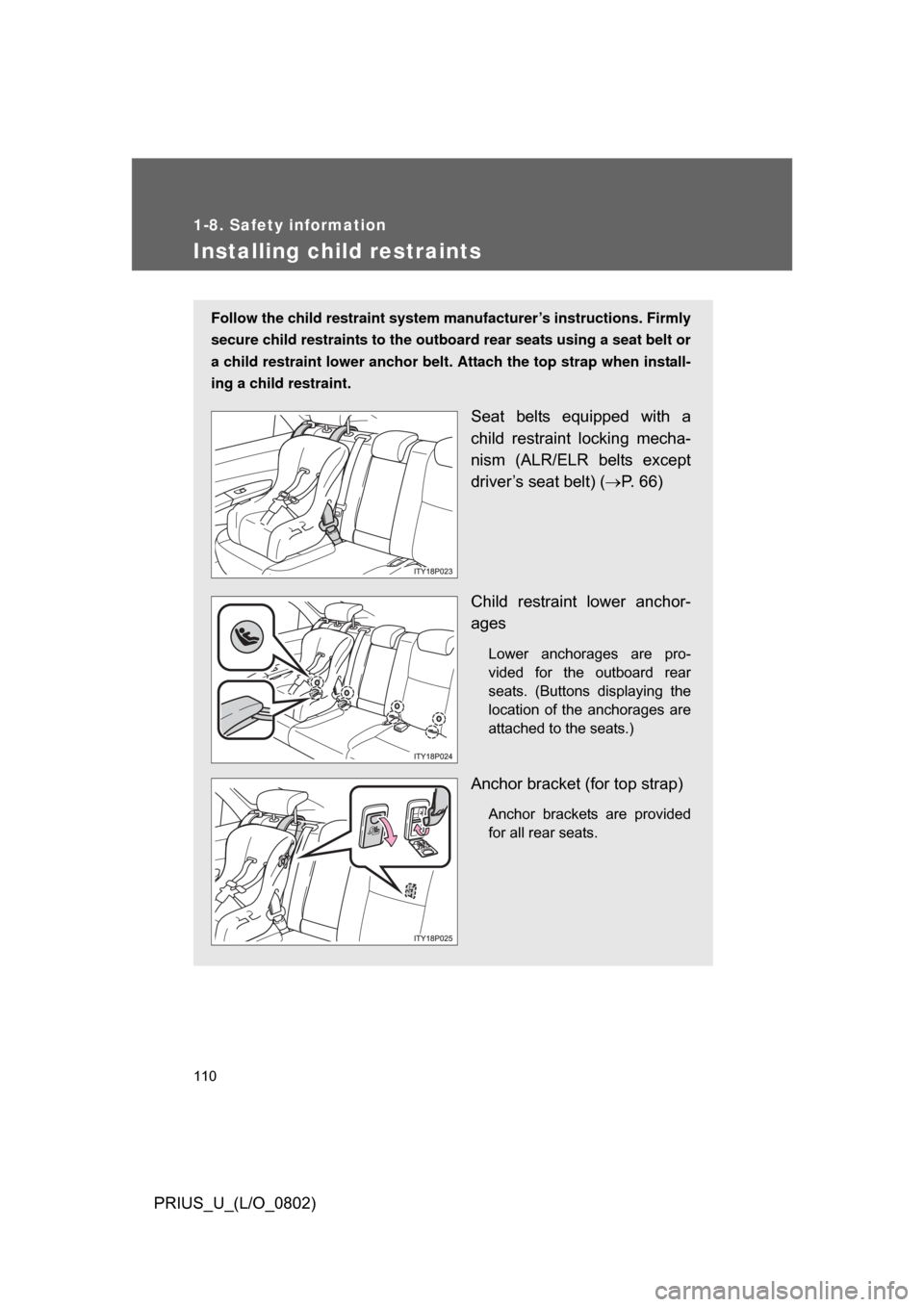
Follow the child restraint system manufacturer’s instructions. Firmly
secure child restraints to the outb oard rear seats using a seat belt or
a child restraint lower anchor belt. Attach the top strap when install-
ing a child restraint.
Seat belts equipped with a
child restraint locking mecha-
nism (ALR/ELR belts except
driver’s seat belt) ( P. 66)
Child restraint lower anchor-
ages
Lower anchorages are pro-
vided for the outboard rear
seats. (Buttons displaying the
location of the anchorages are
attached to the seats.)
Anchor bracket (for top strap)
Anchor brackets are provided
for all rear seats.
Page 202 of 512
202 3-2. Using the air conditioning system and defogger
PRIUS_U_(L/O_0802)
Using the automatic mode
Press . indicator located in the instrument panel.
The air conditioning system will begin to operate. Air outlets
and fan, and automatically sw itches between outside air and
recirculated air modes are automatically adjusted according to
the temperature setting.
Press to increase the temperature and to decrease the
temperature.
The temperature for the driver and passenger seats can be set sep-
arately.
Adjusting the settings
■ Adjusting the temperature setting
Press to increase the temperature and to decrease the temper-
ature.
STEP1
STEP3STEP2
Page 209 of 512
209
3-2. Using the air conditioning system
and defogger
3
Interior features
PRIUS_U_(L/O_0802)
Using the automatic mode
Press . indicator located in the instrument panel.
The air conditioning system will begin to operate. Air outlets
and fan, and automatically switches between outside air and
recirculated air modes are autom atically adjusted according to
the temperature setting.
Press to increase the temperature and to decrease the
temperature.
The temperature for the driver and passenger seats can be set sep-
arately.
Adjusting the settings
■ Adjusting the temperature setting
Press to increase the temperature and to decrease the temper-
ature.
STEP1
STEP2
Page 350 of 512

350 4-1. Maintenance and care
PRIUS_U_(L/O_0802)
NOTICE
■Cleaning detergents
Do not use the following types of detergent, as they may discolor the vehicle
interior or cause streaks or damage to painted surfaces.
● Non-seat portions: Organic substances such as benzine or gasoline, alka-
line or acidic solutions, dye, or bleach.
● Seats: Acidic solutions, such as thinner, benzine, or alcohol.
■ Preventing damage to leather surfaces
Observe the following precautions to avoid damage to and deterioration of
leather surfaces.
● Remove any dust or dirt on leather surfaces immediately.
● Do not expose the vehicle to direct sunlight for extended periods of time.
Park the vehicle in the shade, especially during summer.
● Do not place items made of vinyl, plastic, or that contain wax on the uphol-
stery, as they may stick to the leather surface if the vehicle interior heats
up significantly.
■ Water on the floor
Do not wash the vehicle floor with water.
Vehicle systems such as the audio system may be damaged if water comes
into contact with electrical components under the floor of the vehicle, and
may also cause the body to rust.
■ Cleaning the inside of the rear window
Be careful not to scratch or damage the heater wires or antenna.
Page 354 of 512
354 4-2. Maintenance
PRIUS_U_(L/O_0802)
Vehicle interior
ItemsCheck points
Accelerator pedal • Moves smoothly (without uneven pedal
effort or catching)?
Automatic transmission
“Park” mechanism • Can the vehicle be hold securely on an
incline with the shift lever in “P”?
Brake pedal • Moves smoothly?
• Does it have appropriate clearance and
correct amount of free play?
Brakes • Pulls to one side when applied?
• Loss of brake effectiveness?
• Spongy feeling brake pedal?
• Pedal almost touches floor?
Head restraints • Move smoothly and lock securely?
Indicators/buzzers • Function properly?
Lights • Do all the lights come on?
Parking brake • Moves smoothly?
• Can hold the vehicle securely on an
incline?
Seat belts • Does the seat belt system operate
smoothly?
• Are the belts undamaged?
Seats • Do the seat controls operate properly?
Steering wheel • Moves smoothly?
• Has correct free play?
• No strange noises?
Page 481 of 512
481
6-1. Specifications
6
Vehicle specifications
PRIUS_U_(L/O_0802)
Warning: The temperature grades for this tire are established for a
tire that is properly inflated and not overloaded.
Excessive speed, underinflation, or
excessive loading, either sepa-
rately or in combination, can caus e heat buildup and possible tire fail-
ure.
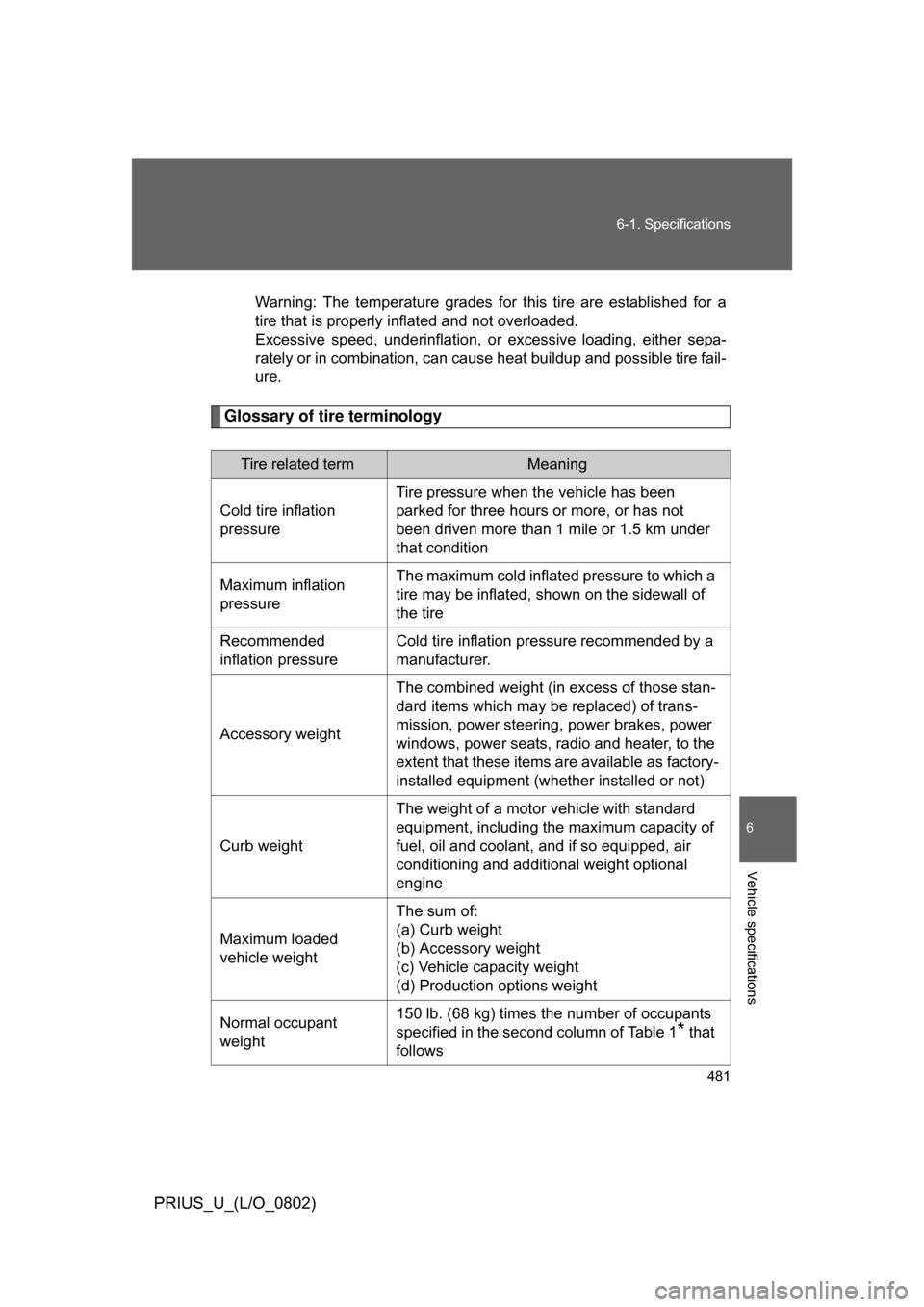
Glossary of tire terminology
Tire related termMeaning
Cold tire inflation
pressure Tire pressure when the vehicle has been
parked for three hours or more, or has not
been driven more than 1 mile or 1.5 km under
that condition
Maximum inflation
pressure The maximum cold inflated
pressure to which a
tire may be inflated, s hown on the sidewall of
the tire
Recommended
inflation pressure Cold tire inflation pressure recommended by a
manufacturer.
Accessory weight The combined weight (in excess of those stan-
dard items which may be replaced) of trans-
mission, power steering, power brakes, power
windows, power seats, radio and heater, to the
extent that these items
are available as factory-
installed equipment (whether installed or not)
Curb weight The weight of a motor vehicle with standard
equipment, including the maximum capacity of
fuel, oil and coolant, and if so equipped, air
conditioning and additional weight optional
engine
Maximum loaded
vehicle weight The sum of:
(a) Curb weight
(b) Accessory weight
(c) Vehicle capacity weight
(d) Production options weight
Normal occupant
weight 150 lb. (68 kg) times the number of occupants
specified in the second column of Table 1
* that
follows
Page 502 of 512

502 Alphabetical index
PRIUS_U_(L/O_0802)
Engine compartment cover..... 365
Engine/power control unit coolant
Capacity ................................467
Checking ............................... 371
Preparing and checking before winter ....................... 177
Engine oil Capacity ................................466
Checking ............................... 365
Preparing and checking before winter ....................... 177
Engine oil maintenance data ......................................... 369
Event data recorder .................424
Floor mats.................................335
Fluid
Brake .....................................373
Washer .................................. 378
Fog lights
Switch.................................... 156
Wattage .................................471
Front passenger occupant
classification system ............101
Front passenger’s seat belt reminder light.........................429
Front seats Adjustment .............................. 57
Front turn signal lights
Wattage .................................471
Fuel Capacity ................................464
Fuel gauge ............................ 143
Gas station information .........512
Information ............................ 472
Refueling ................................. 78
Type ......................................472
Fuel door.....................................78
Fuel filler door ............................ 78
Fuses......................................... 398 Garage door opener ................ 339
Gas station information .......... 512
Gauges...................................... 143
Glove box ................................. 323
Hands-free system
(for cellular phone) ................ 272
Head restraints........................... 62
Headlights
Discharge headlights precautions ......................... 414
Replacing light bulbs ............. 407
Switch ................................... 150
Wattage................................. 471
Heaters Side mirror ............................ 217
Hood.......................................... 361
Hooks
Cargo .................................... 336
Hybrid system Emergency shut off system..... 27
Energy monitor /
consumption screen ............. 27
High-voltage components ....... 26
Power switch ......................... 130
Illuminated entry system......... 318
Immobilizer system ................... 81
I/M test ...................................... 356
Identification Engine ................................... 463
Vehicle .................................. 463
Ignition switch.......................... 130
Indicator lights ......................... 146
Initialization Items to initialize ................... 491
Inside rear view mirror .............. 71
Instrument panel light control .................................... 144
F
G
H
I