Page 373 of 531
378 4−3. Do−it−yourself maintenance
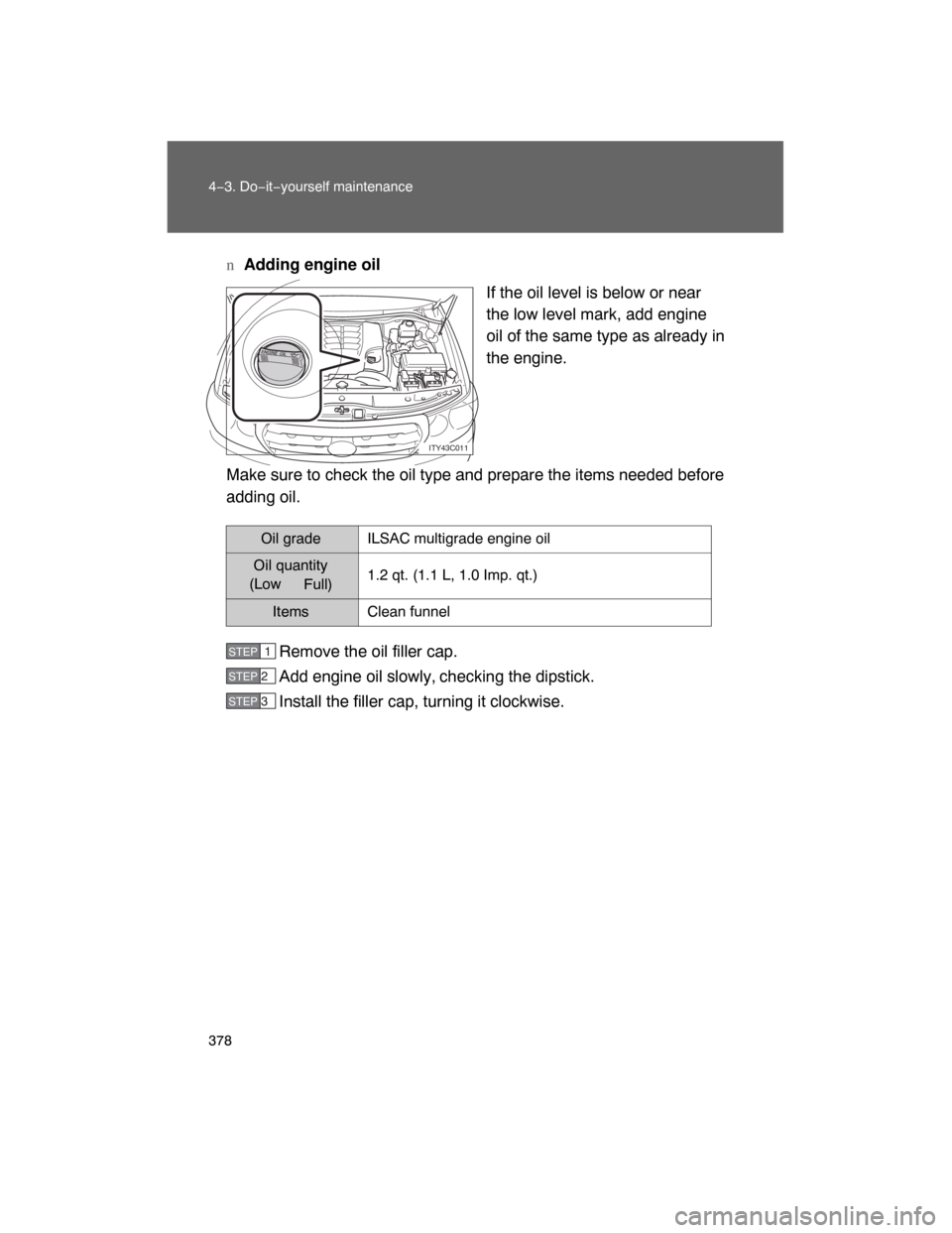
nAdding engine oil
If the oil level is below or near
the low level mark, add engine
oil of the same type as already in
the engine.
Make sure to check the oil type and prepare the items needed before
adding oil.
Remove the oil filler cap.
Add engine oil slowly,
checking the dipstick.
Install the filler cap, turning it clockwise.
ITY43C011
Oil gradeILSAC multigrade engine oil
Oil quantity
(Low
Full)
1.2 qt. (1.1 L, 1.0 Imp. qt.)
Items
Clean funnel
STEP1
STEP 2
STEP 3
Page 374 of 531
379
4−3. Do−it−yourself maintenance
4
Maintenance and care
nRecommended viscosity
SAE 5W−20 or 0W−2 0 engine oil
may be used. However, SAE
0W−20 is the best choice for
good fuel economy and good
starting in cold weather.
nHow to read oil container labels
The ILSAC (International Lubricant Standardization and Approval
Committee) Certification Mark is added to some oil containers to
help you select the
oil you should use.
Outside temperature
Page 375 of 531
380 4−3. Do−it−yourself maintenance
nEngine oil consumption
lThe amount of engine oil consumed depends on the oil viscosity, the
quality of the oil and the way the vehicle is driven.
lMore oil is consumed under driving conditions such as high speeds and
frequent acceleration and deceleration.
lA new engine consumes more oil.
lWhen judging the amount of oil consumption, keep in mind that the oil
may have become diluted, making it difficult to judge the true level accu−
rately.
nResetting the engine oil maintenance data
The oil change system should be reset. Perform the following procedures:
Switch the display to the trip meter A when the engine is running.
( P. 161)
Turn the “ENGINE START STOP” switch OFF.
While pressing the trip meter reset button, set the “ENGINE START
STOP” switch to IGNITION ON mode (but do not start the engine
because otherwise the reset mode will be cancelled). Continue to
press and hold the button until the multi−information display indi−
cates that the reset is complete.
STEP1
STEP 2
STEP 3
Page 376 of 531

381
4−3. Do−it−yourself maintenance
4
Maintenance and care
CAUTION
nUsed engine oil
lUsed engine oil contains potentially harmful contaminants which may
cause skin disorders such as inflammation or skin cancer, so care should
be taken to avoid prolonged and repeated contact. To remove used engine
oil from your skin, wash thoroughly with soap and water.
lDispose of used oil and filters only in a safe and acceptable manner. Do
not dispose of used oil and filters in household trash, in sewers or onto the
ground.
Call your Toyota dealer, service station or auto parts store for information
concerning recycling or disposal.
lDo not leave used engine oil within the reach of children.
NOTICE
nTo prevent serious engine damage
Check the oil level on regular basis.
nWhen replacing the engine oil
lBe careful not to spill engine oil on the vehicle components.
lAvoid overfilling, or the engine could be damaged.
lCheck the oil level on the dipstick every time you refill the vehicle.
l
Be sure the engine oil filler cap is properly retightened.
Page 384 of 531

389
4−3. Do−it−yourself maintenance
4
Maintenance and care
CAUTION
nChemicals in the battery
A battery contains poisonous and corrosive sulfuric acid and may produce
hydrogen gas which is flammable and explosive. To reduce the risk of death
or serious injury, take the following precautions while working on or near bat−
tery:
lDo not cause sparks by touching the battery terminals with tools.
lDo not smoke or light a match near the battery.
lAvoid contact with eyes, skin and clothes.
lNever inhale or swallow electrolyte.
lWear protective safety glasses when working near the battery.
lKeep children away from the battery.
nWhere to safety charge the battery
Always charge the battery in an open area. Do not charge the battery in a
garage or closed room where there is not sufficient ventilation.
nHow to recharge the battery
Only perform a slow charge (5A or less). The battery may explode if charged
at a quicker rate.
nEmergency measures regarding electrolyte
lIf electrolyte gets in your eyes
Flush your eyes with clean water for at least 15 minutes and get immedi−
ate medical attention. If possible, continue to apply water with a sponge or
cloth while traveling to the nearest medical facility.
lIf electrolyte gets on your skin
Wash the affected area thoroughly. If you feel pain or a burning sensation,
seek medical attention immediately.
lIf electrolyte gets on your clothes
It can soak through clothing on to your skin. Immediately take off the cloth−
ing and follow the procedure above if necessary.
l
If you accidentally swallow electrolyte
Drink a large quantity of water or milk. Follow with milk of magnesia,
beaten raw egg or vegetable oil. Get emergency medical attention immedi−
ately.
Page 439 of 531

5
When trouble arises
445
5−1. Essential information
If you think something is wrong
If you notice any of the followin g symptoms, your vehicle probably
needs adjustment or repair. Contact your Toyota dealer as soon as
possible.
nVisible symptoms
lFluid leaks under the vehicle
(Water dripping from the air cond
itioning after use is normal.)
lFlat−looking tires or uneven tire wear
lEngine coolant temperature g auge needle continually points
higher than normal
lEngine oil pressure gauge continually points lower than nor−
mal
lVoltmeter continually points higher or lower than normal
n
Audible symptoms
l
Changes in exhaust sound
lExcessive tire squeal when cornering
l
Strange noises related to the suspension system
l
Pinging or other noises related to the engine
nOperational symptoms
l
Engine missing, stumbling or running rough
l
Appreciable loss of power
lVehicle pulls heavily to one side when braking
l
Vehicle pulls heavily to one side when driving on a level road
l
Loss of brake effectiveness, s pongy feeling, pedal almost
touches the floor
Page 448 of 531

454 5−2. Steps to take in an emergency
nIf the malfunction indicator lamp comes on while driving
The malfunction indicator lamp will come on if the fuel tank becomes com−
pletely empty. If the fuel tank is empty, refuel the vehicle immediately. The
malfunction indicator lamp will go off after several trips.
If the malfunction indicator lamp does not go off, contact your Toyota dealer
as soon as possible.
nFront passenger detection sensor and passenger seat belt reminder
lIf luggage is placed on the front passenger seat, the front passenger
detection sensor may cause the warning light to flash, even if a passen−
ger is not sitting in the seat.
lIf a cushion is placed on the seat, the sensor may not detect a passen−
ger, and the warning light may not operate properly.
nSRS warning light
This warning light system monitors the following:
lThe airbag sensor assembly
lFront airbag sensors
lThe curtain shield airbag sensors
lThe side and curtain shield airbag sensors
lThe seat belt buckle switches
lThe driver ’s seat position sensor
lThe inflators
lThe interconnecting wiring and power sources
lThe front passenger occupant classification ECU
l“AIR BAG ON” and “AIR BAG OFF” indicator lights
lThe seatbelt pretensioners
lThe roll sensing of curtain shield airbags off indicator light
nChanging the engine oil
l
Make sure to reset oil change system
Page 456 of 531
462 5−2. Steps to take in an emergency
nResetting the tire pressure warning data
After adjusting the tire inflation pressure, be sure to initialize the data.
(P. 393)
If the message remains on, the system may have malfunctioned. Have the
vehicle inspected by your Toyota dealer as soon as possible.
nWarning messages in the cruise control mode
In the following instances, there is a possibility that the approach warning will
not illuminate even when vehicle−to−vehicle distance is closing.
lWhen the speed of the vehicle ahead matches or exceeds your vehicle’s
speed.
lWhen the vehicle ahead is traveling at an extremely slow speed.
lImmediately after the cruise control speed has been set.
l
At the instant the accelerator is applied.
NOTICE
nEngine oil maintenance message
The warning message is based on the projected driving range after engine
oil maintenance message is reset.
The system does not monitor the purity of the engine oil.