Page 172 of 531
174 2−3. Operating the lights and wipers
nThe windshield wiper and washer can be operated when
The “ENGINE START STOP” switch is in IGNITION ON mode.
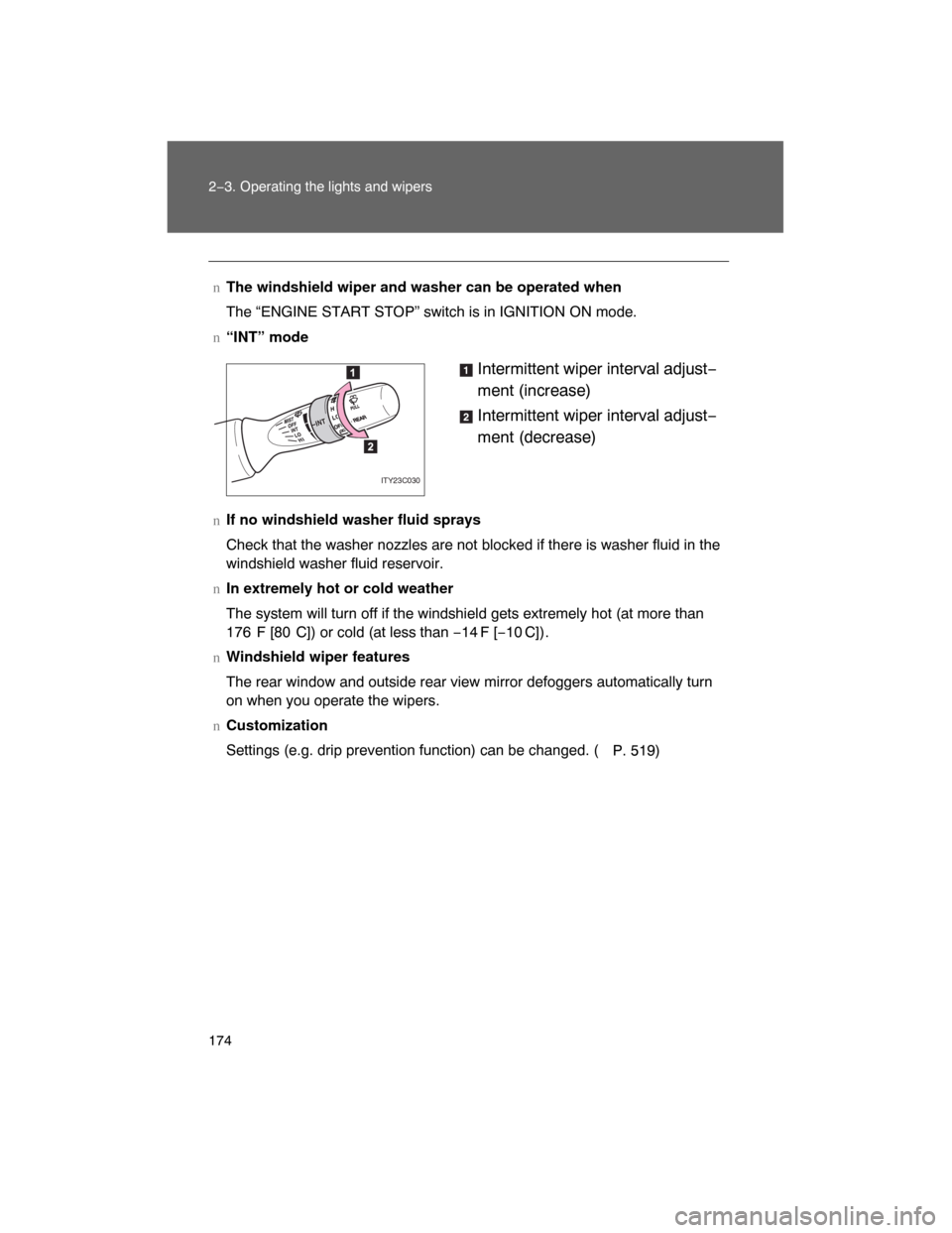
n“INT” mode
nIf no windshield washer fluid sprays
Check that the washer nozzles are not blocked if there is washer fluid in the
windshield washer fluid reservoir.
nIn extremely hot or cold weather
The system will turn off if the windshield gets extremely hot (at more than
176 F [80 C]) or cold (at less than −14 F [−10 C]).
nWindshield wiper features
The rear window and outside rear view mirror defoggers automatically turn
on when you operate the wipers.
nCustomization
Settings (e.g. drip prevention function) can be changed. (
P. 519)
Intermittent wiper interval adjust−
ment (increase)
Intermittent wiper interval adjust−
ment (decrease)
ITY23C030
Page 234 of 531

236 2−5. Driving information
nBefore towing
Check that the following conditions are met:
lThe vehicle’s tires are properly inflated.
lTrailer tires are inflated according to the trailer manufacturer ’s recom−
mendation.
lAll trailer lights work.
lAll lights work each time you connect them.
lThe trailer ball is set up at the proper height for the coupler on the trailer.
lThe vehicle remains level when a loaded or unloaded trailer is hitched.
Do not drive if the vehicle is not level, and check for improper tongue
load, overloading, worn suspension, or other possible causes.
lThe trailer cargo is securely loaded.
lThe rear view mirrors conform to all applicable federal, state/provincial or
local regulations. If they do not, install rear view mirrors appropriate for
towing purposes.
nBreakin schedule
Toyota recommends that you do not use a new vehicle or a vehicle with any
new power train components (engine, transmission, differential, wheel bear−
ings, etc.) to tow a trailer for the first 500 miles (800 km) of driving.
nMaintenance
lIf you tow a trailer, your vehicle will require more frequent maintenance
due to the additional load. (See “Scheduled Maintenance Guide” or
“Owner ’s Manual Supplement”.)
lRetighten the fixing bolts of the towing ball after approximately 600 miles
(1000 km) of trailer towing.
Page 381 of 531
386 4−3. Do−it−yourself maintenance
Power steering fluid
nFluid level
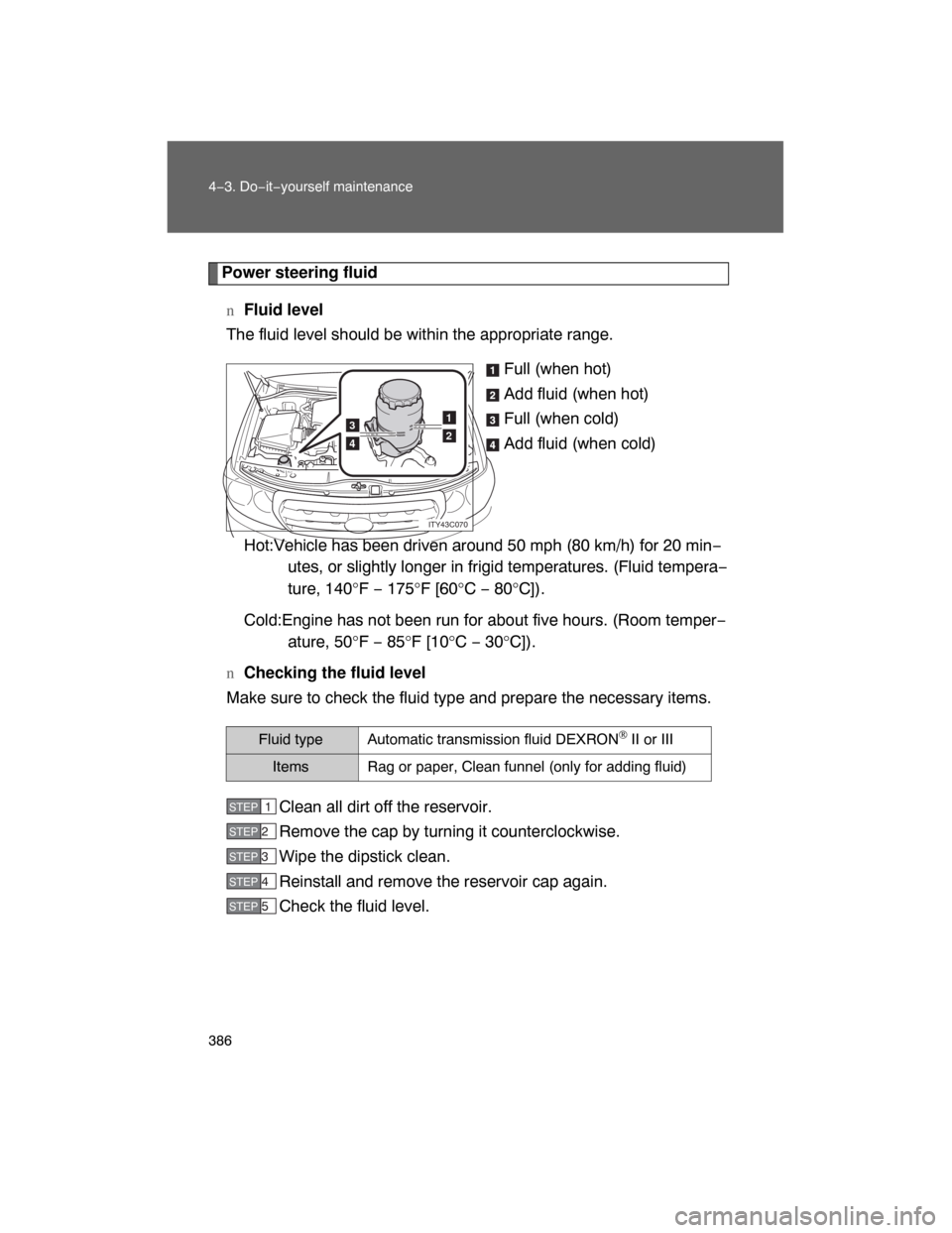
The fluid level should be within the appropriate range.
Full (when hot)
Add fluid (when hot)
Full (when cold)
Add fluid (when cold)
Hot:Vehicle has been driven around 50 mph (80 km/h) for 20 min−
utes, or slightly longer in frigid temperatures. (Fluid tempera−
ture, 140°F − 175°F [60°C − 80°C]).
Cold:Engine has not been run for about five hours. (Room temper−
ature, 50°F − 85°F [10°C − 30°C]).
n
Checking the fluid level
Make sure to check the fluid type and prepare the necessary items.
Clean all dirt off the reservoir.
Remove the cap by turning it counterclockwise.
Wipe the dipstick clean.
Reinstall and remove the reservoir cap again.
Check the fluid level.
1
23
4
ITY43C070
Fluid type Automatic transmission fluid DEXRON® II or III
Items
Rag or paper, Clean funnel (only for adding fluid)
STEP1
STEP 2
STEP 3
STEP 4
STEP 5
Page 383 of 531
388 4−3. Do−it−yourself maintenance
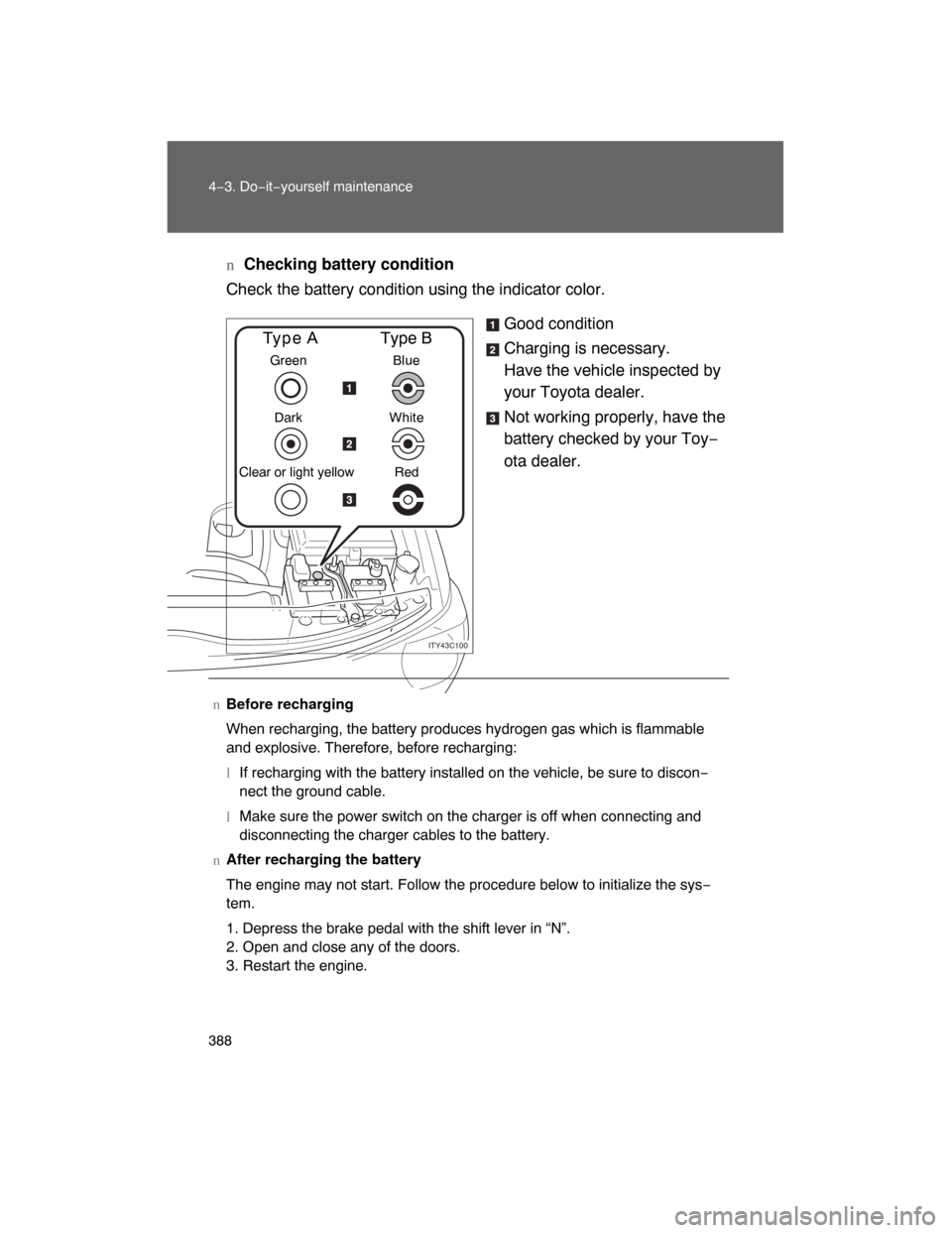
nChecking battery condition
Check the battery condition using the indicator color.
Good condition
Charging is necessary.
Have the vehicle inspected by
your Toyota dealer.
Not working properly, have the
battery checked by your Toy−
ota dealer.
ITY43C100
Green
Dark
Clear or light yellow
Type A
Blue
White
Red
Type B
nBefore recharging
When recharging, the battery produces hydrogen gas which is flammable
and explosive. Therefore, before recharging:
lIf recharging with the battery installed on the vehicle, be sure to discon−
nect the ground cable.
lMake sure the power switch on the charger is off when connecting and
disconnecting the charger cables to the battery.
nAfter recharging the battery
The engine may not start. Follow the procedure below to initialize the sys−
tem.
1. Depress the brake pedal with the shift lever in “N”.
2. Open and close any of the doors.
3. Restart the engine.
Page 450 of 531

456 5−2. Steps to take in an emergency
nIf the tire pressure warning system is inoperative
The tire pressure warning system
will become inoperati ve in the follow−
ing conditions:
(When the condition becomes normal, the system will work properly.)
lIf tires not equipped with tire pressure warning valves and transmit−
ters are used.
lIf the ID code on the tire pressure warning valves and transmitters is
not registered in the tire pressure warning computer.
lIf the tire inflation pressure is more than 73 psi (500 kPa, 5.1 kgf/cm2
or bar).
The tire pressure warning system may become inoperative in the follow−
ing conditions:
(When the condition becomes normal, the system will work properly.)
lIf electronic devices or facilities us ing similar radio wave frequencies
are nearby.
lIf a radio set at similar frequencies is in use in the vehicle.
lIf a window tint that affects the radio wave signals is installed.
lIf there is a lot of snow or ice on the vehicle, in particular around the
wheels or wheel housings.
lIf non−genuine Toyota wheels are used. (Even if you use Toyota
wheels, the tire pressu re warning system may not work properly with
some types of tires.)
lIf tire chains are used.
lIf the spare tire is in a location subject to poor radio wave signal
reception.
lIf a large metallic object which caninterfere with sign al reception is
put in the luggage compartment.
nIf the tire pressure warning light comes on after blinking for 1
minute frequently
If the tire pressure warning light comes on after blinking 1 minute fre−
quently when the “ENGINE START STOP” switch is turned to IGNITION
ON mode, have it checked by Toyota dealer.
Page 471 of 531

5
When trouble arises
477 5−2. Steps to take in an emergency
Emergency start function
When the engine does not start, the following steps can be used as
an interim measure to start the engine if the “ENGINE START STOP”
switch is functioning normally.
Set the parking brake.
Put the shift lever in “P”.
Set the “ENGINE START ST
OP” switch to ACCESSORY
mode.
Press and hold the “ENGINE START STOP” switch about 15
seconds while depressing the brake pedal firmly.
Even if the engine can be start
ed using the above st eps, the system
may be malfunctioning. Have the vehicle checked by your Toyota
dealer. nThe starter motor does not turn over, the interior lights and
headlights do not turn on, or the horn does not sound.
One of the following may be the cause of the problem.
l
One or both of the battery terminals may be disconnected.
l
The battery may be discharged. ( P. 484)
lThere may be a malfunction in the steering lock system.
Contact your Toyota dealer if the problem cannot be repaired, or if
repair procedures are unknown.
STEP1
STEP 2
STEP 3
STEP 4
Page 479 of 531
5
When trouble arises
485 5−2. Steps to take in an emergency
nAvoiding a discharged battery
lTurn off the headlights and the audio system while the engine is turned
off.
lTurn off any unnecessary electrical components when the vehicle is run−
ning at a low speed for an extended period, such as in heavy traffic, etc.
Open and close any of the doors with the “ENGINE START
STOP” switch off.
Maintain the engine speed of the second vehicle and start
your vehicle’s engine.
Once the vehicle’s engine has started, remove the jumper
cables in the exact reverse order in which they were con−
nected.
Once the engine starts, have the vehicle checked at your Toyota
dealer as soon as possible.
STEP3
STEP 4
STEP 5
Page 523 of 531

532
Alphabetical index
Doors
Back door ................................ 48
Side door ................................. 43
Side mirrors ............................. 80
Driver’s seat belt reminder
light ......................................... 452
Driving
Break−in tips .......................... 141
Correct posture ..................... 100
Off−road precautions ............. 209
Procedures ............................ 140
Winter driving tips.................. 222
Driving position memory........... 62
Electronic key
If your electronic key
battery is discharged... 410, 481
Emergency, in case of
If a warning message is
displayed............................. 460
If the electronic key does
not operate properly............ 481
If the engine will not start ...... 476
If the shift lever cannot be
shifted from P...................... 478
If the vehicle has discharged
battery ................................ 484
If the warning buzzer
sounds ................................ 449
If the warning light turns on ... 449
If you cannot operate back
door opener ........................ 480
If you have a flat tire ............. 463
If you lose your keys ............. 479
If you think something is
wrong .................................. 445
If your vehicle becomes
stuck ................................... 491
If your vehicle needs to be
towed .................................. 440
If your vehicle overheats ....... 488Engine
Compartment ........................ 375
Engine switch ........................ 149
Hood ..................................... 374
How to start the engine ......... 149
Identification number............. 495
If the engine will not start ...... 476
Ignition switch ....................... 149
Overheating .......................... 488
Engine coolant
Capacity ................................ 498
Checking ............................... 382
Preparing and checking
before winter ....................... 222
Engine coolant temperature
gauge ...................................... 160
Engine immobilizer system ...... 93
Engine oil
Capacity ................................ 497
Checking ............................... 377
Preparing and checking
before winter ....................... 222
Engine oil maintenance
data ......................................... 380
Engine switch........................... 149
Event data recorder ................. 447
Firstaid kit holder ................... 351
Floor mat .................................. 349
Fluid
Brake..................................... 384
Power steering ...................... 386
Washer.................................. 390
Fog lights
Replacing light bulbs ............. 426
Switch ................................... 172
Wattage................................. 503
Fourwheel drive system......... 190
Front fog lights
Replacing light bulbs ............. 426
Switch ................................... 172
E
F