Page 495 of 577

494 5-2. Steps to take in an emergency
*1: Open door warning buzzer:The open door warning buzzer sounds to alert one or more of the doors is
not fully closed (with the vehicle having reached a speed of 3 mph [5 km/h]).
*2: Driver's and front passenger’s seat belt reminders:
The driver’s and front passenger’s seat belt reminders sound to alert the
driver and front passenger that his or her seat belt is not fastened. These
buzzers sound for 10 seconds after the vehicle has reached a speed of at
least 12 mph (20 km/h). Then, if the seat belt is still unfastened, the buzzer
will sound in a different tone for 20 more seconds.
*3: Vehicles without navigation system
*4: Vehicles with navigation system
■ Key reminder buzzer (vehic les without smart key system)
The buzzer indicates that the key has not been removed with the engine off
and the driver’s door opened.
■ Open moon roof reminder buzzer (vehicles with mult i-information dis-
play)
The buzzer indicates that the moon roof is not fully closed with the engine off
and the driver’s door opened.
■ Front passenger detect ion sensor and passenger seat belt reminder
● If luggage is placed on the front passenger seat, the front passenger
detection sensor may cause the warning light to flash, even if a passen-
ger is not sitting in the seat.
● If a cushion is placed on the seat, the sensor may not detect a passen-
ger, and the warning light may not operate properly.
■ Engine oil replacement re minder light (U.S.A. vehicles without multi-
information display)
The engine oil replacement reminder light will come on and flash at approxi-
mately 4500 miles (7200 km) after an oil change. When the distance driven
after an oil change exceeds approximately 5000 miles (8000 km), the light
will come on and remain on.
■ Changing the engine oil (U.S.A. only)
Make sure to reset the oil change system. ( P. 424)
Page 502 of 577
5
When trouble arises
501
5-2. Steps to take in an emergency
Taking out the spare tire
Open the center deck board and
remove the cover.
Remove the cover.
If it is difficult to remove the
cover, you can use the key.
Attach the adapter socket (for
removing a spare tire) on the
spare tire clamp bolt.
STEP1
STEP2
STEP3
Page 511 of 577

510
5-2. Steps to take in an emergency
If the engine will not star t
If the engine still does not start after following the correct starting
procedure (P. 164, 168) or releasing the steering lock ( P. 166,
169), confirm the fo llowing points.
■The engine will not start even when the starter motor oper-
ates normally.
One of the following may be the cause of the problem.
●There may not be sufficient fuel in the vehicle’s tank.
Refuel the vehicle.
● The engine may be flooded.
Try to restart the engine once more following correct starting
procedures. ( P. 164, 168)
● There may be a malfunction in the engine immobilizer system.
( P. 1 1 0 )
■ The starter motor turns over slowly, the interior lights and
headlights are dim, or the horn does not sound or sounds at
a low volume.
One of the following may be the cause of the problem.
●The battery may be discharged. ( P. 516)
● The battery terminal connec tions may be loose or corroded.
■ The starter motor does not turn over (vehicles with smart
key system).
The engine starting system may be malfunctioning due to an
electrical problem such as an open circuit or a blown fuse. How-
ever, an interim measure is available to start the engine.
( P. 511)
Page 512 of 577
5
When trouble arises
511
5-2. Steps to take in an emergency
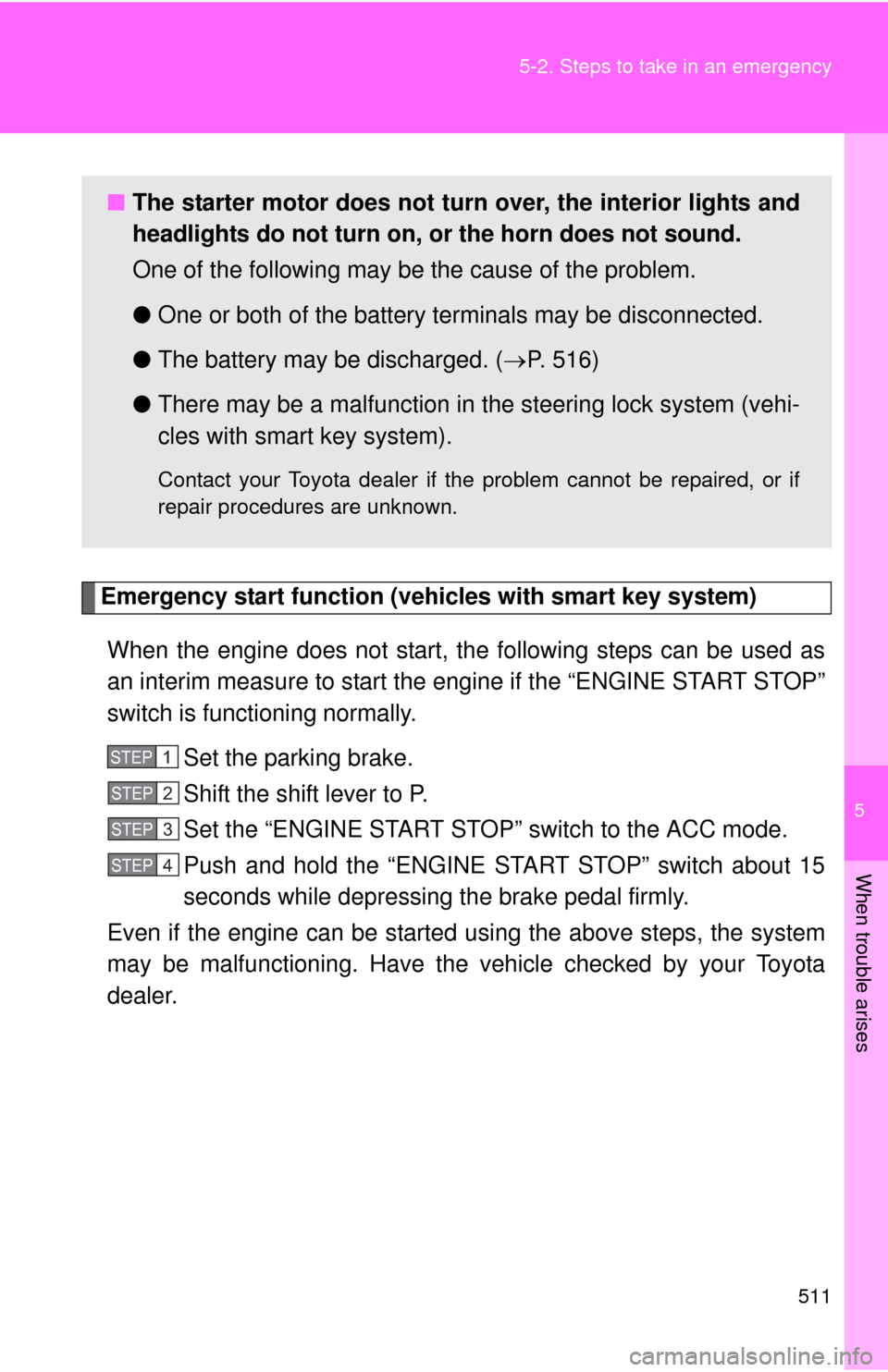
Emergency start function (vehicles with smart key system)
When the engine does not start, the following steps can be used as
an interim measure to start the engine if the “ENGINE START STOP”
switch is functioning normally. Set the parking brake.
Shift the shift lever to P.
Set the “ENGINE START STOP” switch to the ACC mode.
Push and hold the “ENGINE START STOP” switch about 15
seconds while depressing the brake pedal firmly.
Even if the engine can be start ed using the above steps, the system
may be malfunctioning. Have the vehicle checked by your Toyota
dealer.
■ The starter motor does not turn over, the interior lights and
headlights do not turn on, or the horn does not sound.
One of the following may be the cause of the problem.
● One or both of the battery terminals may be disconnected.
● The battery may be discharged. ( P. 516)
● There may be a malfunction in the steering lock system (vehi-
cles with smart key system).
Contact your Toyota dealer if the problem cannot be repaired, or if
repair procedures are unknown.
STEP1
STEP2
STEP3
STEP4
Page 514 of 577
5
When trouble arises
513
5-2. Steps to take in an emergency
If you lose your keys/wireless remote control transmitter
■Keys
New genuine keys can be made by your Toyota dealer. For vehi-
cles with the smart key system, bring the other key and the key
number stamped on the key number plate. For vehicles without
the smart key system, bring a master key and the key number
stamped on the key number plate.
■ Wireless remote control transm itter (vehicles without smart
key system)
New genuine wireless remote control transmitters can be pur-
chased and programmed by your Toyota dealer. If a wireless
remote control transmitter has been lost, bring the other wireless
remote control transmitter when going to pick up the new trans-
mitter.
Page 515 of 577

514
5-2. Steps to take in an emergency
If the electronic key does not operate properly (vehicles with smart key system)
Locking and unlocking the doors, and mechanical key linked functions
Locks all doors
Unlocks all doors
Turning the key rearward unlocks
the driver’s door. Turning the key
once again unlocks the other
doors.
Changing “ENGINE START STOP” switch modes and starting the engine
Shift the shift lever to P and apply the brakes.
Touch the Toyota emblem side of
the electronic key to the
“ENGINE START STOP” switch.
An alarm will sound to indicate
that the start function cannot
detect the electronic key that is
touched to the “ENGINE START
STOP” switch if any of the doors
is opened and closed while the
key is touched to the switch.
If communication between the electronic key and vehicle is inter-
rupted (P. 37) or the electronic key cannot be used because the
battery is depleted, the smart key system and wireless remote con-
trol cannot be used. In such cases, the doors can be opened or the
engine can be started by following the procedure below.
STEP1
STEP2
Page 516 of 577
5
When trouble arises
515
5-2. Steps to take in an emergency
To change “ENGINE START STOP” switch modes: Within 5
seconds of the buzzer soundin
g, release the brake pedal and
press the “ENGINE START STOP” switch. Modes can be
changed each time the sw itch is pressed. (P. 164)
To start the engine: Press the “ENGINE START STOP” switch
within 5 seconds after the buzz er sounds, keeping the brake
pedal depressed.
In the event that the “ENGINE ST ART STOP” switch still cannot be
operated, contact your Toyota dealer.
■ Stopping the engine
Shift the shift lever to P and press the “ENGINE START STOP” switch as
you normally do when stopping the engine.
■ Replacing the key battery
As the above procedure is the temporary measure, it is recommended that
the electronic key battery be replaced immediately when the battery
depletes. ( P. 452)
STEP3
Page 518 of 577

5
When trouble arises
517
5-2. Steps to take in an emergency
■
Starting the engine when the battery is discharged
The engine cannot be started by push-starting.
■ Avoiding a discharged battery
●Turn off the headlights and the audio system while the engine is turned
off.
● Turn off any unnecessary electrical components when the vehicle is run-
ning at a low speed for an extended period, such as in heavy traffic, etc.
■ When the battery is removed or discharge
●The power back door must be initialized ( P. 71)
● The tire inflation pressure warning system must be initialized. ( P. 435)
Start the engine of the second vehicle. Increase the engine
speed slightly and maintain at that level for approximately 5
minutes to recharge the battery of your vehicle.
Vehicles with smart key system: Open and close any of the
doors with the “ENGINE START STOP” switch OFF.
Maintain the engine speed of the second vehicle and turn
the “ENGINE START STOP” switch or the engine switch to
ON, then start the vehicle's engine.
Once the vehicle’s engine has started, remove the jumper
cables in the exact reverse order in which they were con-
nected.
Once the engine starts, have the vehicle checked at your Toyota
dealer as soon as possible.STEP2
STEP3
STEP4
STEP5


