Page 32 of 580
32 1-1. Hybrid system
●To help prevent the 12-volt battery from becoming discharged, drive the
vehicle at least once a month, and operate the accessories only when
the “READY” indicator is on. When parking the vehicle, make sure the
doors is closed and all lights are turned off.
■ After the 12-volt battery has di scharged or has been changed or
removed
The gasoline engine may not stop even if the vehicle is running on the hybrid
battery (traction battery). If this continues for a few days, contact your Toyota
dealer.
■ Sounds and vibrations specific to a hybrid vehicle
There may be no engine sounds or vibration even though the vehicle is able
to move. Always put the shift lever in P when parked.
The following sounds or vibrations may occur when the hybrid system is
operating, and are not a malfunction:
●Motor sounds may be heard from the engine compartment.
● Sounds may be heard from the hybrid battery (traction battery) behind
the rear seat when the hybrid system starts or stops.
● Sounds may be heard from the transaxle when the hybrid system starts
or stops, or while the vehicle is idling.
● Engine sounds may be heard when accelerating sharply.
● Sounds may be heard from the regenerative brake when you press the
brake pedal.
● Vibration may be felt when the gasoline engine starts or stops.
● You may hear cooling fan sounds coming from the air intake vents below
the second seat.
■ Maintenance, repair, recycling, and disposal
Contact your Toyota dealer regarding maintenance, repair, recycling and
disposal. Do not dispose of the vehicle yourself.
Page 33 of 580
33
1-1. Hybrid system
1
Before driving
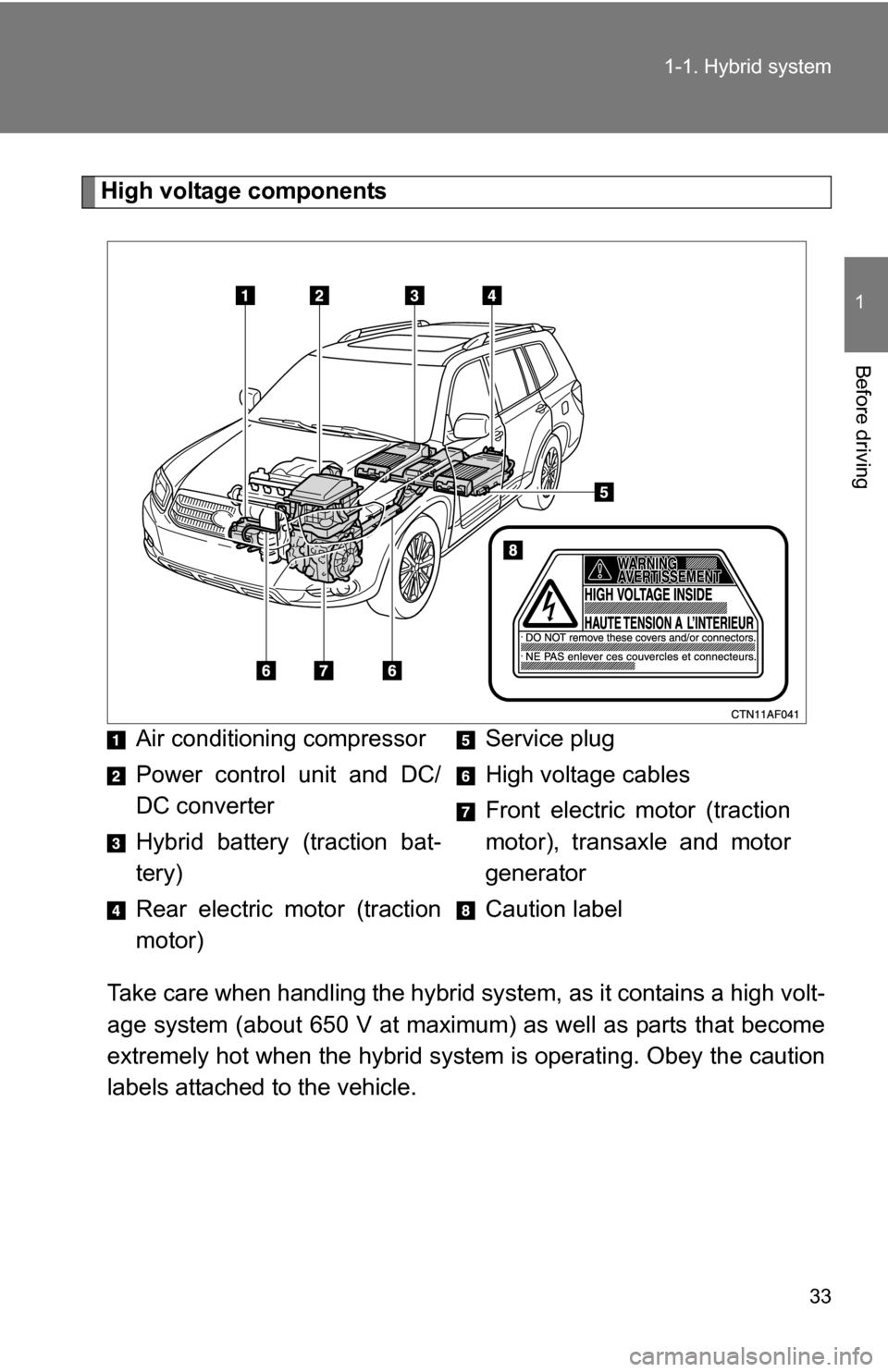
High voltage components
Take care when handling the hybrid sy stem, as it contains a high volt-
age system (about 650 V at maximum) as well as parts that become
extremely hot when the hybrid system is operating. Obey the caution
labels attached to the vehicle. Air conditioning compressor
Power control unit and DC/
DC converter
Hybrid battery (traction bat-
tery)
Rear electric motor (traction
motor)
Service plug
High voltage cables
Front electric motor (traction
motor), transaxle and motor
generator
Caution label
Page 173 of 580
173
2-1. Driving procedures
2
When driving
NOTICE
■
When encountering flooded roads
Do not drive on a road that has flooded after heavy rain etc. Doing so may
cause the following serious damage to the vehicle.
●Engine stalling
● Short in electrical components
● Engine damage caused by water immersion
In the event that you drive on a flooded road and the vehicle is flooded, be
sure to have your Toyota dealer check the following.
● Brake function
● Changes in quantity and quality of oil and fluid used for the engine, hybrid
transaxle, rear motor transaxle, etc.
● Lubricant condition for the bearings and suspension joints (where possi-
ble) and the function of all joints, bearings, etc.
Page 224 of 580
224 2-5. Driving information
NOTICE
■To prevent the water damage
Take all necessary safety measures to ensure that water damage to the
hybrid battery, hybrid system or other components does not occur.
●Water entering the engine compartment may cause severe damage to the
hybrid system. Water entering the interior may cause the hybrid battery
stowed under the rear seats to short circuit.
● Water entering the hybrid transaxle w ill cause deterioration in transmission
quality. The malfunction indicator may come on, and the vehicle may not
be drivable.
● Water can wash the grease from wheel bearings, causing rusting and pre-
mature failure, and may also enter the transaxle case, reducing the gear
oil’s lubricating qualities.
■ When you drive through water
If driving through water, such as when crossing shallow streams, first check
the depth of the water and the bottom of the river bed for firmness. Drive
slowly and avoid deep water.
■ Inspection after off-road driving
●Sand and mud that has accumulate d in brake drums and around brake
discs may affect braking efficiency and may damage brake system compo-
nents.
● Always perform a maintenance inspection after each day of off-road driv-
ing that has taken you through rough terrain, sand, mud, or water. For
scheduled maintenance information, refer to the “Scheduled Maintenance
Guide” or “Owner’s Manual Supplement”.
Page 464 of 580

464 4-3. Do-it-yourself maintenance
24 ECU-B10 ASteering sensor, gauges and
meters, air conditioning system,
main body ECU, wireless remote
control, smart key system, power
back door, on-board diagnosis sys-
tem
25 DOME 10 AVanity lights, personal lights, inte-
rior light, gauges and meters, door
courtesy lights, power back door
26 AMP 15 A Audio system
27 TOWING 30 A Trailer lights
28 IG2 25 A INJ NO.1, INJ NO.2
29 STR LOCK 20 A Steering lock system
30 IGCT 30 AIGCT No.2, IGCT No.3, INV-W/P,
EFI NO.3
31 HAZ 15 A Turn signal lights
32 ABS NO.3 15 AElectronically controlled brake sys-
tem
33 ABS NO.2 10 AElectronically controlled brake sys-
tem
34 ABS NO.1 10 A Capacitor
35 OIL PMP 10 A Transaxle fluid cooling system
36 BATT FAN 15 A Hybrid system
37 G/H 10 AGlass hatch, multiplex communica-
tion system
38 DC/DC-S 10 A Hybrid system
39 AM2 7.5 A Multiplex communication system
40 H-LP LH 15 A Left-hand headlight (high beam)
41 H-LP RH 15 A Right-hand headlight (high beam)
42 H-LP LL 15 A Left-hand headlight (low beam)
FuseAmpereCircuit
Page 537 of 580
537
6-1. Specifications
6
Vehicle specifications
Transaxle
Fluid capacity
Drain and refill Front
4.1 qt. (3.9 L, 3.4 Imp.qt.) Rear
1.9 qt. (1.8 L, 1.6 Imp.qt.)
The fluid capacity is a reference quantity. If
replacement is necessary, contact your
Toyota dealer.
Fluid type Toyota Genuine ATF WS
NOTICE
■Transmission fluid type
Using transmission fluid other than “Toyota Genuine ATF WS” may cause
deterioration in shift quality, locking up of your transmission accompanied by
vibration, and ultimately damage the transmission of your vehicle.