Page 324 of 476

324 4-3. Do-it-yourself maintenance
CAUTION
■Used engine oil
●Used engine oil contains potentially harmful contaminants which may
cause skin disorders such as inflammation or skin cancer, so care should
be taken to avoid prolonged and repeated contact. To remove used engine
oil from your skin, wash thoroughly with soap and water.
● Dispose of used oil and filters only in a safe and acceptable manner. Do
not dispose of used oil and filters in household trash, in sewers or onto the
ground. Call your Toyota dealer, service station or auto parts store for
information concerning recycling or disposal.
● Do not leave used engine oil within the reach of children.
NOTICE
■To prevent serious engine damage
Check the oil level on a regular basis.
■ When replacing the engine oil
●Be careful not to spill engine oil on the vehicle components.
● Avoid overfilling, as the engine could be damaged.
● Check the oil level on the dipstick every time you refill the vehicle.
● Be sure the engine oil filler cap is properly tightened.
Page 332 of 476
332 4-3. Do-it-yourself maintenance
CAUTION
■Chemicals in the battery
A battery contains poisonous and corrosive sulfuric acid and may produce
hydrogen gas which is flammable and explosive. To reduce the risk of death
or serious injury, take the following precautions while working on or near the
battery:
●Do not cause sparks by touching the battery terminals with tools.
● Do not smoke or light a match near the battery.
● Avoid contact with eyes, skin and clothes.
● Never inhale or swallow electrolyte.
● Wear protective safety glasses when working near the battery.
● Keep children away from the battery.
■ Where to safely charge the battery
Always charge the battery in an open area. Do not charge the battery in a
garage or closed room where there is not sufficient ventilation.
■ How to recharge the battery
Only perform a slow charge (5 A or less). The battery may explode if
charged at a quicker rate.
■ Emergency measures regarding electrolyte
●If electrolyte gets in your eyes
Flush your eyes with clean water for at least 15 minutes and get immedi-
ate medical attention. If possible, continue to apply water with a sponge or
cloth while traveling to the nearest medical facility.
● If electrolyte gets on your skin
Wash the affected area thoroughly. If you feel pain or burning, get medical
attention immediately.
● If electrolyte gets on your clothes
It can soak through clothing on to your skin. Immediately take off the cloth-
ing and follow the procedure above if necessary.
● If you accidentally swallow electrolyte
Drink a large quantity of water or milk. Follow with milk of magnesia,
beaten raw egg or vegetable oil. Get emergency medical attention immedi-
ately.
Page 382 of 476

382 5-2. Steps to take in an emergency
Stop the vehicle immediately.The following warning indicates the possibility of damage to the vehi-
cle that may lead to an accident. Immediately stop the vehicle in a
safe place and contact your Toyota dealer.
Have the vehicle inspected immediately.Failing to investigate the cause of the following warnings may lead to
the system operating abnormally and possibly cause an accident.
Have the vehicle inspected by your Toyota dealer immediately.
Warning lightWarning light/Details
Charging system warning light Indicates a malfunction in the vehicle’s charging system.
Low engine oil pressure warn ing light (vehicles without
multi-information display) Indicates that the engine oil pressure is too low.
Warning lightWarning light/Details
(U.S.A.)
(Canada) Malfunction indicator lamp
Indicates a malfunction in:
• The electronic engine control system;
• The electronic throttle control system; or
• The electronic automatic transmission control system.
SRS warning light
Indicates a malfunction in:
• The SRS airbag system;
• The front passenger occupant classification system; or
• The seat belt pretensioner system.
Page 385 of 476

5
When trouble arises
385
5-2. Steps to take in an emergency
(U.S.A.)
Engine oil replacement
reminder light (vehicles
without multi-information
display)
Illuminates for about 3 sec-
onds and then flashes for
about 15 seconds approxi-
mately 4500 miles (7200
km) after the engine oil is
changed: Indicates that the
engine oil is scheduled to be
changed.
Check the engine oil, and
change if necessary.
Comes on and remains on if
the distance driven exceeds
5000 miles (8000 km): Indi-
cates that the engine oil
should be changed. Check and change the
engine oil.
(U.S.A.)
Tire pressure warning
light
When the light comes on:
Low tire inflation pressure. Adjust the tire inflation
pressure.
When the light comes on
after blinking for 1 minute:
Malfunction in the tire
pressure warning system. Have the system checked
by your Toyota dealer.
Master warning light
(vehicles with multi-infor-
mation display)
A buzzer sounds and the
warning light comes on
and flashes to indicate that
the master warning system
has detected a malfunc-
tion. P. 391
Warning lightWarning light/DetailsCorrection procedure
Page 386 of 476

386 5-2. Steps to take in an emergency
*1: Open door warning buzzer:The open door warning buzzer sounds to alert the driver that one or more of
the doors is not fully closed (with the vehicle having reached a speed of 3
mph [5 km/h]).
*
2: Driver's and front passenger’s seat belt reminders:
The driver’s and front passenger’s seat belts reminder sound to alert the
driver and front passenger that his or her seat belt is not fastened. The
buzzer sounds intermittently for 10 seconds after the vehicle has reached a
speed of at least 12 mph (20 km/h). Then, if the seat belt is still unfastened,
the buzzer will sound at a different tone for 20 more seconds.
■ Key reminder buzzer (vehic les without smart key system)
The buzzer indicates that the key has not been removed with the engine off
and the driver’s door opened.
■ Open moon roof reminder buzzer (if equipped)
The buzzer indicates that the moon roof is not fully closed with the engine off
and the driver’s door opened.
■ Front passenger detect ion sensor and passenger seat belt reminder
● If luggage is placed on the front passenger seat, the front passenger
detection sensor may cause the warning light to flash, even if a passen-
ger is not sitting in the seat.
● If a cushion is placed on the seat, the sensor may not detect a passen-
ger, and the warning light may not operate properly.
■ Changing the engine oil (U.S.A. only)
Make sure to reset the oil change system. ( P. 323)
■
When the tire pressure warning light comes on
Check the tire inflation pressure and adjust to the appropriate level.
Pressing the tire pressure warning reset switch does not turn off the tire
pressure warning light.
■The tire pressure warning light ma y turn on due to natural causes
The tire pressure warning light may turn on due to natural causes such
as natural air leaks or tire inflation pressure changes caused by temper-
ature. In this case, adjusting the ti re inflation pressure will turn off the
warning light (after a few minutes).
Page 392 of 476
392 5-2. Steps to take in an emergency
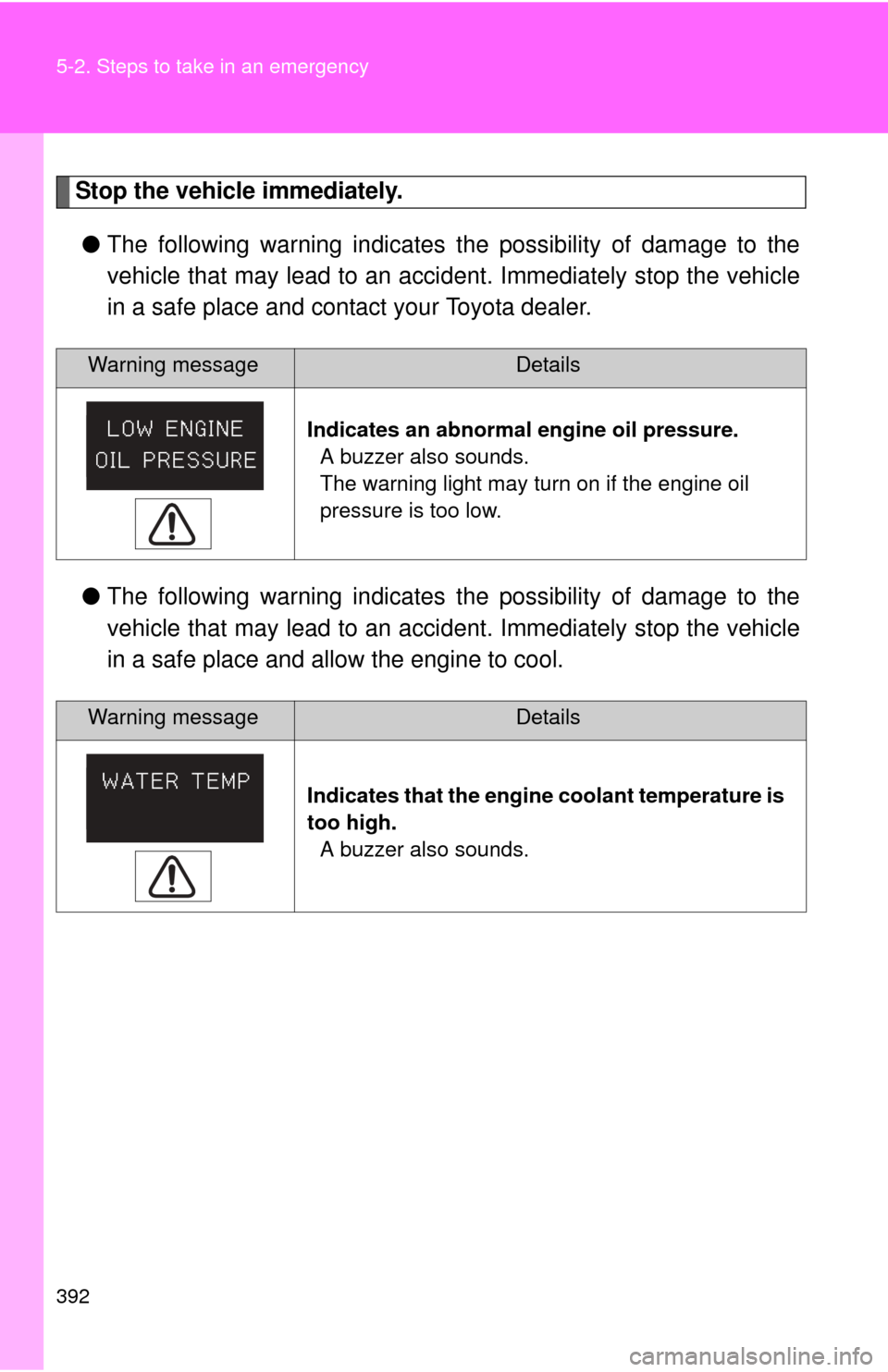
Stop the vehicle immediately.● The following warning indicates the possibility of damage to the
vehicle that may lead to an acci dent. Immediately stop the vehicle
in a safe place and contact your Toyota dealer.
● The following warning indicates the possibility of damage to the
vehicle that may lead to an acci dent. Immediately stop the vehicle
in a safe place and allow the engine to cool.
Warning messageDetails
Indicates an abnormal engine oil pressure.
A buzzer also sounds.
The warning light may turn on if the engine oil
pressure is too low.
Warning messageDetails
Indicates that the engine coolant temperature is
too high.
A buzzer also sounds.
Page 396 of 476
396 5-2. Steps to take in an emergency
(U.S.A. only)Indicates that the
engine oil is sched-
uled to be changed.
A buzzer also sounds.
Check the engine oil,
and change if neces-
sary.
Comes on approxi-
mately 4500 miles
(7200 km) after the
engine oil is changed.
(The indicator will not
work properly unless
the oil maintenance
data has been reset).
(U.S.A. only) Indicates that the
engine oil should be
changed.
A buzzer also sounds.
Check and change the
engine oil.
Comes on approxi-
mately 5000 miles
(8000 km) after the
engine oil is
changed (and the oil
maintenance data
has been reset).
■ Changing the engine oil (U.S.A. only)
Make sure to reset the oil change system. ( P. 323)
Warning messageDetailsCorrection procedure
Page 408 of 476

408 5-2. Steps to take in an emergency
CAUTION
■Using the tire jack
Improper use of the tire jack may lead to death or injuries due to the
vehicle suddenly falling off the jack.
●Do not use the tire jack for any pu rpose other than replacing tires or
installing and removing tire chains.
●Only use the tire jack that comes with this vehicle for replacing a flat
tire.
Do not use it on other vehicles, and do not use other tire jacks for
replacing tires on this vehicle.
●Always check that the tire jack is securely set to the jack point.
●Do not put any part of your body under the vehicle while it is supported
by a jack.
●Do not start or run the engine while your vehicle is supported by the
jack.
●Do not raise the vehicle while someone is in it.
●When raising the vehicle, do not put an object on or under the jack.
●Do not raise the vehicle to a hei ght greater than that required to
replace the tire.
●Use a jack stand if it is necessary to get under the vehicle.
Take particular care when lowering the vehicle to ensure that no one
working on or near the vehicle will be injured.
■Replacing a flat tire
Observe the following precautions to reduce the risk of death or serious
injury.
●Never use oil or grease on the wheel bolts or wheel nuts.
The oil or grease can cause the wheel nuts to loosen, causing a seri-
ous accident.
Remove any oil or grease on the wheel bolts or wheel nuts.
●Have the wheel nuts tightened with a torque wrench to 76 ft•lbf (103
N
•m, 10.5 kgf•m) as soon as possible after changing wheels.
Failure to follow these precautions could cause the nuts to loosen and
the wheel may fall off, which could lead to an accident causing death
or serious injury.