Page 348 of 476
348
4-3. Do-it-yourself maintenance
Wheels
■When replacing wheels
The wheels of your Toyota are equipped with tire pressure warning
valves and transmitters that allow the tire pressure warning system to
provide advanced warning in the event of a loss in tire inflation pressure.
Whenever wheels are replaced, the tire pressure warning valves and
transmitters must be switched over from the old wheels. (P. 336)
If a wheel is bent, cracked or heavily corroded, it should be
replaced. Otherwise, the tire may separate from the wheel or
cause loss of handling control.
■ Wheel selection
When replacing wheels, care should be taken to ensure that
they are equivalent to those removed in load capacity, diameter,
rim width, and offset.
Replacement wheels are available at your Toyota dealer.
Toyota does not recommend using:
●Wheels of different sizes or types
● Used wheels
● Bent wheels that have been straightened
■ Aluminum wheel precautions
●Use only Toyota wheel nuts and wrenches designed for use
with your aluminum wheels.
● When rotating, repairing or changing your tires, check that the
wheel nuts are still tight after driving 1000 miles (1600 km).
● Be careful not to damage the aluminum wheels when using
tire chains.
● Use only Toyota genuine bal ance weights or equivalent and
use a plastic or rubber hammer when balancing your wheels.
Page 428 of 476
428
6-1. Specifications
Maintenance data (fuel, oil level, etc.)
Dimensions and weights
*1: Unladen vehicles
*2: P215/55R17 tires
*3: P215/60R16 tires
Vehicle identification■ Vehicle identification number
The vehicle identificati on number (VIN) is the legal identifier for your
vehicle. This is the primary identification number for your Toyota. It is
used in registering the ownership of your vehicle.
This number is stamped on the
top left of the instrument panel.
Overall length 189.2 in. (4805 mm)
Overall width71.7 in. (1820 mm)
Overall height*157.7 in. (1465 mm)*2
57.9 in. (1470 mm)*3
Wheelbase109.3 in. (2775 mm)
TreadFront 62.0 in. (1575 mm)
Rear 61.6 in. (1565 mm)
Vehicle capacity weight
(Occupants + luggage) 900 lb. (410 kg)
Towing capacity
(trailer weight + cargo weight)1000 lb. (453 kg)
Page 430 of 476
430 6-1. Specifications
Engine
Fuel
Model2AZ-FE2GR-FE
Ty p e4 cylinder in line,
4 cycle, gasoline 6 cylinder V type,
4 cycle, gasoline
Bore and stroke
3.48
3.78 in.
(88.5 96.0 mm) 3.70
3.27 in.
(94.0 83.0 mm)
Displacement 144.1 cu.in. (2362 cm3) 210.9 cu.in. (3456 cm3)
Drive belt tension Automatic adjustment
Valve clearance
(engine cold)
Intake
Exhaust0.007
0.011 in.
(0.19 0.29 mm)
0.015 0.019 in.
(0.38 0.48 mm) Automatic adjustment
Fuel type
Unleaded gasoline only
Octane rating 87 (Research Octane Number 91) or higher
Fuel tank capacity 18.5 gal. (70 L, 15.4 lmp.gal.)
Page 431 of 476
431
6-1. Specifications
6
Vehicle specifications
Lubrication system
Oil capacity
(drain and refill)
With filter
Without filter 2.4 L 4-cylinder (2AZ-FE) engine
4.5 qt. (4.3 L, 3.8 Imp.qt.)
3.5 L V6 (2GR-FE) engine
6.4 qt. (6.1 L, 5.4 Imp.qt.)
2.4 L 4-cylinder (2AZ-FE) engine
4.3 qt. (4.1 L, 3.6 Imp.qt.)
3.5 L V6 (2GR-FE) engine
6.0 qt. (5.7 L, 5.0 Imp.qt.)
Oil grade
ILSAC multi-grade engine oil
Recommended oil
viscosity Use Toyota approved “Toyota Genuine Motor
Oil” or equivalent to satisfy the grade and vis-
cosity shown below.
2.4 L 4-cylinder (2AZ-FE) engine
3.5 L V6 (2GR-FE) engineOutside temperature
*1
Outside temperature
*2
Page 433 of 476
433
6-1. Specifications
6
Vehicle specifications
Cooling system
Ignition system
Capacity
(Reference)
2.4 L 4-cylinder (2AZ-FE) engine
6.6 qt. (6.2 L, 5.5 Imp.qt.)
3.5 L V6 (2GR-FE) engine
9.5qt. (9.0 L, 7.9 Imp.qt.)
Coolant type Use either of the following.
• “Toyota Super Long Life Coolant”
• Similar high-quality ethylene glycol-based non-silicate, non-amine, non-nitrite, and non-borate coolant with
long-life hybrid organic acid technology
Do not use plain water alone.
Spark plug
Make
Gap 2.4 L 4-cylinder (2AZ-FE) engine
DENSO SK20R11
NGK IFR6A11
3.5 L V6 (2GR-FE) engine
DENSO FK20HR11
0.043 in. (1.1 mm)
NOTICE
■ Iridium-tipped spark plugs
Use only iridium-tipped spark plugs. Do not adjust spark plug gap.
Page 434 of 476
434 6-1. Specifications
Electrical system
Manual transaxle
Automatic transaxle
*: The fluid capacity is a reference quantity. If replacement is neces-
sary, contact your Toyota dealer.
Battery
Open voltage at
68 F (20 C): 12.6 12.8 V Fully charged
12.2 12.4 V Half charged
11 . 8
12.0 V Discharged
(Voltage checked 20 minutes after the
engine and all the lights turned off)
Charging rates 5 A max.
Gear oil capacity (Reference) 2.6 qt. (2.5 L, 2.2 Imp.qt.)
Gear oil type API GL-4 or 5
Recommended gear oil
viscosity SAE 75W-90
Fluid capacity
(drain and refill)2.4 L 4-cylinder (2AZ-FE) engine:
3.7 qt. (3.5 L, 3.1 Imp.qt.)
Fluid capacity
3.5 L V6 (2GR-FE) engine:
6.76 qt. (6.4 L, 5.63 Imp.qt.)*
Fluid type
Toyota Genuine ATF WS
Page 448 of 476
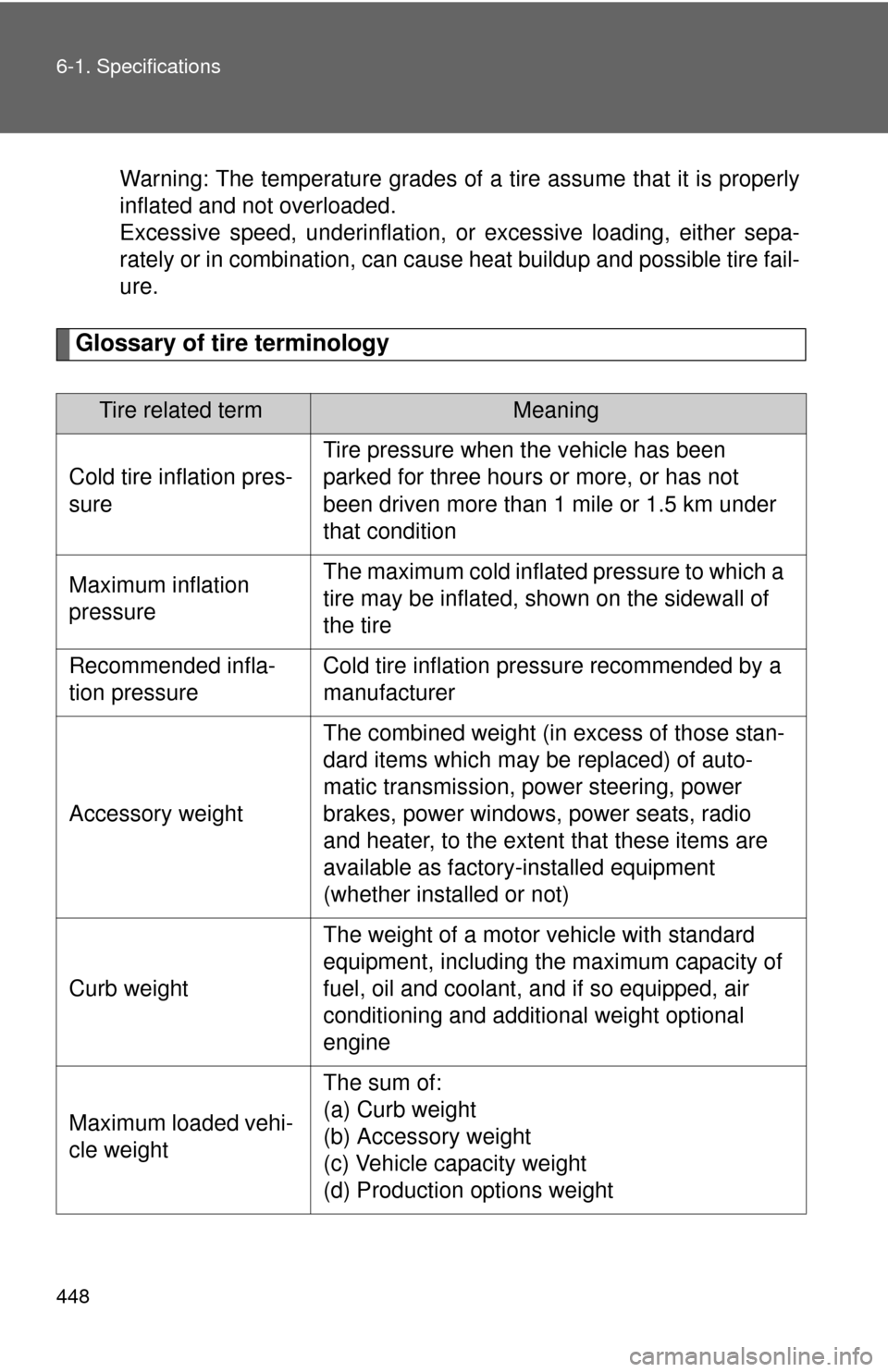
448 6-1. Specifications
Warning: The temperature grades of a tire assume that it is properly
inflated and not overloaded.
Excessive speed, underinflation, or excessive loading, either sepa-
rately or in combination, can cause heat buildup and possible tire fail-
ure.
Glossary of tire terminology
Tire related termMeaning
Cold tire inflation pres-
sure Tire pressure when the vehicle has been
parked for three hours or more, or has not
been driven more than 1 mile or 1.5 km under
that condition
Maximum inflation
pressure The maximum cold inflated
pressure to which a
tire may be inflated, s hown on the sidewall of
the tire
Recommended infla-
tion pressure Cold tire inflation pressure recommended by a
manufacturer
Accessory weight The combined weight (in excess of those stan-
dard items which may be replaced) of auto-
matic transmission, power steering, power
brakes, power windows, power seats, radio
and heater, to the extent that these items are
available as factory-installed equipment
(whether installed or not)
Curb weight The weight of a motor vehicle with standard
equipment, including the maximum capacity of
fuel, oil and coolant, and if so equipped, air
conditioning and additional weight optional
engine
Maximum loaded vehi-
cle weight The sum of:
(a) Curb weight
(b) Accessory weight
(c) Vehicle capacity weight
(d) Production options weight
Page 449 of 476
449
6-1. Specifications
6
Vehicle specifications
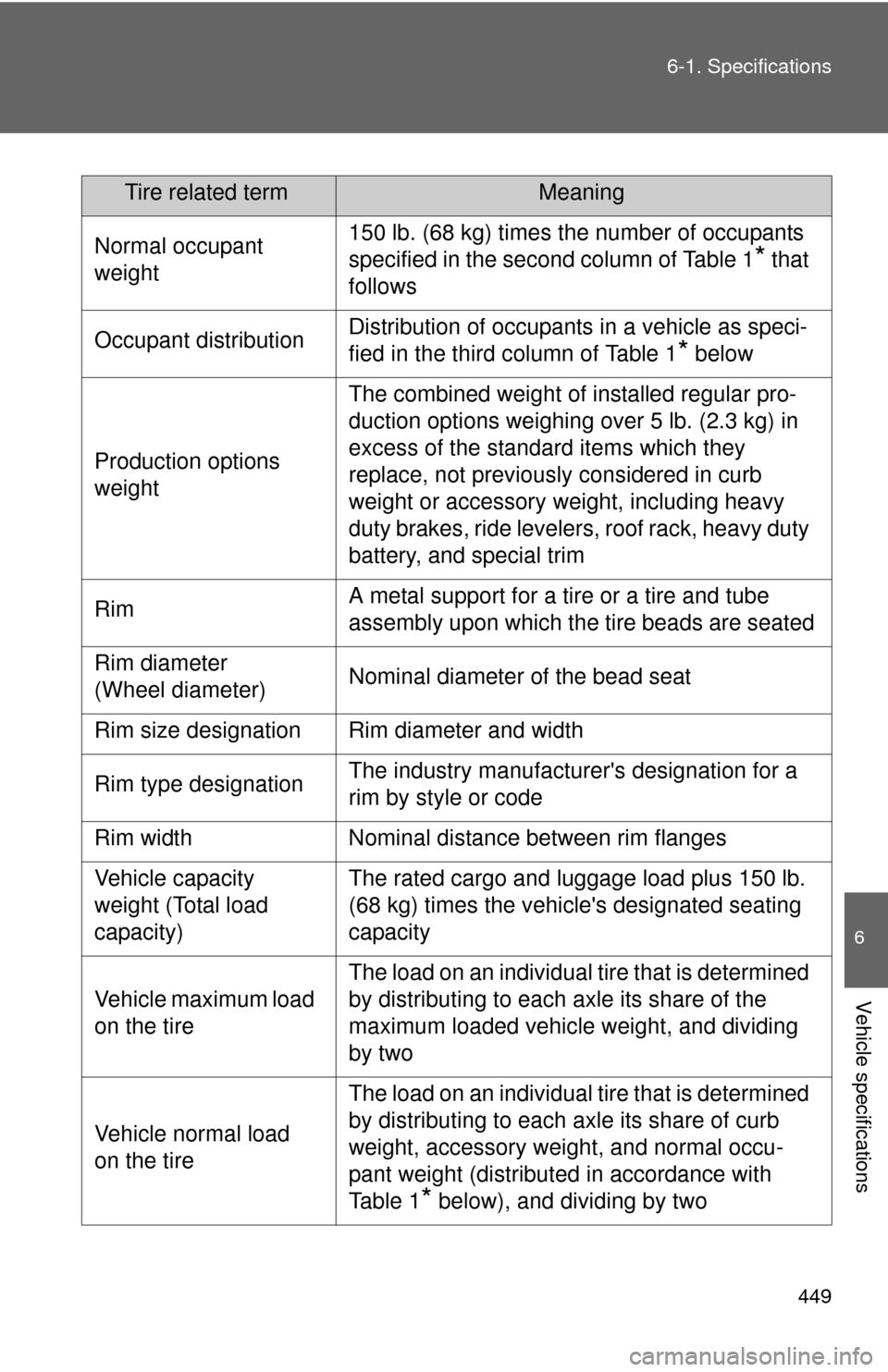
Tire related termMeaning
Normal occupant
weight 150 lb. (68 kg) times the number of occupants
specified in the second column of Table 1
* that
follows
Occupant distribution Distribution of occupants in a vehicle as speci-
fied in the third column of Table 1
* below
Production options
weight The combined weight of installed regular pro-
duction options weighing over 5 lb. (2.3 kg) in
excess of the standard items which they
replace, not previously considered in curb
weight or accessory weight, including heavy
duty brakes, ride levelers, roof rack, heavy duty
battery, and special trim
Rim A metal support for a tire or a tire and tube
assembly upon which the tire beads are seated
Rim diameter
(Wheel diameter) Nominal diameter of the bead seat
Rim size designation Rim diameter and width
Rim type designation The industry manufacturer's designation for a
rim by style or code
Rim width Nominal distance between rim flanges
Vehicle capacity
weight (Total load
capacity) The rated cargo and luggage load plus 150 lb.
(68 kg) times the vehicl
e's designated seating
capacity
Vehicle maximum load
on the tire The load on an individual tire that is determined
by distributing to each axle its share of the
maximum loaded vehicle weight, and dividing
by two
Vehicle normal load
on the tire The load on an individual tire that is determined
by distributing to each axle its share of curb
weight, accessory weight, and normal occu-
pant weight (distributed in accordance with
Ta b l e 1
* below), and dividing by two